Blog Archives
Quiet Recognition

The Worry Whisper follows a young girl who is anxious about reading aloud in class, and with the help of her little brother and grandmother, she learns how to manage her feelings. When did you first imagine the “worry whisper” as a bird?
The idea of the “worry whisper” as a bird came to me quite naturally—and, in many ways, from my own childhood.
I was an anxious child. I didn’t have the language for it then, but I remember how it showed up in small, everyday moments. I would overcompensate in ways that felt automatic—talking really fast when I was nervous, or doodling when what I actually wanted was to be quiet and still. There was always this subtle hum in the background, something I couldn’t quite name but could definitely feel.
When I began shaping the story, I wanted to give that feeling a form—something a child could see and relate to without fear. A bird felt right. It can appear unexpectedly, perch close by, and make itself heard in different ways—sometimes softly, sometimes more insistently. That’s what worry felt like to me. Present, persistent, but not something that needed to be chased away.
More than anything, I wanted children to understand that worry isn’t something to silence or fight. It’s something to notice, to understand, and to gently learn how to live alongside. The “worry whisper” as a bird wasn’t a single moment of invention—it was a quiet recognition of something I had known all along.
What inspired you to reframe worry as something to listen to rather than fight?
That shift came from both lived experience and reflection over time.
For a long time, I treated worry as something to get rid of—as if the goal was to silence it completely. But the more I paid attention, the more I realized that fighting it often made it louder. It would show up in different ways—restlessness, overthinking, that urge to rush through things or fill the silence. The resistance didn’t quiet it; it amplified it.
Over time, I began to see worry differently—not as an enemy, but as a signal. Something in me was asking for attention, for care, for a pause. When I stopped trying to push it away and instead listened, even briefly, it softened. Not because it disappeared, but because it felt acknowledged.
That perspective is what shaped The Worry Whisper. I wanted children to learn early what many of us figure out much later—that emotions don’t need to be battled to be managed. When we listen, we create space. And in that space, we regain a sense of steadiness and choice.
Why was it important that Aarya didn’t “defeat” her fear by the end?
It was important to me that Aarya didn’t “defeat” her fear because that’s not how emotions actually work—especially not for children.
Fear doesn’t disappear in a single moment of courage. It comes and goes. It changes shape. And sometimes, it shows up again right when we think we’ve moved past it. I wanted the story to reflect that reality in a gentle, honest way.
Growing up, I often felt like I was supposed to “get over” my anxiety—to be braver, quieter, more in control. But what I really needed wasn’t to defeat those feelings; it was to understand them. To know that I could feel nervous and still move forward. That both could exist at the same time.
With Aarya, the goal wasn’t to eliminate fear, but to change her relationship with it. She learns to notice it, to listen to it, and to not let it decide what she can or cannot do. That felt like a more meaningful kind of strength—one that children can return to again and again, long after the story ends.
What conversations do you hope this book sparks between children and adults?
I hope The Worry Whisper opens the door to quieter, more honest conversations—ones that don’t rush to fix, but instead make space to understand.
For children, I hope it gives them language for what they’re feeling. That they can say, “I think my worry whisper is talking,” instead of shutting down or acting out. And for adults, I hope it’s a gentle reminder to pause and listen—not just to the words, but to what sits underneath them.
I also hope it shifts the dynamic from problem-solving to connection. Instead of “How do we make this go away?” the conversation becomes “What is this feeling trying to tell us?” or “What might help you feel a little steadier right now?” Those are very different starting points.
And perhaps most importantly, I hope it normalizes these experiences. That a child sees they’re not alone in feeling this way, and an adult recognizes that what looks like resistance or avoidance might actually be a child asking for support—just not in words they’ve learned yet.
If the book can help even one family move from reacting to understanding, from fixing to listening, it has done what I hoped it would do.
Author Links: GoodReads | Facebook | Website | Unscripted Growth | Instagram | Amazon
In The Worry Whisper, eight-year-old Aarya Bloom feels a quiet flutter in her chest — like a small bird tapping gently from inside. Tomorrow, she must read aloud in class. She loves stories. She loves words. But what if she makes a mistake? What if her voice disappears?
With the help of her playful little brother Kiyan and the gentle wisdom of Grandma Bloom, Aarya learns that worries aren’t enemies to fight — they are whispers reminding us that something matters.
Through lyrical storytelling, warm family moments, and beautifully relatable emotions, this heartfelt picture book helps children:
Understand what anxiety feels like in their bodies
Develop emotional awareness and self-compassion
Build confidence in speaking and trying new things
Practice calming techniques through reflection and imagination
Perfect for children ages 4–8, The Worry Whisper is ideal for:
Kids who struggle with performance anxiety or school fears
Parents looking to support emotional regulation
Classrooms teaching social-emotional learning (SEL)
Bedtime conversations about courage and resilience
Part of The Bloom Series, this story gently reminds young readers — and the adults who love them — that bravery isn’t the absence of fear. It’s learning to listen kindly… and still fly.
Includes reflective questions for children and a thoughtful message for adults to continue the conversation beyond the final page.
Because sometimes, a whisper can’t outshout a good laugh.
The Reset Self


The Reset Self is a self-help book that argues you are not broken, you are over-conditioned, and most of your pain comes from living as a “role-self” instead of as a real person. Seravyna Böhm walks through how early family dynamics, cultural pressure, and constant performance teach you to become the Strong One, the Good Child, the Fixer, or the High-Achiever, then shows how expectation scripts and the nervous-system load of constant over-compliance turn into anxiety, resentment, burnout, and numbness. The heart of the book is a set of simple tools, like Role Naming, Expectation Tracking, the Fingertips Principle, Non-Compliance Experiments, Feeling Without Feeding, and the Daily De-Script, all aimed at helping you step out of old roles in real time and act from choice instead of fear.
I really like the core idea that “you are conditioned, not defective.” It feels kind, and it also feels sharp. The shift from “I need to fix myself” to “I learned this role, and I can unlearn it” has a surprisingly strong emotional impact. I also appreciate how clearly the book names common identities like the Strong One or the Peacemaker and then maps them to concrete patterns in work, family, and healing spaces. The chapter on the “invisible engine of misery” and the expectation–resentment loop hit hard for me, because it turns messy feelings into something you can actually see and work with. The latter material on ethics, choice, and accountability keeps the method from slipping into selfishness. It keeps repeating that understanding conditioning explains behavior and does not excuse harm, and that balance feels very grounded and humane.
I appreciated the writing and structure overall, especially the warm, steady voice that often feels soothing and reassuring. The author takes time with each idea, circling around it in a way that lets the message really sink in, with phrases and examples that come back like friendly reminders. The strong use of metaphor and direct address creates an intimate, conversational feel, which works well. The focus stays almost entirely on lived experience, which keeps the material accessible. What stood out most to me is that the tone remains compassionate, clean, and practical, and the case examples keep the tools grounded in real life.
I would recommend The Reset Self to anyone who feels like the “responsible one,” who is burned out from people-pleasing, or who has done a lot of therapy and self-work and still feels strangely stuck. It’s especially well-suited to high-functioning, over-thinking adults who look fine on the outside and feel empty or angry on the inside. As a clear, gentle guide for unhooking from old roles, easing the nervous-system load, and making everyday choices from something that feels more like your actual self, it is thoughtful, practical, and genuinely encouraging.
Pages: 231 | ASIN : B0GBZWFMRN

Meaningful Work

Emetophobia & Me follows your transformation from a childhood shaped by fear to an adulthood grounded in courage, compassion, and the radical act of choosing to live fully even when anxiety whispers otherwise. Why was this an important book for you to write?
What a great question. It brought up quite a lot for me. I will try to summarise it. Having battled crippling anxiety throughout most of my childhood and adult life, I wanted nothing more than to help others who were suffering too. When I saw someone suffering with anxiety and/or emetophobia and heard them speak of their experience in ways I deeply resonated with, my heart would literally hurt. For many years, I would just listen and try to offer any understanding and …. well, just love really. It felt like a lifeline for me to have someone who would just listen and remind me that I was not alone. So when I decided to write this little book, it was really to create a lifeline for those who feel lost and to remind them that they were safe. There is hope, and they are deeply loved.
What feels important to me is that, even when I am gone, my books might still bring comfort to others. That feels like meaningful work to me.
What was the hardest memory to revisit while writing Emetophobia & Me, and how did you care for yourself during that process?
Writing the book really did bring up some old feelings and fears, but it was therapeutic in a way too. I think the hardest part to revisit was those times, as a child, where I felt so unsafe. I had the phobia, anxiety, and panic ( I had no idea they had names then), there was violence at home, and my sister was diagnosed with cancer.
I felt so sad for that frightened little girl, who tried tirelessly to control what was never in her control. I guess that is why I turned inward more and more, to try and control myself. To try and keep myself safe with rituals, behaviour, and fear.
Was there a specific moment when your relationship with fear shifted from something to avoid to something you could coexist with?
You know, I wish there was a light bulb moment when it all changed. We are all looking for the magical quick fix, right? But, actually, it was a slow process. A process of seeing, then not seeing, then seeing more. The real change came from being open to being wrong …. about who I thought I was, my beliefs, and my misunderstanding about fear.
Being open. Being prepared to change your mind. Being aware that there is a lot you don’t know yet, is huge.
What do you hope readers who don’t struggle with phobias take away about empathy and the lived experience of anxiety?
It has always been important to me that loved ones and family members have some understanding about anxiety and Phobias. The one thing a sufferer needs is understanding. Followed by time and love. Just listen, not always to fix, but just to hear. Often, we sufferers of anxiety feel unheard, and that increases fear and insecurity.
The answer to everything always is love.
Author Links: GoodReads | Facebook | Instagram | Finding Peace | Website | Books.By | Amazon
She could control everything—
except her own fear.
From the outside, Jess Smith looked fine. A wife, a mother, a woman doing her best to hold it all together. But behind every smile hid a secret terror—an obsessive fear of vomiting so intense it ruled her every decision. Every meal was measured. Every outing calculated. Every day, a battle with her own mind.
Until the fear began to consume her life completely.
In this raw and beautifully written memoir about emetophobia, anxiety and panic attacks, Jess takes readers inside the hidden world of a phobia few dare to talk about. Her story unfolds like a psychological thriller—every symptom, every panic episode, every desperate attempt to stay “safe” pulling her further from the life she longed to live.
But when she finally hit breaking point, something miraculous happened.
She stopped running.
She turned inward.
And she began the journey home—to herself.
Part memoir, part self-help guide for anxiety and recovery, Emetophobia and Me will make you feel every heartbeat of fear—and every breath of freedom that follows.
If you’ve ever lived your life controlled by fear—whether of panic, sickness, or simply losing control—this story will hold your hand through the darkness and show you that healing isn’t about fixing yourself.
It’s about finally allowing yourself to be free.
A powerful, honest, and inspiring read for anyone navigating anxiety, emetophobia, panic disorder, or trauma recovery.
You are not afraid of what you think you are.
It’s time to see the truth — and take your life back.
Illuminating Human Connection

Navigate Family Technology explores the modern family’s dilemma of how to help children thrive without letting technology consume them, focusing on topics such as communication struggles, social media traps, empathy loss, anxiety, and sleep disruption. Did you find anything in your research of this story that surprised you?
I learned so much while researching the book, I’ll try to narrow the answer down to a few!
- That most Modern Tech executives strictly limit their family’s tech-use time and send the kids to low-tech schools
- The number of online predators actively working every day
- The amount of information we take in daily compared to 20 years ago
- The staggering number of hours of screen time displaces connection and well-being activities
What were some ideas that were important for you to share in this book?
My mission is about illuminating human connection in a disconnected modern world. Technology is one of the key drivers of this. We are often alone together on individual devices.
I also found it important to cover technology’s impact on empathy and distress tolerance.
What is one thing that you hope readers take away from Navigate Family Technology?
That overuse of technology is not our fault. Or our kids’ fault. But now that we understand the problem, it’s our responsibility to be intentional about it. And that we can do it – we have so much living to do and real-world connections to make.
Author Links: GoodReads | Facebook | Instagram | LinkedIn | Website | Amazon
Modern tech is an invaluable resource though its rapid development has created downsides. Nora provides accessible strategies to live our tech lives with intention rather than constant reaction mode. The content inspires hope for connection and comfort in knowing we do not face tech challenges alone.
Entertain a quest to level up your knowledge of modern tech’s influence and explore how to navigate its challenges
Digital Stressors

Anxiety Reset 30 Days to Find Calm is a structured 30-day guide to understanding and managing anxiety based on science-backed strategies to assist readers in identifying patterns and mastering self-regulation techniques. Why was this an important book for you to write?
The city that I live in has the youngest average population age in Canada. Also, the highest suicide rate. This comes along with depression and anxiety. Initially, I wanted to help children, but I realized that children learn by mirroring their parents. Thus, I needed to write an anxiety book for adults, not in a lazy way, and also doing something that other books in the genre are not doing.
How much research did you undertake for this book, and how much time did it take to put it all together?
Great question, it took many months of research and around 23 updates leading to the current version available on Amazon. It has been a second full-time job on top of my regular day job. My 3-week vacation this year was almost entirely spent on the book in some component of its updating/advertising, etc.
What were some ideas that were important for you to share in this book?
The idea that we have not evolved to deal with all the modern-day digital stressors and combined inputs that the world demands our attention/focus. Even when grieving, there are so many triggers that our ancestors never faced. Digital Pictures, radio music, connected yet disconnected friends.
What is one thing that you hope readers take away from Anxiety Reset 30 Days to Find Calm?
Any tool that they find beneficial. I realize that most people may not have the energy or time to complete the full 30 days; however, using the summaries at the back and emergency regulation sheets, the chances are high that someone finds a tool that improves their life or someone in their circle’s life. That is a win for me and for humanity.
Author Links: GoodReads | X (Twitter) | Facebook | Website | Amazon
Anxiety overwhelms body and mind, impacting millions of adults in today’s chaos. Anxiety Reset: 30 Days to Find Calm delivers a science-backed, 30-day program tailored for busy adults—a 463-page workbook with narrated pages, relaxing videos via scannable QR codes, and emergency relief cards for instant support.
Inside: • 4-part system to build skills daily • Practical exercises for adult life • Emergency relief techniques and cards • Flexible, schedule-friendly practices • Advanced resilience strategies
What Sets It Apart: Combat workplace stress and digital overload with neuroscience and psychology, enriched by color illustrations, tracking sheets, and multimedia—every page narrated, with day-specific video QR codes.
Your 30-Day Journey: • Days 1-5: Unravel Your Anxiety Triggers • Days 6-10: Master Emergency Techniques • Days 11-20: Cultivate Daily Calm • Days 21-30: Achieve Lasting Mastery • Bonus: Quick-reference guides
Ideal for professionals, parents, or anyone seeking clear, comprehensive tools. Launch your reset today and take control of your emotional well-being!
Self-Care for the Creative: A Survival Guide for Creatives, Empaths and Highly Sensitive People
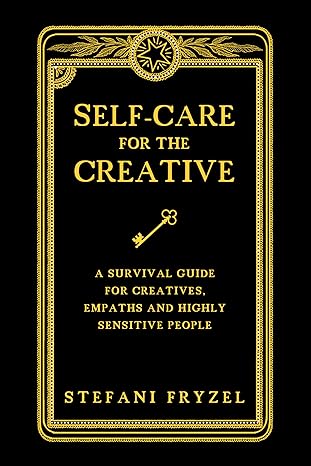
Self-Care for the Creative is part memoir, part survival manual, and part pep talk for empaths, highly sensitive people, and artists who are burning themselves out in pursuit of their craft. Fryzel draws on her own life of gritty lows, career highs, and all the messy middle, to explain how sensitivity and creativity often walk hand in hand, and why that combination demands intentional care. The book blends personal stories, practical tips, and a hefty dose of humor to guide readers through setting boundaries, managing overwhelm, and building a self-care toolkit that actually works in the unpredictable life of a creative.
Fryzel writes with a voice that is equal parts tender and unapologetic. She’s funny without being flippant, and her swearing isn’t there for shock value; it’s exactly how a real conversation with her would sound. I appreciated that she never veered into airy, vague “just love yourself” territory. Instead, she gave concrete, actionable steps, all while weaving in stories that made me laugh, wince, and occasionally nod in recognition. That mix of vulnerability and authority made me trust her completely.
What I liked most was how well she captures the emotional reality of being both highly creative and highly sensitive. She doesn’t romanticize the struggle or paint it as a necessary price for great art. She calls out toxic patterns, talks openly about depression and burnout, and reminds the reader that martyrdom isn’t a badge of honor. At the same time, she treats sensitivity as a superpower worth protecting. Her framing felt liberating, especially for those of us who have been told our feelings are “too much” for as long as we can remember. The book also gave me a few new self-care strategies that I immediately wanted to try.
I’d recommend this book to any creative who feels overwhelmed, stuck, or simply too drained to make their best work. It’s especially powerful for empaths and highly sensitive people who haven’t yet learned how to protect their energy without shutting down their gifts. If you’ve ever felt like your art is costing you more than it’s giving back, Fryzel’s words might just be the reminder you need to step back, take a breath, and start taking care of the most important tool you have… yourself.
Pages: 369 | ASIN : B0CLK5HRQ8

Anxiety Reset 30 Days to Find Calm: A Self-Regulation Workbook for Busy Adults


Anxiety Reset 30 Days to Find Calm: A Self-Regulation Workbook for Busy Adults is a structured 30-day guide to understanding and managing anxiety. It blends science-backed strategies with practical exercises, moving step-by-step from identifying personal anxiety patterns to mastering self-regulation techniques. The book begins with self-assessment mapping triggers, physical symptoms, and thought patterns before teaching both in-the-moment relief skills and long-term habits. It covers modern stressors like digital overload, workplace pressure, and life transitions, offering tools for building emotional resilience. The program feels intentional, with each day adding a piece to an integrated framework, culminating in a personalized plan for ongoing calm.
What struck me most was how grounded and personal the approach feels. Many books on anxiety either drown you in theory or throw a list of tips at you without context. This one makes you slow down and really notice your own patterns, which was surprisingly emotional. I found myself reflecting more deeply than I expected and connecting dots between physical sensations, old thought habits, and the modern chaos that feeds them. It’s not preachy, and it doesn’t assume you can drop everything for two hours of meditation each day. It works with real-life, messy schedules and all.
The writing is clear, warm, and refreshing. I appreciated the mix of science explanations with relatable stories from people like “Sarah” and “Michael,” which made the material easier to connect with. Sometimes the number of exercises felt a little intense, especially if you’re already stressed, but that’s where the “do what you can” attitude helped. I also liked that it didn’t stop at symptom relief, it’s about rewiring habits and building resilience.
This book is ideal for busy adults who feel stuck in an ongoing cycle of stress and want something more than quick fixes. If you like practical structure but also want space for self-reflection, this will likely hit the mark. It’s a guide you can work through once, then revisit whenever life ramps up again, and it leaves you feeling not just calmer, but more in control.
Pages: 463 | ASIN : B0FH1SK85C
Worries and Anxiety

Carnival Chaos follows a curious, anxious young boy visiting his first carnival who finds it to be a sensory overload experience, learns to face his fears, and ends the day not just braver, but full of joy and pride. What was the inspiration for your story?
The Inspiration for this story is as with my previous two in this series, my son Kale. Kale represents the child of today’s world. Worries and anxiety are prevalent everywhere. These stories are a wonderful way to start a conversation about feelings.
What were some ideas that were important for you to share in this book?
This book is about trying new things and having new experiences. Trying something new can be scary, but it can also be a great accomplishment for anyone.
What scene in the book did you have the most fun writing?
The child running off the ride looking sickly was my favourite. Kale’s response is exactly how he would respond to seeing such a sight. The calm demeanor of Mama as she tries to just brush it aside so as not to worry poor Kale even more is perfect.
What will the next book in that series be about, and when will it be published?
I am going to concentrate on these three books in this series for now. I do however have a few ideas rumbling around in my brain, but right now I want people to understand the message behind my books and realize that they are teaching tools for not only parents but also teachers to start that all-too-important conversation about feelings with their children or students.
Author Links: Goodreads | X (Twitter) | Facebook | AllAuthor | Instagram | Website | Amazon
Kale will want to go to the carnival every year knowing how much fun new experiences can be. Trying something new can be scary, but it can also be a great accomplishment for our little ones.


