Blog Archives
The Lived And The Imagined

The Falls of Us explores what happens when women confronting faith, grief, family wounds, and oppressive systems can no longer keep their private burdens hidden. What inspired you to combine personal reflection, literary realism, psychological drama, and speculative fiction in a single collection?
I built this collection over the course of a few years, and I came to understand that the lived and the imagined can functionally coexist with one another. Some truths need the intimacy of ordinary details and specific memories. Others need the distance of an imagined world, where readers can step back and see familiar patterns more clearly.
Subjects like oppression, grief, and denial can become so common that we stop seeing them for what they really are. In realism, I wanted readers to sit inside an experience as it is endured. In speculative fiction, I wanted them to see the larger system around it, including the absurdity of the rules, expectations, and beliefs that can shape a person’s life.
I intertwined the lived and the imagined in a single collection because both types of stories are doing the same work. They are both asking the reader to look more closely at what happens when the world around them is asking too much of them.
How did you decide which experiences could be approached directly and which were better explored through dystopian or imagined worlds?
I usually know by the feeling of the story. Some experiences need to remain true to the details because distance would soften what they are trying to accomplish.
For instance, in “Let Go,” unless readers can ride along with me in the car and imagine their own demise as an eighteen-wheeler comes barreling toward us, it is merely a fantastical story. The truth matters because it allows the reader to feel the fear, the helplessness, and ultimately the real surrender of that moment.
But in “The Curse of Eve,” I need distance. By placing the story in an imagined world, I can push the logic of a misogynistic system further and see what it reveals. The world may be fictional, but the impulse to control women’s bodies, voices, choices, and freedom is not.
What did including author’s notes allow you to communicate that the stories alone could not?
I was inspired by the experience of reading Octavia Butler’s Bloodchild and Other Stories. Her afterwords made me feel as though she was letting me in on her secrets and experiences that led her to the page. I wanted to create that same sense of conversation in The Falls of Us.
The author’s notes give me that space to sit beside the reader and hold their hand after each story, a kind of “let’s talk about this” moment.
I want them to feel like it’s a friendly invitation rather than a straight explanation. Some readers may want to know what inspired a certain story or why I made a particular choice within it. Others may want to leave the story exactly as it is. The notes are there for readers who simply desire a little more context.
After readers finish The Falls of Us, what questions about faith, control, survival, or surrender do you hope remain with them?
If nothing else, I hope readers question the difference between faith and performance. Don’t get me wrong, faith should be visible. We are called to be a light, and light has to be seen in order to be recognized. But there is a difference between reflecting what we truly believe and performing belief for the approval of others. It should be revealed in how we treat people, how we carry hardship, and how we make room for grace. There is a simplicity in that, and far too often we overcomplicate it.
Author Links: GoodReads | Facebook | Website
“Expiate” follows two strangers pulled into a ritual of public repentance where even small acts, like being asked to remove your shoes, become measures of guilt and worthiness. In “Cliffhangers,” a driving lesson gone wrong leaves an instructor and her student stranded on a literal ledge, forcing them to confront entitlement, generational survival, and the thin line between accident and consequence.
Blending literary prose with speculative twists, The Falls of Us is a collection of microfiction, flash, and full-length short stories for readers of literary, speculative, and socially conscious fiction.
The Falls of Us
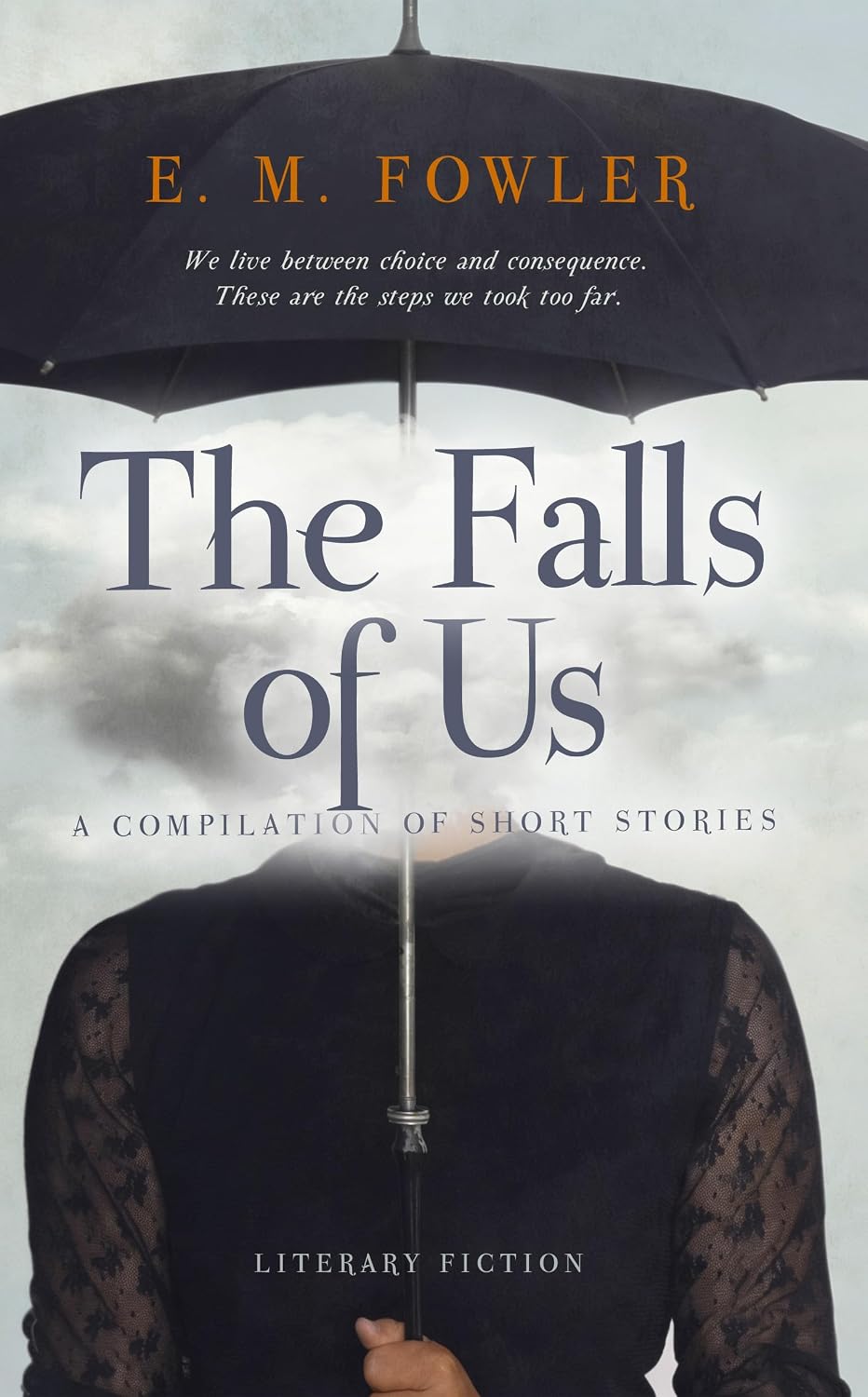

E.M. Fowler’s The Falls of Us is a collection of eighteen short stories that moves between literary fiction, personal reflection, psychological drama, and speculative fiction while returning again and again to questions of faith, womanhood, family, grief, control, and survival. Some stories are rooted closely in lived experience, while others build unsettling imagined worlds to examine familiar human behavior from a different angle. The title story, for example, looks back at childhood, religious culture, abuse, and the complicated love between a daughter and her father, while stories such as “The Curse of Eve,” “Expiate,” and “We The People” push those concerns into dystopian settings. Even with that range, the collection feels connected because Fowler is consistently interested in what people carry privately and what happens when the systems around them make that burden heavier.
Fowler is especially good at turning physical objects and ordinary situations into extensions of a character’s inner life. “Water Damage” makes a worsening leak and repeated coats of paint part of a woman’s determination to cover over the collapse of her marriage. “The Blue Curtains” uses a dimmed home and an unreliable narrator to gradually reveal how a mother is shaping her daughter’s view of her father. In “Fragments,” memory itself becomes unstable as the story enters the confusion of dementia, while “The Quiet Never Comes” captures workplace exhaustion through a woman who longs so badly for silence that even escape starts to feel unreachable. The collection’s strongest moments often come when Fowler lets a concrete image do the emotional work. A stain, a ledge, a prayer closet, a pair of curtains, or a disabled car can carry far more weight than its literal purpose suggests.
Faith is one of the book’s most persistent threads, but Fowler approaches it from several directions. “Peace That Surpasses” follows a successful Christian speaker who continues preaching a clean story of healing while privately taking medication for the depression she claims to have overcome. “Confessions of an Innocent Sinner” considers the frightening distance between legal innocence and a person’s conviction that she is morally guilty. “Dying Day,” one of the collection’s most elaborate speculative pieces, turns spiritual gifts, discernment, ministry, exhaustion, and restoration into an imaginative world with its own visual language. Fowler also includes author’s notes with many of the stories, making the collection feel partly like fiction and partly like a conversation with the writer afterward. Those notes make her intentions unusually clear. At times they narrow some of the ambiguity the stories create, but they also give the book a personal, intimate quality, particularly when Fowler explains where a story intersects with her own experiences.
The Falls of Us will probably resonate most with readers who like emotionally direct short fiction with something moral, spiritual, or psychological to wrestle with after the plot ends. It’s especially well suited to readers interested in women’s experiences, complicated relationships with Christianity and religious culture, family wounds, grief, motherhood, social expectations, and the tension between control and surrender. Readers who enjoy moving between realistic stories and speculative ones will also find plenty here, since Fowler can go from the quiet loss of a friendship in “The Last Summer” to an invented society policing women’s voices or social behavior without abandoning the collection’s central concerns. What stays with you is Fowler’s interest in people reaching the point where whatever they’ve covered, suppressed, misunderstood, or tried to control finally demands to be seen.
Pages: 232 | ASIN: B0HF1BHHWY

We Needed To Share This

Hey Baby – The Elk That Survived! tells the story of an injured young elk who is rescued, cared for through a long, harsh winter, and eventually nursed back to health so he can return to his herd. What inspired you to create this story?
I believe Annie mentioned it to her grandchildren, and they loved our story about the Elk. A few days later I thought we needed to share this with children everywhere. It sat on my desk for over 9 years while I was caring for my husband Jay with early-onset Alzheimer’s. I promised him I would publish it someday, and the time was now after he passed away in October 2024.
Were there moments from the real experience that were too emotional or difficult to include in the book?
The look in his eyes as he sat alone every night while we could hear the coyotes.
One of the book’s strongest messages is that we can love wild animals without trying to keep them. Why was that lesson important for you to share?
Rarely will we have the opportunity to help a wild animal, as nature usually takes care of them, whether good or bad.
There are times when you just know it is safe and can help the best way you know how.
What emotions did you hope readers would feel when Hey Baby returned to his herd?
First and foremost the wonderful satisfaction the animal is alive and can go back to his home in nature. The excitement of how the animal accepts help. The sadness that we had to lose him in order to save him.
Author Links: pamelahowardauthor.com | pamelajhoward.com
The elk was given the name ‘Hey Baby’ during this life saving adventure.
Read how he was saved and how the elk accepted help along the way.
The story will warm your heart and make you look differently at wildlife.
Eros and Order: Love That Creates and Destroys

Carl Parsons’s Eros and Order: Love That Creates and Destroys is a literary fiction story collection about love in its many unstable forms: romantic love, marital love, possessive love, moral love, social duty, desire, grief, and rescue. The stories move from a collapsing marriage to a murder shaped by obsession, then into a tender but uneasy attempt at saving someone from despair, before widening into immigration, communication, and historical memory. As a work of literary fiction, it is less interested in neat comfort than in the pressure people put on one another when they confuse love with ownership, salvation, escape, or control.
Parsons doesn’t rush. He lets conversations unfold, sometimes at length, and he gives his characters room to argue themselves into corners. It made the book feel less like a set of twists and more like a series of moral tests. The title story, especially, has a classical weight to it, with its references to ancient order, vows, betrayal, and consequence. At times, I felt the author was almost standing beside the characters, asking them, “Are you sure this is freedom? Are you sure this is love?” That can make the prose feel old-fashioned in places, but not carelessly so. It has a formal, almost stern rhythm that fits the book’s concern with discipline, disorder, and the damage caused when desire becomes the only law.
I also found myself reacting strongly to the author’s choices. Some characters speak in ways that are blunt, and the stories are not shy about judging certain kinds of behavior. It made me pause and think more than once. But I think the collection works best when it lets the tension remain messy. “Perfect Girl” moves like crime fiction, but beneath the crime is a sharper look at beauty, male entitlement, and family corruption. “No Good Deed” turns toward rescue and hope, though even there Parsons keeps asking whether love can actually save someone or whether it can only offer a place to begin. “I Am Zico” is short and painful, and its direct first-person voice hits differently from the longer domestic dramas. It feels like the book opening a window and letting colder air in.
Eros and Order is a thoughtful and often compelling collection for readers who like literary fiction with moral stakes. It would especially appeal to readers who enjoy character-driven stories about relationships, consequences, crime, and social order, rather than fast plots or easy answers. It asks you to sit with flawed people, watch them make damaging choices, and consider what love creates when it is patient, and what it destroys when it becomes selfish. Readers who appreciate reflective fiction with a classical sensibility and a serious view of human behavior will likely find a lot to think about here.
Pages: 142 | ASIN: B0GZ3HQNV4
With A Chilling Touch of Authenticity

An Imprint of Evil and Other Hauntings is a collection of ten horror stories centered around cursed objects, hungry gods, and terrible choices. What draws you to the horror genre?
As a kid, I grew up reading EC horror comics and watching TV programs like ‘The Twilight Zone’ and ‘The Night Gallery.’ In my early teen years I started reading classics like Dracula and Frankenstein. I was just drawn in by such stories that slowly create a feeling of unease in the reader. Although supernatural in nature, they echo with a chilling touch of authenticity. And that’s what makes them so frightening.
Many of the stories begin with familiar situations before slowly turning sinister. Why do you think ordinary settings make horror more effective?
It’s the creeping uncertainty about what is real or true in ordinary situations that brings about the more subtle feeling of dread or fear, an unsettling feeling that lingers with the reader well after the story has been read.
Horror can easily become overly graphic or overly abstract, but your stories stay focused and concise. Was restraint an intentional stylistic choice?
Yes. I wanted the stories to build up slowly, with subtle hints along the way that not is all what it seems to be. These are stories that lean on the classic atmosphere of the Victorian-era spinechiller stories. Stories that were meant to be read out-loud by candle light on dark winter nights.
Which story in the collection was the most enjoyable or unsettling for you to write?
Enjoyable – would be ‘The Barn’. It’s my first folk horror story and I actually felt sorry placing the main character in such a desperate situation!
Unsettling – would be ‘Charles Linkwood’. It was difficult to read about the horrors experienced by WWI soldiers while doing my research for the story, and how many returned home as broken lads suffering from ‘shell shock’ (PTSD). I tried to capture some of that horror in my story.
Author Links: Amazon | GoodReads
The Miners’ Cat & Other Stories


The Miners’ Cat & Other Stories follows Soot, a stray black cat rescued from a coal shed and folded into the lives of Ron, a miner, and Mabel, whose small Midlands home becomes the warm center of his world. Told through a series of linked, nonlinear stories, the book moves between school trips, sausage prizes, snowy yards, pub visits, Christmas performances, and quieter reckonings with grief. Beneath the gentle adventures is a deeper pulse: the ache of vanishing mining communities, the tenderness of chosen family, and the way memory keeps a lamp burning long after the street has changed.
The book’s charm doesn’t come from grand spectacle but from chipped green paint, coal dust, fish suppers, duffel bags, Jaffa cakes, and the old rituals of ordinary care. Soot is sweet without being saccharine, and Ron’s gruff affection gives the stories their best emotional weather. I especially appreciated how the book allows sadness to sit beside humor. A lost PE kit, a runaway rat, or a pop shop can make room for laughter, yet the shadow of Mabel’s absence gives the collection a tender undertow.
Lizzie Jayne writes as though nostalgia is a landscape: smoky skies, pit wheels, frosted pub windows, washing lines, and streets that remember more than they say. The sentiment is full-hearted, but that openness feels true to the book’s purpose. It wants to preserve a world before it is swept clean by time, and it does so with sincerity, dialect, and a lovely attention to the small consolations that help people carry on.
The illustrations are a major part of the book’s spell. The watercolour images have a soft, weathered feel: red-brick houses, lamplit snow, black-cat silhouettes, smoky horizons, and rooms made holy by firelight. They don’t merely decorate the stories; they deepen their feeling. I liked the way Soot often appears as a dark, watchful shape against pale snow or warm windows, making him feel both tiny and mythic, like a little soot-smudge guardian of a whole community.
The target audience includes children, families, cat lovers, nostalgic adult readers, and anyone drawn to historical fiction, animal stories, illustrated short stories, cozy fiction, and grief-and-healing stories. Readers who enjoy the gentle animal-centered warmth of James Herriot or the homely emotional world of Paddington will likely find a similar comfort here, though this book carries a distinctly coal-dusted Midlands soul. The Miners’ Cat & Other Stories is a tender book that I heartily recommend.
WORLD OF WORLDS

Richard Scott Sacks’s World of Worlds is a literary action-adventure short story collection that follows young, restless travelers, reporters, climbers, drifters, and idealists across Africa, Europe, India, and the United States between 1968 and 1981. The book gathers fifteen stories shaped by travel, political unrest, culture shock, danger, and moral pressure, with much of its world centered on the turbulence of the late 1960s and 1970s.
I came away feeling that Sacks is less interested in adventure as spectacle than in adventure as a test of character. That surprised me, in a good way. The stories have movement, and sometimes real peril, but the strongest moments often happen in the quiet after the danger, when a character has to sit with what they have done, avoided, misunderstood, or lost. The writing feels alert to place. Rivers, roads, mountain air, crowded rooms, border crossings, and decaying outposts don’t just sit in the background. They press on the characters. They wear them down. The prose has the confidence of someone who has carried these landscapes in memory for a long while.
What I found most compelling was the author’s choice to keep the characters young, often proud, often naïve, and not always easy to like. That gives the book its bite. These are people who want freedom, meaning, escape, or a story worth telling, but they keep running into systems and histories much larger than themselves. Colonial aftermath, corruption, racial violence, war, and personal ambition all move through the collection without turning it into a lecture. Some stories are more direct politically, while others work through mood and tension. I appreciated that mix. Its pace can be reflective, and its moral questions are not neatly packaged. I liked that. Life on the road rarely comes with clean lessons.
I would recommend World of Worlds to readers who enjoy literary short fiction with an adventurous edge, especially those drawn to travel writing, political fiction, and stories about outsiders trying to understand places they can never fully possess. It will appeal most to readers who like their action grounded in atmosphere and consequence. For me, the collection works best as a map of uneasy encounters, both with the wider world and with the self.
Pages: 264 | ASIN: B0GX2Z6MJV


