Blog Archives
To Improve Tolerance And Understanding
Homespun follows the people from two small South Carolina towns who struggle with adapting to the changing world. This is an intriguing setup for a novel that is high in social commentary. What was your moral goal when writing this novel, and do you feel you’ve achieved it?
I wanted to showcase the South in a fresh light, and I accomplished that, I do believe. The characters aren’t perfect, but you grow to care about them, and that’s the main moral goal—to improve tolerance and understanding.
Ginny and Jack face a moral dilemma in dealing with her family’s opposition to them seeing one another, but my real purpose in that situation was more along the lines of showing how each party’s stubbornness caused the most lasting harm. Conflict inevitably occurs in all families, but to hold grudges forever can be literally heartbreaking, as we see in Homespun.
Promoting the development of empathy has always been an underlying goal of The Silk Trilogy. I think most novels do achieve this, at least to an extent. Let’s hope that my distinctive characters—for example, Ginny’s domesticity as opposed to Vivian’s more outgoing lifestyle—put that empathy-learning curve on the accelerated track. Empathy makes for kinder, not-so-dismissive people; plus it’s simply intriguing to try to figure out what prompts certain decisions. Everyone has reasons for what they do, even if they’re bat-shit crazy ones—but more often, they’re not.
That said, Homespun is perhaps less motivated this way than the other two novels in the trilogy. I’m afraid it even tends towards campy at times. Maybe that has to do with it being inspired, in large part, by true events or rumors—which are all highly fictionalized. For instance, the story of Henry up in the tree, waiting to jump down on Buford, was inspired by a real-life situation I heard about my great-grandfather. In retrospect, I probably didn’t plumb the true depths of his feelings there, though I suppose I must have seized on some of his rationale.
Neglect is a great evil that can’t so much be applied to Jessie’s host of negative traits, so it seemed only fair to bring it up. It’s one fault that our new antagonist, Zingle Caddell, is imbued with, and it causes his family much grief. With many millions of refugees in the world today—whom I rarely hear about anymore in the news—and more specifically the refugee camps near our border with Mexico, it seems important to be cognizant of what harm comes from neglecting people. Factory farms for livestock animals terribly neglect their basic needs for movement and fresh air as well, violating nature in the extreme—and I suspect those creatures can bear it less well than humans, actually, as we are more cerebral and can escape through deep conversation and within our imaginations, at least.
Each character in this novel is unique and memorable. What character did you enjoy writing for the most? Was there one that was more challenging to write for?
Vivian was the most fun to write, of course! When I was penning the trilogy’s early draft, I even had a dream of Vivian going off and parachuting into the jungle—only afterwards realizing that her personality was being tapped from a friend of mine who really did go rafting down the Amazon. She was her sorority’s president and became an ER doc and ran marathons. She’s working on a book, too, and is an advocate for patients’ rights. She can do anything, and it’s all in the attitude. She’s bright enough, certainly, but there are countless people just as bright and attractive who never have the courage nor the vision to succeed like her. Vivian even looks like her, I realized. The great-aunt whose spot she fills was someone I never met and know very little about—except for that whole baby-giving scene. It was inspired by my grandfather’s indignation, even into his old age!
You might be surprised to learn that Ginny was the most challenging character to write. Her perspective felt narrow, even claustrophobic. Ginny wasn’t a reader, and she was secretive and held grudges—but she was also loving. I was trying to depict how she’d been damaged by her upbringing, absorbing some of Jessie’s behaviors without necessarily sharing her mentality. Those formative earliest years had been different for Vivian, who had her mother, and Gaynelle, who had Vivian, and even for Annie, who had Ginny. I’m afraid, though, that Ginny comes across as more flawed than I’d meant for her to, although some of those flawed aspects of her personality were there, too, in the ‘real’ Ginny, if not to that extent. Her character is based on my granny, a woman who was actually such a comfort to be around that the local hospital once offered her a job to simply come and sit with patients—that’s how soothing she was. I’m convinced I did not capture that portion of her personality very well, and I’m sorry for it. Isn’t it fascinating that she came across as so incredibly soothing—and yet once had a nervous breakdown herself?
As this ends the trilogy, where do you see your characters after the book ends?
Since this is a highly-fictionalized version of my own genealogy, I have a very clear idea—undoubtedly clearer than most novelists—of what happens to all the characters afterwards. The epilogue in Homespun actually gives a broad overview.
What are your plans now that this series is completed? Have you started another story?
I’m writing two separate series, both entirely different. The Silk Trilogy has a slender connection, however, with one of them. In Tapestry: A Lowcountry Rapunzel, the middle book of The Silk Trilogy, there’s a brief discussion—to Rosa Pack’s embarrassment—about how she is descended from King George II. Well, my next book happens to be about King George II’s mother, Sophia Dorothea of Celle. Set in the Baroque era in the Holy Roman Empire, it’s a biographical novel about her life—but in that story, I don’t purposely change the names, nor is it quite so fictional!
You might be surprised to learn that the other series is a YA Fantasy about a runaway princess, a wild boy, and a wolf-dog. At this point it is a duology. It may stay that way, as that was my original intent, but I was surprised at the end of the second novel’s draft when I left it set up for another adventure, as if I couldn’t help myself, so we will see if that’s how it stays. This storyline came into being when we went on a trip to the Poconos, where my favorite childhood author vacationed as well—we’d actually visited Lloyd Alexander near Philadelphia for our first anniversary, so he was high in my thoughts as we headed back to Pennsylvania for another anniversary (when I was twelve, I’d even dreamt that he was my actual father—hence my pen surname). I might have been in the midst of writing Sophia Dorothea’s story at the time of our Poconos vacation, but the connection to Lloyd Alexander called for something different; he had been writing-obsessed during his own Poconos vacation, as well, as he related in his charming book about his wife, Janine is French. I’d already been toying with the idea of starting a fantasy novel in his honor while there, but when I fell sick with a miserable flu early during our vacation and couldn’t go out, that cinched it. I seized the opportunity to begin my first fantasy novel, hoping to draw inspiration through that special place with that amazing fantasy author. I think it might have worked.
Author Links: GoodReads | Twitter | Facebook | Website
Meet Zingle Caddell, who doesn’t regret the destruction left in his wake so much as he is annoyed by it. Figuring no man can continue to have such bad luck, Zingle is waiting for his fortunes to improve. He knows what he likes–alcohol, women, and family, in about that order–and he’ll continue on with them as before. That is, until he’s surprised by a violent encounter with his match, Jessie Bell, when her stepdaughter doesn’t come home as expected. Bad blood is rampant between the Bells and the Caddells by the time Jessie’s daughter and Zingle’s nephew unwittingly fall in love. Forbidden to see one another, the couple must decide how much they’re willing to risk. Is it worth being ostracized from their families? Destitution? Their very lives?
Homespun
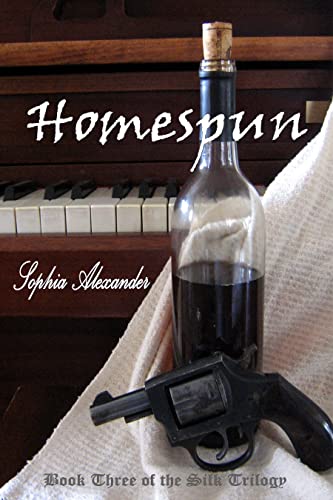

It is a time of significant change in South Carolina. The time between the First and Second World Wars is filled with progress in industry and social structures. Women are taking a more active role in the world, and things like automobiles, electricity, running water, and radios are becoming more commonplace in homes. But, for the Bell and Caddell families, their long-standing feud continues, and it is on the younger generation to try and mend fences. When Ginny and Jack fall in love, it is a forbidden romance full of strife and struggle. Family ties are stretched to their limits, and the question of “Is love enough” hangs in the air.
As the third and final installment of Sophia Alexander’s ‘Silk Trilogy,’ readers return to the small towns of Greeleyville and Kingstree in Homespun. Jessie’s personality is as hateful and disagreeable as ever, but her villainous deeds are overshadowed by the introduction of Zingle. A character that feels no remorse has no morals and no saving grace. While misguided, Jessie’s character stands behind her family values and morals; Zingle offers no redeeming qualities and gives readers someone new to hate and despise. He is the perfect villain for this final novel.
What stands out about ‘Silk Trilogy’ is the focus on ordinary people and their struggles during this time of rapid change in America. Between the war, industrial revelation, and women taking on roles outside the home and showcasing they have more to offer than just raising babies, this series shed light on how the average citizens faced these changes. From the country families to the small-town residents, everyone is shown fighting to find a place. Vivian’s character is inspirational and has been from the start. Homespun allows her to shine through and gives her character, as well as women from this time, a voice. Ginny reminded me of someone stuck between two generations, trying to bridge the gap and find herself. Many women will relate to her coming-of-age story in this novel, even in modern times. The struggle to balance family and breaking off to follow their own path is still relevant today.
Homespun is a gripping and captivating conclusion to the historical fiction ‘Silk Trilogy.’ Readers will be drawn into the drama and transported back in time to the South Carolina countryside and experience the winds of change that were blowing through the Lowcountry South. Some of the best fictional stories have roots in the truth, and the world that Sophia Alexander has created here is one that stays with readers long after they finish the story.
Pages: 377 | ASIN : B09VSYQZL9

A Dramatic Re-interpretation
‘Silk: Caroline’s Story’ follows three women as they look for love, for themselves, and navigate the drastically changing culture of the south, some doing whatever it takes to get what they want. What was the inspiration for the setup to your story?
My own family tree! I’ve been obsessed with genealogy since I was a girl, and there are some unclear, unexplained branches that I’m fairly sure I’ll never discover the absolute truth about. Why did Caroline choose to marry whom she did? What happened to her? Many of the main characters are based loosely on real people, but I’ve changed names as it’s so fictionalized. Silk is a dramatic re-interpretation of my own family’s obscured past, in which Jessie was likely not so evil at all.
What were the morals you were trying to capture while creating your characters?
Hmm… I generally shy away from spelling them out, but you seem to have already gathered that my novels are rife with morals, if only because it’s simply how I think. Silk is flat, Lowcountry terrain compared with the mountains that exist of all my soapboxes!
Perhaps the most pervasive moral in the book, however, is one nearly universal for novelists: that it’s important to try to understand where others are coming from, to develop empathy—even for those with bats in their belfry, as Anne would say. That moral is not so much taught as experienced with all the head-hopping—and studies have shown that fiction readers do become more empathetic.
Honesty and fidelity, the value of friendships, the dangers of alcohol and extremism—these are other moral themes in Silk. I’m afraid, however, that many of the moral analogies I personally draw to today’s society are bound to be missed by readers. For instance, readers sometimes express their disdain for brothels and their understandable relief that brothels aren’t still widespread in America today. Rampant pornography is, however, now far more available than brothels ever were, is damaging to psyches and relationships, and objectifies people entirely.
Gracious, for all that I was hesitant to jump on an invitational soapbox, I’ve gotten started now! Countless moral ideas guided my writing of The Silk Trilogy—even if they barely brush the surface and are hardly mentioned. For example, broad-brimmed hats and parasols protect from the sun, which my characters do actively consider; this might not sound like a moral issue and certainly isn’t presented as such in the novel but, in fact, folks do need to protect themselves from skin cancer—I’ve personally had melanoma—yet most sunscreens are endocrine disruptors, even carcinogens themselves, while also damaging coral reefs. So as you can see, I can only relate a fraction of what’s relevant, just hoping to plant little seeds.
Other moral elements are briefly shared when Dr. Connor goes on about his dilemmas in practicing medicine—how to choose the safest, most effective therapies; being aware of the marketing ploys of pharmaceutical companies; issues with not being able to follow up with patients, etc.
One of my most heartfelt morals was difficult to flesh out satisfactorily, so to speak. I’m a vegetarian, quite against factory farming, so the meals feature casseroles, biscuits, cobblers, butterbeans, collard greens, pickles, etc. Reluctantly, I also include dishes like turtle soup and crabcakes, hoping to muster a traditional Southern table while not sending people salivating to their kitchens, inspired to throw on a pan of fried chicken. Jessie does eat barbeque in the first chapter, however, which helps set a Southern tone. Sigh… I tried, but I doubt that Silk helped my animal-rights mission one iota, except maybe through Caroline’s love for Julep.
I will say, however, that an overarching purpose/moral of the novel was to conjure up a fairly authentic Southern historic setting to help readers relate to Southerners a bit more. I’m thoroughly convinced that Southerners are one of the most maligned groups these days—so often parodied as ignorant, selfish, racist, bigoted, etc. Frankly, it’s now trendy to disparage Southerners, so I’m doing what I can with The Silk Trilogy to balk against that ugly bias.
What were some themes that were important for you to explore in this book?
One theme is dealing with women’s issues—how to exist as a woman in society, the joys and difficulties of motherhood and/or of having a career, clarifying and validating how difficult our choices can sometimes be.
Another theme is how extreme thoughts, fixations, and desperation can distort facts and lead to unspeakable acts, acts that perpetrators justify and too often entirely get away with.
What is the next book that you are working on and when will it be available?
Homespun, the last installment of the Silk Trilogy, is due to come out next St. Patrick’s Day, March 17th, 2023. It centers on Caroline’s granddaughter, Ginny. Jessie’s still as deadly as ever, but her energies are channeled in a surprising new direction.
Author Links: GoodReads | Twitter | Facebook | Website
It’s 1899, and Caroline Corbett is ready for the twentieth century. She’s excited to find work and meet new people—but gets more than expected when a rough-hewn Lowcountry farmer and a small-town doctor both engage her affections.
The broad-shouldered, genial farmer is clear about his desires, and he’s there for her. The doctor is sophisticated, educated, and obviously the right choice—but sees no reason to dwell on certain realities.
In trying to decide between them, Caroline fails to consider the girl Jessie. A young sociopath bent on her own way, Jessie Bell sees very good reasons to dredge up unpleasant realities—and to create new ones. Before long, this South Carolina landscape is riddled with the detritus of her intense jealousies, which have set astonishing and horrifying events into motion.
Silk: Caroline’s Story
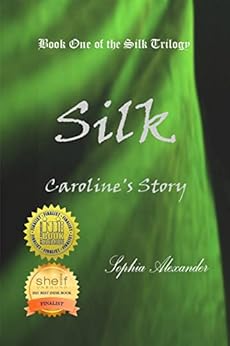
Silk: Caroline’s Story is the first installment in a trilogy set in post-Reconstruction South Carolina. This first novel centers on Caroline Corbett, a sanguine southern belle. At the story’s beginning, Caroline suffers from a lack of romantic success. So, at her uncle’s request, she moves to his plantation. She had dual purposes: to work in a clothing factory and find herself an acceptable husband. Shortly, she meets two handsome men, Dr. Stephen Conner and Clayton Bell. Quickly, Caroline is swept up in romances with both men. Dr. Conner is handsome and well-off, while Clayton Bell is a sharecropper, followed by his lovesick little cousin, Jessie.
From the opening pages, author Sophia Alexander takes readers back in time to experience what life is like for women as society is just beginning to accept them as more than homemakers. There is a romance story in this exceptional novel. However, the portrayal of how different life was for women drew me in and kept me. Jessie is a young girl in this story and clings to the old ways, wanting a simple life with the man she has decided is the only one for her. A time when marrying your cousin was not considered strange or inappropriate. Caroline is a dreamer, full of passion and the desire to be different from the elderly women in her life, wanting more than just a suitable husband for her future.
Sophia’s character development as the two leading women is what gives this novel its life. Readers will feel as if they know Jessie and Caroline intimately, though, with Jessie, they may also be afraid of her. Her twisted and dark reasoning to achieve the things she feels she deserves in life is genuinely terrifying at times. It is as much a psychological thriller as a historical romance following these characters.
Dr. Conner and Clayton Bell are prime examples of the class differences in the Carolinas. Both bring something different to the story, and readers will be torn between who is the favorite and who should end up with Caroline. It is a whirlwind following the three of them and watching Jessie maneuvering in the background to make things go as she wants.
The novel’s pacing keeps readers engaged. There is never a dull moment in the plot. The descriptions are vivid, and you feel like you are there in the old south, experiencing the changes in the society as they happen.
Silk: Caroline’s Story is an emotionally charged historical romance that gives readers a complex love story from multiple points of view and a riveting plot that takes this novel beyond the genre of romance.
Pages: 362 | ASIN: B095CVP3G7
Tapestry: A Lowcountry Rapunzel

Tapestry: A Lowcountry Rapunzel, written by Sophia Alexander, is the second book in her Silk Trilogy series. However, this book stands on its own and will captivate readers from the opening pages.
Gaynelle and Vivian are two sisters being raised by their stepmom, Jessie. They live on a family farm in rural South Carolina, sheltered from most of modern society. There is fear of men being drafted into fighting in World War I and the Spanish flu taking loved ones away. Vivian is often sick, and Jessie thrives on doting on her as if she were her own blood. Meanwhile, Jessie hates everything about Gaynelle. In her eyes, Gaynelle embodies everything from her husband’s first wife that she hated.
When Vivian is sent away to recover from her mysterious illness, Gaynelle struggles at home alone. Gaynelle wants to make friends and doesn’t understand why she can not be friends with the Black family next door. She falls in love with a summer farmhand working with her father only to end up pregnant, turning her already dysfunctional family even more on end.
This astonishing novel grabs readers in the first chapter and takes them on a journey that makes it impossible to put the book down. The characters are well developed. Even the minor characters stand out for their parts in this novel. The characters are my favorite part of this novel. Jessie, the evil stepmom, is crazy and will do anything to achieve the dream she has imagined in her head. As the story progresses, her nefarious personality comes out slowly, but the actual depth of her devious plot unfolds shockingly.
Gaynelle is an innocent character many can relate to, wanting the fairytale love. Believing her true love could rescue her from her situation if only he knew what was happening. She is a sweet character that readers will want to see bloom into a strong woman. Her older sister Vivian takes her under her wing when she moves into the town. Vivian thrives in town, picking up the latest in fashion and politics. The emergence of women’s rights plays a vital part in Vivan’s personality.
This engaging novel takes readers into the mind of two young women coming of age in the 1920s and realizing they have more potential than just being farmwives. It also takes readers into the twisted mind of a woman that will stop at nothing to take what she believes she is owed in life. The multiple viewpoints in the narration allow readers to get to know the characters through their own minds and those around them.
Tapestry: A Lowcountry Rapunzel is a dramatic coming of age and family saga novel exploring the 1920’s women rights movement through the eyes of two young women and the romance of unrequited love. This novel will entertain readers with captivating dialog and the mystery of what other secrets this family hold.
Pages: 226 | ASIN : B095DYHDDJ


