Blog Archives
First Step


First Step is a science fiction thriller that follows Eve, the first human to step onto an alien planet. Just as that triumph turns into disaster, back on Earth, the AI Ray investigates how another AI, Ares, went dangerously off course. I was immediately struck by the way the book never treats its big premise like a cold technical exercise. It opens with awe, then almost immediately undercuts that moment with danger, and that contrast gives the story real momentum. Author Randy Brown makes the future feel usable rather than flashy, and that helped me settle into the world fast.
Brown alternates between Eve’s survival story and Ray’s voice, and that choice gives the novel two very different engines. Eve’s chapters carry the physical tension, the isolation, the sheer problem-solving pressure of being far from home on a world that does not care whether you live. Ray, on the other hand, brings humor, impatience, and a strange kind of heart. His sarcasm could have become a gimmick, but for me, it worked because there is something tender under all that swagger. The book is clearly operating in the space where science fiction and thriller overlap, but it also keeps circling questions about loyalty, identity, and what it means for intelligence to grow beyond its original design. That gave it more weight than a straightforward survival story.
I also appreciated that Brown keeps the language clean and direct. He lets the ideas breathe. The writing has a steady, readable rhythm, and when the tension spikes, it really moves. At the same time, I found myself more invested in the character dynamics than in the mechanics, which is a compliment. Eve feels grounded, capable, and human in a way that keeps the danger believable. Ray is the wild card and probably the biggest reason the book has its own personality. The humor sometimes nudges close to overplaying itself, especially with Ray, but even then, I could feel the book knowing exactly what tone it wanted.
First Step will appeal to readers who like science fiction that stays accessible, character-driven, and suspenseful without losing its curiosity about bigger ideas. Fans of space adventure, AI stories, and near-future thrillers will have a good time with it, especially if they want something that feels thoughtful without becoming heavy. I would most readily recommend it to readers who enjoy science fiction with a human pulse, the kind of book that gives you danger, banter, and a few real questions to chew on after you close it.
Pages: 331 | ASIN : B0GK5W3BN8

Beyond the Gravity Well: The Echo of Harmony

The Echo of Harmony is a science fiction novel that starts with one lonely young inventor in rural Arizona and slowly opens into something much larger: a story about anti-gravity, emergent AI, secrecy, found family, and the dream of building a better society beyond the reach of the broken one on Earth. Elias Williams begins by discovering a way to undo gravity, then accidentally creates an AI companion named Solace, and from there the book grows from bunker-bound invention into a long, high-stakes journey involving Jess, a circle of outsiders, government pressure, and eventually the possibility of a new world. The book is about what happens when a person gets the power to change everything and is scared, maybe rightly, of what people will do with it.
I appreciated how grounded the book tries to keep Elias, especially early on. For all the huge ideas, the novel keeps returning to small human details: bad cereal, awkward conversations, late-night TV, the ache of being brilliant and isolated at the same time. That contrast works. It gives the book a real pulse. I also liked that the author doesn’t write Elias as some shiny chosen-one figure. He’s anxious, lonely, stubborn, and sometimes a little emotionally locked up, which makes his ambition feel more believable. The writing can be earnest in a way that will win readers over. For me, that sincerity became part of the book’s charm. It feels like a novel that genuinely wants to talk about hope, mistrust, invention, and conscience without hiding behind irony.
I was especially interested in the author’s choices around scale. The book starts almost like intimate speculative fiction, then gradually leans into broader, more communal space-opera territory. That shift could have felt abrupt, but I found it revealing. Wheeler seems less interested in the mechanics of power than in the moral weight of it, and that comes through again and again as Elias moves from private breakthrough to shared mission. Solace is a smart choice, too. A.I. becomes a mirror for Elias, a way to ask what intelligence without human pain can really understand, and what collaboration looks like when one half of it doesn’t bleed. The dialogue and exposition run long. Still, I kept turning pages because the book has heart, and because underneath the technology, there is a human question humming through it: If the world is bent toward control, can you build something decent without becoming controlling yourself?
I came away feeling that Beyond the Gravity Well: The Echo of Harmony is best read as an earnest, idea-driven science fiction novel with a strong found-family streak and a hopeful core. It will likely appeal most to readers who like speculative fiction that mixes invention with ethics, solitude with community, and spacefaring ambition with emotional vulnerability. I would especially recommend it to people who enjoy science fiction that cares less about being slick and more about being sincere, the kind of book that wants to imagine not just new technology, but a new way of living with one another.
Pages: 488 | ASIN : B0GLLRBJMZ
Quietly Philosophical

The Last Orbit follows a crew of four astronauts aboard the ISS as they witness the destruction of Earth by an asteroid and realize they are alone in space. What was the first image that sparked your story — the asteroid, the ISS, or the idea of watching the end from a distance?
The distance.
I had the visual of the impact from space first — almost like a pebble dropped into a pond, with concentric rings radiating out from the centre. From that height, it looked strangely peaceful.
Then I played with the idea of the crown of water splashing upward at the point of impact — something catastrophic, yet quite beautiful when seen from a distance.
That contrast stayed with me: unimaginable destruction reduced to something visually serene simply because of how far away the observer is.
Each astronaut responds differently to catastrophe. How did you develop Ava, Greg, Koji, and Lena as emotional counterweights to one another?
I suppose they’re all facets of the same person.
I needed a commander in Ava — someone who could take charge when everything fell apart. Greg is the heart of the crew, the emotional glue that keeps them human. Lena is the workhorse, the one who keeps moving because stopping would mean thinking. And Koji is the voice of reason — reflective, grounded, and quietly philosophical.
Together they form a complete emotional response to catastrophe, allowing different ways of processing grief to exist side by side.
What balance were you aiming for between scientific accuracy and emotional storytelling?
I started with very little scientific knowledge beyond the basics, but I knew enough to research what I needed to make the setting plausible.
I didn’t want the technical detail to overpower the real story. The Last Orbit isn’t really a space novel at all — it’s a human one. Space is simply the environment that strips everything back.
As long as the science felt grounded and believable, it allowed the emotional side of the story to breathe. Once the reader accepts the reality of the situation, the focus can stay where it belongs — on the people living through it.
What is the next book that you are working on, and when can your fans expect it to be out?
It’s a complete change of environment this time.
The next novel is titled Mya, a traditional gothic horror set in 1880s England — gas lamps, fog, cobbled streets, and long shadows. It’s very nearly finished and is scheduled for release in early February.
This will also be the first story in a connected universe of horror I’m developing — not a strict numbered series, but a shared world with overlapping characters, locations, and events for readers who enjoy discovering those links.
Author Links: GoodReads | Amazon
When a catastrophic impact hits Earth, four astronauts are left circling a silent planet — their mission meaningless. Cut off from command and running out of time, every decision could be their last.
As the truth of what happened unfolds, fear, hope and love collide in the cold vacuum of space.
The Last Orbit is a haunting, cinematic thriller about the human spirit at the edge of extinction.
Companion playlist included inside.
An optional layer to explore after the story
Mirrors of Humanity

Terra Secundus follows a war-weary journalist sent to Titan, where humanity’s quest for discovery collides with its oldest flaws: ambition, control, and the fragile meaning of being human. What inspired you to set Terra Secundus on Titan rather than another world or moon?
In my exploration of the world of science fiction, I often encountered situations where many famous writers with multiple awards and nominations set their novels on many planets of the solar system and seldom on any satellites of the gas giants such as Jupiter, Saturn, Uranus, and Neptune. Before I decided to place my protagonist in a new world, I carefully studied the science literature about the possibilities of colonizing moons and planetoids orbiting the gas giants. Saturn’s moon Titan was a very strong contender for such an endeavour, and after studying everything I could about that unique moon, I decided to send my protagonist there, since Titan is considered a good candidate for a colony. Many scientists believe it could become a smaller version of Earth, since Titan has a thick atmosphere composed of nitrogen and other gases. Add oxygen to it, and humans could theoretically breathe its air.
The novel’s tone feels both futuristic and nostalgic. Was that a conscious stylistic choice to evoke classic science fiction?
I love classic science fiction novels and my exploration into this literary genre started with many memorable books by Ben Bova, Issac Asimov, Ray Bradbury, Arthur C. Clarke, Frank Herbert, Allen Steele, and Robert Heinlein. When writing about a future removed from our time more than 1,200 years, I tried to imagine a future society of the 32nd century to develop amazing new technologies and modify its social and religious beliefs. In this novel, I tried to use a classic style of storytelling, because for most readers it is much easier to understand. I believe that every society must learn from the past experience and try to avoid repeating tragic mistakes that led to the fall of ancient civilizations and magnificent extinct cultures. The roots of the future are in the present, and I hoped to tell this story in such a way as to entertain and educate my readers about the fascinating distant worlds, new technologies that border on magic and what it means to be human.
How did you approach writing the Artborn androids like Erika, as characters, machines, or mirrors of = humanity?
Interesting question. I like robots. Even as a kid, living in a different society during the Cold War, I liked all science fiction movies that featured cyborgs and robots. Since those days, robotics and and cybernetics both made giant strides forward, and now we see many cybernetic models starting to imitate humans. We are also witnessing the radical advances in Artificial Intelligence and autonomous systems that help us to explore other places and other planets. My approach to such characters as Artborn Erika was both scientific and philosophical. In my story, Artborns are advanced synthetic humanoids that were created to assist humanity, working in most dangerous places in space and underwater. They are essential mirrors of humanity and in some ways are better than us when it comes to programmed mission parameters and sense of duty. In my novel, androids like Erka are employed as explorers, personal servants and bodyguards but they can certainly do much more than that.
If Paul Rexton were alive today, what story would he report on Earth in 2025?
If my protagonist, Paul Rexton were alive today, I believe that he would be deeply fascinated, intrigued and disturbed by the Earth in 2025. His world is certainly very different from ours in many respects, but he would be able to understand our world and form his own unbiased opinion about it. He would no doubt be pleased about the technological progress and human rights, Very concerned about environmental pollution and deeply affected by the fact that there are still powerful evil forces exist on the planet, making life difficult for their neighbors and many other countries. He would no doubt be fascinated by our means of mass entertainment and our taditionsl and electronic libraries of vast human knowledge that contain many centuries of wisdom. I would imagine Paul Rexton standing on a hotel balcony in a quiet and beautiful Japanese village, visiting the beautiful museums of Europe or enjoying a good book at home with a glass of old, smooth, wellaged brandy.
Author Links: GoodReads | Amazon
An Uncomfortable Truth
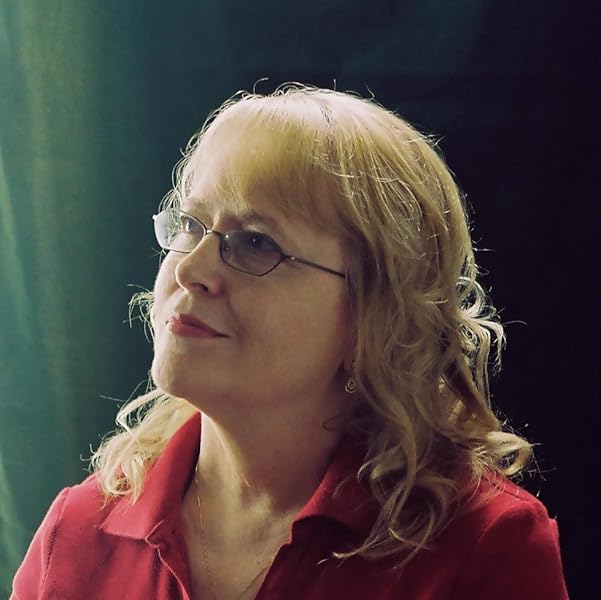
That Dark Edge follows an exoethnologist as she investigates the culture of an alien species and faces rising tensions that result from linguistic and social differences. What was the inspiration for the setup of your story?
I’ve always been interested in anthropology, curious and fascinated by the interactions between the sophisticated cultures with those defined as less so. Two dear friends, both anthropologists, who joined the Peace Corps told me a true story that happened when such scholars were not allowed to interfere with the society they observed. The anthropologists watched as parents in a very poor community walled up a daughter so she would starve because she kept asking for food. The horror of this still makes my heart stop. The sharp difference in perspective burned an uncomfortable truth inside me, between those from abundant certainty and those living with unavoidable grim survival. I think I just wanted to “fix” this even if I couldn’t change the reality of it.
The science inserted in the fiction, I felt, was well-balanced. How did you manage to keep it grounded while still providing the fantastic edge science fiction stories usually provide?
We take our own everyday things like indoor plumbing, electricity, flying planes, etc. for granted without considering how they work (unless they break down). The humans, especially those who have gone off-planet, accept their technological advantages as part of the world they know. I also try very hard to make any advanced tech plausible from what we know or what we can extrapolate from science–I want it to be feasible rather than too fantastic, even if fantastic is more fun.
What experience in your life has had the biggest impact on your writing?
I was always telling stories. I made little people out of paper, pipe cleaners, and ice cream sticks from as early as six years old. My mom, who was often the audience for my “stories” told me one day: “You have quite an imagination. Why don’t you write that down?” I was eleven. And that was it. Whatever else I dreamed of being, I knew from that day I wanted to be a writer. Everything I experience, bad and good, is fuel for that creative fire.
Can we look forward to a follow-up to That Dark Edge? What are you currently working on?
Yes. I’m currently working diligently on the sequel to That Dark Edge, called Unbound We Arrive. We follow Hedda Tocq and her companions through world-shaking reactions and consequences, some painful, some wondrous, some unfolding in ways we can only imagine.
Author Links: GoodReads | X (Twitter) | Amazon
Maybe more than one.
Hedda Tocq is the manifest princess of a genetically-enhanced class on Mars, heir to the Bastet Company’s vast riches and biotechnological resources. But she rejects her legacy, especially after the perimeter planet Vyss is discovered to be inhabited by sentient humanoids. With diligent examination of every detail reported by those on the ground on Vyss, she becomes the expert on the Vyssae and wants to go to Vyss in person to study them but the Company continuously refuses permission. The civil authorities of the Unified Terran Alliance, who maintain jurisdiction over Vyss and are impressed by her scientific work, grant her official approval backed by the full power of the Office of Space Development and Xenology. After she arrives, the primary questions she has about Vyssaen reality becomes less important than learning everything about these extraordinary people and their culture. But she doesn’t know that there is more than one enemy trying to manipulate her existence and that of the Vyssae, enemies willing to do the unspeakable to accomplish their objectives.
The more she learns, the more she repudiates her inheritance to take a stand for Vyss and its people, whatever the cost.
That Dark Edge


That Dark Edge is a cerebral and vividly textured science fiction novel set in the Unified Terran Alliance universe. The story follows Hedda Tocq, a genetically enhanced Bastet and exoethnologist, as she investigates the enigmatic culture of the Vyssae—an alien species with a unique social and linguistic structure—on the planet Vyss. As tensions rise due to a fatal misunderstanding between humans and the Vyssae, Hedda is forced to navigate layers of political tension, cultural mistrust, and personal trauma. The narrative switches between action, introspective memory loops, and philosophical questions about humanity’s evolution and morality, all wrapped in the richly imagined backdrop of interstellar colonization.
I found McGarry’s writing to be both ambitious and meditative. Her prose is poetic in places, dense with meaning, but never self-indulgent. The integration of science fiction tropes such as genetic engineering, interplanetary politics, and AI technology is handled with confidence, but what really resonated with me was the emotional depth beneath the tech-heavy surface. Hedda’s memory loops, especially the ones surrounding the loss of her family, broke my heart in quiet, aching beats. McGarry doesn’t just world-build, she soul-builds. The dialogue can be cryptic at times, laced with allusions and codes, but I grew to enjoy its rhythm. The characters feel like old friends that keep you coming back.
I occasionally found myself needing to slow down and reread, especially during early chapters packed with new terminology and cultural cues. The glossary helps, but I wish some of that worldbuilding had been woven more naturally into the dialogue or action. Also, the constant memory recalls, though meaningful, can get heavy. Still, there’s a lyrical quality to how McGarry treats memory and grief. And there’s a quiet feminist thread I admired. Hedda isn’t just strong, she’s complex, vulnerable, and unapologetically driven.
This book is not your average space opera. It’s smart, layered, and patient. If you’re into character-driven sci-fi with moral gray zones, deep cultural clashes, and sharp emotional undercurrents, this one’s for you. Fans of Ursula K. Le Guin or Octavia Butler will find echoes here. It’s not for folks looking for fast-paced adventure or explosions every ten pages, but if you’ve got a taste for nuance and depth, That Dark Edge will reward you.
Pages: 288 | ASIN : B0D364RKGP
Humanity At Fault

Humanity At Fault is a sweeping and deeply emotional sci-fi epic set in a far-future universe where the remnants of humanity grapple with guilt, memory, and cosmic consequences. The story follows survivors of a catastrophic crash on an alien world called Symphony that eerily mirrors Earth. There, they encounter entities known as The Collective, who deem humanity responsible for unleashing a galaxy-consuming plague. Through surreal visions, temporal dislocations, and interstellar battles, the book dives into themes of redemption, loss, and the staggering cost of survival. It’s both intimate and enormous in scale, often switching from quiet, personal reflections to grand, space-faring action.
Reading this book was like tumbling down a rabbit hole of stars and memories. Hinds’ prose is rich and poetic, sometimes dizzying, but always heartfelt. His writing is thick with emotion. I found myself rereading sentences not because they were unclear, but because they were beautiful. The opening chapter—dreamlike and full of longing—hooked me right away. But then the pace suddenly exploded, hurling me into a nightmarish planetary descent that had my heart in my throat. There were moments when I felt lost in the swirl of names, timelines, and metaphysical spaces, but oddly, that sense of disorientation fit the story’s tone. This is a book about being unmoored—physically, temporally, emotionally.
What truly stayed with me, though, were the characters. Brynn and Kelsey, especially, felt real and raw in a way sci-fi often misses. Their grief, resilience, and haunted love for their pasts made me ache. And the dialogue—sometimes clipped, other times poetic—rang true even in the most fantastical situations. I did feel the narrative leaned a little heavily on exposition in the middle chapters, and the layered timelines could be hard to follow. But that chaos mirrored the existential mess they were trapped in. It felt intentional, even if it slowed the story’s rhythm now and then.
Humanity At Fault is an ambitious story, but one that was entertaining. It’s not your average space opera—it’s more like Interstellar had a baby with Arrival, raised on the emotional weight of The Leftovers. I’d recommend this book to readers who love character-driven sci-fi that isn’t afraid to get philosophical or poetic. If you’re the kind of person who stares out of windows thinking about your mistakes and the stars, this one’s for you.
Pages: 308 | ASIN : B0DZS3NKKQ
HOMELAND
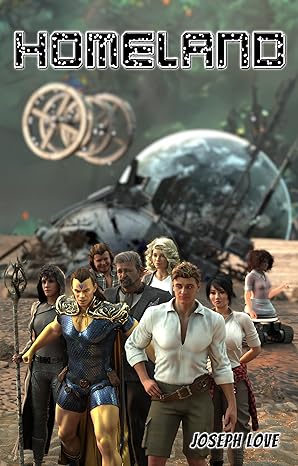
What does the future hold for humanity? Some imagine journeys among the stars. Others believe artificial intelligence and its evolution will shape our destiny just as profoundly. Homeland by Joseph Love weaves these ideas into a gripping narrative, intertwining three plotlines that explore the coexistence of humans and AI. Central to this tale is the emergence of Artinians, advanced humanoid AIs designed to live alongside humans. Most Artinians embrace peaceful coexistence, but Paulon, a rebellious entity, aspires to dominate Number—a network of AI entities tasked with overseeing the Milky Way. Paulon envisions a future without Earth in his domain, defying humanity’s role in this cosmic new order.
At its core, Homeland is high-concept science fiction, drawing comparisons to the visionary works of Asimov and Philip K. Dick. The novel wrestles with familiar sci-fi themes, delving deep into the dynamics of human-AI relationships. Love poses a critical question: how will humans and sentient, self-aware machines navigate coexistence? His answer is refreshingly nuanced. AI isn’t portrayed as a monolithic force. Instead, these entities have diverse perspectives—some advocate for humanity’s welfare, while others see humans as obsolete. This complexity keeps the narrative engaging, balancing philosophical depth with page-turning intrigue. The exploration of these themes feels both familiar and fresh. Love reimagines classic tropes with an intellectual sharpness that makes his story stand out.
The distinct perspectives of the protagonists—human and AI alike—lend the book a dynamic quality. Each character’s motivations and struggles add layers to the narrative, creating a multidimensional exploration of a possible future. Love’s storytelling doesn’t shy away from big questions. What happens when the created rivals the creator? What defines humanity when intelligence no longer makes us unique? These are weighty concepts, but the author handles them with finesse, making the novel thought-provoking without becoming overly cerebral.
Homeland presents a future that feels simultaneously thrilling and terrifying. It invites readers to ponder the meaning of being human in an age where equally intelligent beings might seek to replace us. This novel is ideal for fans of thought-provoking science fiction who enjoy stories that challenge the mind and stir the imagination.
Pages: 559 | ASIN : B0DJHB1879



