Blog Archives
We Have Agency

Time and Space follows a woman on the verge of turning forty who, on the way to work, is kidnapped by three university-aged young men from the future and is taken forward in time to a society built on patriarchal dominance. What was the inspiration for the setup of your story?
I remember becoming angrier and angrier at the objectification of women and the failed promise of equality.
Women’s Liberation hit the news when I was in school. I also grew up with a Zoroastrian father who taught us, in accordance with his religion, that men and women are equal. I didn’t understand the need for Women’s Lib until my later university/early working years, when I saw how women were treated in the workplace. Decades on, and except for Federal and provincial Canadian laws, nothing had changed. Women who felt they were liberated because of issues around sex having been loosened were wrong. It seemed like only the older generation understood that changing laws and mores didn’t translate to women being treated and perceived as equal to men. Whether women were virtually unclothed in one culture or covered up to the eyeballs in another, they were still being treated as objects for men to control. They still had less value.
I was also getting fed up with how Toronto and Ontario treat Toronto’s public transit and the commodification of every aspect of life.
On a personal note, I had little control over any part of my life because of my brain injury. I guess I was telling myself through Time’s story that we may not see it, but we have agency.
What are some things that you find interesting about the human condition that you think make for great fiction?
Our weaknesses. And the forces that both exploit them and force us to grow. That often surprises us when they lead us to fulfilling our own potential.
What were some themes that were important for you to explore in this book?
Sexism:
- The objectification of women and how they’re perceived as either baby bearers or sex fulfillers for men.
- What equality truly looks like when men and women perceive women as having inherent worth.
- Women recognizing their own intelligence, both to receive help and to problem-solve their own challenges.
Classism:
- Through the neglect of public transit.
- In the commercial arena or public spaces.
Racism:
- I’ll leave this to the reader to ponder the way I presented it and its meaning.
Ageism:
- I made Time an older woman.
- Since then, I began writing a trilogy (The Q’Zam’Ta Trilogy) featuring a woman in her 60s. Book one, The Soul’s Awakening, is out now.
- With such an emphasis on stories with younger people and the whole mindset that the youth will “save us,” we need to hear stories about older people also able to “save us,” especially older women in nondescript jobs.
What is the next book that you are working on, and when can your fans expect it to be out?
I’ll be publishing The Soul’s Reckoning, book 2 of The Q’Zam’Ta Trilogy, in December 2025 and am currently writing book 3, The Soul’s Turning, which I hope will come out at the end of 2026.
I’m particularly excited about The Soul’s Turning because it’s set in far, far future Toronto, London, and Mumbai, and expands on some of the technology and themes I first explored in Time and Space. However, I’ll be making climate change an essential background to the character development and plot settings. And unlike Time and Space, it delves into the latter aspects of Revelation — what would a world without Satan and the beasts of “the elite” actually look like?
Author Links: GoodReads | Bluesky | Website | Amazon
Time is turning forty, but her ordinary morning walk to work shatters when three university-aged boys from the future snatch her into a shimmering white cube. Their destination: a technologically advanced, male-dominated future where girls are tightly controlled, kept cosmetically perfect, and denied knowledge and autonomy.
When their professor discovers the abduction, he’s furious. The boys had promised never to interfere with the past again. Now he orders them to dump Time in a desolate era few dare visit, The Nasty Time. It’s 2411. The world is stripped of equality, connection, and choice. Time is abandoned and left stranded.
But someone unexpected intervenes, offering Time a sliver of hope—and knowledge she never asked for. Now, survival may depend on learning more than she ever imagined.
Smart, satirical, and deeply unsettling, Time and Space is a genre-defying journey across centuries and systems of control. Shireen Jeejeebhoy blends speculative science, biting social commentary, and sharp humour in a story that asks: “What happens when the powerless are forced to reclaim their life—or be erased from their future?”
Time is waiting. Don’t delay.
Tachyon Tunnel 3
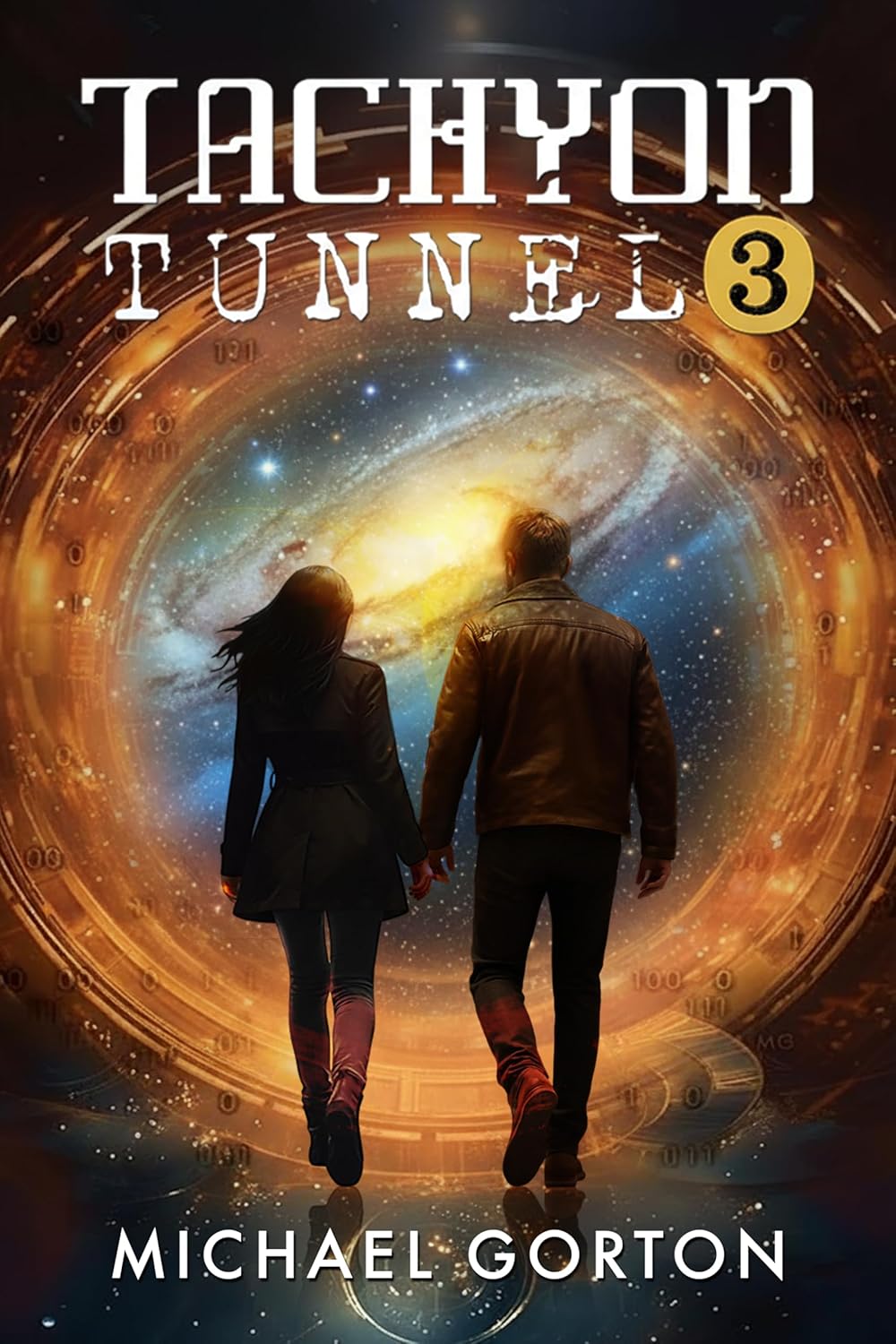

Tachyon Tunnel 3 continues the breathtaking saga of Alex Durant, Paula Campbell, and the evolving AI, Emily, as they face a galaxy on the brink. The story picks up where the last book left off: Earth barely spared from annihilation and the Daklin Empire’s grip tightening over the Milky Way. Author Michael Gorton plunges us into a universe brimming with complex technologies, alien politics, and impossible odds. We meet Fortak, a Daklin scientist stranded on Earth, and follow the growing resistance led by Alex and his allies. There are vast ships that hold cities within their hulls, civilizations millions of years old, and battles that unfold across the fabric of space and time. It’s part space opera, part philosophical exploration of humanity’s place in the cosmos.
Gorton’s writing crackles with energy. His descriptions of the Martian Empire and their cities made me feel the weight of their history, their pride, their downfall. The pacing runs hot, but it fits the chaos of a war that stretches between galaxies. I loved how science isn’t just a backdrop here. It’s part of the soul of the story. Tachyon tunnels, plasma consciousness, and sentient AI aren’t just gimmicks. They’re extensions of how we think about creation and survival. I wanted to sit longer with the characters, especially Fortak, who’s both villain and victim. His curiosity and isolation hit me harder than I expected.
Emotionally, this book is a roller coaster. It made me think about what it means to be human in a universe filled with beings far older and smarter. The scenes on Andromeda Prime, with its harmony and peace, contrasted beautifully with the Daklin Empire’s cruelty. There’s awe in the way Gorton writes about discovery. There’s sorrow in his portrayal of loss. And yet, there’s a spark of hope that keeps burning, even when the odds seem hopeless. I found myself rooting for Emily, the AI who feels more alive than most of the humans. Her growth and sharp wit gave the story its heart.
I’d recommend Tachyon Tunnel 3 to readers who love big ideas mixed with real emotion. If you enjoy science fiction that feels vast but still human, this one’s for you. It’s for those who want their space battles served with philosophy and heart. Gorton writes like someone who believes in both science and soul, and that combination makes his universe feel alive.
Pages: 519 | ASIN : B0DWKRQFJS

The Impossible Choice
Time Lines follows a group of characters who move between the Nazca desert, space stations, collapsed civilizations, and alternate timelines, trying to find a timeline that saves humanity. What was the inspiration for the setup of your story?
Originally, this idea was supposed to be a Mayan prophecy story/idea that I had back around 2010. It mostly involved the main foundation of my ultimate story – with 2012 approaching, I thought it would be interesting to revolve a story around the memory of a cataclysmic event involving the moon that would be sent back in the time with the astronauts who then help send a message forward. That moment came and went, and I never committed to writing the story.
My brother Peter passed away in June of 2021, and that experience and feeling of loss is what drove me to finally start writing. My brother was always an inspiration – a person who always worked to better himself and never left anything on the table, so to speak. The grief I felt after losing him inspired me to get this story out of my head. It became my outlet.
I have always been fascinated by ancient cultures – the Nazcan lines and the Nazcan people in particular and thought I could weave some of their unexplained history into my story. I admit, the story became a whole other thing after that.
I know that the combining of philosophy, some hard sci-fi, and the palatable feelings of loss and grief create what is perhaps a unique story. I wrote the story and then put it all together in a purposeful nonlinear flow that I hope will resonate with future readers. Memory isn’t linear, and neither is my story.
I agree it can be frustrating to read at times. That is purposeful. I want you to feel that sense of frustration and feeling of living similar moments over and over again – but set in different timelines. I want the reader to feel the same sense of loss that one of our characters feels after losing their family to the past. Only in the end do I allow the reader to see the story for what it is – A story of sacrifice, loss, and the wish to spend one more day with those you love that are now gone.
This story was and is at its very soul a story written to allow me to grieve in my own way. Once I wrote it, I then decided I owed it to the memory of my brother and to myself to share it. I have been fully committed to that endeavor since the book was published.
What are some things that you find interesting about the human condition that you think make for great fiction?
The human condition truly is a beautifully flawed idea to me. We call it a condition, as if it has been diagnosed with some ailment or disease. We, the ones bestowed with this condition, are not perfect, not even close. We strive to be better through our own actions, and many times, thankfully, with the help of those around us. If we are lucky, this gift can allow us to be better – to help tender our fire and hopefully in time that fire will grow into something even more beautiful.
What were some themes that were important for you to explore in this book?
Time Lines isn’t just a story about time travel. It’s a story of love, of loss, and of the impossible choice to leave your family in the past… so the rest of us might have a future.
It is also a story of grief and trying to take something back from the thief that is time, so that we have the hopeful chance to get it right just once.
Where do you see your characters after the book ends?
I hope that wherever they are – lost in time or those who have made the final sacrifice so that the rest could have a future will know that they had purpose. I see Elly, Max, Sunita, Renée, Sam, and Peter as they are in my mind – people who have lived a thousand lifetimes and have always been the best of humanity.
Through fractured memories created from these many lifetimes, these characters never cracked. Others, trapped in their shattered lives, could never move forward.
Author Links: GoodReads | Facebook | Instagram | TikTok | Website | Amazon
Four suits. Four names. No astronauts missing. No mission logged.
The spacesuits had been there for 2000 years—how did they get there?
When archaeologists uncovered them beneath the Nazca desert, time itself began to fracture.
What followed wasn’t just discovery. It was memory—echoing across centuries. It was sacrifice, carried from the Moon to the ancient past. And it was the desperate search for the only timeline that worked.
Time Lines is a haunting, non-linear science fiction novel where the past collides with the future, and memory itself becomes the battlefield.
Perfect For Fans Of
- Neal Stephenson’s Seveneves
- Arrival and thought-provoking, idea-driven sci-fi
- Emily St. John Mandel’s Station Eleven
- Post-apocalyptic and time-travel thrillers
Why You’ll Love It
- Nonlinear storytelling that mirrors memory itself
- Ancient mysteries intertwined with futuristic science
- Emotional depth: love, sacrifice, and the cost of survival
- A pulse-pounding finale where not every astronaut makes it home
Time Lines isn’t just a story about time travel. It’s a story of love, of loss, and of the impossible choice to leave your family in the past… so the rest of us might have a future.
The past is buried in the desert. The future is written in the stars.
Discover Time Lines today.
Vital Historical Knowledge

Jigsaw: Shadow Ball follows a group of Temporal Guardians trying to preserve and repair the timeline from a ruthless organization set on altering history and erasing the racial integration of Major League Baseball. What was the inspiration for the setup of your story?
Excellent question. I love baseball, and I have always wanted to do a story on that. However, in the vein of my formerly titled History’s Forgotten series, I wanted to focus this book on Larry Doby, the second man to break the color barrier in baseball after Jackie Robinson. Most know the story about Robinson, but not as many know about Doby, and I wanted to delve into his importance in baseball and integration in American society in general.
When discussing the civil rights movement, most people automatically think of figures like Dr. King and other politically recognized activists; the involvement of athletes is not as well known, and I appreciate that you brought this aspect into the series. Was it important for you to deliver a moral to readers, or was it circumstantial to deliver an effective novel?
Yes. I want my stories to be both entertaining and educational where readers enjoy the tale but also take away vital historical knowledge, character education lessons, and moral parables.
I find that authors sometimes ask themselves questions and let their characters answer them. Do you think this is true for your characters?
Sometimes, especially with my two major protagonists, Francesca and Noah.
I hope the series continues in other books. If so, where, and when, will the story take readers next?
The next installment in the Jigsaw Series, titled Temporal Apocalypse will be released in the spring of 2026. It will center on the post-World War I era and take place in Jerome, Arizona, the Russian-Polish war front, and Fiume off the Adriatic Coast.
Author Links: GoodReads | Amazon
A rip in reality is spreading, and the fate of history hangs by a thread.
The ruthless organization Global Harmony has launched Project Shadow Ball, a devastating mission to erase the racial integration of Major League Baseball—rewriting the past to build their own twisted future.
Temporal Guardians Francesca and Noah are the only ones standing in their way. As they hurtle through time, they must protect baseball greats Rube Foster and Larry Doby, whose very existence is at risk.
With every pitch, every stolen base, and every moment altered, the fate of history—and the fight for truth—hangs in the balance.
Time is slipping away. The stakes have never been higher.
Can Francesca and Noah outwit their enemies before baseball’s greatest revolution is erased forever?
Or will history be rewritten in the shadows?
If they fail, history shatters. If they fall, the future is lost.
Who Am I?
A Code of Knights and Deception follows a disillusioned stay-at-home mother, who is unexpectedly thrust into a medieval world after a visit to Warwick Castle. What was the inspiration for the setup of your story?
The seed for this story was planted over a decade ago when I was going through major life changes—navigating motherhood, grappling with identity shifts, and craving a sense of purpose beyond the everyday routines. One day, I found myself imagining a woman standing in a historic castle, feeling invisible and out of place in her own life, when suddenly everything changed. What if she wasn’t just visiting history, but living it?
I’ve always been fascinated by time travel stories like Outlander, but I wanted to explore something different. What would it be like for a modern woman with a scientific, logical mindset to be thrown into the raw, brutal reality of medieval England? Not a fantasy version, but a historically grounded one—with real stakes, real danger, and no magic to save her. I wanted her disorientation to feel authentic, her reactions believable. That meant no corset-loving romanticism, but real struggles: survival, powerlessness, the aching separation from her child, and the weight of being a woman in a society that barely saw her as a person.
Warwick Castle was the perfect setting. I spent time researching its layout, history, and the de Beauchamp family, who ruled it during the 1400s. I loved the idea of grounding her journey in an actual place with rich historical detail while weaving in the mystery of how—and why—she ended up there. What unfolds isn’t just a survival story, but a deep personal reckoning with identity, freedom, and desire.
What were some of the emotional and moral guidelines you followed when developing your characters?
I wanted the characters to feel emotionally raw and morally complex—especially Sophia and Henry. Sophia is thrust into a world where her values and modern sensibilities clash with the brutal, hierarchical system of medieval England. I didn’t want her to be overly idealistic or immediately capable; she reacts with fear, grief, rage, and resilience in believable ways. Her love for her son grounds her, even as her growing connection with Henry threatens to unravel everything she thought she knew about loyalty and love.
With Henry, I had to be especially careful. He’s not a modern man, and I didn’t want to sanitise or romanticise him. But I also didn’t want to make him irredeemable. His morality is shaped by a violent, patriarchal world, and yet he’s quietly resisting it in his own way. His protectiveness, secrets, and inner conflict make him both dangerous and compelling.
Even the secondary characters—like Lizzi or Charles—had to reflect the values of their time while still offering space for nuance. I avoided making anyone purely good or evil. Instead, I focused on motivation, trauma, and the grey areas where love, duty, and survival intersect.
What were some themes that were important for you to explore in this book?
The central theme is identity—what defines it, what threatens it, and what reshapes it. Sophia is a woman who has slowly lost herself to motherhood and societal expectations. Being thrown into the past strips her of all external identifiers—her phone, her career, even her name at times. She’s forced to ask: Who am I without everything I used to rely on?
Another key theme is freedom vs. confinement. From the very beginning, Sophia is caged—emotionally, domestically, and eventually literally. The castle becomes both a place of fascination and a prison. I wanted to show the subtle and overt ways women have been trapped across time—and how reclaiming power, even in small moments, can be a radical act.
Love and moral compromise are also central. Sophia’s growing feelings for Henry don’t erase the reality that she has a husband and son in the future. She constantly wrestles with guilt, desire, and the tension between emotional truth and moral obligation.
Finally, truth and reality play a big role, especially given the sci-fi twist of VR. If your body is in one place, but your heart belongs to another… what’s real? This will become even more important in the second book, where the boundary between memory, identity, and illusion begins to blur.
Where does the story go in the next book and where do you see it going in the future?
Book two will conclude the series and picks up right where A Code of Knights and Deception leaves off—with Sophia facing the fallout of a devastating cliffhanger. Without giving too much away, she’ll be forced to make an impossible choice: stay in her world—or fight for a place in one that was never meant for her. Ethan’s secrets unravel, and Sophia must reckon with the real consequences of the technology that brought her there. Will she save the people who did her wrong?
The next book will delve deeper into the question: What is real? Memory, consciousness, emotion? If those things can be simulated, what does that mean for love—and for truth?
Expect more swordplay, political tension, emotional turmoil, and steamy scenes that test both characters’ limits.
Author Links: GoodReads | Facebook | Website
When Sophia wakes up in 15th-century England, she expects hardship—but nothing prepares her for this brutal, unforgiving world. Lost, alone, and desperate to return to her husband and son, she vows to find a way home. But as weeks pass, Sophia finds kinship and purpose in this strange land.
After a violent attack, she takes fate into her own hands, disguising herself as a man to train under Henry, the castle’s enigmatic master-at-arms. As steel clashes and their connection deepens, forbidden desire ignites.
Yet Henry is not the knight he claims to be. His real name is Ethan, and this is the least of the lies he tells her. Falling for Sophia was never part of the plan—but the closer they become, the more he realises how wrong it is to keep her in the dark.
As danger closes in and the lines between reality and deception blur, Sophia must uncover the truth about Henry—and herself—before she runs out of time.
Outlander meets Black Mirror in this sizzling dark Historical Romantasy with time travel, forbidden love, found family, a morally grey knight, and a fierce heroine—both hiding secret identities, deceiving each other in a game of survival and passion.
*Warning: strong language, steamy scenes, and graphic violence inside. Mention/Description of, but not limited to, abduction, blood, death, amputation, childbirth, death, sexual assault, suicide, violence against children, rape, and torture.*
The book is the first in a duology and ends with a cliffhanger.
A Code of Knights and Deception


Eliza Hampstead’s A Code of Knights and Deception blends time-slip historical fiction with a tense psychological journey, following Sophia, a disillusioned stay-at-home mother, as she is unexpectedly thrust into a medieval world after a visit to Warwick Castle. What begins as a simple solo trip soon turns into a bizarre and haunting experience where reality blurs, complete with knights, castles, and a creeping sense that something is terribly off. Her struggle to reconcile what’s happening with her rational mind propels a tense narrative that shifts between mystery, survival, and self-discovery.
The writing really grabbed me. Hampstead has this uncanny knack for showing claustrophobia and vulnerability without overexplaining. Sophia’s internal monologue is raw, honest, often sarcastic, and sometimes heartbreaking. I felt her fear, her desperation. That choking scene in the peasant’s hut was absolutely harrowing. The author doesn’t pull punches when describing the violence or emotional exhaustion Sophia endures. At the same time, the prose can be beautiful, too. There are moments, especially in descriptions of the castle or Sophia’s fleeting hopes, that feel like small sighs in the middle of a storm. The whole book keeps you off-balance, and I couldn’t stop flipping pages, needing to know if she’d wake up from the nightmare, or if it was never a dream at all.
This book isn’t just a thriller dressed up in chainmail. It’s a sharp look at what it means to feel powerless in your own life. Sophia’s journey through the medieval setting reflects her internal crisis: a woman smothered by expectations, by an unhappy marriage, by invisibility. There’s a quiet rage beneath it all, and it builds beautifully. Her yearning for independence is so relatable, and that makes her trauma hit harder. The story also plays with genre expectations in clever ways. You’re never quite sure if this is a psychological break, time travel, or some elaborate trap. That ambiguity made it addictive and unsettling.
A Code of Knights and Deception left me breathless and unnerved but in the best way. I’d recommend this book to fans of Outlander who like their history with more grit and less romance, or anyone who appreciates a layered, emotional, psychological mystery with a medieval twist. If you’re looking for a story that makes you feel disoriented, a little scared, and totally invested, then this one’s for you.
Pages: 542 | ASIN : B0D6VGNQ41

Fundamental Questions

Tachyon Tunnel 2: The Daklin Empire follows two time-travelers who have returned to Earth and have to contend with an altered timeline and unexpected challenges. What was the inspiration for the setup of your story?
I am a scientist, adventurer, and a storyteller. Combine those three elements and the result is fun!
I think science fiction gets time and interstellar travel wrong. A few years ago, I decided to write Tachyon Tunnel to fix that problem.
Tachyon Tunnel 2: the Daklin Empire goes a step further, answering more fundamental questions about time and space.
What things do you find interesting about the human condition that makes for great fiction?
I love bold persistence and imagination. I think those things can be taught and inspired. A big part of the book is about inspiration while wrapping it in some cool physics!
I felt that the action scenes were expertly crafted. I find that this is an area that can be overdone in novels. How did you approach this subject to make sure it flowed evenly?
As an entrepreneur, I have learned that simplicity is almost always the best path. Tell the story, efficiently. Like many, I had to read James Joyce – Ulysses. Enough said?
Will there be a follow-up novel to this story? If so, what aspects of the story will the next book cover?
YES. There will be a part 3. The human drama of galactic war will wrap around time travel, inertia, and the fundamental question of whether plasma is a life form.
Author Links: GoodReads | Facebook | Website | Amazon
Tachyon Tunnel 2 explores how time travel might actually work within the laws of physics, and the implications of changing events in the past. The book combines science, adventure, romance and the complexities of human decision-making in high-stakes situations. Part two of bestselling author Michael Gorton’s award-winning Tachyon Tunnel series will keep readers on the edge of their seats and is sure to become one of the best science fiction works of the year!
Tachyon Tunnel 2, The Daklin Empire
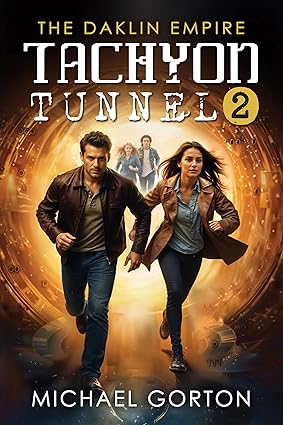
Michael Gorton’s Tachyon Tunnel 2: The Daklin Empire picks up right where its predecessor left off—interstellar travelers Alex Durant and Paula Campbell have returned to Earth after a mind-bending adventure through time and space. But home is anything but normal. Between Paula’s memory loss, a tragic second car crash, and a rapidly unraveling timeline, the book blends quantum physics with emotional stakes, then rockets forward into a high-tech corporate thriller. All of it rests on a central question: can you outmaneuver fate, or does it always find you?
This book surprised me in the best way. I expected a sci-fi sequel with more spaceships and techy jargon, but what I got was a personal and often exhilarating look at relationships, ambition, and betrayal. The emotional core hit me hardest early on, with Paula waking up in a hospital after her second crash, her memories scrambled and her heart fractured. The way she searches for clarity while Alex stands by, trying not to break the illusion, was actually heartbreaking. There’s a line when Alex watches Paula light up while solving equations on a whiteboard, and all he can think is, “She was chaos, beauty, and brilliance…” That line stuck with me.
Then there’s the whole startup saga with Zander and his teleportation company, T-Portal Co. At first, I was grinning ear to ear. A sci-fi story about turning teleportation into a consumer business? Brilliant. But things go dark fast. Maillew, the smooth-talking board member who teaches Zander about capitalism, turns out to be a snake. If you’ve ever built something and had it ripped from your hands, this section will sting.
Still, what really makes this book shine is the weird and beautiful connection between Paula and Alex. Her dreams of other lives, other galaxies, and the humming of a ship called Tranquility—and how those dreams slowly turn into memories—was so well done. The whole “reverse aging through frequency” subplot was wild, and I honestly don’t care how plausible it is. It made me want to believe in something impossible. When Paula whispers to Alex about their shared past—memories she shouldn’t have—it feels intimate and magical. It’s not just science fiction; it’s about finding each other through all the noise of time, memory, and loss.
Tachyon Tunnel 2 is not just for science fiction fans. Yes, there’s time travel, AI, tachyon particles, and interstellar tech, but it’s also got heart. If you enjoy stories about second chances, brilliant women solving cosmic mysteries, or just want a good ol’ tale of love, loss, and betrayal wrapped in quantum physics—this book is for you. If you liked The Martian or Project Hail Mary, but wish they had a bit more soul and less sarcasm, Gorton’s got you covered.
Pages: 413 | ASIN: B0DXQFT7FK


