Blog Archives
Fight For What Matters
American Entropy is a collection of poetry that swings from political outcry to spiritual yearning, from queer love to existential doubt, and ignites readers’ desire to fight for what matters. What inspired you to write this particular collection of poems?
It was largely just paying attention to the news and seeing how every day, Trump is violating the Constitution, trying to force universities and museums to adopt right-wing propaganda and treat it as fact. Like all fascist authoritarians, Trump hates it when truths that contradict his lies proliferate, so I felt it important to do my part to tell those truths.
Doing it in a way that makes readers want to fight for what matters, rather than just dwelling on the darkness of modern American life, was important to me too, because if you don’t focus on what we still have, it becomes all too easy for people to give up.
The poems about love, metaphysical, spiritual topics, and queer love are all just examples of me writing what I know.
Your poetry tackles deeply emotional and politically volatile topics while also touching on hope for the future. How do you approach writing about deeply personal or emotional topics?
“Power through and write what’s true,” like it says in the poem “It’s Not Too Late.” I just get it out onto the page as accurately as I can before giving myself a chance to question how honest is too honest. I feel like if I’m too reserved in writing my poetry it won’t be as relatable, and the reader will be able to tell I’m holding something back, and it won’t foster empathy as much as I hope my work does by being unflinchingly honest.
How has this poetry book changed you as a writer, or what did you learn about yourself through writing it?
This book really crystalized for me that poetry is an important type of resistance, which is something I think my work has always been when it comes to fighting heteronormativity and homophobia and other bigotries, but this is the first time I’ve dedicated so much of any one poetry collection to raging against one corrupt administration and detailing all the ways it’s trampling our rights and waging war against the American people.
I’ve learned about myself that I really just don’t give up no matter what, and I can help others not give up either.
What is one thing that you hope readers take away from American Entropy?
That this isn’t normal, the way Trump is shredding the Constitution and speaking to our worst natures, and the way Republicans in Congress and conservative Supreme Court justices are complicit in enabling it. That it’s bigoted Nazi fascism, and we don’t have to just roll over and take it.
Author Links: GoodReads | Facebook | Website | Amazon
Through explorations of the metaphysical, religion, and relationships, the poems delve into both darkness and the light born of efforts to expand human consciousness. Despair is given unflinching witness, making the discovery of hope all the more profound. And love—raw, imperfect, and essential—is celebrated as a balm for our plugged-in yet detached modern lives.
If you’re disillusioned with an America sliding toward fascism and the strain it places on relationships, American Entropy may reignite your fire to keep fighting for what matters, keep loving, and hold faith in something greater than ourselves.
American Entropy


Travis Hupp’s American Entropy is a gut-punch of a poetry collection that straddles rage, revelation, and redemption. The book unfolds across sections named for emotions, Anger, Politics, Metaphysical, Despair, Hope, and Love, each one a pulse of raw feeling. Hupp writes from the jagged edge of personal struggle and cultural collapse, his voice cracking with both fury and faith. The poems swing from political outcry to spiritual yearning, from queer love to existential doubt. It feels like watching someone fight off demons with words, sometimes literally, sometimes metaphorically, until the language itself starts to shimmer like something divine.
Reading Hupp’s work shook me up in the best way. His writing doesn’t just tell you what he’s feeling, it makes you feel it too. The anger is real, the despair palpable, and the hope stubbornly alive. His author’s note alone hit me hard. It’s this mix of confession and confrontation that sets the tone for the entire collection. There’s no pretense here. He talks about hearing voices, about spiritual warfare, about the cruelty of politics, and yet there’s a strange humor threaded through it all. The poems rage against Trumpism, systemic hate, and hypocrisy, but they also reach for angels and grace. His faith isn’t clean or easy, it’s a messy, miraculous survival instinct. That duality is what makes it powerful.
What I enjoyed most was how relatable it all felt. The writing doesn’t hide behind polish or perfect meter. It’s rough and raw and full of bite. Sometimes the rhythm stumbles, but that only makes it more alive. You can hear the exhaustion in his lines, the defiance, the flashes of tenderness. His metaphysical poems, especially, have this haunting, electric pulse that made me stop and reread. It’s poetry that talks back to God and politics in the same breath. I could feel his mind running hot, reaching for meaning in a country and a body both cracking under pressure.
I’d recommend American Entropy to anyone who’s ever felt overwhelmed by the noise of modern life and still wanted to believe in something good. It’s for readers who crave honesty over polish, for those who don’t mind poetry that bleeds on the page. Hupp’s voice is that rare mix of furious and forgiving, and by the end, I felt like I’d witnessed someone claw their way toward the light.
Pages: 231 | ASIN : B0FCD51KZG

God Does Love LGBTQ+ People
Sin and I is a poetry collection that delves into the themes of identity, faith, and the complexities of the human experience from your perspective as a queer man. Why was this an important book for you to write?
It’s important because people still very often equate homophobia with God, to the point that they feel like you can’t believe in God without believing in homophobia. That pains me to witness people acting as though bigotry is some kind of sacrosanct deity on the same level as God himself. It felt vital to me to draw attention to the fact that homophobia is a part of religion (hopefully a dwindling part) but not a part of God. Religion is a human institution that exists to commune with and worship the divine, but since it’s made up of flawed human beings, it unavoidably encapsulates human failings. But people are led to believe that God shares those failings when they think that God would ostracize them and “other” them because that’s what human beings who have presented themselves as emissaries of God in one way or another are in the habit of doing. I want to make sure, at the same time, that people…LGBTQ+ people in particular…are shown also that religion isn’t JUST it’s failings…that there’s a diversity in Christianity, and that more and more, it’s those forces that have oppressed gay and trans people that are being recognized as truly being something other than God. Time after time, Jesus is proven to stand up for the people in society who are looked down upon and abused when they’re in need of and deserving of being embraced without reservation. Jesus would never stand AGAINST those people. The fact that LGBTQ+ people keep being born the way we are, and that all the various forms of attacks and abuse our community absorbs haven’t been able to “minister gayness out of existing” more or less proves that we’re right with God. It’s God fortifying our resolve to be honest about who we are, and our knowledge that this is just who we innately are no matter how many people try to convince us to lie about it is God given wisdom. Ultimately, “Thou shalt not lie” is one of the 10 commandments, but “thou shalt not be gay” or “though shalt not be non-binary” is not. So Christianity, even with all the faults in how its been lived out, is still on the record as being in favor of gay people being themselves and opposed to the lie that there’s even any other option. We could lie about it, but we don’t want to, and luckily for us, God would never want us to lie about it either. It’s very important not to cede Christianity or religion in general to the voices that use fear-mongering and bullying to argue in favor of dishonesty and oppression. Stuff like that has nothing to do with God and I believe God is hurt by and angry about that sort of thing so often being laid at His doorstep.
I appreciated the candid nature with which you told your story. What was the hardest thing for you to write about?
Some of the more graphic verses, such as in “Hunger Under Cover”, even though they’re necessary to tell the story, are challenging to employ. I want to make sure I’m being clear, for example, when I’m talking about men who are fully grown and can’t rationally admit any gayness in themselves even while they’re acting exactly according to the definition of what the word “gay” means, but I don’t want to descend into “sexing it up” just for shock value. So it’s just a challenge I try to be sure to rise to when it comes to being graphic enough to leave no doubt about the level of denial I’m depicting but not employing blunt descriptions of gay sex beyond whatever levels clarifies the message of the poem instead of distracting from it. However, when something’s been maligned and banned, like any depiction of gay sex has traditionally often been, it’s also important, in some ways, to have it be freely and openly elucidated on to the same extent that straight people’s sex lives always have been, whether the rest of us care to hear about them or not. So there’s also the aspect of not allowing myself to be censored just because certain readers might be squeamish about sexual content, especially if it’s gay. I write for adults, and sex is part of adult life, but it’s not ALL of adult life. Anytime I encounter poetry or song lyrics that either steer completely clear of sex or get hung up on JUST sex, I feel like that’s a very immature form of self expression. Sex should be addressed in love poems and other places when relevant to the themes of the poem. And since LGBTQ+ people keep getting discriminated against for reasons that ultimately are about sex…the kind of sex we’re actually having and the kinds straight people obsessively imagine us having and then look down on us for…it’s challenging in an overly onerous way for gay writers to address sexual themes in organic ways while still being tasteful, mature adults, and also having to face down the possibility that some heterosexuals who feel like their squeamishness should be deferred to will certainly vocally, excessively trash anything that depicts homosexual acts without giving them what they feel is a proper trigger warning somehow. And of course, some people think the only appropriate level to depict gay sex at is none at all. Gay people have been made responsible for straight people’s hang ups about gay sex for so long that it’s hard not to consider hetero sensitivities even when we really shouldn’t have to. So that’s difficult, for sure.
What were some ideas that were important for you to share in this collection?
In the poem “Things You Can’t Have” there’s the line about God’s OCD making everything “tic”. That detail was important to me; the idea that we have so often misappropriated and misread and misjudged God that, at this point, I wouldn’t be surprised if we have given this imperfect, infallible being mental health issues to match our own. The question of whether we can actually do harm to God when we present Him as being eaten up by human bigotries that run contrary to the fact that we’re called upon to love everyone. And then God has to keep going to greater lengths to reach us with that indispensable part of His divine truth. How frustrating that must get even to an infinitely patient being, I imagine. How can God not have some kind of visceral reaction to the petty, bigoted, small ways so many of His own followers insist on seeing Him no matter what He does?
Then in the poem “Always Within Us”, it ends with the line “You know your rights, what’s the law got to do with it?”, and that sentiment is important to get across, too: the fact that even in places where the law hasn’t caught up to the reality of human rights, gay people still absolutely DO have the right to live and love freely and safely, with full equality, even though the law may incorrectly think it has any right to outlaw that. That sort of thing has never actually been something the law has any right to ban. Laws stem from people, so to my mind, on a basic level, laws that steamroll over our fundamental autonomy render themselves null and void. Ultimately, law gets a lot wrong and when laws don’t serve certain essential functions that make things better, we have the right and maybe even the obligation to disobey those laws. Human rights are not something the law ever has the right to take away from anyone even if the law is able to get away with it for a time. It’s important to make the distinction that LGBTQ+ people aren’t just advocating equality, we’re demanding it, because it’s already ours by rights anyway.
What is one thing you hope readers take away from your poetry?
God will not hold it against you if you actually conceptualize and embrace His sweeping, radical, unflagging love for and acceptance of you. God will not create you just the way you are and then expect you to lie about being that creation. What dismays God is when we try to convince ourselves and each other that God’s love and acceptance is difficult to attain and easy to lose. God isn’t shallow and petty, and He actually knows what His purpose is for each of us being who He made it us to be. He knows why LGBTQ+ people are just as important as anyone else. He doesn’t want to be rid of us. If God had a choice between people transgressing against religion or transgressing against love, He would rather us transgress against religion. Because a love that defies human understanding is God’s whole mission statement, and religion has a track record of being so poorly lived out that people can’t even tell it was ever even supposed to be based on love in many cases. And that’s not to minimize the very real fact that a lot of religious people absolutely do live out their faith in the right way, in accordance with God’s vision, to the best of their ability. But religion has also failed God’s children in innumerable ways, and will continue failing them if we can’t acknowledge that. And when religion fails God’s children, it fails God, too. Never conform to religion at the expense of loving each other and yourselves, because that’s the same as failing to love the God who made each of us in His image. No exceptions. There’s no one God is in favor of oppressing. Oppression is hostility towards God.
Author Links: GoodReads | Website
Employing free verse, kwansabas, pantoum, and haiku, Hupp takes us on another journey that encompasses anger and despair over the personal and the political, but ultimately leads to faith, hope, and abiding love.
Sin and I

Sin and I, a poetry collection by Travis Hupp, delves into the themes of identity, faith, and the complexities of the human experience. Hupp’s poetry is a raw and poignant exploration of his journey as a queer man navigating the tensions between his sexuality and his faith, confronting and challenging traditional religious doctrines. The book is thoughtfully divided into six sections—Anger, Politics, Metaphysical, Despair, Hope, and Love—each reflecting a different facet of the poet’s inner life. With a voice that is both tender and forthright, Hupp shares his struggles to find authenticity and acceptance in a world that often demands conformity. His poems invite readers to embrace empathy and pursue their own truths, regardless of societal expectations.
This collection is a powerful testament to the struggles and triumphs of living one’s truth amidst a society that frequently enforces silence. Hupp’s poetry resonates deeply, offering solace to anyone who has ever felt alienated or misunderstood. His exploration of queer identity within the framework of Christianity is particularly bold and insightful, exposing contradictions and hypocrisies while fostering a space for meaningful dialogue and reflection. Hupp’s language is a compelling blend of raw emotion and lyrical beauty. Each section of the book unfolds like a chapter in a universal narrative of pain, resistance, and eventual healing. Poems such as “Self Defense” and “Non-Entity” capture the profound anguish of feeling different, while “Heart of a City” and “Feeling Better” shine with hopeful aspirations.
Although the writing style is intense and raw, there are many moments where the poems resonate deeply with me. The emotional authenticity and vulnerability in Hupp’s work are compelling and make the collection truly impactful. The “Anger” section articulates the agony of rejection and the deep yearning for acceptance. “Politics” critiques societal norms that demand conformity, advocating for a break from conventional thinking. “Metaphysical” delves into profound spiritual questions, seeking meaning beyond the mundane. “Despair” portrays moments of loneliness and darkness, while “Hope” offers glimpses of renewal and resilience. Finally, “Love”—perhaps the most captivating section—celebrates the transformative power of connection, presenting love as both a sanctuary and a catalyst for change.
Sin and I is a compelling collection that captures the essence of living authentically in a world that often resists genuine self-expression. Travis Hupp’s poetry is a courageous and resonant journey through pain, defiance, and ultimately, the healing power of love and truth.
Pages: 168 | ASIN : B0CYQNTXBY

I Want People to Think
Faster, Annihilators! is an evocative anthology of poetry chronicling sexual awakening within the LGBT community and confronting societal norms through a blend of raw emotion and thought-provoking themes. How did you decide which experiences and emotions to include in this book?
Good question, because, naturally, any experience a poet writes about is one we find worth chronicling. Ultimately, a lot of it was intuitive. Simply, “this poem is stronger than this one” so I’d include one and not the other, and go back to tinkering with the other one. I write multiple poems about the same experiences looked at from different angles, if they were formative enough, so most of the important stuff will eventually make it into a poetry collection.
As for emotions included, I just feel what I feel and try to be honest about it when I write.
“Fact-proof” and “Die Trying” are particularly compelling pieces in your anthology. Can you share some insight into the inspiration behind these poems and what you hoped readers would take away from them?
“Fact-proof” is a composite of different experiences with different people in my past who, let’s just say, have certain narcissistic qualities, because I’m not a psychiatrist.
It’s not about any one person exclusively, but it is largely about this one friend I had who would act like something I said was stupid or not worth replying to when I said it to him, then I would overhear him repeating it verbatim to other people later. Like he was trying to impress people by appropriating things I said about my emotions and my life. That’s when I felt irritated and creeped out enough to write “your suppurating empty narcissism is gnawing my very identity”. For anyone else whose dealt with that kind of thing – which can really throw you, as far as knowing how to respond – I hope it makes them realize they’re not alone.
“Die Trying” is largely about how most of my family (with the exception of my incredible dad) has always treated me. Because they think it’s irresponsible of me to want to be a poet and writer. Because when I was sidelined by mental health issues they wanted to believe I was just making excuses to cover up the lack of a work ethic. For who knows what other possible reasons?
I’m sure lots of people can relate to getting relegated to black sheep status without anyone ever telling you exactly why, and you find your family either not talking to you at all or doing so only to scold you. If you’ve been there or are there, “Die Trying” is for you.
Your poems range from personal experiences to broader societal and political themes. Can you speak to how you balance the micro and macro perspectives within your work?
Alanis Morissette said “I believe the microcosm is the macrocosm” in an interview once when asked something similar, and I really agree with that. A lot of my poems try to demonstrate that. They’ll start out in my own microcosm of being a gay man living in the south, on my porch wrestling with a certain issue, and then they’ll kind of keep panning out into more and more of a macrocosm the longer I write. And that just happens naturally. So again, it’s just intuitive as far as me knowing when to reign that instinct in or just let it ride. How we all affect each other is something I try to keep in mind, though. The fact that we are all going through heartbreak, and life isn’t fair no matter who you are, and endstage capitalism exacerbates that for most people. And on top of all that, no matter how tired and jaded that threatens to make us, it is still each and every one of our responsibilities to also think about big problems like oppression in all of its intersectionality. And do our part to oppose it.
Your work invites readers to question societal norms and think unconventionally. How do you hope they change after reading your anthology?
Like I say in the introduction of the book, I mainly hope I give people something to think about, or that compels them to keep thinking about things they already do. For straight people, if it shows them how their behavior towards the LGBTQ+ community looks to us a lot of the time, and how angry and hurt that can make us feel, then I’m gratified by that.
I guess I hope my work helps people become a little braver in confronting things, too, and allowing themselves to feel anger about systemic injustice, and allow that to compel them to do something about it (non-violently, of course). Rage Against the Machine says “Anger is a gift” and that can be true, but only if channeled correctly. Which isn’t easy to do with anger, but worth it when it comes to art.
Author Links: GoodReads | Website
If you share this perspective, yet refuse to let it crush your humor, empathy, and determination to express your authentic self and create a better world, then Faster, Annihilators! is the book for you. This poetry collection chronicles a gay man’s struggle to reject conformity, demand more from himself, and thrive in a society that is still inexcusably oppressive.
Faster, Annihilators!
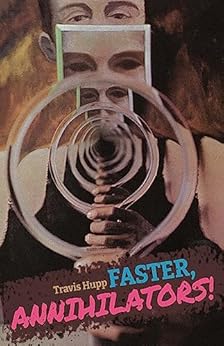

Faster, Annihilators! by Travis Hupp is a remarkable collection of poetry that eloquently portrays his journey of sexual awakening and his poignant experiences within the LGBT community, all during a time when same-sex marriage was yet to gain legal recognition in the United States. Spanning over a remarkable period of 24 years, from his high school years in 1996 to January 2023, the poems within this anthology form an unparalleled chronicle of his personal growth and societal evolution.
One of the compelling pieces in this collection is “Fact-proof,” a thought-provoking poem that boldly confronts narcissism and the rejection of complexity. In “Well,” Travis Hupp passionately expresses disagreement with another, skillfully depicting the emotional process of severance. “Dance Boy Dance Boy” brings to life the vibrant atmosphere of parties and encapsulates the essence of living in the present moment. Travis Hupp ingeniously navigates an array of themes, including drug addiction, auditory hallucinations, love, politics, governmental oppression, liberation, homophobia, racism, and numerous other thought-provoking subjects. The authenticity of his words is striking as he unabashedly lays bare his innermost emotions throughout the pages of Faster, Annihilators!
The poem “Die Trying” strikes a deep chord, as the author’s frustration becomes palpable through questions like “What exactly do you want from me?” and “Sacrifice my heart to your ego?” These introspective moments resonate profoundly, evoking relatable experiences within the reader’s own relationships. The infusion of first and second-person narratives, seemingly addressing specific individuals who served as inspiration, adds an intimate and sincere quality to the poetry. The brevity of most poems, often confined to one or two pages, invites a contemplative reading experience. This deliberate approach allows readers to fully immerse themselves in the abstract and concise yet emotionally charged verses. Some poems, deliberately enigmatic, are designed not merely for comprehension but to evoke intense emotions and encourage unconventional thinking, making the anthology especially appealing to the LGBTQ+ community and individuals with open minds.
Faster, Annihilators! is a literary offering that dares its readers to question societal norms and embrace a mind-bending and captivating journey. The poignant reflections on the hardships faced by homosexuals in a discriminatory environment are undeniably heart-wrenching. However, through his artful craft, Travis Hupp transforms these adversities into a beautiful and precious work that fosters tolerance, understanding, and love. It is a must-read for those who seek intellectual stimulation and a connection with the human experience.
Pages: 160 | ASIN: B0C8JZ2FF6



 LITERARY TITAN