Blog Archives
Metaphor for the Good Things

Altamara’s Gift follows a gifted southpaw who finds refuge in baseball as a child and whose adulthood is marred by the Vietnam War. What was the inspiration for the setup of your story?
I am a Vietnam veteran, and I never really cared for how vets were often depicted in films and on television. I wanted to write something that to me felt true and genuine. Most of the guys I served with were skinny 18- and 19-year-old kids thrown into a war they didn’t fully understand. Many were draftees just out of high school, and seemingly went from being the kid you sat next to in your English class, to young soldiers living like cavemen armed with automatic weapons. They missed their moms, girlfriends, and families. These valiant young men formed an unlikely and unshakeable brotherhood that allowed them to seemingly endure every hardship. However, they carried that war the rest of their lives. Combat is what I attempted to write about. There were long moments of boredom punctuated by seconds of sheer terror. They survived on letters from home, profane humor, their brotherhood, and, in Altamara’s case, memories of baseball.
I enlisted when I was 18 and served in the US Army from 1967-1971, spending most of my tours in combat units in the Central Highlands. Altamara’s Gift is the first part of a trilogy that follows many of the same cast of characters from age 18 and how they navigate life after they survive combat and try to return to normal lives.
Why did baseball feel like the right counterpoint to war — not just as subject matter, but as emotional language?
Baseball is simply a metaphor for the good things in life for Sergeant Lefty Altamara. Despite the fear, chaos, and death around him in Vietnam, Altamara always drifts back to baseball as his safe place.
Altamara is a paratrooper placed in charge of the recon platoon. However, his closest friendship is with the company medic Doc Hood, a former Duke Divinity student who failed to gain “conscientious objector status” and was drafted. They form an unlikely alliance trying to save the men of Delta-Double-Deuce.
Doc’s girlfriend, Kate, back home in North Carolina literally writes to him every day. She is the light and the hope of his life. However, Altamara gets very little mail from home except a weekly edition of the Sporting News (baseball), which he reads religiously. While the other men are resting and trying to stay out of the heat back at base camp after missions, Altamara has 5 worn baseballs that he fires repeatedly into sagging sandbags near their fortress. Baseball and the art of throwing them represent Lefty’s salvation.
I was an anchor, writer, and reporter for close to four decades, covering Major League Baseball for NBC, ESPN, and ABC. Baseball and what it represents to so many people all played an underlying theme in the novel.
Did you think of the book as partly about survivor’s guilt, or was redemption the deeper center?
The deeper center of the novel is about endurance. The core of the book is about the men and how they endure brutal conditions, the possibility of death, the loss of friends, and the hope and dream of returning home. The combat wears everyone down, but somehow, they still maintain a sense of humor. The expression they all use and say to each other is “WETSU.” An acronym that stands for “We Eat This Shit Up.” The men maintain a gallows sense of humor that they can take anything and everything that is thrown at them; you cannot grind them down.
If Altamara’s Gift leaves readers with one enduring image — whether a baseball, a battlefield, or something quieter — what image do you hope stays with them, and why?
My fondest wish is that the reader will come away with a greater understanding about the soldiers and nurses who served in Vietnam. Hopefully, the reader will cry a little, laugh a little, and gain a bit of understanding about the emotional baggage Vietnam veterans have carried around with them all their lives. The loss, the heartbreak, and the brotherhood. Perhaps Doc and Lefty represent the best of us.
Author Links: GoodReads | Facebook | John Gregg | Amazon
Altamara’s Gift


Altamara’s Gift follows Lefty Altamara, a damaged but gifted southpaw whose childhood refuge is baseball and whose adulthood is scorched by Vietnam. The novel moves between the diamond, the San Fernando Valley, the Battle of Hue, Delta Company Double-Deuce, and the lives of soldiers like Doc Hood and Tran Binh Trong, building a war story that is also about memory, loyalty, shame, tenderness, and the brutal search for redemption.
I was struck by how physical this book feels. Baseballs are not just baseballs; they have seams, age, smell, and a kind of private liturgy. War is not abstract either; it’s noise, rot, sweat, panic, gallows humor, and the terrible discipline of doing what must be done when the soul is trying to flee the body. The prose can be blunt and profane, but it also has surprising pockets of lyricism, especially when it turns toward gardens, rivers, music, or the clean geometry of a thrown ball.
I liked the novel’s refusal to make bravery simple. Lefty is heroic, but not polished; Hood is gentle, but not weak; even enemy soldiers are allowed fear, poetry, and longing. The book is capacious, sometimes sprawling, and that sprawl gives it the feeling of an oral history told by someone who cannot separate the jokes from the corpses or the love stories from the firefights. I found that messy abundance moving because trauma rarely arrives in neat chapters.
One other thing I liked was the book’s sense of texture. The way it lets ordinary objects carry emotional weight. A baseball glove, a scarred weapon, a garden, a Vespa, a letter from home, even the smell of gun oil or tomato plants can suddenly become charged with memory. That attention to tactile detail makes the story feel authentic, and it gives the violent scenes a stronger contrast because the world outside the war still feels vivid, specific, and worth saving.
This book is best suited for readers of Vietnam War historical fiction, military fiction, baseball fiction, literary war fiction, and stories about brotherhood, PTSD, and redemption. Fans of Tim O’Brien’s The Things They Carried may appreciate the way this novel blends battlefield horror with memory, absurdity, and aching human detail, while readers of W.P. Kinsella may recognize the almost sacramental treatment of baseball. Altamara’s Gift is a bruising, big-hearted novel about the men who come home from war carrying more than anyone can see.
Pages: 305 | ASIN : B0DYLJSZ8P

Life-Long Impact

The Legacy of the Twins Platoon follows a group of young Minnesotans who enlist as Marines in 1967 and find themselves facing some of the most horrific battles of the Vietnam War. Where did the inspiration for this novel come from?
It was my calling. But due to the perceived difficulty of writing a book about 150 Marines and their experiences, it took 6 years before I set out to do what seemed to me to be an overwhelming task.
What draws you to this period in US history?
I am drawn to this period in history because it is unforgettable and is forever etched into memory. To have experienced and witnessed how the Vietnam War forever changed the lives of those who served in the military, and the life-long impact it had on their families and loved ones, is something I felt compelled to write about.
Can we look forward to more work from you soon? What are you currently working on?
My focus now is to bring awareness to the book, so that the life experiences of those I have written about can benefit other people. At a time when new books are like a “blizzard in a snowstorm,” my challenge now is to weather the storm.
Author Links: GoodReads | Facebook | YouTube | Website | The Legacy of the Twins Platoon | Amazon
They were sworn in on television at a pregame ceremony and were guests of the Twins at the game. By the end of the fourth inning, the recruits were hustled to buses whisking them to the Wold-Chamberlain Field Airport, and they flew to San Diego. Before dawn the next day, the Twins Platoon met their drill sergeants at the receiving barracks of the Marine Corps Recruit Depot. By the end of the year, the Marines were in Vietnam sprinkled across the length and breadth of the Marine Corps operating areas of I Corps, the northernmost part of South Vietnam where they experienced some of the toughest combat of the war. Khe Sanh and Hue City were just a few of the hot spots they encountered as the 1968 TET Offensive rolled across the country. Not all members of the Twins Platoon came home in one piece. Some did not come home at all. In The Legacy of the Twins Platoon, author Christy Sauro Jr. tells their complete stories from baseball to combat and their lifelong readjustment to civilian life.
The Legacy of the Twins Platoon

The Legacy of the Twins Platoon follows a group of young Minnesotans who enlist together in the Marine Corps at a Minnesota Twins game in 1967 and then get swept into some of the hardest fighting of the Vietnam War, from Khe Sanh and Hue City to Dai Do and the DMZ. The book is split into life before Vietnam, brutal combat tours in-country, and the long shadow of the war afterward, including PTSD, broken marriages, suicides, and quiet acts of resilience that play out over decades. Author Christy Sauro Jr writes as one of them and tracks down the stories of his fellow Marines and their families, so the story stretches from their teenage years to their later lives as aging veterans who still carry the weight of what happened. It ends up as both a unit history and a long, painful look at what the war did to a particular slice of America.
I found the book to be surprisingly intimate and straightforward. Sauro’s style is plainspoken and very visual, and he leans on short scenes and dialogue rather than high drama. The boot camp sections and early combat chapters move fast and feel almost like you are standing on the yellow footprints, getting barked at, then shoved into the red mud around Khe Sanh and Dai Do. The moment when Wallace “Skip” Schmidt describes the rifle being shot out of his hands and then whispers that everyone he knows is dead hit me in the gut, because Sauro lets the scene sit there with minimal commentary. Sometimes the level of detail can feel overwhelming, with name after name and battle after battle, and I caught myself having to flip back to remember who was who. That said, the repetition also mirrors what he is trying to show: a grinding series of patrols, firefights, and losses that blur together for the men who lived it. It is not a sleek literary war memoir, and I ended up liking that roughness, because it feels honest to the world he is describing.
What stayed with me even more than the combat was the moral and emotional through-line. Sauro is obsessed with what the country asked of these teenagers and what it gave them back in return. The homecoming scenes are almost harder to read than the firefights. Larry Jones getting smashed in the face with a beer bottle in a bar, then realizing that everyone is staring at him like he is the problem, not the guy who hit him, made me angry in a very immediate way. The chapters on PTSD and suicide are bleak and careful at the same time. Sauro walks through how men like Schmidt fell apart in the years after the war and how the term “post-traumatic stress disorder” arrived too late to help some of them or their families. The big idea here is not just that war is hell, which we all know in the abstract, but that the real cost keeps showing up in family kitchens and quiet Midwestern streets long after the shooting stops. I could feel his frustration with how slowly institutions moved and how much of the heavy lifting fell on spouses, siblings, and parents who were trying to understand what had happened to their sons.
I would recommend The Legacy of the Twins Platoon to readers of military history who want something rooted in lived experience rather than strategy charts, to younger people who have only heard the Vietnam War reduced to slogans, and to policymakers and professionals who work with veterans today. The book does exactly what a legacy should do. It keeps these Marines and their families from being reduced to a line in a textbook, and it holds up both their courage and their pain in a way that is hard to shake.
Pages: 410 | ISBN : 978-1663271556
Nothing So Broken
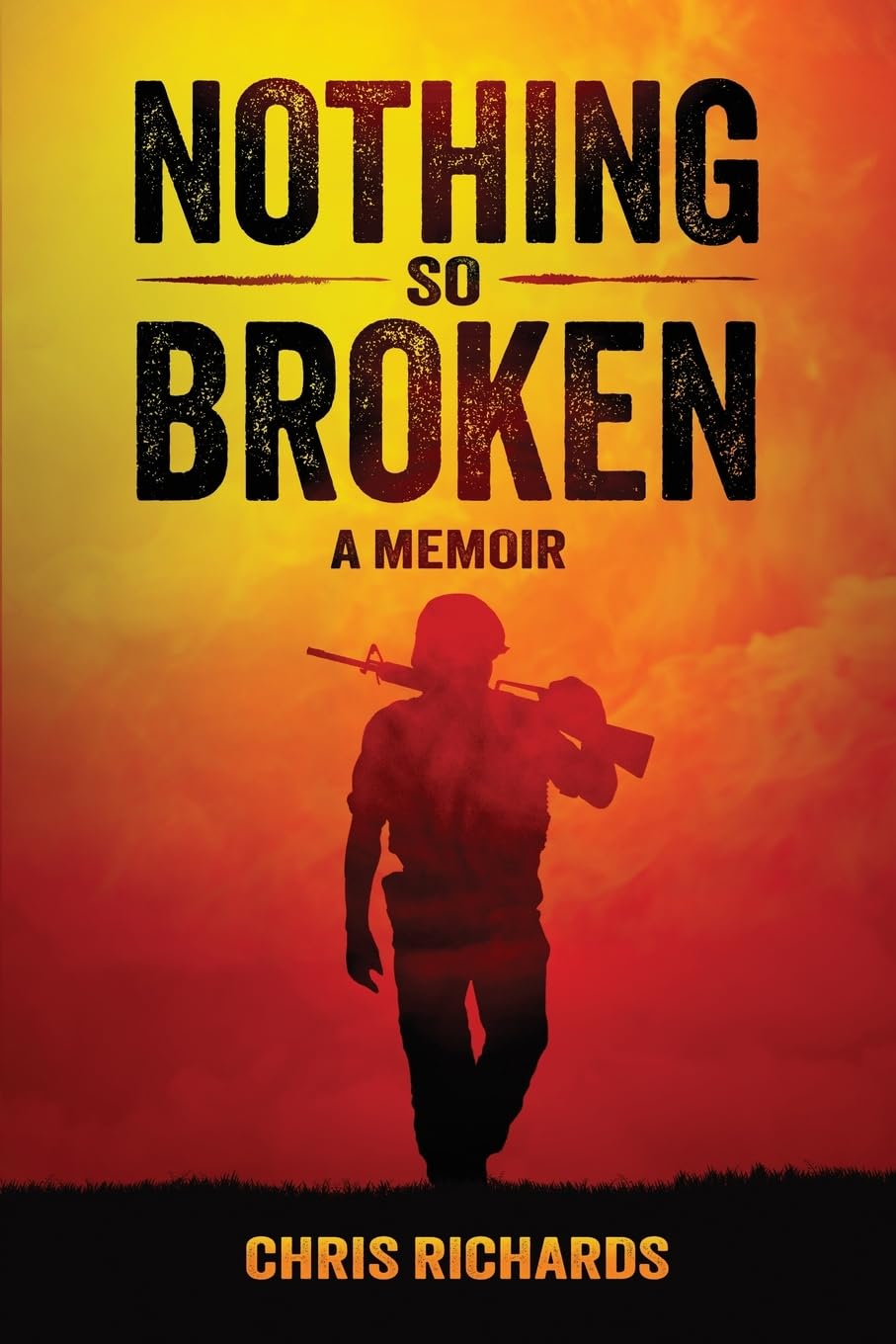
Chris Richards’s Nothing So Broken is a heartfelt memoir that weaves together family, friendship, and the long shadows cast by war. It’s told through a lens that shifts between generations, the Vietnam experiences of Richards’s father, and the tangled, messy journey of growing up in small-town America. The book captures what it means to inherit pain without ever being in the war yourself. It’s not just a story about Vietnam or divorce or youth; it’s about how those things mix together to shape who we become. Richards writes with a storyteller’s rhythm, turning memory into something vivid and cinematic, but also deeply personal.
The writing feels alive, sharp and tender at once. The way Richards talks about fathers and sons, love and loss, is both funny and painful. Some scenes had me smiling because they reminded me of my own childhood, while others just sat heavy in my chest for hours afterward. The tone is conversational, like he’s sitting across from you with a beer, just telling you how it all went down. The shifts between boyhood memories and reflections on his father’s war experiences work beautifully. They pull you into the idea that trauma doesn’t stop at the person who lived it. It seeps into the next life, quiet and steady. His language is simple, but it hits deep, no fluff, just truth.
The family stuff, especially the divorce and the father’s illness, his a deep emotional chord. But I loved that honesty. Richards doesn’t clean up the mess or try to make anyone a hero. Everyone is human, flawed, and trying their best. That’s what makes the book work. The emotional range, grief, humor, confusion, hope, feels real because life feels like that. He captures that strange middle ground between heartbreak and gratitude, and it made me feel like I knew these people, like I’d grown up right next door.
If you’ve ever wondered what it’s like to live with the echo of someone else’s war or if you just like stories about complicated families and growing up, this one’s for you. I’d recommend Nothing So Broken to anyone who appreciates honest, character-driven stories that don’t sugarcoat real life.
Pages: 201 | ASIN : B0FCSHMDMW

I Was a Hero Once


Peter Mahoney’s memoir, I Was a Hero Once, offers a deep reflection on a life shaped by extraordinary experiences and the search for meaning. A Vietnam veteran and activist with Vietnam Veterans Against War (VVAW), Mahoney recounts his journey from an 18-year-old college dropout to an infantry lieutenant deployed to Vietnam. His military service was defined by duty and routine, but his return to the U.S. ignited a deeper battle for justice through activism.
The memoir delves into Mahoney’s later years, including his participation in a veterans’ delegation to meet Soviet soldiers, where he fell in love with and married a Russian woman. He spent nearly a decade raising a family in Russia, only to return to the suburban life he had once sought to escape. Mahoney weaves these extraordinary events with the “ordinary” moments that define his humanity, creating a rich narrative that balances adventure with introspection.
Mahoney recounts his adventures while reflecting on the ordinary moments that underpin them. His candid approach underscores a central theme: life is not solely defined by its extraordinary chapters but by the connections between them. While this narrative style enhances the memoir with depth and detail, some sections could benefit from more concise storytelling, as they occasionally lean toward repetition or feel loosely structured. Yet, Mahoney’s compelling voice and ability to ground the extraordinary in relatable human struggles ensure the reader remains engaged. The memoir resonates deeply because it captures the universality of Mahoney’s quest for purpose and morality amidst a life filled with rare experiences. His heartfelt prose offers a vivid window into both the external events and internal conflicts that have shaped him.
I Was a Hero Once is a powerful and introspective memoir that captures the complexity of a life filled with extraordinary moments and grounded in universal struggles. Mahoney’s ability to intertwine his grand adventures with the quiet realities of everyday existence creates a narrative that is both engaging and human. This is a must-read for those interested in personal stories of resilience, transformation, and the quest for meaning.
Pages: 299 | ASIN : B0D9HST1PM
Confront The Truth

The Saigon Guns shares facts about the final year of US combat operations in South Vietnam from the perspective of someone who was actually there. Why was this an important book for you to write?
This is a history that has not been told. Most people think the US Army involvement in South Vietnam ended in mid-June of 1972. Actually, some of the most intense combat that year for the US Army forces was after June. The US Army Greenbook, which is the official history of the US Army even perpetuates this myth today. A consequence of the lies about 1972 US Army operations was that the military records for those of us there at that time went missing. This plagued me for the rest of my career, as it did for many others, and almost denied me VA benefits. Only recently has the National Archives allowed access to some of these records.
When I attended the US Army War College in 1994, I heard seminar instructors explain that no US Army forces conducted combat operations, only local unit defense, after June of 1972. I pointed out that this was not true. I was asked on what basis I could say that. I explained I was there and that the US Army units still in-country were seriously taking the fight to the North Vietnamese and the Soviets well into December of 1972. The seminar leader was incredulous. He suggested I write a paper, which I did. Never saw that paper again, and it was not to be published.
President Nixon stated that he had pulled out all combat troops of Vietnam in June of 1972 as a re-election ploy, despite the fact that he did not. But no one wanted to confront the truth. After we were actually out of Vietnam as the result of the peace treaty, President Nixon and Congress had no appetite to re-engage even in the face of the massive North Vietnamese violation of that very treaty in 1975.
The Vietnam War is one of those moments in history that is glossed over in textbooks or outright ignored. Your book sheds light on the facts and uncovers the uncomfortable truth of the situation. I appreciated the candid nature with which you told your story and those who were stationed in Vietnam. What was the hardest thing for you to write about?
I suspect that most combat veterans have the hardest time dealing with “survivor guilt.” As a consequence, it was most difficult for me to write about the loss of friends in combat. For the rest of your life, you wonder, “Why them and not me?” But I also found that writing about specific combat actions or engagements sometimes became a bit too intense for me, and I would simply stop and take a break. Then I found that on many occasions it was hard to pick the narrative back up and continue. It might take hours, a week, or even a month to do that sometimes. Of course, then there was research I needed to try and make the narrative as accurate as I could. This took time. My wife and I even traveled to the National Archives in Maryland to research records. Though what we found was scant few records of use for this period of the war. I also reached out to fellow unit members that I served with in Vietnam to pick at their memories and personnel records to fill out details. That is why it took me several years to write this book.
What is a common misconception you feel people have about the Vietnam War and the military forces that were sent there?
The main misconception, now fostered in many high-school textbooks, is that the Vietnam War was an illegal war. This is, of course, the same line that anti-war groups, often assisted by the Soviet-operated World Peace Counsel, publicized to support their anti-war efforts. The truth is that the war was started by the North Vietnamese for two purposes. One was certainly to unify the country under Communist control. The other, less clear reason, was that the Soviets wanted a “warm water’ port on the South China Sea. The Soviets wanted this port because it provided them an all-weather power projection base against the American Pacific Fleet and against the Chinese, with whom they were in direct conflict in the 1960s and 1970s. The US turned down a request by Ho Chi Minh to assist them in unifying the country by force in the early 1960’s. The US refused to assist him with a takeover by force of arms. Additionally, the US had an air base in South Vietnam in Da Hang that was strategic to our defenses against the rising power of the Soviets. So, when the effort to overthrow the government in South Vietnam was begun by the North Vietnamese, supported by the Russians, we sided with the South Vietnamese on the basis that it was illegal for one country to take over another peaceful country by force of arms. It is also interesting to note that most Americans, again as the result of Soviet propaganda and, to a certain degree, the interests of opposing political parties in the United States, were told that we were only fighting poor Vietnamese peasants and the North Vietnamese were simply assisting them. The truth was that the North Vietnamese were who we were primarily fighting and who made up the bulk of what we refer to as the VC or Viet Cong irregular forces. By 1972, with the major North Vietnamese invasion of South Vietnam with conventional armored forces, entire Soviet military units were committed to the way and were engaged against US forces. Today there is a Russian Vietnam Veterans organization!
What is one thing you hope readers take away from your story?
The truth about the war and what those of us who served there tried to do for America and for the poor South Vietnamese is what I hope readers take away from my book. Remember that millions of people died in Southeast Asia upon our pullout of forces and our refusal, after the Spring of 1973, to provide support to the South Vietnamese.
There is an old joke among my contemporaries about that war. We were winning when we left. This was quite true. In the space of 8 months in 1972, four US Army Cavalry troops, the US Air Force, and the US Navy, with an assortment of American military advisors with various South Vietnamese Army and Marine units, wiped out five divisions of North Vietnamese and Soviet armor. This was not old, obsolete Russian Armor from World War II but then state-of-the-art Soviet military hardware. Yet the North Vietnamese offensive combat power was destroyed to the point that the North lacked the capability to continue the war when the Peace Treaty in Paris was signed.
It took the North Vietnamese, and their Soviet supporters two and a half years to rebuild the North Vietnamese offensive combat power and then conquer South Vietnam. With our complete pullout and refusal to provide help to the region, panic set in across all the nearby countries, and dictators and thugs, backed by the Soviets and the North Vietnamese, seized power in Cambodia and Laos. Estimates for the loss of life over the four years following our complete withdrawal and the fall of South Vietnam in these three countries alone run as high as 10 million people! And, to this day, the propaganda of the Soviets and of the anti-war movement here still denies these facts and the reality of that war. We see the same approach to war in Ukraine today, along with the same use of propaganda and ruthless war on a civilian population. The “just war” concept has no place in the Russian way of war. It was so in Vietnam, and it is so in Ukraine. So yes, there are lessons, and they start with recognizing and accepting the truth of what is actually happening.
Author Links: GoodReads | Facebook | Website | Amazon
The remaining US aviation forces, along with the US Air Force and US Navy and Marine aviation assets, would not be easily removed from the battle. For the US forces still in-country, this is an untold story of heroism, dedication, and refusal to yield the battlefield despite being largely considered by US political leaders as “expendable.”


