Blog Archives
Rise in Courage

In Aimed & Ready, you emphasize that the seasons of delay, silence, loss, and backward movement can actually be forms of divine preparation. Why was this an important book for you to write?
I wrote this book to address a need I kept seeing in people’s lives. Many Christians know how to celebrate seasons of success, blessing, and prosperity, but often lack a framework for navigating hardship, uncertainty, delay, and disappointment. Over the past six months, this burden grew strongly in my heart, and I felt compelled to put into words the hope and perspective people need during difficult seasons.
The core message of the book is that when life doesn’t make sense, there is still purpose, hope, and destiny available when we choose to trust God and surrender our struggles to Him. Rather than seeing trials as endings, I want readers to recognize that something beautiful may be forming just beyond the present challenge.
I also wanted to provide prophetic encouragement by exploring the emotions people experience in seasons of stretching, waiting, discomfort, and shaking. The book not only acknowledges those feelings but also offers insight into why we experience them and how we can respond in faith.
One of the key metaphors I use is that of an archer pulling back an arrow. The Archer’s aim is never careless. Although the pressure of being pulled back can feel intense, it is actually preparation for forward movement. In the same way, I believe God often uses seasons of tension to position us for growth, blessing, and His greater purpose.
Ultimately, the book challenges readers to rise in courage, break limiting mindsets, and step confidently into God’s calling. I want people to understand that their trials can transform them and become a powerful testimony of God’s faithfulness.
When did the bow-and-arrow metaphor first come to you, and why did it feel central?
The book really began with one simple thought: your pullback is a setup for your comeback. That idea immediately gave me the picture of an archer with a bow fully drawn back. What feels like strain is often actually alignment, and what looks like a setback may be God positioning you for greater impact.
In a world where many people feel like targets, I wanted to remind readers that God didn’t create them to be victims of circumstance—He crafted them to be the arrow. Sometimes the pullback isn’t the end of the story; it’s the beginning of something greater. That’s why the bow-and-arrow metaphor felt so powerful and fitting for this message.
A major theme in the book is surrender. In God’s Kingdom, surrender is never defeat. In His hands, surrender becomes strength, stability, and precision. It allows your life to go farther than human effort alone ever could. Many people think surrender means losing control or identity, but I believe the opposite is true—it places your life in the hands of Someone who knows you completely and sees further than you can see.
Just as an archer never draws back an arrow without intention, God never allows seasons of waiting, silence, or tension without purpose. He sees the obstacles, opportunities, and timing that we often cannot. Sometimes what feels like delay is really a divine reset to align our trajectory with His greater vision.
Ultimately, the message of the book is that every arrow finds its meaning when it yields to the Archer. When we surrender to God, our lives can move with greater clarity, purpose, and precision toward the calling He has set before us. This book, along with its devotional workbook, is designed to help readers grow stronger in the tension, realign with Heaven’s purpose, and step confidently into their God-given destiny.
How can readers tell the difference between spiritual stillness and spiritual distance?
One of the key messages I wanted to communicate is that trust in God must always be the foundation of faith. There are seasons when God can feel distant, but often that sense of distance comes because something is clouding our perspective, or because the answer we’re looking for is not yet visible. It doesn’t mean God has moved away.
I also talk about stillness, because stillness is not the absence of God. I describe it as a holy hush—an intentional choice to silence the noise around us so we can hear, see, and discern what God is doing in that moment. Rather than being empty, stillness can become a place of deep intimacy with Him.
When people feel distance from God, they often assume He is far away or hard to reach. But that is never His heart. God desires closeness and a relationship with His people. Scripture asks, What can separate us from the love of God? and the answer is clear: nothing.
So any feeling of separation is not a truth we should accept, but often a perception shaped by fear, disappointment, or misunderstanding. The reality is that God remains near, loving, and fully present—even in the quiet seasons. My hope is that readers come to see silence not as abandonment, but as an invitation into deeper trust and intimacy with Him.
How do you respond to readers who feel that their pain has no visible outcome?
One of the important truths I explore in the book is that while difficult seasons can feel confusing and unclear, we must be careful not to let that drift into fatalism or hopelessness. Just because we cannot see the outcome doesn’t mean there is no purpose or direction. Often, it simply means the perspective belongs to Someone greater than us. As I say in the book, the archer sees what the arrow cannot yet perceive.
That perspective changes how we view our battles. What looks like an obstacle may actually be the very thing God uses to launch us into what He has already prepared. Your Goliath may not be there to destroy you—it may be the catapult into your next season of purpose and victory. That’s why I encourage readers not to be afraid, but to trust God completely, because true breakthrough happens when His power is behind what He has placed in your hand.
My prayer is that this book would saturate people with faith and hope, bring their hearts into alignment with God, and strengthen their confidence in His purpose. If someone is in a season of waiting, stretching, or feeling hidden, I believe this message can be a real lifeline. It is designed to help readers rest again, realign with God’s perspective, and trust His heart in a fresh way.
Author Links: GoodReads | X (Twitter) | Facebook | Website | Nico Smit | Amazon
With prophetic insight and pastoral clarity, Nico Smit reframes seasons of tension, delay, and apparent retreat-not as disqualification, but as divine preparation. Drawing from a powerful vision of a bow drawn tight and an arrow held under pressure, ‘Aimed & Ready’ reveals a profound truth: what feels like strain is often alignment, and what looks like setback may be God positioning you for greater impact.
This powerful cutting-edge prophetic book speaks to those who feel buried, forgotten, or off-track, reminding them that God does not waste His arrows. The pullback is not punishment-it is precision. The pressure is not abandonment-it is proof of purpose.
With prophetic revelation, biblical insight, and hope-filled exhortation, these pages restore faith for the waiting, courage for the weary, and vision for those standing between promise and fulfillment.
You are not retreating. You are being aligned, sharpened, and prepared. ‘Aimed & Ready’ will restore your perspective and strengthen your faith.
Will you let God aim you?
If your answer is yes, your comeback has already begun.
FOREWORD by Stacey Campbell
This book also has a Devotional Workbook available on Amazon.
Professional Endorsements by: Gary Heyes, Ryan Laubscher, Chelsea Hagen, Elaine Tavolacci, Joshua Sawiris, Ada Boland and Melvain Donyes
Aimed & Ready
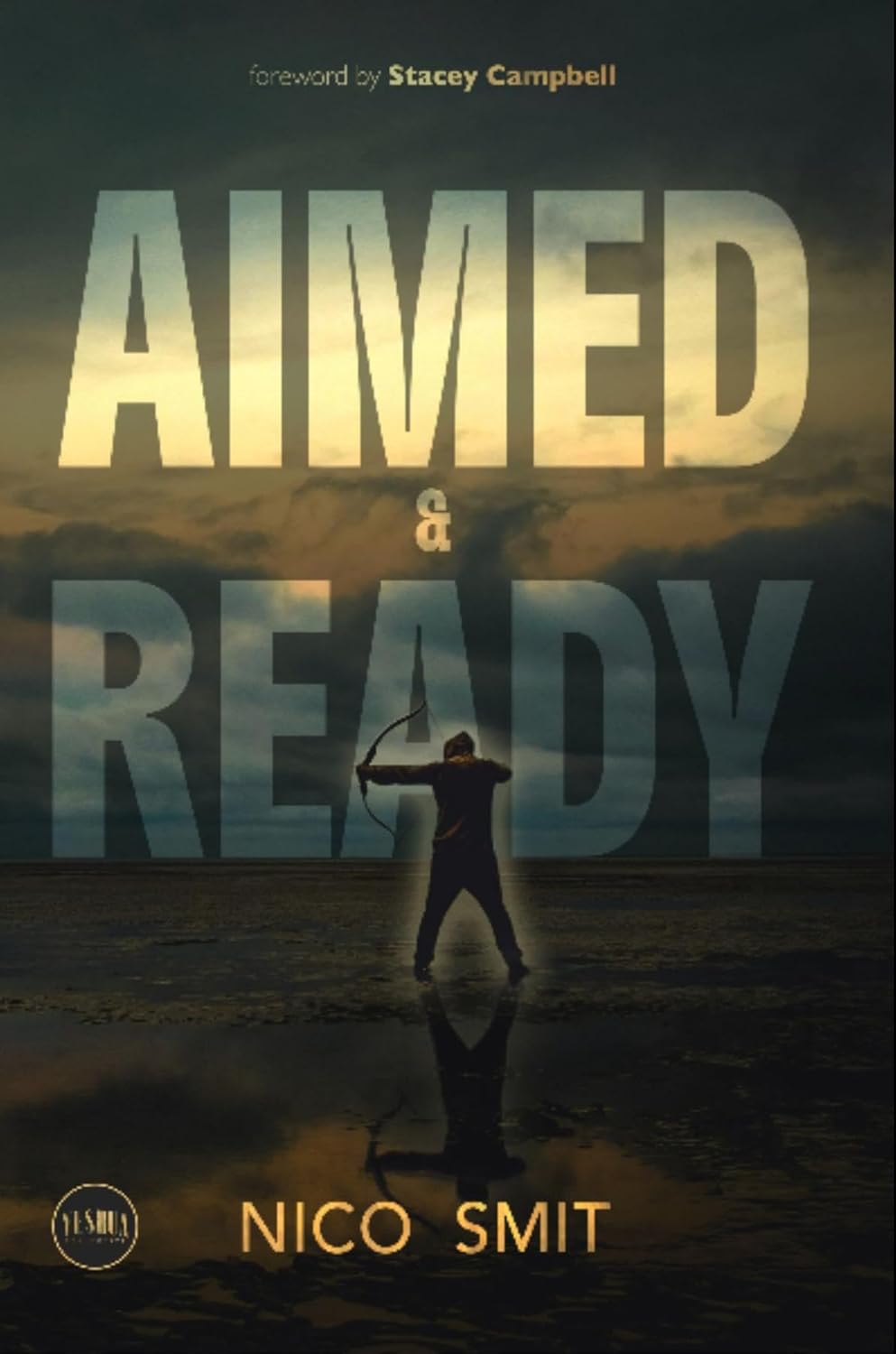

I found Aimed & Ready to be a spiritually focused book about how seasons of delay, silence, loss, and apparent backward movement can actually be forms of divine preparation. Author Nico Smit’s central image is the bow and arrow: the life that feels pulled back is not abandoned, but being aimed. From there, he builds a sustained meditation on surrender, waiting, spiritual alignment, and eventual release, moving through ideas like the “holy hush,” the reset that becomes a re-aim, David’s devastation at Ziklag, and the insistence that hope is not sentimental optimism but evidence that God is still at work. It’s a book written for readers who feel stalled and bruised, and it keeps returning to the same steady conviction that what looks like burial may be the first stage of resurrection.
What stayed with me most was the emotional steadiness of the book. Smit writes with the urgency of a preacher, but also with a pastoral tenderness that keeps the message from feeling harsh or abstract. I liked the way he lingers over images until they start to feel lived in. The bare fruit tree, the buried seed, the rowers facing one way while still moving forward, the ruined city of Ziklag, all of it feeds the same argument from slightly different angles, and that repetition gives the book a kind of devotional pulse. At its best, the writing has real lift. There are passages that feel genuinely bracing, especially when he reframes pressure as alignment and refuses the easy language of defeat. I also appreciated that he opens by reminding readers that this book is not Scripture and shouldn’t replace Scripture. That note of humility matters, and it gives the book a better spiritual proportion than it might otherwise have had.
Smit is so committed to the pullback/comeback framework that nearly everything gets absorbed into it. For readers already attuned to prophetic Christian language, that will probably feel clarifying and consoling. I admired the conviction. The prose can also swell into exhortation. Still, even when I felt the book pressing too insistently on one note, I couldn’t deny the sincerity behind it. Smit clearly believes these ideas down to the bone, and that kind of belief gives the book warmth, gravity, and a persuasive emotional center.
The book gives discouragement a shape people can actually work with. Smit turns spiritual exhaustion into something legible through the bow-and-arrow metaphor, the “holy hush,” and the Ziklag section, so a reader in a hard season can feel less lost inside their own experience. A lot of encouraging books tell you to hold on, but this one tries to explain what holding on feels like from the inside. I think that interpretive quality is one of its real strengths.
I found Aimed & Ready earnest, vivid, and often moving. It’s a book that wants to steady the heart, reframe suffering, and call the reader back into trust. I’d especially recommend it to Christians who are living through a season of disappointment, transition, spiritual fatigue, or long waiting, and to readers who respond to devotional writing that leans on metaphor, exhortation, and hope. For the right reader, this will feel less like a lecture than a hand at the shoulder, firm, warm, and convinced that the story isn’t over yet.
Pages: 168 | ASIN : B0GK9NMGRY

Suffering Leads to Hope


James Velissaris’s Suffering Leads to Hope is part prison memoir, part devotional theology, and part spiritual self-audit. It traces a deliberate movement from denial, anger, bitterness, and surrender into repentance, humility, forgiveness, sanctification, faith, peace, freedom, and finally hope, love, joy, and glorification. What gives the book its shape is not just Romans 5:3-4 as a governing text, but the author’s insistence that suffering can become a furnace of transformation rather than a dead end. He writes out of corporate fraud, prison, family grief, divorce, childhood abuse, addiction, and the death of his stepfather, and he keeps returning to the same hard-won claim: pain doesn’t become meaningful by shrinking, only by being faced and yielded.
Velissaris is at his strongest when he lets the argument rise naturally out of lived moments: arriving at MDC Brooklyn in a fitted navy suit still half-believing the ordeal is temporary, watching Catracho drift through prison in a haze of deuce and longing for the daughter he can’t bear to see, or witnessing Abu lose what might have been his way home in a single eruption of anger. Those scenes have real force because they aren’t presented as sermon illustrations first. They feel observed, inhabited, and earned. I also found myself drawn to the way he describes interior states. His account of denial as “the mind’s final illusion of control” has a stark clarity to it, and the book is often most persuasive when it sounds wounded, chastened, and unsparing toward the self. The writing can be genuinely vivid, sometimes almost lyrical, especially when he slows down and trusts image, memory, and rhythm to do the work.
The book’s ideas are earnest and often moving. Velissaris wants to make every affliction legible inside a Christian framework. When he’s wrestling with bitterness, forgiveness, or the slow discipline of service, I felt the texture of genuine struggle. When he shifts into more explanatory, doctrinal passages, especially where he presses psychological or social analysis into firm theological conclusions, the prose can harden and the complexity thins out. Still, even there, I respected the seriousness of his attempt. He is not writing from a safe distance, and that matters. The sections on repentance, discipleship, and joy are most convincing when they show that transformation is not clean, triumphant, or instant, but repetitive, humiliating, and daily. I appreciated, too, that the book does not confuse joy with cheerfulness. Its better insight is sadder and truer: grief remains, but it is no longer sovereign.
I found Suffering Leads to Hope sincere and often affecting. It’s a book written by someone trying to tell the truth about what broke him and what he believes remade him, and that gives it a gravity that polished self-help books rarely have. I never doubted the depth of conviction behind the book. I’d recommend it most to Christian readers who are living through loss, guilt, addiction, or long seasons of unanswered prayer, and to anyone interested in spiritual memoirs. It’s a book for readers who don’t need suffering explained away, but do want to see what it looks like when someone tries, stubbornly and imperfectly, to wrestle it into meaning.
Pages: 223 | ASIN : B0GQHT9J1R
Joe Gross is Dead

Helen DeBell’s Joe Gross Is Dead is a raw and deeply personal memoir chronicling her battle with depression, bullying, and self-worth, and how her life was radically transformed through her faith in Jesus Christ. Growing up as the youngest child in a large Iowa farm family, DeBell weaves memories of her loving home life with the intense isolation and cruelty she experienced from peers. The nickname “Joe Gross,” cruelly given to her in high school, became a symbol of deep shame and self-loathing. But over the course of her story, we witness a spiritual awakening. DeBell shares how the voice of God intervened in her darkest moments, eventually leading her to a life of purpose, joy, and ministry. Her journey from the pain of near-suicide to becoming a mother, writer, and Christian leader is both heartbreaking and inspiring.
Reading this book was like stepping into someone’s diary and watching the pages of hurt slowly turn into a hymn. What struck me most was Helen’s ability to balance poetic honesty with gritty memories that don’t sugarcoat anything. The way she describes the moment she nearly took her own life felt like time stopped. Her writing is simple but full of emotion. It never felt distant or rehearsed. She made me feel like I was there beside her, in her childhood barn, in her quiet heartbreak, and later, in her healing. I admired her strength in exposing wounds that many people would rather forget. There’s something rare and brave about the way she holds nothing back.
But what really moved me wasn’t just the pain. It was the change. The book doesn’t just say “things got better.” It shows it. Her love story with Randy, her discovery of worship music, and the moment she gave her life to Christ, those pages glowed. You can sense her joy, not just in the words but in the way she lifts the weight off the story. There’s a powerful beauty in the way she reclaims the insult “Joe Gross” and turns it into “Jehovah’s Gardener.” It’s rare to read something that feels so personal and still leaves space for the reader to reflect on their own story.
Joe Gross Is Dead is for anyone who has ever felt invisible or broken, for anyone who’s been labeled and left out. It’s especially meaningful for people of faith or those curious about finding hope in God during deep pain. This isn’t a perfect, polished redemption arc, it’s a real one. I wouldn’t call it light reading, but I would call it necessary. If you’ve ever needed proof that people can come back from the edge and find life again, this book is it.
Pages: 42 | ASIN : B0F7C9F4BM
Re-Imagining Contentment: Living Life from God’s Perspective

ReShone L. Moore’s Re-Imagining Contentment is a heartfelt roadmap to finding peace amid life’s hardships. Blending scriptural wisdom with her lived experience of chronic illness, Moore guides readers through a seven-step journey toward contentment, defined not by worldly measures but by spiritual alignment with God’s will. From the metaphor of the Potter in Jeremiah to her own battle with multiple sclerosis, Moore illustrates how surrender, trust, and reflection are vital tools for emotional and spiritual healing.
I found Moore’s writing both intimate and grounding. She doesn’t sugarcoat the reality of pain—physical, emotional, or spiritual. Her vulnerability in the “Prologue,” where she recounts her diagnosis and the day she experienced “foot drop,” is raw and powerful. But rather than wallow, she transforms this pain into purpose. In Chapter 1, “The Potter,” she reflects on how disobedience and striving without God led her to discontent, and how returning to the Creator reframed her view. The metaphor is simple yet effective: God, as the potter, molds us, mess and all. It’s a reminder that even in brokenness, we are in divine hands.
What struck me most was Moore’s pushback against the notion that contentment equals complacency. Her step-by-step breakdown, especially in chapters like “Step #1 – Reflect” and “Step #2 – Reject,” teaches that being content doesn’t mean giving up dreams—it means releasing the burden of control. She writes about surrender not as defeat, but as “a position of power and peace.” Her honesty when describing letting go of her beloved high heels—a small but symbolic act—was strangely emotional for me. I saw in that moment the thousands of compromises we all make with grief, and how dignity can survive change.
Chapter 7, Concluding with a Plan (Repeat When Needed), brings the journey full circle by reinforcing the idea that contentment isn’t a destination—it’s a continual process. Dr. Moore reminds readers that the seven steps outlined in the book are not one-time fixes but tools to be revisited as life unfolds. She encourages becoming a “lifelong learner,” emphasizing the importance of spiritual growth, reflection, and renewal. This chapter feels like a gentle nudge to stay the course, no matter how many times we stumble.
I’d recommend this book to anyone struggling with transition, loss, or burnout, particularly those whose faith is part of their healing journey. It’s not a self-help book in the traditional sense; it’s more like a long, healing letter from someone who’s been through it and found the light anyway. Moore writes with soul, spirit, and strength. Her journey through MS becomes a ministry of encouragement for the rest of us. This book helped me breathe deeper, think wider, and pray more honestly.
Pages: 132 | ASIN : B0DW4H8XL8
You Are 100% Unique

Purpose Made: 12 Steps to Discovering Your God-given Purpose and Living an Abundant Life is a thought-provoking book that takes readers on a journey of introspection and self-discovery. Why was this an important book for you to write?
I think most people would agree that we are living in a broken and hurting world. We are constantly bombarded with negativity – through the news, devastating weather events, personal challenges and tragedies. It’s easy to get disillusioned with life and wonder what’s it all for? There has never been a more important time to talk about, and live out, our ‘purpose’. Once you can discover the purpose that is already inside of you, your life will begin to make sense amid the chaos in the world around you. You will become outward-focused and have direction. ‘Purpose Made’ has been written for right now, at at time when people need it the most.
What were some ideas that were important for you to share in this book?
That you are 100% unique. There is no-one else on this planet with your set of talents, gifts, passions, loves, fire and assignments. You have been created by a loving God for a reason – a one-of-a-kind purpose that no-one else can contribute to the world. That this purpose was predestined before you were born and is waiting for you to discover what it is, and then move forward with a renewed confidence in yourself, in life, and in God. Working through ‘Purpose Made’ will bring you a sense of hope and excitement, and an understanding of why you are incredibly special.
What were some goals you set for yourself as a writer in this book?
When I write a book I keep writing until I feel the book is complete. There are no timelines or deadlines, but I know when it’s done. May aim, with ‘Purpose Made’ was to bring both a holistic and Biblical view to the topic of ‘purpose’. We often read books about gifts, or goals or self-discovery, which are great but are only components of the whole picture. ‘Purpose Made’ takes all of the many facets of purpose and weaves them together in one place, and looks at purpose through God’s eyes, using Biblical scripture as anchor points.
What is one thing that you hope the readers take away from Purpose Made?
A sense of relief. I wrote, in ‘Purpose Made’, about a study that was done to determine the best emotion, which was voted to be ‘relief’. Relief could be what it feels like when you finally get clarity on God’s purpose for your life. Or, when you start to strip away limiting mindsets and begin to move in new-found freedom. Relief could also be when you finally see yourself as God sees you – strong, amazing, loved and created for a reason.
Author Links: Website | YouTube | Instagram
Did you know that you are special? You are unique.
There is no one on this great, big, beautiful planet like you. In all eternity, there has never been another person with your unique DNA; your set of experiences; and your combination of gifts, talents and passions.
Did you also know that God knew exactly the circumstances you would be born into, the people you would grow up with, go to school with, socialise and work with? Your place in time is no accident.
You have been created to make a never-seen-before (and never-to-be-seen-again) contribution to this world – your world. But what if you don’t know your gifts or purpose? This book will give you a 12-step guide to help you sort through your unknowns, doubts and past and help you see yourself as God sees you – an incredible person He created on purpose and for a purpose.
That’s you, purpose made.
Purpose Made: 12 steps to discovering your God-given purpose and living an abundant life

In Purpose Made: 12 Steps to Discovering Your God-given Purpose and Living an Abundant Life, Sarah Ritchie offers an insightful exploration into finding and embracing one’s purpose, tailored for a diverse audience navigating various life stages. The book serves as a beacon of motivation, encouraging readers to perceive life from a fresh perspective. Ritchie’s approach is both nurturing and instructive, providing wisdom and a practical roadmap for overcoming life’s hurdles.
Ritchie begins with a fundamental question, “Why are we here?” which, though common, she delves into with a thought-provoking depth. The discussion extends beyond a simple existential query, prompting readers to introspect about their existence, purpose, and potential to make an impact. Ritchie’s narrative is anchored in a Christian worldview but is inclusive, emphasizing the uniqueness and significance of every individual, regardless of their religious beliefs.
The core of Ritchie’s book is her 12-step framework, which comprehensively addresses various aspects of self-discovery and personal growth. The steps encompass understanding one’s foundational values, personality traits, innate gifts, talents, passions, and practical skills. Ritchie clearly distinguishes between gifts and talents, an often confusing concept for many. The inclusion of the ‘Purpose Discovery Wheel’ is a notable feature, offering readers a visual tool to better comprehend and apply the book’s teachings.
Ritchie’s writing is not limited to the 12 steps; she also touches upon essential themes like faith, making informed life choices, understanding modern-day pitfalls, and the importance of personal journey and letting go. The book is imbued with spiritual references, skillfully balanced with practical advice. Ritchie’s ability to weave spiritual elements with real-world guidance makes Purpose Made a compelling read for those seeking both spiritual and practical wisdom.
Purpose Made is more than a self-help guide; it is a journey of introspection and enlightenment. Ritchie’s narrative is both uplifting and grounding, making the book a valuable resource for anyone at a crossroads or in search of deeper meaning in life.
Pages: 268 | ASIN : B0CL32Y2M3
A Hypnotizing World: Discovering an Unshakable Hope in a Confusing Culture

A Hypnotizing World by Weston A. Knudtson is a reflective exploration of human existence, delving into the complexities of reality, spirituality, and the essence of biblical teachings. Knudtson invites readers to question the fabric of our understanding, focusing on the deep-seated misconceptions that have long influenced humanity. The book is structured into two parts: the first examines the widespread illusion obscuring our perception of the world, and the second navigates towards recognizing and accepting truth.
Throughout the book, Knudtson adeptly examines a range of topics, including fear, emotions, societal status, and their collective impact on our view of reality. His insights offer clarity on the divine role in our lives, highlighting the concepts of purpose and truth from a Christian perspective. This work is notable for its capacity to provoke enduring contemplation. Knudtson’s musings on the cyclical nature of history and the role of emotion and faith in our lives encourage deep, personal introspection. The book’s engaging style, marked by a conversational tone, renders complex theological and philosophical ideas more approachable, thus maintaining the reader’s engagement.
A noteworthy aspect of A Hypnotizing World is its integration of biblical scriptures. These references serve not only as anchors to core gospel tenets but also as points of personal reflection. The author’s use of specific verses, such as Hebrews 11:1, provides meaningful touchpoints for readers exploring their faith. Knudtson’s work is particularly relevant for those seeking insights into humanity’s fundamental challenges, ranging from conflict to mental health issues and ethical dilemmas. The book is rich with actionable insights, thought-provoking queries, and meticulously chosen scriptural excerpts. It is an invitation to reengage with spiritual values and embark on a journey of discovery and faith.
A Hypnotizing World is a thoughtful and accessible guide for anyone interested in exploring the intersections of faith, reality, and human purpose. Its inclusive approach makes it a valuable read for both Christians and those new to Christian teachings, offering a perspective that is both enlightening and inspiring.
Pages: 138 | ASIN : B0CL3R1M55


