Blog Archives
The Progression of Women’s Rights

The Crones’ Tales gathers five women from different eras of the feminist movement in a cottage to drink wine, trade stories, debate ideas, and retell a classic fairy tale through the lens of their own generation. What inspired the idea of gathering women from different feminist eras into one story?
The short answer is that it evolved. A few years ago, I had an idea for an anthology of fairy tales written by different female authors. I talked to the women in my local writer’s centre. There was a lot of interest but no action so I decided to move on to other things. Still, the idea of fairy tales told by different voices stayed with me and then last year I set myself a challenge – I would publish a short story every two weeks on my website. During this challenge, I wrote the story What’s In A Name and realised that that story had a distinctive voice. That made me wonder if I could return to my original idea but instead of different writer’s voices, I would write with different story teller’s voices. That meant that I needed to figure out what these women had in common and what would bring them together. I considered story telling frameworks like the travellers (Canterbury Tales), the strandees (The Decameron), the desperate (The Thousand Nights and One) and then I remembered a movie called My Dinner With Andre. The plot sounds terribly dull – two men eat dinner and talking – and yet it’s one of my favourite movies. With this idea of a dinner conversation in mind, I remembered reading about Mary Wollstonecraft attending dinners thrown by her publisher, Joseph Johnson at 72 St Paul’s Churchyard Lane in London. It was the Age of Enlightenment, an age when men were focused on their rights and freedoms. Johnson invited these radical thinkers to sit around his dining table, eating, drinking, talking. Mary wasn’t the only woman to attend these dinners, but it was her Vindication of the Rights of Women that made her stand out. She didn’t want to only be a woman who wrote, she wanted to be a woman who could support herself with her writing. While she never achieved her goal, her voice came to represent that of the movement that would much later, become known as feminism. It was this slow progression in the fight for women’s rights, the progress and the regression, that led me to ask the question – how have women’s ideas of ‘their rights’ changed over time.
How did you approach representing different waves of feminism through the five women, and what tensions between generations were most interesting to explore?
That’s a great question. Beatrice is modelled on Mary W — only mellowed a bit with age — because she pre-dated any formal movement. Women before and during the Enlightenment, were like lone voices struggling to create their own lives. She witnessed the women of the French Revolution being murdered for demanding the same rights as men. She never achieved the financial independence she longed for and she died, like so many women of her age, in childbirth. While her daughter, Mary went on to become famous as a writer, Mary W and her treatise and her life were debased by her husband William Godwin. Her treatise lay dormant for years until it was revived by the Seneca Falls Convention which produced the Declaration of Rights and Sentiment written by Elizabeth Cady Stanton. Magret is not based on Stanton alone – but perhaps her prickliness is — because she was part of a movement. That movement for women’s rights was an off shoot of the abolitionist movement which not only pushed to free the slaves but also pushed for black men to receive the right to vote. In 1870, black men won that right, but women wouldn’t get the same right in America until 1901. That’s a 30-year gap. In those 30 years, WW1 wiped out so many young men that women had to fill the gap. Then WW2 again asked women to take the place of men. Each time they stepped up, they gained confidence in their ability to keep the home fires burning. So why did they abdicate their newfound freedom in the post-war years? The simple answer seemed to be that women were told they were no longer needed and that coincided with the media building an image of a fairy tale life in the suburbs. Initially I planned a Rosie the Riveter character, but I didn’t think that adequately portrayed why so many women retreated to home and hearth. Women, especially those who knew what men endured during the war, were much more complex than that. So what, I wondered would convince that woman to take up the role of the traditional housewife? The solution was to choose a woman who knew exactly what she was giving up. Someone who understood that it was an act of sacrifice. For younger women today, I think the 50s of America looked like a peaceful, domestic age when women vacuumed their immaculate houses in heels and pearls while their husbands went to work in the cities. Ginger isn’t that woman. If anything, she and her husband strive jointly to create their own safe haven. I think, that’s why she has a vested interest in upholding that image. As for Verna, the 70s feminist, she is the one who’s internally most conflicted. Her generation demanded the same sexual freedom as men while also railing against being treated as sex objects. They entered the work force demanding the same jobs as men but settled for less pay, thus reducing worker’s wages. They changed divorce laws and found themselves raising children on their own. They toppled the male dominated house of cards but failed to provide a firm foundation for the next generation of men and women. That internal conflict, that desire to have it all, Verna pushes onto her millennial daughter. It’s Chloe who is told she needs a career to feel fulfilled but also feels the need to be the wife and mother that the boomers traded for success in the boardroom. Verna’s fairy tale speaks for both her and Chloe. And finally, there is Florence, the Gen Z woman. While the storm rages outside and she sits in her cosy cottage, she wants a world without conflict – one that gives everyone an equal chance. The question is, will she hide in her cosy cottage or will she step outside and face the storm?
What do you hope readers take away from the conversations between these women?
The current backlash against women’s rights, places the rights of all people in jeopardy. And that is frightening and demoralising. What I want readers to take away is that we have weathered such storms before and in the process become stronger. We’ve encountered schisms in our movement and learned from them. And finally, in terms of my writing, I want readers to take away that the current night may have come to an end but there are more evenings to come.
Author Links: GoodReads | Facebook | Website | Substack
The Crones’ Tales


The Crones’ Tales gathers five women from different eras of the feminist movement in a single stormy evening, as they converge on Florence’s cottage to drink mulled wine, argue, and trade re-imagined fairy tales. Beatrice, a Mary Wollstonecraft stand-in from the Enlightenment, sits beside suffragist Margret, suburban housewife Ginger, second-wave firebrand Verna and their younger host Flo, whose politics stretch toward intersectional, eco-minded justice. Between courses of food and history, each woman tells a tale, Rumpelstiltskin from the miller’s daughter’s point of view, a reworked royal romance, a twist on the maiden-in-the-tower myth, and more, each story refracting the struggles and contradictions of her own generation, until their shared night edges toward both reckoning and renewal.
Reading it, I felt as if I’d been invited into a book-club in a liminal cottage at the edge of a wood: cosy, candlelit, but with the wind of social change rattling the windows. The frame narrative is warm and talky, yet undercut by real unease, about backlash, about violence, about Chloe, Verna’s absent daughter. I especially loved “What’s In A Name?”, the miller’s daughter’s first-person retelling of Rumpelstiltskin, where questions of naming, contracts, and ownership of labour get teased apart with sly humour and mounting rage. The way the narrator realises she’s been letting everyone else do the thinking for her, and then literally walks herself out of the castle to reclaim her life, landed for me as both a fairytale catharsis and a contemporary wake-up call.
I also enjoyed how unabashedly the book nerds out about language and history: the etymology of “spinster”, the politics baked into fashion, the colour codes of suffragist sashes, the quiet sabotage of knitting. Those passages risk feeling like mini-lectures, but the characters’ squabbling keeps them alive, Verna’s sharp, sometimes defensive quips bouncing against Margret’s earnestness and Beatrice’s reflective gravitas. Every so often, I felt that the moral is stated a touch too plainly, and I wished for a bit more narrative subtlety or ambiguity. Still, the overall effect is a kind of polyphonic tapestry: stories within stories, threaded with grief, missteps, and stubborn hope that the sisterhood, however frayed, can re-stitch itself.
I’d hand The Crones’ Tales to readers who love feminist fairytales, mythic retellings, historical fantasy, and speculative fiction that talks back to tradition. If Angela Carter’s The Bloody Chamber had a gentler but no less incisive cousin who wanted to sit you down and argue through several waves of feminism, it might look a lot like this book. For anyone who has ever felt both indebted to earlier feminists and exasperated with them, these crones offer a generous, sometimes prickly, but always human conversation. I think, in the end, The Crones’ Tales reminds us that the stories we inherit are only the beginning of the stories we’re allowed to tell.
Pages: 132 | ASIN : B0GH57ZXM2

For Where There Are Harps
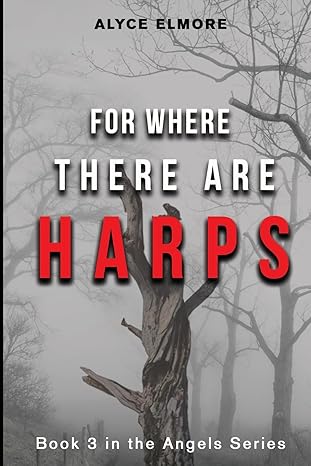
For Where There Are Harps, the third book in Alyce Elmore’s Angels Have Tread trilogy, plunges readers into a post-pandemic dystopian world where societal structures have crumbled and a matriarchal republic reigns. This installment intertwines the personal struggles of its characters with the broader socio-political turbulence of the era, exploring themes of power, survival, and human connection. It is an expansive tale, shifting between the perspective of a young historian seeking truths and the lives of those who experienced the chaos firsthand.
Elmore’s writing is vivid and immersive, though it occasionally leans toward a richness that may feels very detailed in some moments. One scene early in the book particularly struck me—a young girl grappling with the Old One’s stories, her sense of truth shifting like tectonic plates. The descriptions of nature, such as the mocking laughter of the kookaburra, are poetic and grounding. The Old One’s philosophical musings, while thought-provoking, sometimes slow the story’s momentum.
The interplay of characters adds both charm and tension. The four musketeers—Karen, Josh, Benny, and Zane—each represent different responses to the repressive laws of the Republic. Benny’s cynicism, borne from his experiences as a stud, is balanced by Karen’s quiet resilience. The moment Benny realizes the futility of plans, while imprisoned in Inverloch, encapsulates his character’s journey. The subplot involving Patricia Bishop could have been more tightly woven into the main narrative because what we are giving is intriguing. Her investigative arc often felt tangential, though her fiery confrontations were highlights.
Elmore shines brightest when tackling big ideas—what it means to control a narrative, the ethics of rebellion, and the cost of change. The Great Upheaval looms large in the backdrop, a reminder of the fragility of peace. The nuanced portrayal of Evelyn Perkins’ leadership as both tyrannical and tragically misunderstood struck a chord with me.
For Where There Are Harps is a sprawling and ambitious tale. It’s for readers who love deeply political dystopias, rich world-building, and morally complex characters. If you’re patient with its deliberate pace, this book rewards you with thought-provoking insights and poignant moments. It’s a gripping conclusion to a trilogy that asks us to question the truths we take for granted.
Pages: 274 | ISBN : 176385020X
A Web Of Conflict

Pray to the Dead: Book Two in Angels Have Tread Trilogy is a unique and interesting concept for a storyline. Where did the idea for this trilogy come from, and how did it develop over time?
As part of a writing course, we were asked to write an action scene so I had this idea for a researcher looking for a cure to save her son. That formed the basis of the character for Dr Harris. As I developed that idea, I realised that most action books and movies are set in a male dominated world. In the first draft of the first book in the trilogy, When All Hope Is Lost, I didn’t explain to readers that all men over 20 had died from a disease. Instead I dropped the reader directly into a world where all the characters were female; politicians, doctors, guards, reporters. I gave those opening chapters to a number of readers and the response from male readers was interesting. They were visibly upset by the lack of men. That’s when I realised that I didn’t want to write about the disaster or the struggle to get through it. I wanted my readers to discover a world that was already a comfortably established matriarchy. It’s a world that accepts women in all walks of life.
What was your approach to writing the interactions between characters?
I wanted to create a three dimensional world so I felt it was important to have multiple points of view. I wanted characters that had known the world before the pandemic and those who’d grown up in this changed world. I wanted to show that intergenerational conflict. I also wanted characters that came from different locales which is why there is the urban versus rural points of view. In my first book, When All Hope Is Lost, the relationships are laid out in parallel lines. Patricia the reporter lives with her mother. Dr Bonnie Harris with her son Josh. Evelyn as the political leader in Melbourne has her inner circle in the same way Sofia has hers in the Warragul Colony. The idea was to bring these separate lines together in a web of conflict that reaches its conclusion in the final book of the trilogy.
What experience in your life has had the biggest impact on your writing?
I took the creative writing course as a way to reconnect with life. I’d spent time caring for my partner whose dementia was slowly eating away at both our lives. Covid struck, he went into full time care and I was bereft. I’ve always made up short stories but I found myself with a lot of time and the need to deal with my loss. That loss added a new dimension to my writing.
What will the next book in that series be about and when will it be published?
The next book, For Where There Are Harps, is still in first draft but it brings all the characters together in the civil war called the Great Upheaval. As one of my early readers pointed out, this world is out of whack and you need to put it back in balance. Book three is about destroying what isn’t working and laying the groundwork for something that will be better.
Author Links: GoodReads | Twitter | Facebook | Website | Instagram
Pray to the Dead
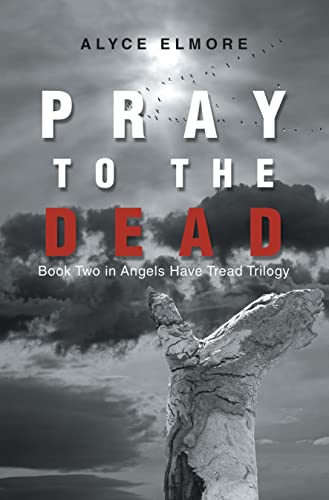
Pray To The Dead, the second book in Alyce Elmore’s Angels Have Tread Trilogy, follows the lives of several individuals and the new world they encounter 20 years after the desolation exterminated all males over the age of 20. Catherine is pleased to be the rising star of the New Order Party and looks forward to a new society with no use for males. Sofia, a council moderator in the Warragul colony, believes the government, or someone in the government, is responsible for the murders of the boys she is investigating. Finally, Patricia, a political journalist, discovers that the government is concealing some research from the public and is perplexed about what it all means. Is there a diabolical scheme being carried out by the government against males?
The gripping book features an impressive and well-developed world. The glossary of terms at the beginning of the book contains several words that reflect the changes in the new world. For example, the latter years of a young man’s life are referred to as cusp, and male sex workers are referred to as studs. Furthermore, viewing the physical features via the perspective characters’ thoughts makes envisioning the scenes a delight. The book contains profound insights, such as when Patricia characterizes an interior design as nice enough but lacking in personality. Another excellent quality of the novel is how unpredictable it is; the twists and turns have you eagerly anticipating the next chapter.
Pray To The Dead is a thought-provoking and riveting novel that will have sci-fi and fantasy readers unable to put the book down. I applaud author Alyce Elmore for writing such a brilliant story that inspired me to envisage a world where males play minimal societal roles through a riveting chain of events. Readers who appreciate dystopian and political novels with multiple intricate turns will enjoy this book.
Pages: 354 | ASIN : B0BSGQYQ4J


