Blog Archives
Sensory-Driven Experiences

Dissociative Effect is a visceral and introspective poetic journey through trauma, embodiment, and healing, revealing how returning to the body becomes an act of truth and transformation. What inspires you to write poetry?
It is said that there is almost nowhere on earth where you can stand more than six feet away from a spider. Poems too can also be found everywhere if they’re looked for – addressing every realm of what in our lives can feel broken: injuries of the heart, in love, in friendship, in family, grief, fear, anger, injustice, powerlessness, loneliness, and so many other places. Bringing words together in lyrical form helps us deal with some of the emotional intensity of living.
Amidst the trauma and the suffering of our lives, most of us can appreciate that powerlessness and invisibility are not minimal things. Poetry is the language that bridges our interior and exterior worlds. A person who asks words to do things with their feelings and emotions is not powerless. A person who makes phrases that connect people, that tell the truth, and expand reality is countering despair and depression. Anyone who has written a poem has felt this. I think this is the healing alchemy of poetry.
How did your work in medicine shape the way you approached writing about trauma and the body?
Practicing medicine for nearly two decades has taught me about the link between our personal stories and the universal or collective human narrative. Stories of health, trauma, and the body often rely on specific, intimate, and sensory-driven experiences which reflect broader shared human truths. I don’t want to minimize the personal effects of trauma, but to acknowledge that we are not alone in our experiences and our search for meaning.
The book moves from pathology to reclamation across its three sections. Did you always envision this structure, or did it emerge as you wrote?
I can’t speak to the process for all poets, but when I started writing poetry, I had no expectation that I would ever publish a book. I wrote poetry because I wanted to, because I needed to. After a couple of years, I realized that I had written several hundred poems. When I looked for themes in the content, I could see that there was a trajectory, a healing arc, which I had been living and writing about. As a physician, we are trained to see problems with a lens that matches the three sections of this book; namely, disease (pathos), diagnosis (diagnoses), and treatment (ad sanadum).
You write about dissociation with such clarity. What helped you reconnect with your own body enough to translate that experience into language?
In the process of writing the book, I was engaging regularly with several embodied or somatic practices (yoga, meditation, sauna with cold water immersion), which helped me to reflect on the ways in which we are present and not present in our lives. Sometimes, disembodiment involves distraction or a lack of mindful attention as we are going about our lives. Sometimes, disembodiment and dissociation are more than that when they serve as elaborate protective mechanisms against trauma, which might otherwise be unbearable in a moment.
I had mostly finished the book and chosen the title, Dissociative Effect, when ketamine became widely available as a mental health treatment. Before writing the intro and publishing the book, I researched therapeutic ketamine in an effort to understand if and how this might help my patients. Along the way, I received a ketamine treatment and experienced “the dissociative effect.” Through my own journey, I understood more deeply how dissociation can shift perspective, just as narrative voice shifts perspective in writing and storytelling. Therein lies our capacity for healing.
Author Links: GoodReads | Amazon
Dissociative Effect
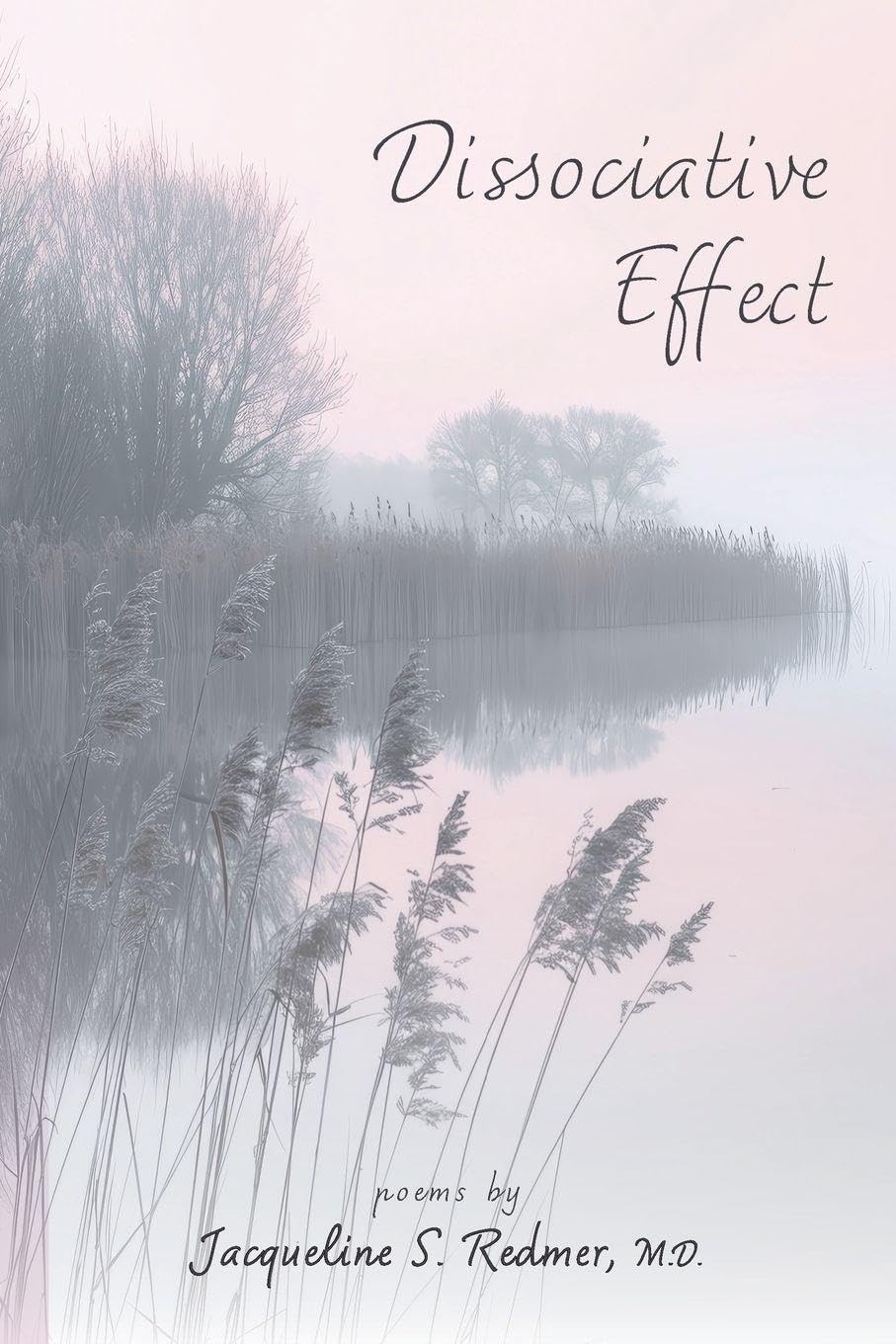

Jacqueline Redmer’s Dissociative Effect is a raw, searing collection of poems shaped by pain, memory, healing, and hope. Part memoir, part emotional excavation, the book moves through themes of trauma, womanhood, embodiment, medicine, and spiritual searching. It opens with a deeply personal introduction that lays the groundwork for what follows. Redmer’s poetry is not a passive reflection, but an active, pulsing lifeline. Across three sections, Pathos, Diagnoses, and ad sanadum, Redmer travels inward, dissects her story, and leaves nothing unexamined. It’s at once intimate and universal. Clinical and poetic. Grief-stricken and triumphant.
Reading this book was not easy. There’s a kind of precision here that only a physician-poet could pull off. Some poems cut like scalpels. Others whisper truths I didn’t know I needed to hear. Redmer doesn’t flinch from the hard stuff, body shame, sexual trauma, mental illness, motherhood, aging, and invisibility. In “dis-comfort food” and “the crime scene,” she writes about girlhood and the betrayal of the body with such clarity, I found myself holding my breath. And then there’s “listen,” a poem that addresses the inability to scream during assault, and it just wrecked me. Her language is so direct. No wasted words. No prettying up the truth. But it’s not just pain for pain’s sake, there’s deep intelligence and heart in these pages.
What stuck with me most was the feeling of coming home to something hard. That ache of knowing and not knowing. Redmer has a gift for taking ordinary moments, eating a peach, watching rain, yoga class, and flipping them inside out to reveal emotional depth you didn’t expect. She made me think about all the ways we dissociate to survive, and what it means to come back to our own bodies. I felt comforted by her honesty, her imperfection, her willingness to say what so many of us only feel. Her poems gave me language for things I thought were unspeakable. And at the same time, I laughed, nodded, and underlined like crazy.
I’d recommend Dissociative Effect to anyone who has lived through trauma, especially women, caregivers, clinicians, survivors, and seekers. If you’ve ever felt too much or not enough, this book will find you where you are. Redmer doesn’t offer tidy answers, but she opens a door. You walk through.
Pages: 86 | ISBN: 1962082822



