Blog Archives
The Turning Point

Too Strong For Your Own Good is an intimate blend of memoir and guidance that invites readers to explore the hidden cost of chronic strength and to show exhausted high achievers how to reclaim health, joy, and self-leadership by listening to their bodies. Why was this an important book for you to write?
This book wasn’t something I decided to write—it was something that asked to be written through me.
For decades, I lived the life of the “strong one.” The high achiever. The helper. The woman who could handle anything—until my body finally said no. After surviving multiple cancer diagnoses, chronic illness, and profound burnout, I realized that the very strength I had been praised for was slowly costing me my health, my joy, and my sense of self.
As I healed, I began to recognize this same pattern everywhere. In my years of coaching leaders and high performers, I watched capable, compassionate people quietly disconnect from themselves in the name of responsibility, success, and survival. The strongest people were often the most exhausted and the least supported.
I wrote Too Strong For Your Own Good so others don’t have to spend decades learning what nearly cost me my life—that real strength includes the wisdom to rest, the courage to feel, and the trust to finally come home to yourself. This book is both a truth-telling and an invitation to evolve from survival-based strength into a more soul-aligned way of living and leading. It’s the book I wish someone had handed me years earlier.
When did you first realize that being “strong” had become harmful rather than helpful?
I realized it when my body stopped responding to willpower. I could no longer push through symptoms, override exhaustion, or “mindset” my way forward. What once felt empowering began to feel like self-erasure.
As I slowed down enough to listen, I saw something more clearly: the strength I had relied on wasn’t a conscious choice-it was a survival strategy I had developed very early in life. Proving my worth through constant doing had once helped me feel safe, capable, and in control. But over time, it came at a cost.
Being strong became harmful the moment it required me to abandon myself. When saying yes to everyone else meant saying no to my own body, my own needs, and my own truth, I knew something had to change.
That realization was humbling and clarifying. I understood that my body wasn’t betraying me-it was protecting me. It was asking me to stop living from adrenaline and proving, and to begin listening. That moment became the turning point not only in my healing but in how I now guide others.
How does burnout in leaders quietly ripple into families, teams, and organizations?
Burnout doesn’t stay contained. Even when leaders are highly competent, their nervous systems set the tone. Chronic stress shows up as urgency, control, emotional distance, and reactivity- often without anyone naming it.
Families feel it as an absence. Teams feel it as pressure. Organizations feel it as disengagement and quiet erosion of trust. When leaders are operating from survival, they unintentionally teach others to do the same, moving faster, bracing tighter, and normalizing constant pressure.
Sustainable leadership isn’t just about resilience or performance. It requires regulation, presence, and self-trust. When leaders feel safe in their own bodies, they create environments where others can do their best work without burning out.
What does sustainable healing actually look like day to day?
Sustainable healing is quiet and relational. It looks like pausing instead of pushing. Listening instead of overriding. Setting boundaries that honor the body. Making decisions that feel congruent rather than impressive.
Day to day, it’s less about adding more practices and more about removing what no longer fits. It’s learning to notice when we’re slipping back into survival and choosing to respond with honesty and care instead.
Healing becomes lasting when strength is redefined – not by how much we can carry, but by how well we stay connected to ourselves.
Author Links: GoodReads | X (Twitter) | Anette Demattio | Facebook | Instagram | LinkedIn | Website | Amazon
Too Strong For Your Own Good reveals the hidden cost of pushing through, pleasing, and holding it all together—while your body quietly pays the price.
After surviving six cancer diagnoses, Anette DeMattio realized her body wasn’t broken—it was speaking. Now, with over 25 years of experience in transformational coaching, she helps high achievers and caregivers turn survival patterns into embodied self-leadership.
In this book, you’ll learn how to:
• Understand your symptoms as signals—not setbacks
• Break patterns that silently drain your energy
• Rest in a way that feels safe—not scary
• Lead and live from calm, clarity, and soul
This isn’t just a book about healing. It’s a powerful invitation to return to your truest self—strong, soft, and fully alive.
If your body is whispering for relief…
If you’re tired of pretending you’re fine…
If you want peace without burnout and strength without suffering…
Let this book show you how to stop surviving—and start living, vibrantly and freely as the real you.
Too Strong For Your Own Good: Success With Soul
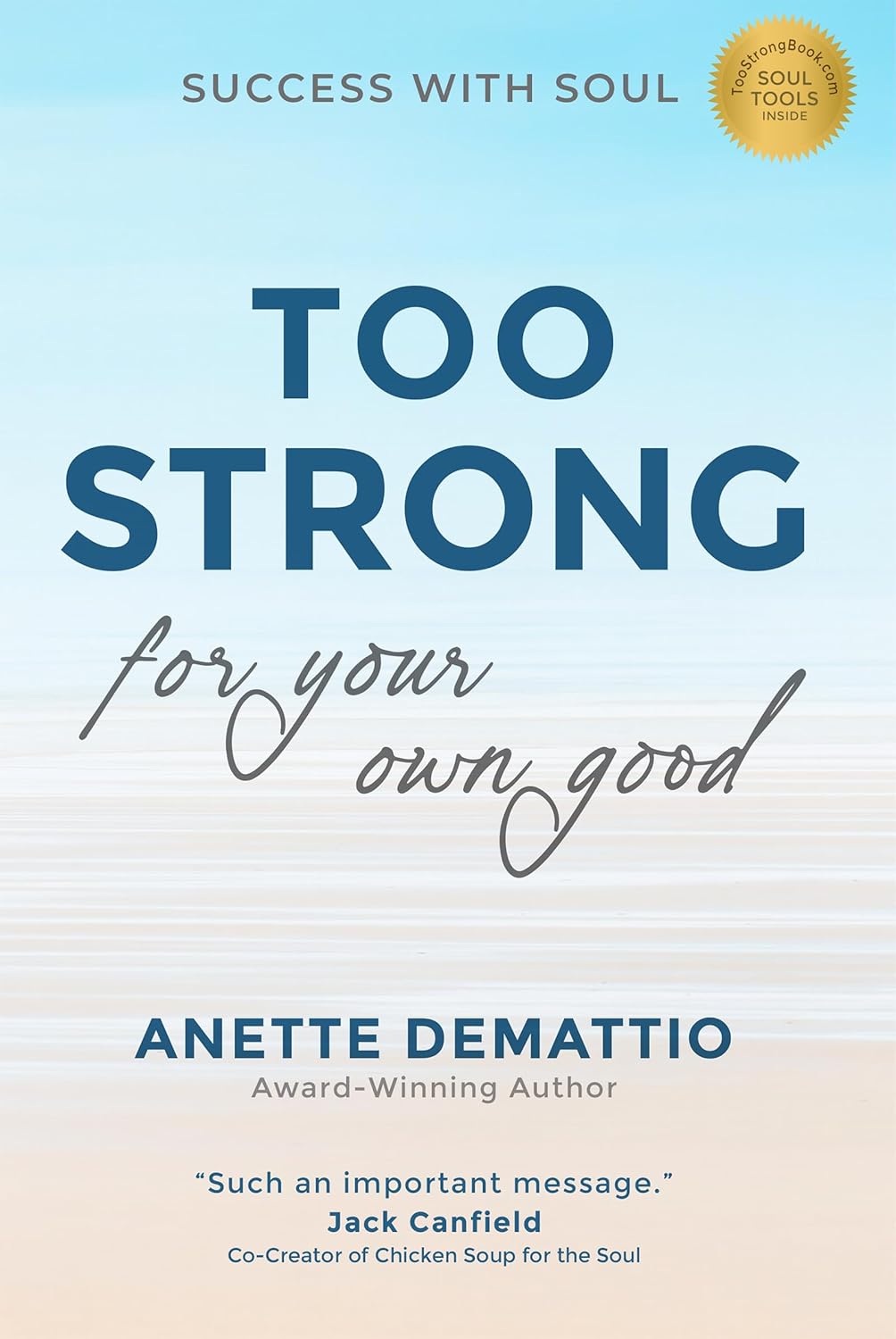

I read Too Strong For Your Own Good by Anette DeMattio straight through with very few pauses. The book is about what happens when strength turns into self-erasure. DeMattio shares her personal story of illness, burnout, trauma, and recovery while guiding the reader toward a softer and more embodied way of living and leading. The core idea is straightforward. Being strong for too long can disconnect you from your body, your needs, and your joy. The book blends memoir, reflection, and gentle exercises meant to help readers come back to themselves.
What struck me most was the voice. It feels intimate and unfiltered, like someone sitting across from you telling the truth without cleaning it up first. I felt seen more than once, and that surprised me. Some moments made my chest tighten. Others made me laugh in that tired recognition kind of way. The writing is emotional and direct. It repeats ideas on purpose, which at times felt comforting and at other times felt heavy. Still, I never doubted the author’s sincerity. Her lived experience gives the book weight, and I trusted her because she never pretended to have an easy fix.
The focus on listening to the body felt grounded and human, not preachy. I appreciated how often she reminded the reader that exhaustion is not failure. The spiritual language is rich and expressive, and the extended metaphors show how deeply the author wants the reader to fully feel and absorb the message. The heart of the message kept pulling me back. I felt encouraged, challenged, and oddly calmer by the end. It felt less like being taught and more like being invited.
I would recommend this book to people who are tired in a way sleep does not fix. It is especially good for caregivers, leaders, high achievers, and anyone who has built a life around holding it all together. If you are open to reflection, emotion, and slowing down, this book can feel like a deep exhale and a quiet companion when you need one most. Too Strong For Your Own Good: Success With Soul reminds you that real strength isn’t pushing harder. It’s finally listening to yourself.
Pages: 181 | ASIN : B0FZRWRTY7

Sensory-Driven Experiences

Dissociative Effect is a visceral and introspective poetic journey through trauma, embodiment, and healing, revealing how returning to the body becomes an act of truth and transformation. What inspires you to write poetry?
It is said that there is almost nowhere on earth where you can stand more than six feet away from a spider. Poems too can also be found everywhere if they’re looked for – addressing every realm of what in our lives can feel broken: injuries of the heart, in love, in friendship, in family, grief, fear, anger, injustice, powerlessness, loneliness, and so many other places. Bringing words together in lyrical form helps us deal with some of the emotional intensity of living.
Amidst the trauma and the suffering of our lives, most of us can appreciate that powerlessness and invisibility are not minimal things. Poetry is the language that bridges our interior and exterior worlds. A person who asks words to do things with their feelings and emotions is not powerless. A person who makes phrases that connect people, that tell the truth, and expand reality is countering despair and depression. Anyone who has written a poem has felt this. I think this is the healing alchemy of poetry.
How did your work in medicine shape the way you approached writing about trauma and the body?
Practicing medicine for nearly two decades has taught me about the link between our personal stories and the universal or collective human narrative. Stories of health, trauma, and the body often rely on specific, intimate, and sensory-driven experiences which reflect broader shared human truths. I don’t want to minimize the personal effects of trauma, but to acknowledge that we are not alone in our experiences and our search for meaning.
The book moves from pathology to reclamation across its three sections. Did you always envision this structure, or did it emerge as you wrote?
I can’t speak to the process for all poets, but when I started writing poetry, I had no expectation that I would ever publish a book. I wrote poetry because I wanted to, because I needed to. After a couple of years, I realized that I had written several hundred poems. When I looked for themes in the content, I could see that there was a trajectory, a healing arc, which I had been living and writing about. As a physician, we are trained to see problems with a lens that matches the three sections of this book; namely, disease (pathos), diagnosis (diagnoses), and treatment (ad sanadum).
You write about dissociation with such clarity. What helped you reconnect with your own body enough to translate that experience into language?
In the process of writing the book, I was engaging regularly with several embodied or somatic practices (yoga, meditation, sauna with cold water immersion), which helped me to reflect on the ways in which we are present and not present in our lives. Sometimes, disembodiment involves distraction or a lack of mindful attention as we are going about our lives. Sometimes, disembodiment and dissociation are more than that when they serve as elaborate protective mechanisms against trauma, which might otherwise be unbearable in a moment.
I had mostly finished the book and chosen the title, Dissociative Effect, when ketamine became widely available as a mental health treatment. Before writing the intro and publishing the book, I researched therapeutic ketamine in an effort to understand if and how this might help my patients. Along the way, I received a ketamine treatment and experienced “the dissociative effect.” Through my own journey, I understood more deeply how dissociation can shift perspective, just as narrative voice shifts perspective in writing and storytelling. Therein lies our capacity for healing.
Author Links: GoodReads | Amazon
Love Yourself

Indra’s Net offers readers a spiritual guide that blends personal experiences and grounded spiritual lessons within a Tarot-inspired structure. Why was this an important book for you to write?
For my own growth.
Is there anything you now wish you had included in Indra’s Net? Any additional anecdotes or bits of wisdom?
No.
What is one thing you hope readers take away from your book?
Love yourself.
Can we look forward to more releases from you soon? What are you currently working on?
Ideas, but nothing definite.
Author Links: GoodReads | Facebook | Website
Adult Nonfiction Book of the Year, San Francisco Writer’s Conference
FOR THOSE WHO SEEK ANSWERS, UNDERSTANDING, INSPIRATION, & INNER PEACE
Indra’s Net is a collection of themes about learning to live an awakened life and opening one’s mind and heart to the Self. It is for those who seek answers, understanding, inspiration, and inner peace. It discusses topics such as vulnerability, codependence, arrogance, impermanence, gratitude, and failure, and contains wisdom and teachings from many paths.
This book can be used as daily inspiration, a tool for self-improvement, a spiritual lesson plan, and a source of divination. Full of helpful techniques, hints, humor, and love, all oriented towards making sense of our human experiences and discovering a cosmic home here on Earth, it is a how to do and how to be manual.
The format mirrors a traditional Tarot card deck, although it offers a new take on both Tarot meanings and spiritual discovery outside of Tarot readings. The book can be used as a modern guide to reading and understanding Tarot card meanings.
In the two-thousand-year-old tradition of Indra’s Net, each perfect faceted jewel reflects every other jewel and is reflected by that jewel. It’s an image of interdependence, in that everything is connected to everything else. Indra’s Net is not a poetic or a philosophical idea, it’s the way life functions.
Indra’s Net is a product of author Indra Rinzler’s 50+ years of living on the spiritual path, assembled from decades of study, wisdom paths, practices, experiences, and revelations.
How we view life is our choice. This book is meant to encourage one to choose from a higher wisdom and connection to the truest Self. That which we wish to understand and become, transforms us in the very process of seeking. As we open to awareness, we awaken to the significance of all dimensions of reality.
Indra’s Net: A SEEKER’S Guide to the Human Experience

Indra’s Net, by Indra Rinzler, is a spiritual guide built from seventy-eight themes that weave stories, reflections, and practices into a single tapestry of awakening. The book blends personal experience, Tarot-inspired structure, mythic symbolism, and grounded spiritual lessons. It invites readers to look inward, release old patterns, and explore consciousness with curiosity. The author draws from decades of study, travel, meditation, and teaching to create a kind of living manual that meets readers wherever they are. The effect is a blend of memoir, parable, and spiritual toolkit.
Reading the book, I kept feeling a mix of surprise and comfort. The writing carries a warm, almost conversational honesty that makes even the heavier ideas feel approachable. I liked how the author refuses to separate the mystical from ordinary life. A simple bowl of oatmeal becomes a miracle. A long walk in Thailand becomes a spiritual dilemma. A beggar’s smile becomes a master class in grace. The stories feel loose and unforced. I found myself nodding along, then stopping, then looking up from the page because something landed in my chest. The rhythm moves from personal anecdote to broad spiritual teaching so quickly that it left me slightly off balance in a good way. It reminded me that understanding rarely arrives in a straight line. It sneaks up on you.
At the same time, the ideas stirred up a strange mix of awe and restlessness. The author talks a lot about surrender, intuition, and letting life unfold. Some moments felt so gentle that I relaxed into them. Other moments poked at me. The theme of impermanence, for example, made me strangely uneasy. I felt myself push back, even as I knew the point was to soften. That emotional tug made the book stick with me. I appreciated how the stories never try to be perfect teaching moments. They wander and land where they land. The book feels authentic, and that gave it a texture that pulled me deeper.
By the last pages, I felt a quiet gratitude for the way the Rinzler uses imagery and structure. The Tarot framework, the themes, and the practices are presented at the end of each chapter. It all creates a rhythm that feels like a long walk with someone who has been on the road a while and wants you to see the scenery with fresh eyes. I would recommend Indra’s Net to readers who enjoy reflective, spiritually curious writing and who like books that offer small, steady insights rather than big proclamations. It is especially good for people who want a companion on their inward journey. Someone who wants to feel less alone and more connected to something larger and kinder than their own thoughts.
Pages: 286 | ASIN : B0FX65LB69

Awakening Stories
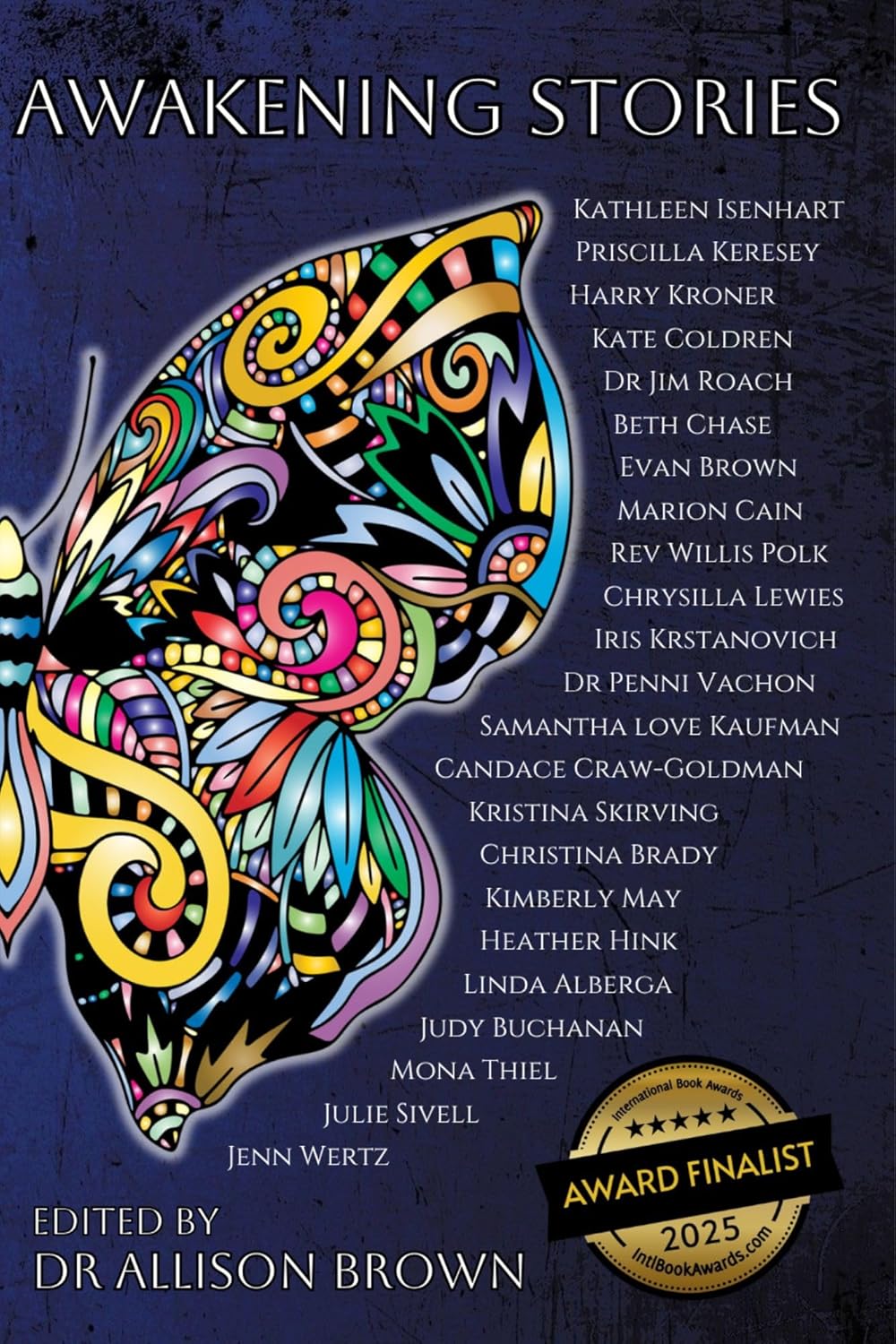
Awakening Stories is a collection of personal essays written by twenty-three individuals who share their spiritual and emotional transformations. The book begins with an introduction by Dr. Allison Brown, who frames the anthology as part of a broader human awakening, a time when individuals and societies are breaking down old ways of being to rebuild something more authentic and compassionate. Each story follows a different thread: grief, addiction, faith, illness, self-discovery, and love. Together, they form a patchwork of healing, vulnerability, and inner strength that echoes one truth, awakening isn’t a single event but a lifelong process of remembering who we are.
Every chapter opened a window into someone’s private reckoning with pain and renewal. The writing varies, sometimes lyrical, sometimes blunt, but always sincere. I found myself pausing often, not because the text was dense, but because it stirred things I hadn’t planned to feel. Some stories shimmered with beauty, like Julie Sivell’s reflection on homesickness for the divine, or Evan Brown’s raw recollection of a moment of awakening in a Hawaiian temple. Others punched harder, especially those that dealt with trauma and survival. There’s a rhythm to the book, like waves of confession and clarity, and though the voices differ, there’s a common heartbeat pulsing through them: hope.
Stylistically, the book has an intimacy that pulls you close. It doesn’t read like a polished self-help manual or a philosophical treatise, it reads like a gathering around a fire. Some passages drift into the mystical. It invites you to question, to lean in, to wrestle with what you believe. Dr. Brown’s vision as editor feels grounded in compassion rather than doctrine.
I’d recommend Awakening Stories to anyone feeling lost, restless, or curious about the deeper layers of being alive. It’s not a quick read, it’s one you sit with. If you’ve ever faced a moment that cracked your sense of self, this book will meet you there and whisper that you’re not alone. It’s for the seekers, the skeptics, the wounded, and anyone brave enough to believe that breaking apart might just be the first step toward becoming whole.
Pages: 287 | ASIN: B0DKG1RNT3
It’s Never Personal: Weaving Psychology, Neuroscience, and Ancient Wisdom Through a 5-Step Process to Finally Let It Go

Vicki Kennedy’s It’s Never Personal is a heartfelt and practical guide to understanding why we take things personally and how to let go of that burden. Through her five-step “Never Personal Process,” she blends neuroscience, psychology, and ancient wisdom into a pathway for real emotional freedom. The book moves between personal stories, client experiences, and clear, accessible explanations of concepts like attachment theory and the mind-body connection. At the end of each chapter, reflective questions invite the reader to dig deeper, making the book part manual, part mirror. It’s not just theory, it’s a lived approach to releasing shame, resentment, and self-criticism, and finding the peace that comes with truly seeing that “it’s never personal.”
What struck me most was the openness and warmth in Kennedy’s writing. She doesn’t hide behind clinical distance. She shows her own struggles, moments of feeling unworthy, rejected, or invisible, and how she worked through them. This made the book feel like a conversation with a trusted friend who also happens to have a lot of professional wisdom. I found myself pausing to think about my own raw spots, the times I’ve rushed to forgive without healing, and how often my mind leaps to negative conclusions without evidence. Her examples, whether about a casual slight or a deep betrayal, hit that sweet spot of being specific enough to feel real, but universal enough to resonate.
I also appreciated how she bridged the gap between emotional healing and spiritual growth without slipping into abstract mysticism. Her tone is grounded and compassionate, and she has a knack for taking big ideas like flow states, shadow work, and generational patterns and making them simple without making them shallow. She’s equally willing to quote neuroscience research and the Tao Te Ching, and she makes both feel relevant. Some passages challenged me to face uncomfortable truths about my own defensiveness and judgment. Others left me feeling lighter, more hopeful. By the time I finished, I could see my own patterns a little more clearly and felt more willing to try her process in real life.
I’d recommend It’s Never Personal to anyone who finds themselves replaying conversations in their head, holding grudges they wish they could drop, or feeling too easily bruised by others’ words and actions. It’s ideal for those already in therapy or on a personal growth journey, but it’s also accessible to someone just beginning to wonder why certain hurts linger. If you’re ready to let go of the weight you’ve been carrying, whether it’s been a few weeks or a few decades, this book offers both the map and the encouragement to take those steps.
Pages: 139 | ASIN : B0F9B51HNT
Gratitude with Grace: Finding Happiness


Gratitude with Grace: Finding Happiness is a deeply personal and heartfelt guide to self-love, healing, and spiritual transformation. Written in an accessible and conversational tone, Anita Fonteboa draws from her own life—her hardships, her healing, and her growth—to offer readers a roadmap to joy. The book is organized into thematic chapters that tackle gratitude, manifestation, intuition, and self-awareness. It encourages readers to tune into their inner voice, shift their mindset, and connect to something greater—be it God, angels, or the universe. Through affirmations, real-life anecdotes, meditative practices, and soulful wisdom, the book leads you to discover your own light, even in the darkest moments.
Reading this felt like having a warm and honest chat with a wise friend who’s been through the wringer and still found reasons to smile. I appreciated how Anita doesn’t hide behind theory or abstract advice. She gives you the raw truth of her lived experience, from financial struggles and single motherhood to spiritual awakenings. That honesty makes her message land with impact. The writing is simple, direct, and full of warmth. She repeats her messages often, which might bother some readers, but to me it felt intentional, like a mantra. I especially loved the affirmations peppered throughout the book. At times, I actually found myself saying them out loud, which is a testament to the author’s ability to make her words feel like an invitation rather than a command.
There were moments I wished for more clarity or a deeper dive into certain tools she mentions, like grounding or chakras, which are touched on. Still, the emotion is always present, and that’s what kept me hooked. This isn’t a textbook or a clinical how-to. It’s a love letter to the person who’s struggling but still showing up every day. And that makes it an incredible tool. Chapter 8 was one of my favorite parts of the book because it felt like the heart of everything Anita had been building up to. It was empowering and full of emotional honesty. I loved how she tied all the previous lessons together and reminded us that happiness isn’t something you wait for, it’s something you claim.
I’d recommend Gratitude with Grace to anyone who’s feeling stuck, broken, or lost in the noise of daily life. It’s perfect for readers new to the world of self-help or spiritual growth, especially those who resonate with personal storytelling and faith-driven inspiration. If you’ve ever whispered “there has to be more than this,” this book might just be the soft nudge toward that “more.” It won’t change your life in one read—but it just might remind you that you can. And that’s more than enough to start.
Pages: 82 | ASIN : B0CK79ZGX6


