Blog Archives
Underwater Archaeology

Set in Atlantis, The Power of Water follows two men–one fighting for his people’s freedom and the other battling to keep the upper hand against his nemesis. What was the inspiration for the setup of your story?
I enjoy reading and watching shows about alternative history, or, as some would call it, pseudo-science. When I started writing, I thought about Atlantis and how the downfall would have occurred. Plato talks about the people angering the gods, but could that have been future generations sent back to hunter-gatherers, trying to make sense of something they did not understand? Like how do the Sentinelese natives or any other primitive natives today describe a helicopter coming near them? Is it an animal? Do they understand it is a machine or just the amount of strange people?
So, I tried to build a story around an advanced civilization that used a power source we would not understand, but that gave them many of today’s conveniences. The story would then progress through their downfall and attempt to survive.
Did you plan the tone and direction of the novel before writing, or did it come out organically as you were writing?
Mostly organically. I knew the direction I wanted to go in but would stop occasionally to read what I wrote (some correcting, but mostly just to make sure it flowed to me). Usually, I would then ask myself how this got here or what if that happened first. Then, I would try to add that into the story, and if I liked it, I would flesh it out.
What were some themes that were important for you to explore in this book?
I guess the biggest thing is I wanted to write a story about how I thought a prior level of civilization could have been here and disappeared. Plato states Atlantis was a naval power, so I believe that means they would have been on the coasts. The coasts in many parts of the Ice Age world are hundreds of feet underwater now. And I think the current state of our underwater archaeology is still in the beginner phase.
Many like to think that we are the apex of human history, but I wonder if that is correct. I mean, we have been at our biological level for over 100,000 years, and only in the last 10,000 years have we gone from picking berries to rockets, nanites, quantum physics, and the like. Our long-ago ancestors seemed to be as inquisitive as we are, so why now and not before?
Can you give us a peek inside book 2 of The Doom of the Gods series? Where will it take your characters?
Book Two, The Power of Blood, will concentrate on the chaos of the Atlantean empire and the struggle between the parties. Jana will once again go after Risor. Rogat and Demetri will have a “come to the gods” moment. Shandar will struggle to keep his people together, and Lena, poor Lena, will find herself thrust into a power vacuum that forces her further away from finding her love, Tilor. Indrajit and Zhen will find themselves on a secret mission that turns into making friends from enemies.
Author Links: GoodReads | Facebook | Website | Amazon
Now, Atlantis wants to use WMDs…
But can civilization survive it?
During the last Ice Age, the clash of steel and the roar of aircraft echo through the land as the empires of Atlantis and Rama wage a desperate war.
There are many stories to tell the tale.
Risor sees the trap closing. But Jana, the mission commander, refuses to withdraw. She fears the consequences of failure. Threatening mutiny, he forces her to order the retreat. That Risor is right makes matters only worse, turning the rivalry personal.
Rogat is not sure what he did to offend the gods. Because the demi-god hero constantly chasing him doesn’t seem fair.
With Atlantis suffering, the empire falls apart.
Fleeing from a vengeful Jana, Risor must lead his people to freedom. Meanwhile, leading another band of survivors, Rogat tries to stay one step ahead of his nemesis. Read about Risor and Rogat in a gripping tale of war and survival that will keep you on the edge of your seat. Because revenge is such a satisfying reason to destroy a civilization.
The Power of Water


James Grimm’s The Power of Water is an exhilarating dive into a richly imagined historical world where Atlantis, blessed with Aether-powered weapons from the gods, has flourished for millennia. The Aether’s gifts have granted the Atlanteans immense wealth, knowledge, and power, but they have also sown seeds of arrogance and envy among rival empires. These tensions set the stage for a high-stakes narrative as the Rama empire devises a plan that threatens to upend the balance of power. The Atlanteans, facing existential threats, must grapple with the sacrifices and duties required to preserve their once-great empire.
Grimm crafts a story of mythic proportions, seamlessly blending action with the rise and fall of this legendary civilization. The narrative unfolds through various perspectives and battles, immersing readers in the dynamic world of Atlantis. This multifaceted approach provides a panoramic view of the empire and its adversaries, enriching the story with diverse viewpoints and experiences. To enhance the reader’s journey, I believe a glossary at the beginning could offer valuable context and deepen the understanding of the complex relationships and settings.
Grimm’s talent shines in his compelling battle scenes and engaging dialogue, creating a vivid and action-packed tale. I feel a bit more background development would further enrich the characters and their motivations, offering readers a more profound connection to the unfolding drama. Grimm’s organizational prowess shines through with a timeline-structured chapter layout that effectively tracks the ebb and flow of the plot.
James Grimm’s The Power of Water offers an exhilarating journey through the legendary world of Atlantis. With its dynamic storytelling, thrilling battles, and a richly imagined setting, the novel captures the essence of a mythic civilization in turmoil. The book’s strengths in action and intrigue make it a captivating read. Fans of historical fiction and epic tales will find much to enjoy in this engaging exploration of Atlantis’ rise and fall.
Pages: 292 | ISBN : 978-1963553017

“A Poem and a Mistake”

Poetic Justice follows a poet in Rome who is exiled by the emperor and winds up in a town plagued by a mysterious murder. What was the inspiration for the setup of your story?
It started with a question much asked by Classicists – why did the Emperor Augustus exile the poet Ovid? We still don’t really know though it hasn’t stopped people guessing. Ovid himself – the real poet Ovid, that is – hints that he offended the Emperor with “a poem and a mistake”. From there I started to wonder how Ovid would have coped living in a small Greek town on the edge of Empire. And when I discovered that, in his youth, the real Ovid possibly spent a year working in the world of law and order in Rome, that gave me the idea for him turning detective.
What kind of research did you do for this novel to ensure you captured the essence of the story’s theme?
I read Ovid’s poems – the ones he wrote in exile – and was struck by how badly he seemed to be coping. Of course, this is a portrait of himself that he wanted to convey in the poems. Interesting that he wants us to see him constantly complaining and wailing. No Roman endurance here!
I also had to research the town of Tomis, now covered by the modern Romanian city of Constanta. I was fortunate in that Constanta has a wonderful Museum of History and Archaeology, and its website freely publishes many useful documents.
I read a lot about how witchcraft is depicted in Roman writers, and I discovered that Ovid stopped at Samothrace on the way to Tomis. It is likely that he was initiated into the mysteries of the Great Gods at the huge temple complex on the island. You know the famous Winged Victory statue in the Louvre? That comes from Samothrace. These cults from the east were embraced by the Romans quite readily, which I found interesting.
What were some themes that were important for you to explore in this book?
I always like to explore the difference between what the sources tell us and what common sense tells us. If you just read Ovid, then you would wonder why anyone ever lived in Tomis, so I wanted to show life here as normal, relatable. A small town like Tomis would have a long history but there would be none of the huge buildings we see in Rome, none of what I call the Hollywood element. There would be far fewer slaves than in Rome, and the population would be mixed – Greeks, some Romans, people who had settled from around the Black Sea, lots of locals from the tribes around the Danube, and traders from around the Mediterranean. And Ovid would have been the most famous person ever to live in Tomis – just imagine if your favourite writer came to live in your ordinary, nobody’s-heard-of-it small town!
When will book 2 be available? Can you give us an idea of where that book will take readers?
Book 2 should be available by the autumn, and it takes the reader away from Tomis to an extent, giving an Empire-wide view. It’s set around the death of Augustus, and this was important because an Emperor had never died before. Everyone was waiting to see what would happen. I’m afraid our hero is still in trouble – we find out what it was that was so terrible that Augustus could never forgive Ovid…
Author Links: Goodreads | Twitter | Facebook | Website | Amazon
Rome’s celebrated love poet Ovid finds himself in exile, courtesy of an irate Emperor, in the far-flung town of Tomis.
Appalled at being banished to a barbarous region at the very edge of the Empire, Ovid soon discovers that he has a far more urgent – and potentially perilous – issue to address. A killer is at large in Tomis.
Somebody is slaughtering animals in a parody of ritual, and the Governor’s advisor Marcus Avitius is under pressure to apprehend the perpetrator.
Romans are held in low esteem by the local populace, however, and assistance is hard to come by. When the killer progresses from animal to human victims, Avitius reluctantly allies himself to the mercurial, tipsy Ovid.
It seems that Ovid has an inexplicable link to the murderer too, with his poetry providing the timetable by which the killer works.
After a secret visit from the elite Praetorian Guard, Ovid realises he is in mortal danger in Tomis. If he doesn’t follow the Emperor’s line, more than just his freedom is at risk.
With Avitius distracted by the demands of the Governor, Ovid becomes a target for dark forces at work in Tomis – and in Rome.
Recommended for fans of Steven Saylor, Lindsey Davis and Simon Scarrow.
Fiona Forsyth studied Classics at Oxford before teaching the subject for 25 years. Fiona is also the author of the Lucius Sestius Mysteries.
The Core of Innocence

Imperatrix: The Empress Who Was Once a Slave follows a young slave thrust into the decadence and danger of Nero’s court as he strives to survive and find his place in a world ruled by an insane emperor. What inspired you to choose Nero’s Rome as the backdrop for Imperatrix?
Growing up in England in the 1960s, I was one of the last generation to receive a “classical education” in which subjects like Latin were compulsory. So, the history of imperial Rome was almost as familiar to me as real life — and, compared to real life in a British boarding school, almost as weird, too. I was surrounded by fictional depictions of Nero’s Rome, in literature and film, yet they generally are as much about the mores and culture of the time they were written in as about Rome. I wanted to try to achieve the real alienness of this pagan culture while at the same time showing that these people are clearly recognizable to us in the modern world. One important difference is the entire societal treatment of sexuality and sexual morality which was in many ways more permissive than today, but also more restrictive in other ways. Relationships today are seen as two-way; in Roman times “maleness” was about doing, and “femaleness” was about being done to. Everything has to be interpreted in that light. “Of course” one could do anything to a slave, no matter what their gender or age — they were owned. Yet a modern, two-way gay relationship where the partners were equal might have been seen as eccentric, somehow un-Roman. When this one pillar of modern moral discourse — the idea of relationships being equal, going both ways — is altered, every little thing in society is seen through a different lens. That was the challenge — not to allow a modern sensibility to be interjected into characters’ attitudes — while at the same time showing characters that modern people share common humanity with.
Sporus is a complex and captivating character. Can you share the process of developing his personality and how you balanced his vulnerability and resilience throughout the story?
So many bad things happened to Sporus that he could not have survived without a great deal of native wit and real intelligence. To survive in Nero’s court was tough even for people who had been raised and bred for it. To develop his character, I imagined him talking to me, letting me share his innermost, often contradictory thoughts. It’s the core of innocence that people around Sporus love — the thing they themselves do not possess. But that innocence is constantly besieged by the realities of his world. I think that making this a first-person narrative makes you constantly strive to understand the realities of that world. It’s an imaginative exercise in chanelling if you will.
How did you approach crafting Nero’s character, and what were the challenges in depicting his divine madness and capricious nature?
Of course, we know a lot more about Nero than we do about Sporus. This means not only that it’s easier to create a character people would recognize as Nero, but also harder to bring out qualities that might be concealed behind the very well-known persona. Nero was not raised to be an Emperor, so on some level, he must have been able to understand how ordinary people felt. The evil madman image is to some extent anti-Julio-Claudian propaganda — followed by Christian propaganda. He was, almost to the end, rather popular, but the mob was fickle.
Can you give us any insights into what we can expect in the next installment of this enthralling trilogy?
In a way, the big events are all in the third part, a large part of which is set during a single year in which four emperors came to the throne, and Sporus’s fortunes ping pong rapidly. Nymphidius “took” Sporus for a while but his bid to become emperor did not work out. Otho, like Nero, married Sporus (and of course both were Poppaea’s ex-husbands.). The first part of Book III, the Grecian tour, is also an immense spectacle. So I hope the third volume will be suitably climactic.
I didn’t mean to do this in three volumes. It’s just that at my age, I worry about not finishing big fat books, so breaking them up is a way that least parts of them reach the audience. At about 180,000 – 200,000 words the three volumes together are a pretty fat work, but they are continuous, so it may also be necessary to do an omnibus edition.
Author Links: GoodReads | Amazon
Imperatrix, the second volume of the tale, takes us into the heart of the Imperial palace with all its intrigue, depravity, and splendor.
Poetic Justice
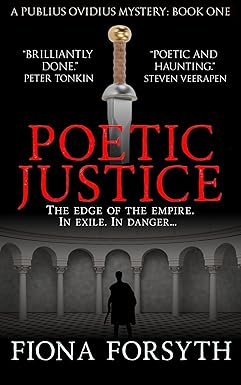

In the dwindling twilight of Roman dominion, Poetic Justice by Fiona Forsyth transports readers to Tomis, a remote outpost at the Empire’s edge, where the esteemed poet Ovid finds himself in exile. Initially dismissive of the locals as mere barbarians, Ovid’s attention swiftly shifts to a more sinister matter: a series of ritualistic murders, eerily escalating from animal to human sacrifices. As the macabre acts begin to mirror the unsettling themes of Ovid’s own verses, he forms an unlikely partnership with Marcus Avitius, the Governor’s advisor, in a bid to unravel the mystery. Together, they delve into the dark underbelly of Tomis, seeking to expose the chilling truth behind the violence.
As the inaugural installment of the Publius Ovidius Mysteries, Forsyth’s novel is an ambitious foray into historical fiction, ingeniously casting the ancient Roman poet Ovid as a central figure in a gripping murder mystery. Against the odds, the narrative captivates with its richly woven tapestry of historical intrigue and literary imagination. Forsyth demonstrates a profound command over the era, bringing Roman life’s societal and political nuances into sharp relief, thus enabling readers to immerse themselves fully in the period.
The depiction of Ovid and Avitius stands out, with both characters meticulously crafted and offering a compelling dynamic. They are supported by a cast of vividly drawn figures, each contributing to the unfolding drama and deepening our understanding of Roman society. Forsyth’s narrative prowess shines through in every element of the book, from the authentic dialogue and well-measured pacing to the underlying tension that simmers throughout, hinting at the lurking dangers in the shadows of Tomis.
Forsyth’s work is a testament to the power of historical fiction, demonstrating an ability to educate about a bygone era and entertain and engage through a story that is as thrilling as it is unlikely. Poetic Justice is a testament to the genre, proving that with enough skill and creativity, even the most obscure historical figures and moments can spring vividly to life, offering readers a window into the past that is both enlightening and profoundly entertaining.
Pages: 283 | ASIN : B0CP9HW9SJ
White Cat – a not entirely fictional mystery

In White Cat: A Not Entirely Fictional Mystery, author Simon Cole masterfully explores the intricate tapestry of a family’s history, weaving a compelling narrative that delves deep into the heart of familial mysteries. This novel stands out as a testament to the enduring power of storytelling, tracing the lineage of Barbara’s family through a series of evocative rooms and poignant letters, unraveling their story posthumously following Barbara’s death at 104.
Simon Cole’s narrative is exceptional in its structure and delivery. The dialogue is meticulously crafted to reflect the era, immersing readers in a world where every word resonates with authenticity and depth. The letters exchanged between Barbara, her brother, and Hugh are crafted with such precision and emotional clarity that they transcend the pages, bringing the characters’ inner turmoil and unspoken thoughts to life.
The novel’s strength lies in its ability to connect readers across time. Despite the historical setting, there is a universal relatability in the characters’ experiences, particularly in Barbara’s inner conflicts and her intricate relationship with Hugh. Cole’s writing style is a standout feature, maintaining a consistent and believable voice that aligns seamlessly with the time period.
White Cat: A Not Entirely Fictional Mystery contains immersive storytelling, rich character development, and a seamless blend of mystery and historical fiction. Simon Cole demonstrates a profound understanding of the genre, promising a bright future in historical fiction with this captivating and thought-provoking novel.
Pages: 272 | ASIN : B0BK775G5N
The Meaning For Life

Eleven Arrows follows an archaeologist in 1850 AD who discovers an ancient manuscript that could change what the world knows about history. What was the inspiration for the setup of your story?
The ancient manuscript idea came later. I have always been fascinated by ancient history and the origin of our world, but the inspiration for this story was more to do with writing an adventure story. In my first trip overseas, as I’m sure many can relate, I experienced an awakening to new experiences and cultures. This awakening brought back my early desire to be an author. The story I started writing was about a boy who grew up in an ancient village of guides. I liked the idea of this happening at a time when you could load what you belonged on a horse or camel and venture into the unknown to find your place in the world. The antagonists for the story were immediately obvious—anyone or thing that would prevent peaceful travel or new settlement. The antagonism needs to grow in a good story and I chose an antagonist in the form of one who stopped people from living wherever they liked, a ruler. I did not know who this ruler was or the exact setting when I started writing. Before I began my research, I created my protagonist, a boy who wanted to discover the world and learn everything. The inclusion of the Archaeologist, Fred Baker, came after I had realised I was not writing a simple story. I had set my story in the ancient past and research was required. The real setup came in the research phase. People didn’t write stories back then, or did they? I wanted to know of the oldest story ever written.
What kind of research did you do for this novel to ensure you captured the essence of the story’s theme?
I knew I had a journey of research ahead of me before I continued my protagonist’s journey. When I returned to Australia, I was distracted from my tertiary studies by the story I had started. I shared the idea for my story with my cousins and a girlfriend of a cousin, they are now married, was interested. She was also studying and worked part time at the Museum. Her assistance was invaluable in my research phase. We spent several days at the University of Queensland library. Margaret (acknowledged in all my books) would search the shelves and bring texts to my desk. Through this process, the Akkadian period, the world’s first empire, was identified as an ideal setting. What also grabbed my attention was repeated mention of a tree of life. This initial research allowed me an entry to the greater story. Ongoing research continued for the next decade. With the advent of the Internet, research became easier. One of my most common searches was etymology. I also researched religious stories and their origins.
The themes I was exploring became clearer to me through a cyclical journey of write, read, research and write again. I enjoyed the process. I’m not one to rush what I care about. The great Library of Alexandria grabbed my attention. Stories from all over the world were recorded there and the demise of the library is still debatable. My character, Fred Baker, was introduced as a means to authenticate the narrative. With his introduction, I was able to label the time and set the scene. Fred, disliked by some readers, has a journey of his own to complete. 1850, an age of discovery and a time when bandages from mummified people was exported as kindle is not to be ignored.
What were some themes that were important for you to explore in this book?
The most important theme to me was meaning, the meaning for life. It is still my first question, often phrased as why? Familial bonds, friendship, truth, duty, destiny, death and change all play a role. In high school I was fascinated by the introduction to the Sumerians and the Egyptians and then it quickly moved to the Romans and Greeks. I understand why education does not dwell on early civilizations. We don’t know enough. The Akkadians were the world’s first Empire and I‘m glad Margaret told me to publish. So many don’t know about this period of history. I might not have either if I didn’t dive into the rabbit hole. And it’s a free dive. My editors might have questioned some content but only in relation to historical accuracy and grammar. More detail has been added in revisions before publication. Would the same story have been told if it went through a publishing house? Enjoy. The ultimate question is answered.
Is this the first book in the series? If so, when is the next book coming out, and what can your fans expect in the next story?
Eleven Arrows is the first book in the trilogy. Enter the Bull’s Burrow was released in 2021. End of Morrow has been released recently. Readers can expect visceral settings and real characters from an ancient past. Book 1 establishes Kar and his journey as a Guardian. Book 2 sees Guardians head west and Kar make life-changing decisions. Book 3 has Kar and the Guardians face the greatest test.
Author Links: GoodReads | Facebook | Website
2300 BC. The Akkadians have blazed a trail of death and destruction through the Sumerian city-states as they carve out the first empire the world has ever seen. Barbarian raids and bandit attacks plague the outskirts of the burgeoning empire. From the chaos, a tribe emerges and establishes their reputation as Guardians — protectors of innocent traders. When an Akkadian army crosses the mighty Zagros Mountains, to forge a stronghold in the East, only the Guardians stand in their way.
Millennia later, in 1850 AD, English archaeologist, Fred Baker, becomes embroiled in this ancient past when he learns of a manuscript that survived the fall of the Great Library of Alexandria. His authentication of the text could challenge written history but he must also tread carefully or risk losing more than his reputation.
Eleven Arrows (Guardians of the East, Book1)

In J.P. Manning’s novel Eleven Arrows, we journey between two distinct yet intricately intertwined epochs: the flourishing Akkadian empire of 2300 BC and the adventures of English archaeologist Fred Baker in 1850 AD. Manning crafts a multi-layered narrative rich in detail, plunging readers into a meticulously rendered universe.
While the initial chapters set in 1850 AD may seem somewhat extended, they deftly lay the groundwork for an enthralling dive into history. Through the eyes of young Kar, we become intimate spectators to the saga’s unfolding events.
Eleven Arrows truly excels in its vivid portrayal of characters, settings, and emotions, forging a deep bond between the reader and the narrative. Manning’s storytelling seamlessly marries simplicity with depth, a testament to his prowess with prose. Central to the tale are themes of kinship, camaraderie, and the embrace of transformation, elements that deeply resonate on a human scale. As the story ends, we are left poised on the precipice of what promises to be a riveting series, hungering for the next book to come.
While Eleven Arrows is very entertaining, with its robust storyline, evocative characters, and gripping themes, I think the pacing of the early Victorian era chapters are absorbing but could benefit from more conciseness.
Eleven Arrows is a remarkable introduction from J.P. Manning, and an absolute must-read for fans of historical fiction. Its universal themes centered on familial bonds and the essence of embracing evolution make it an unputdownable literary treat.
Pages: 252 | ASIN : B09K4SJ7V6



 LITERARY TITAN