Blog Archives
Connections, Purpose, and Belonging

New Days weaves ten unforgettable stories of love, loss, ambition, and resilience, revealing how a city continually transforms while the human longing for connection remains timeless. Why did you choose a short story collection rather than a single continuous narrative to tell the city’s story?
These stories have been brewing in the back of my mind over the last few years, as I slowly approached my 20th year of living in New York City. I had considered fleshing out one or two of them into their own novels, but it became clear that the truest way to pay tribute to New York’s unique history, impressive diversity, constant transient change, and ever-evolving culture was to celebrate a variety of moments across the distinctions of particular eras. Despite each chapter taking place in a particular historical corner of New York’s legacy, they do offer commonality of experiences people often find while living in this complex metropolis. Many New Yorkers can relate to the emotional themes imbued in each chapter, whether that’s the idea of first coming here and the familiar home and family we leave behind, our initial arrival and assimilation into a new world, the challenging search for a new identity as we try to set roots here, the blending of perspectives when we share our lives with people from completely differing backgrounds, or the social bonds we try to hold dear as the environment around us perpetually transforms. While working on my longer novels, New Days was always something I came back to from time to time to add another chapter or experience. A unique form of journaling my life here through allegory and historical reflection. I felt that the short story collection format was the truest way to say that all of these reflections had their distinct value, rather than focusing on a single one to expand above the others.
Why do you believe the search for belonging remains such a powerful theme across different generations and historical circumstances?
Humans are social creatures, and we’re always measuring our existence across connections, purpose, and belonging. But New York is an exceptionally special place in that regard, because compared to other cities whose identities are tied to heritage, tradition, or particular industries, New York’s brand has always been about reinvention of self, fresh start opportunities, and carving out a path for new dreams. We mostly all came here from somewhere else. The population ebbs and flows, perpetually supplemented by waves of new arrivals. We have to fit into the city’s pace and progress, but also add our own elements as new ingredients to the overall soup. That dynamic churns our need to belong, to understand ourselves, to seek meaning in our routines and forward momentum. It’s what makes New York so distinct, challenging, and glorious at the same time. Even if we left somewhere else in dissatisfaction, we still have to figure out what that means for our lives in the new frontier we chose.
What inspired the inclusion of black-and-white illustrations, and how do you see them contributing to the reading experience?
The images were an extension of those common themes across such starkly different historical eras. I could have opted for something colorful, or a distinct style that reflected each time period. But the black-and-white consistency and familiar design echoed those recurring experiences that make the New York story so innately understood by anyone who’s spent time here.
Do you envision exploring additional periods of New York’s history or developing similar collections centered on other places?
To be honest, the more I researched different times in this city’s development, the more I realized I probably could have written several more chapters. Or kept this project going indefinitely. But the combination of wanting to finish my larger novel projects and also accepting that all authors eventually have to pick an end point to their work for fear of getting lost in the ceaseless editing process helped me keep it to a neat 10 chapters spanning the entirety of New York’s heritage. As for writing something similar about a different city… that would feel dishonest to me. I know New York. I’ll let someone who knows Rome, Tokyo, or São Paulo write about their corner of the world.
Author Links: GoodReads | Website | Instagram | Amazon
Between those two mornings: a Lenape leader trades a forest for his people’s survival, a revolutionary soldier is kept alive by his friend’s humor, a boy in Five Points carries two histories but belongs to neither, a man invents a device that could save lives but finds no one willing to spend four dollars to buy it, a con artist’s son mistakes strict instruction for love, a pair of spies spend an afternoon lying to their governments to keep a stranger breathing, a protestor tries to bond with the officer driving her to an uncertain fate, and dear friends stroll a riverbank on the day the sky changed.
Ten stories. Ten echoes of New York, and the magic that survives every century of change.
New Days


Roy Klabin’s New Days is a moving and imaginative collection of ten interconnected-by-theme stories that capture the restless spirit of New York City across more than a thousand years. Beginning in 1036, long before Manhattan became the crowded metropolis we recognize today, and reaching into an imagined future in 2056, Klabin takes readers on a journey through a city that’s constantly reinventing itself. Each story introduces new characters facing moments of uncertainty, ambition, loss, or discovery, with New York serving as the enduring presence that connects their experiences. It’s an inspired approach to storytelling, giving the city a personality shaped by the countless people who’ve called it home. From untouched forests and colonial settlements to revolutionary battlefields, immigrant neighborhoods, and modern streets, New Days explores how a place can change almost beyond recognition while retaining something unmistakable about its character.
One of the collection’s greatest strengths is its ability to make sweeping historical transformations feel deeply personal. Klabin brings readers close to people whose private struggles reflect the larger forces reshaping their world. An ambitious young man searching for belonging in nineteenth-century Five Points, an inventor confronting the harsh realities of industrial progress, and two unlikely confidants navigating the political tensions of the Cold War all offer distinct windows into the human experience. Their circumstances differ enormously, yet their hopes and fears feel familiar. Klabin understands that history is experienced through individual lives, through friendships, difficult decisions, family obligations, and the longing to make something meaningful of the time we’re given. His characters are often caught between the comfort of what they know and the possibilities of what lies ahead, making their stories engaging even when the historical setting is far removed from our own.
There’s also a wonderful visual quality to Klabin’s writing. Forests breathe, rivers carry memories, and city streets pulse with the energy of generations. His descriptions are rich with sensory details, allowing readers to experience New York through its changing sounds, smells, architecture, and atmosphere. The atmospheric black-and-white illustrations accompanying the stories add another dimension, reinforcing the sense of moving through a living historical album. Klabin’s writing frequently turns philosophical, especially when his characters grapple with identity, loyalty, progress, and the meaning of home. Some passages linger deliberately over these ideas, inviting readers to consider how personal convictions are tested by changing circumstances. There’s a compassionate curiosity running throughout the collection, particularly in the way Klabin explores opposing perspectives. People act from competing beliefs, imperfect understanding, and deeply human desires, and their encounters reveal how much can change when someone makes the effort to truly see another person’s world.
What makes New Days especially resonant is its understanding of New York as both a physical place and an emotional inheritance. The city offers opportunities, demands sacrifices, creates unlikely connections, and leaves its imprint on people long after they’ve moved on. Klabin’s affection for New York is unmistakable, but it’s an affection that embraces the city’s contradictions, its extraordinary beauty, its painful history, its chaos, and its endless appetite for reinvention. The collection’s movement from the distant past into a speculative future gives its central questions added significance: What do we carry forward? What deserves to be preserved? And how do we find hope when the world around us changes? These questions give the stories a shared emotional foundation and make the book feel especially relevant to anyone who’s ever watched a familiar place evolve or wondered where they truly belong. Thoughtful, evocative, and filled with affection for the people who give a city its soul, New Days is a memorable meditation on change, resilience, and human connection. In New Days, Roy Klabin reminds us that New York’s greatest landmarks aren’t its buildings, but the lives, dreams, and memories of the people who make it home.
Pages: 115 | ASIN : B0HHTF3S2M

Echoes


Matthias Meinhardt’s Echoes is a collection of eleven historical fiction stories arranged across roughly twelve thousand years, beginning with a prehistoric community in Southwest Asia and ending amid Cold War espionage in 1961 Athens. Between those points, the book moves through ancient Ur and Rome, medieval Damascus, Reformation-era Lübeck, revolutionary and industrial Paris, prewar Vienna, Weimar Berlin, and Auschwitz. The changing settings give the collection considerable range, but its deeper continuity comes from the moral situations its characters encounter. Priests, artisans, soldiers, printers, executioners, inventors, artists, guards, prisoners, and spies all find themselves working within structures larger than themselves. The stories repeatedly examine how those structures acquire authority, how ordinary people sustain them, and what happens when personal conscience begins to conflict with accepted duty.
The collection establishes its central concerns early. In “The First Stones,” belief becomes a means of creating communal identity out of grief, culminating in Edo’s observation that “we don’t believe stories because they’re true. We believe them because they hold us together.” That idea reverberates throughout the book in increasingly complex forms. Written law gives Ur order while institutionalizing inequality. Rome builds an empire through discipline, assimilation, and fear. Religious conviction turns military necessity into holy war in Damascus. Revolutionary ideals in France harden into a system that sends former believers to the guillotine. Meinhardt is particularly interested in the moment when a useful structure becomes self-perpetuating, and when its participants discover that following its rules no longer relieves them of responsibility. Because each story approaches that tension from another century and another social role, the chronological structure creates a cumulative argument about the persistence of human behavior beneath changing institutions.
Meinhardt’s prose favors clarity, momentum, and sharply defined scenes. Characters often articulate the central ethical problem directly, giving several stories the quality of historical parables while keeping them grounded in personal consequences. “The Printer” is especially effective in this respect. Hans Keller regards himself as a craftsman who merely reproduces the ideas that pass through his shop, until antisemitic violence forces him to confront his role in spreading them. The story distills that realization into three words: “Words have weight.” Variations on that recognition shape “The Executioner,” “The Inventor,” and the harrowing “The Death Machine,” in which professional duty and moral agency become increasingly difficult to separate. The collection also makes room for a different register in “The Movie Star,” whose comic collision between Hollywood glamour and German Expressionism brings warmth and creative energy to the book while still placing its characters inside a culture approaching political catastrophe.
Echoes is a book about historical change viewed through individual participation. Its recurring professions matter because they turn large abstractions such as religion, law, empire, revolution, technology, propaganda, art, genocide, and geopolitics into acts performed by particular people. The later stories give the earlier ones additional resonance: mechanical efficiency moves from the optimism of the 1889 Exposition to the industrial organization of Auschwitz, while the Cold War finale shows governments once again subordinating moral history to strategic usefulness. The appendix reinforces the collection’s method by separating its fictional characters from the historical circumstances that shaped their worlds. Across its wide chronology, Echoes presents civilization as an accumulation of inventions, institutions, beliefs, and stories whose meaning depends on the people who inherit and use them. That perspective gives the collection its coherence and makes its title especially apt: centuries change, systems evolve, but the moral questions continue to echo.
Pages: 128| ASIN :B0H12NLLKM
Windows

Skye Elliott’s Windows is an erotic novel built around a simple but surprisingly flexible idea: a lonely woman begins looking through her neighbors’ windows at night and discovers the private sexual lives hidden inside an otherwise ordinary community. The narrator’s voyeurism grows out of grief. Years earlier, she lost the man she considered the love of her life after a fifteen-year affair, and she describes watching other people as part of the way she begins reconnecting with feelings she has shut away. “Peeking just became a harmless hobby of sorts,” she says early on, but the book gradually makes that hobby much more personal. The novel is organized into thirty-eight short “Windows,” followed by six anthology pieces, so it reads almost like a collection of intimate encounters tied together by one observer and her changing relationship with sex, loneliness, and desire.
The voyeurism gives Windows its structure, but the narrator’s emotional life gives it its real center. She doesn’t simply watch couples because she finds sex exciting. She’s fascinated by intimacy, especially the trust, tenderness, companionship, and sense of belonging that she sees alongside the physical acts. Again and again, darkness becomes a place where people can admit desires they’re embarrassed to express in daylight. That idea is especially important for the narrator, who worries about her body, about disappointing a partner, and about exposing too much of herself emotionally. At one point she admits that she feels safer in darkness because there she can become whatever fantasy her lover wants, while daylight makes her feel exposed. Those recurring images of windows, darkness, open curtains, and hidden rooms give the book a surprisingly consistent emotional vocabulary.
The book moves through heterosexual and same-sex encounters, multiple partners, masturbation, role-playing, bondage, dominance and submission, spanking, flogging, toys, and other forms of sexual experimentation. What connects most of those scenes is the narrator’s fascination with people giving themselves permission to want things. She frequently concentrates on trust and the exchange of control, especially as she becomes increasingly curious about BDSM and begins imagining herself as a submissive. Eventually, that curiosity stops being something she only observes. A man whose bedroom she has watched discovers her outside his window, invites her inside, establishes a safe word, and introduces her to the experience she has spent so much of the book wondering about. That development gives the later chapters a sense of movement because the watcher finally becomes a participant.
Elliott’s style is repetitive, but that repetition also reveals what occupies the narrator’s mind. Certain sensations, phrases, gestures, and images return constantly: whispered voices, open windows, moonlight, hard breathing, bodies glistening with perspiration, people falling asleep in each other’s arms. Sex often leads back to cuddling, sleep, reassurance, or conversation, which makes the narrator’s deeper longing increasingly clear. One of the book’s strongest sections is actually among its least sexually focused. In Window 38, she watches a long-term couple who can’t live together comfort each other after the woman’s mother dies. The narrator leaves with “a profound sense of loss” and reflects on her own empty bed. Moments like that deepen the book because they show that what she envies most isn’t simply sexual freedom. It’s the experience of having someone who feels like home.
Windows feels like an erotic diary about a woman slowly returning to a part of herself she thought she had buried. The narrator begins as someone who believes observation is enough, but watching other people gradually forces her to examine her own loneliness, fantasies, fear of vulnerability, and desire to be wanted. After finally stepping inside one of the rooms she has been watching from outside, she says, “I was feeling beautiful and desired.” That sentence captures the book better than any of its more elaborate sexual descriptions. Windows is explicit, curious, repetitive, confessional, and deeply interested in the connection between sexuality and emotional security. Beneath all the bedrooms and open curtains, it’s a story about someone trying to move from watching life happen to other people toward allowing herself to participate in it again.
Pages: 136 | ASIN : B0GMY8T5CY
Faithless Friends and Replacement Lovers: Short Stories About Love and Loss

Faithless Friends and Replacement Lovers is a collection of short stories about the messy, complicated, and sometimes sweet intersections of love, loss, loyalty, and self-discovery. The tone shifts from historical drama to whimsical fable to quiet contemporary reflection, but the heartbeat across the book stays the same. Each story looks at how people cling to one another, fail each other, and try again. Reading it felt like moving through a gallery of relationships, each framed a little differently but sharing a common light.
I was surprisingly moved by how earnest the writing is. Horst leans into classic storytelling styles, almost old-world at times, especially in stories like Rosalyn’s journey away from her “father the general” and the richly voiced tales that read like folklore. There is a simplicity to the prose that makes the emotional turns hit harder. Sometimes the characters feel like archetypes. Other times, they feel painfully relatable. I liked that the author doesn’t rush to explain the lessons. She lets the stories sit with you so you can decide what they mean in your own life.
What stood out most, though, was the author’s underlying curiosity about why we choose the people we choose. Some stories felt like gentle warnings. Others felt like quiet invitations to look inward. And a few caught me off guard, offering moments that were tender or humorous or unexpectedly sharp. The book lives in that space between longing and clarity, where love is both desire and discipline. I appreciated that. It felt honest, even when the characters themselves were fumbling through their own illusions.
This is a collection for readers who enjoy literary short fiction with a reflective bent, especially those who like stories about relationships, imperfect, hopeful, and sometimes heavy. If you appreciate narrative variety within a unified emotional theme, this book will land warmly. And if you’ve ever wondered about your own faithfulness to the people in your life, these stories will give you plenty to think about.
Pages: 211 | ASIN : B0G4HXJF39
Open the Mind of Some Poor “Nitwit”

Revolutionary Women A Little Left of Center, weaves together your personal history with your artistic, and ideological journey, starting with your early life in Toronto to your awakening as a gay artist and the experiences that shaped your identity and worldview. Why was this an important book for you to write?
“The book, Revolutionary Women, a Little Left of Center, is meant to be a work of revolution and revolt. Rejecting stale outdated notions and inspire people to think and see things differently.”
“The old dysfunctional thinking wasn’t working and needed to be laid bare. I wanted to create humorous imagery for all people, who were craving “phycological relief” and “counter-balance,” to the endless outpouring of “agony” and “hate” from the “extreme right.” I wanted to lift up the “left” and show it too, was an important human ingredient.”
“Women, more often than not, embody the left; more subtle in tone, soft, gentle, caring, uncanny intuition, creative and intelligent. These are the same characteristics shared by artists, musicians, gay people and any intelligent free-thinking person. What’s needed is real acceptance by society at large of people who are different. The standing order from idiotic religious & xenophobic ideologies is…. “You’re different and our leaders are telling us who to hate & to join-in their agenda of taking power by suppression and annihilation of others.”
“Let’s look at it from a gay women’s point of view and learn to lean a little to the “left.”
Your book expertly blends memoir with satire, offering readers a dash of humor alongside serious topics that impact modern day women. What is one thing that you hope readers take away from your story?
“What’s happening in the United States right now, sickens and horrifies me. It is my heart felt wish to connect and ease the hearts that ache for the planet and all its living creatures.”
“The “Left” is often attacked, and certainly regarded as less important than the ideas associated with extreme masculine notions of the “Right.” The extreme right rigid binary people are stuck in their own conflict of what is right and what is wrong. Unfortunately, they’ve been misinformed.”
“So, let’s laugh in the face of the ridiculous societal norms. Lay bare the faulty logic in religious beliefs and open the mind of some poor “nitwit” saturated in bigotry and speak out for those who cannot!”
What part of the book did you have the most fun illustrating? Was there one particularly hard section?
“I had the most fun actually drawing all the illustrations. The first four illustrations really set the tone. Firstly, imagine a fantasy of women cleaning up a war scene in WOMEN DO ETHNIC CLEANSING. Or next, envision a 3,000-year-old scene, at the ancient monument STONEHENGE, where women are included in the construction and joke about a huge fear known to all mankind.”
“Thirdly, a reenactment of the famous first moon landing, with women astronauts in MOONWALK. And fourthly, I introduce the character of Mother Nature in the illustration called GOD AND MOTHER NATURE DO THE REVIEW.”
“I suppose THE PHOBE FAMILY was a particularly hard section to finish, as it took me 10 years to resolve the problem presented in THE PHOBE FAMILY and answer it in WHY MAKE IT LEGAL? In the “Phobe Family,” I wanted to hi-light the fear, isolation & denial families go through, when it turns out they have a Gay child. It’s funny but hints of dark undercurrents.”
What is the next book that you are working on, and when can your fans expect it to be out?
Work in progress.
Step into a world where sharp wit meets unapologetic truth. A collection of full color illustrations/cartoons delivers a fierce and funny feminist punch, from the absurdity of gender roles to the hypocrisy of historical myths. With a clever commentary of edgy humor, and a wink into gay culture. These pages don’t just make you laugh; they make you think. Whether poking holes in patriarchy, challenging religious relics or spotlighting modern day madness, these cartoons are radical in the best way. Some are satirical, some are heart felt and sincere. All of them are drawn with a love for justice a questioning spirit and a mischievous pen. Perfect for anyone who’s ever rolled their eyes at the status quo or laughed in its face..
Laura M. Duthie was born in Toronto. Attended the Ontario College of Art from 1976 to 1980. Studied Fine Art. Worked in Real Estate Graphics, Woodworking and Carpentry. Also worked in property management and Security. Recently retired to become a full-time artist.
About the Author:Laura M. Duthie was born in Toronto and studied Fine Art at the Ontario College of Art (1976–1980). Her diverse background spans real estate graphics, woodworking, carpentry, security, and property management. Now retired, she has returned to her true passion as a full-time artist—using her art to speak truth with humor and heart.
Revolutionary Women a Little Left of Center
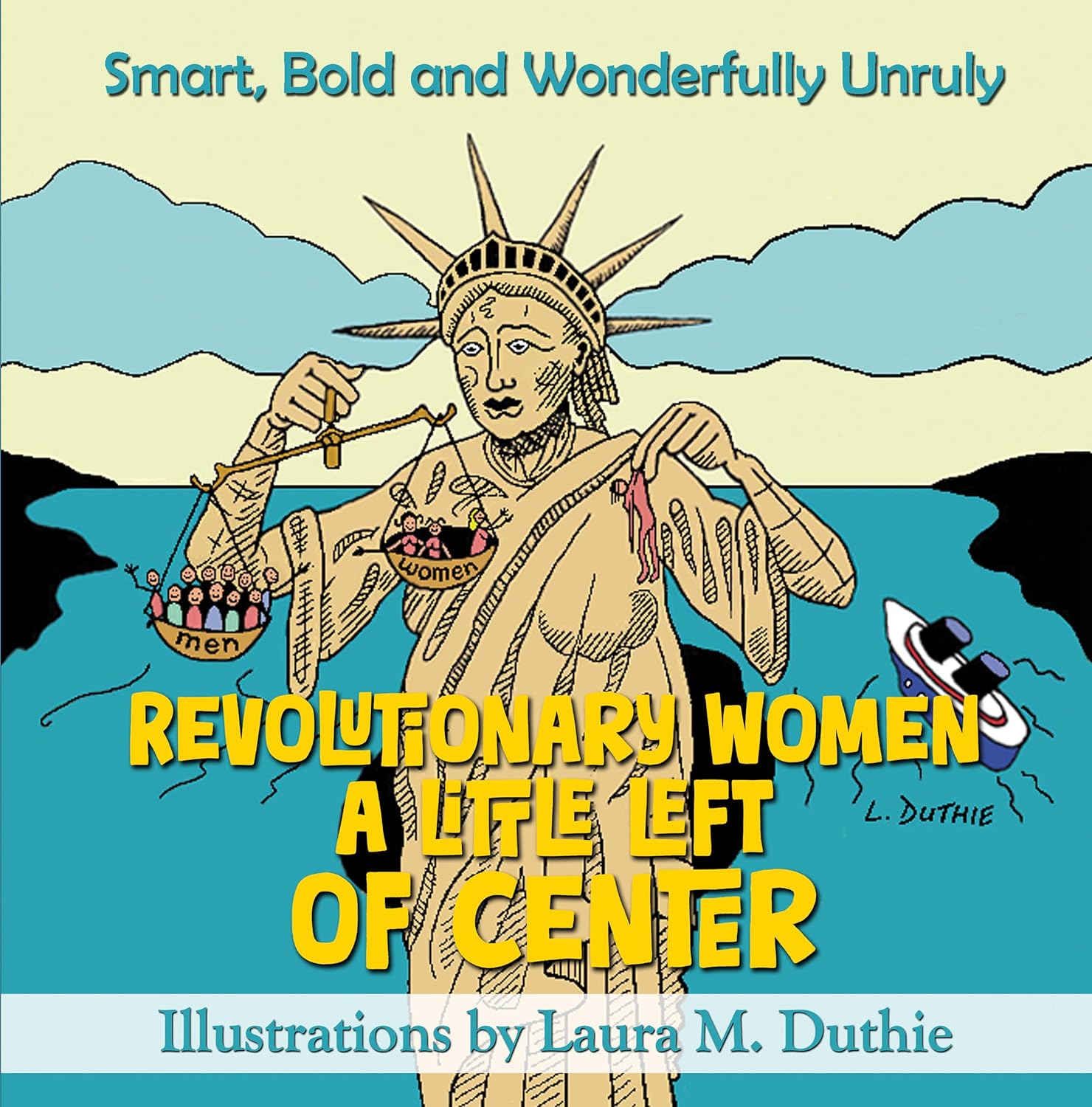
Laura M. Duthie’s Revolutionary Women: A Little Left of Center is part memoir, part feminist manifesto, and part visual commentary. The book weaves together Duthie’s personal history with her artistic and ideological journey. From her early life in Toronto to her awakening as a gay artist, Duthie recounts experiences that shaped her identity and worldview. Alongside her autobiographical reflections, she presents a series of feminist cartoons and essays that tackle themes like religion, patriarchy, sexuality, and society’s deeply ingrained biases. The work feels like both a confession and a call to action, a deeply personal yet universal exploration of what it means to claim one’s voice in a world that often silences women.
Reading this book felt like sitting down with someone who’s lived through several lifetimes of rebellion. Duthie’s tone is sharp and funny and sometimes achingly vulnerable. She doesn’t sugarcoat the pain of growing up under misogyny or the confusion of coming into her sexuality in an unwelcoming world. What struck me most was how her humor doesn’t dull her anger, it sharpens it.
The cartoon’s artwork is executed in a clear, traditional comic-strip style defined by bold outlines and a flat, simple color palette. This accessible visual style serves its purpose effectively, ensuring that the viewer’s attention is drawn immediately to the characters’ actions and the text in the speech bubbles. My favorite was the “Moon Walk.” The cartoon provides a sharp, satirical commentary on contemporary social polarization. It cleverly transports a modern “culture war” debate to a history-making moment, the first landing on another world, signified by the “APHRODITE I” lander. The humor stems from the juxtaposition of this grand achievement with petty ideological infighting.
There’s also something raw in how she talks about art and identity. When Duthie describes art school and the chaos of creative discovery, it’s electric. She paints the world of artists, the lost, the brilliant, the broken, with an honesty that’s both funny and sad. I felt her frustration with the hypocrisy of society, and I admired her courage to turn that frustration into something that challenges and provokes. Some parts run on, sure, but that’s part of the charm. It feels real. It feels like someone thinking out loud, refusing to polish herself for anyone’s comfort. Her take on Freud made me laugh. It’s the kind of commentary you wish you’d said yourself but never found the guts to.
This book left me thinking about what it really means to be revolutionary. Not in the sense of shouting the loudest, but in daring to be honest. Revolutionary Women is alive and full of heart and bite. I’d recommend it to anyone who loves art that has something to say, especially women and gay readers who’ve had to fight for their place in the world.
Pages: 67 | ASIN : B0FFZT3611
An Indoctrinated Horror Enthusiast

Witches and Pumpkins, Fur and Fangs is a collection of twenty short stories surrounding Halloween, bringing together tales of monsters, goblins, ghosts, witches, and everything scary. What was the inspiration for creating this collection of stories?
I got the idea for this collection after I saw the movie Trick ‘r Treat. I first watched that movie in 2009, which also happened to be the year I started writing for the first time. I remember thinking how amazing it was that the movie (almost) had a little bit of everything in it, and how it all took place in the same town on the same night. I thought to myself how cool it would be if a book or movie literally had EVERYTHING in it. Something like that movie, but on a grander scale. A year later, I wrote Jack of the Lantern. After that, I kept adding stories, always making sure they stood alone on their own, but secretly including Easter eggs that connected them to the others. I took the secondary characters from previous stories and threw them into the spotlight for their own stories. I made sure each one either addressed a different type of monster, or revolved around a different Halloween tradition or legend. Almost every character in the book appears multiple times. ‘Science Make Me Mad’ and ‘Can You See Me’ feature the same mad scientist antagonist. The librarian from ‘Hob Gob’ is a main character in ‘Incorporeal Beings’. Things like that. I encourage anybody reading to try to pay attention to the characters and all the connections, because there’s a lot of them.
What intrigues you about the horror and paranormal genres that led you to write this book?
I became an indoctrinated horror enthusiast since I was eleven. I was a child of the 90’s and grew up on late night television specials like Joe Bob Brigg’s Monstervision every Friday and Saturday night. I would catch Sunday afternoon showings of American Werewolf in London and Children of the Corn, complete with commercial breaks, just to find out later that the only parts they really cut out when editing for television was the nudity and cursing. All the scary parts were mostly still intact. I became fascinated with all things scary, and as a teenager I began reading Stephen King and Dean Koontz. I write other stories in the realm of science fiction or fantasy, but I always end up leaning towards the darker sides of things.
Do you have a favorite story in this collection, and if so, what makes it so appealing to you?
I have a couple. ‘Jack of the Lantern’ has always held a special place in my heart. Not only was it my first to write, it was also my first short story to ever get published. When I was reading these stories again for this collection, I stopped at ‘Incorporeal Beings’. I remember telling myself, “Wow I actually wrote this. This is pretty damn good.” I like a good ghost story, especially when it becomes clear that the ghosts are a real threat and can actually kill you. That story was a lot of fun to write.
What is the next book that you are working on, and when can your fans expect it to be out?
I am actively working on a novel entitled I Don’t Want to be a Monster. Imagine if Dexter was the Wolfman; that’s the basic concept. It’s about a werewolf who targets serial killers, rapists, child molesters, etc. I currently have several interested parties requesting the manuscript, and I’ve been given an early December deadline to complete (it’s almost done!). Hopefully you’ll be seeing that one soon.
Author Links: Facebook | Instagram | TikTok | Threads | YouTube


