Blog Archives
Winter in the City
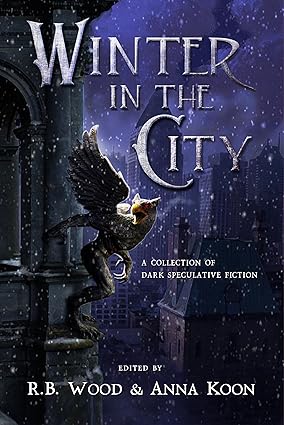

Cozy mysteries are a fall favorite, but if you’re looking for something darker to pair with those chilly nights, Winter in the City: A Collection of Dark Speculative Fiction, edited by R.B. Wood and Anna Koon, offers a different kind of intrigue. This anthology takes readers on a tour of 18 cities across the globe, transforming winter into an ominous force that influences each story. From an artist in Paris unraveling a chilling secret on the frozen Seine, to children navigating icy tombs in Jerusalem, and a fighter battling for freedom in Manila’s slums, each tale unfolds against the backdrop of an unforgiving winter season. The result is a thrilling mix of mystery, danger, and survival.
What struck me most about this collection was the vivid imagery woven into each story. Whether you’re in the snow-dusted streets of Brooklyn or the cold, eerie tombs of Jerusalem, the settings are brought to life with meticulous detail. Winter isn’t just a season here; it’s a character in its own right, shaping the mood and tension of every narrative. You can practically feel the biting cold in each scene, and that relentless chill amplifies the sense of isolation and danger throughout the book. This anthology pulls you into each city’s unique atmosphere, making it easy to get lost in these dark, speculative worlds.
Another highlight is how the collection offers a global journey. Each story transports readers to a new city, maintaining a consistent tone of suspense while offering a fresh perspective on urban life under winter’s grip. The variety of locations adds richness and depth to the overall experience, making every tale feel distinct yet part of a cohesive whole. While I feel a few stories might be a tad predictable, the overall quality of writing and the gripping atmosphere more than make up for it.
Winter in the City is perfect for fans of dark speculative fiction who crave both eerie tales and the thrill of exploring new places. If you’re in the mood to travel the world without leaving your cozy spot on the couch, this anthology delivers a suspenseful, chilling adventure through winter’s harsh embrace.
Pages: 340 | ASIN : B0DGQSD55H

Who’s There?: A Collection of Short Horror, Supernatural, and Ghost Stories
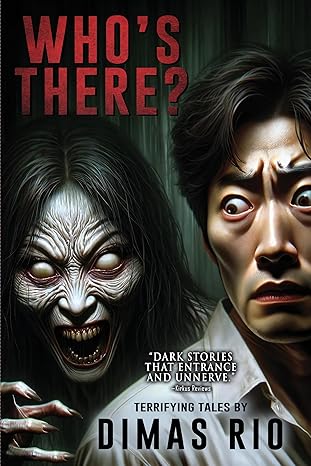

Who’s There?: A Collection of Short Horror, Supernatural, and Ghost Stories by Dimas Rio is a dark and immersive anthology of supernatural horror stories, each laced with elements of suspense and psychological tension. The collection delves into the realms of fear, exploring themes of guilt, unresolved trauma, and the macabre unknown. From tales of haunted islands to cursed beings hiding in the shadows, the stories are designed to unnerve and provoke reflection on the horrors that lurk not only in the supernatural but also within the human psyche. Rio uses atmospheric settings and introspective character-driven narratives to create unsettling experiences for the reader.
One thing that stood out to me is Rio’s use of atmosphere and psychological depth in the stories. He doesn’t rely on jump scares or typical horror clichés. Instead, the horror often comes from the characters’ internal struggles and guilt. Take, for example, the story of Adam, whose anxiety and fear of commitment bleed into his nightmarish encounters. The tension between reality and supernatural dread blurs in such a way that you’re never quite sure where one begins and the other ends. The vivid description of the cursed island and Adam’s mental spiral left me both unnerved and intrigued. While the ambiance and psychological themes were compelling, the pacing of some stories felt uneven. The buildup often took a while, and by the time the supernatural element kicked in, I sometimes felt like it arrived too abruptly. This left me wanting just a bit more payoff from the slow-burn atmosphere Rio is so good at building. One notable aspect of the book is how Dimas Rio weaves cultural references into his horror, especially drawing from Indonesian folklore. In “At Dusk,” when the old man mentions Kelinting, the blood-sucking spirit, there’s a distinct sense of place and history. It’s refreshing to see horror that taps into cultural myths that aren’t as widely explored in mainstream horror. This adds a layer of authenticity and makes the horror feel more personal, as if these are tales that could truly haunt someone’s village or neighborhood, rather than just abstract concepts of fear.
Who’s There? is a haunting and thoughtful collection that’s perfect for readers who enjoy slow-burn psychological horror with a mix of cultural folklore. It’s not a book for someone looking for quick thrills or gore; instead, it’s for those who appreciate moody, atmospheric horror that leaves you unsettled long after you’ve turned the last page. If you’re into horror that’s more about what’s lurking in the shadows of the mind, this collection is well worth the read.
Pages: 193 | ASIN : B0B29PSLSC
Create From the Inside Out

Little Fortified Stories is an entrancing collection of flash fiction that plunges readers into a series of surreal, evocative realms. What was the inspiration for the original and fascinating idea at the center of the collection?
A few years ago I was introduced to what was then called short-short fiction, essentially micro or flash fiction. I won a scholarship to attend the Disquiet International Literary Program in Lisbon, a city steeped in the past but roaring into the future, with an arts culture that fascinated me, whether it was Paula Rego’s startling, fairy-tale inspired artworks, Pessoa’s idiosyncratic, modernist writing, or the gut-wrenching emotion of Portugal’s native fado music. It all poured into me and influenced my first faltering efforts at writing flash fiction, efforts that took place in Lisbon’s Port Institute after my short-short fiction classes. It was here that I sat in the dimly lit room and sampled the national drink (port) and in my own “act of distillation,” produced compact, weird, touching, unsettling stories which would grow to become Little Fortified Stories. I immediately knew this was my genre.
Was it important for you to deliver a moral to readers, or was it circumstantial to delivering entertaining stories?
My interaction with the reader starts with my interaction with the deep material lurking inside my subconscious. Writing, for me, is more about “translating” voices or lived experiences than educating readers. That being said, in my writing I operate in an empathic sphere, trying to illustrate a range of human emotions and situational states that move characters toward some kind of change, however small. Like the great master, Chekhov, whose work I cherish, I don’t operate on a moral basis. Fiction’s purpose, in my take on it, is to share human experience, allowing the reader to reach their own conclusions.
The cover for this book is interesting. How did you create the cover for Little Fortified Stories?
I’ve always been drawn to theatre. My first two years in university were in theatre. I had a knack and maybe even a yearning to inhabit the characters of other people, to “occupy” someone’s physicality and inner world. Little Fortified Stories is an outcome of this desire. Although I didn’t continue pursuing theatre as a career, I turned instead to studying English and writing and my approach to writing is, rather than artificially planning a story structure, to create from the inside out. As Ray Bradbury said, “Your subconscious is smarter than you are.” In the Ancestral Fabrications section of Little Fortified Stories, I reach into both the factual and mythic elements of my ancestry. The story, “The Jaeger Family Theatre,” depicted on the cover is based on my maternal Swedish heritage but steeped in a wildly imagined past when people interacted with pagan gods and occupied their native landscapes as if they were an integral part of it. In this world, the narrator’s mother dies and as a jaeger bird, flies back to her avian origins in Sweden’s north. The narrator, in her mourning, remembers her childhood as a kind of family “theatre” where all members of her family acted out their lives. I thought this story was an ideal illustration of what I’m doing overall in the collection, and so I chose to collage it for the cover, showing the narrator as a young girl performing her role as the fifth born of the Jaeger clan—in both human and bird form. In a way, many of the stories in Little Fortified Stories are fragments of my own inner or remembered life, steeped in a dreamlike other-place. Many other stories, however, are sheer fiction!
Will there be a follow-up book for this collection? If so, what can readers expect in the next book?
Little Fortified Stories is a collection of loosely linked stories, tethered to broad themes. My next work, possibly a novella in flash, will, although told in flash chapters, have an overarching connection, be anchored in a timeframe from the early 1800s to 1980s and set in a partly imagined community on Canada’s west coast. Considering the unusual characters already hanging out in my brain, I predict it won’t be a traditional narrative and it will likely feature my oft-cited “poetic prose.” Of course, the muse might have other ideas.
Author Links: Book’s GoodRead | Author GoodReads | X | Facebook | Website | Instagram | Book Review
Little Fortified Stories

Little Fortified Stories is an entrancing collection of flash fiction that plunges readers into a series of surreal, evocative realms. Each tale, confined to just a few pages, draws you into atmospheres rich with historical references, enigmatic characters, and moments that blur the boundaries of reality. Inspired by an eclectic mix of influences, from spirituous drinks and art to the author’s own heritage. This anthology weaves a complex tapestry where the real and the imagined seamlessly intertwine. Each story offers a brief but potent experience similar to savoring the last drops of a rare, aged wine.
As I delved deeper into the collection, I found Black’s prose both captivating and disquieting. Her mastery of language is evident in every sentence. Stories like “Blood and Oranges” showcase imagery so vivid it verges on cinematic, leaving scenes etched in your memory long after the final word. Her characters, often ensnared in moments of deep introspection or unsettling situations, are hauntingly lifelike despite their surreal contexts. The author’s ability to evoke such powerful emotions within the span of a few pages is nothing short of remarkable. From the subdued horror of “The Bones of Amundsen” to the magical realism in “Where a Dark Heart Burns,” Black effortlessly navigates between genres and tones, keeping the reader perpetually on edge, never knowing what to anticipate next. This variety ensures that while some stories may resonate more strongly with certain readers, others may leave different impressions. Black’s writing often borders on poetic, with sentences that beckon to be reread and savored. In “Stitching,” for instance, the prose is so meticulously crafted that each word seems chosen to evoke a specific emotion or image.
Little Fortified Stories is a remarkable anthology for those who cherish literary fiction that challenges and enchants in equal measure. Barbara Black’s skillful blending of history, surrealism, and profound human emotion makes this collection a must-read for aficionados of flash fiction and for anyone who enjoys stories that linger long after they’re told.
Pages: 197 | ISBN : 1773861409
Curbside Curses: The Yardsale Anthology
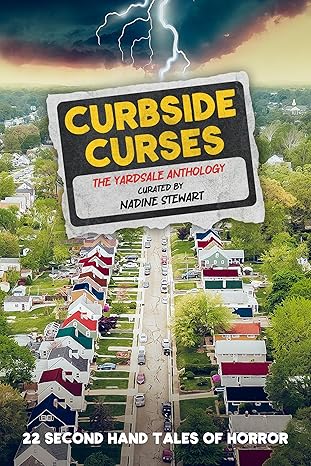
Nadine Stewart’s Curbside Curses is a compelling anthology of short horror stories. Each weaves together diverse characters and plots with a common thread: the eerie and unsettling consequences of items purchased from yard sales. This recurring motif serves as a clever vehicle to explore supernatural horror, infusing ordinary objects with malevolent forces and plunging readers into a world where the mundane becomes ominous.
The anthology stands out with its engaging stories, among which “Watered Down,” “Room for Two,” and “Huber” particularly shine. In Watered Down, Elaine grapples with disturbing visions triggered by a new waterbed while simultaneously trying to repair a strained relationship in the wake of infidelity. The narrative masterfully intertwines personal turmoil with supernatural terror, keeping readers on edge.
In Room for Two, Meg stumbles upon a mysterious box her partner Erin brought home from a yard sale, which seemingly possesses supernatural powers. The suspense builds as Meg unravels the dark secrets linked to the box, making for a gripping read. In Huber, at Jimmy’s housewarming party, an ordinary yard sale find, the Huber, reveals its sinister intentions, endangering all the guests. This story adeptly combines suspense and horror, resulting in a chilling and memorable conclusion.
Stewart brings the work of multiple authors together in this supernatural horror anthology that taps into the primal fear of the unknown, challenging the boundaries of reality and the rational mind. Everyday objects, such as a seemingly innocuous game cartridge or a harmless hairbrush, are imbued with a terrifying presence, provoking readers to question the familiar and the safe. The collection excels with its original and creative horror concepts, seamlessly blending supernatural elements, psychological dread, and physical terror. The authors’ finely crafted characters and unexpected plot twists contribute to an atmosphere of tension and unease, ensuring that the stories linger in the mind long after the final page.
Curbside Curses is a sophisticated and unpredictable journey through various facets of horror, making it a must-read for enthusiasts of the genre. While the mature themes and intense scenarios may not be suitable for younger audiences, adult horror fans will find Stewart’s anthology both captivating and deeply unsettling.
Pages: 332 | ASIN : B0D39QYRMV

It Started with a 1968 Impala

Automobilia is an anthology of short stories and poems that use automobiles as a central motif to explore a tapestry of human experiences. What was the inspiration for the original and fascinating idea at the center of the book?
I’ve loved automobiles since the day my father bought a new 1968 Impala from a dealer and drove it home. I was seven years old. He pulled into the driveway with the shiny, big car and it was a huge moment of excitement for the family. I still have that car today. In my early years of writing–when I was learning how to write a good story or poem–I had experiences related to automobiles that made me write about them. One was a poem I wrote about a high school acquaintance who was killed in an automobile crash just a few years after our graduation. A few years later I had a dream about someone killed by an automobile. And then I read a poem in a copy of Modern Maturity magazine that featured a writer’s memory of being a boy riding in the backseat of the family car, watching the moon following along on the ride. Those three things made me think that assembling an anthology of stories (and poems) by others featuring the automobile might be a cool idea that some readers might enjoy.
What were some goals you set for yourself as the editor of this book?
I wanted to assemble a collection of stories featuring automobiles as an integral part of the plot from famous or established authors like Matheson, Finney, and Nolan, along with newer writers. I also included some poems because the first professional sales I made as a new writer were poems to a couple science fiction and horror magazines. Stories from all genres were welcome in the anthology — from mainstream to science fiction to ghost stories — since the automobile is such an influential technology on the planet. Just about every perspective for a possible story can be connected to an automobile.
What was the process you used to collect the stories and poems for this collection and then narrow them down?
First, I set about looking for stories from known writers I might be able to buy reprint rights from. Each of those authors–or their agents for those no longer living–were very accommodating. I cannot thank them enough. Then I issue a call-for-submissions to the major writer’s markets listed on the internet, like Duotrope. I believe in paying writers (since I’m a writer too) a fair wage for their work. So, I offered the Science Fiction Writers Association per-word minimum at the time, which was eight cents per word and a dollar a line for poems.
I hope the series continues in other books. If so, where will the next anthology take readers?
Thank you for that good hope! There were so many GOOD stories featuring automobiles I could not get the rights to or include in a single volume I plan to publish two more anthologies featuring autos to make a trilogy. Right now, however, I already have a call for submissions out for the next two thematic anthologies. One is ALIENS AMONG US and the other is TRAIN TALES. I’m open for submissions for those until November 30, 2024. I’m paying a little more this time: 10 cents per word and $2 per line for poems. Publication for both books is planned for the first quarter of 2025.
Author Links: GoodReads | Facebook | Website
41 stories • 9 poemsSince the first automobiles rolled down a street, the range of human emotions attached to these machines has run from love to hate, humor to horror, joy to sadness. This book is a sampling of how fiction writers have viewed the automobile, from yesteryear to tomorrow.
Famous writers, experienced story tellers, and new literary voices are mixed together between these covers.
Automobilia is the first in a trilogy of stories and poems featuring that one machine that has changed the face of the earth, for the good and for the bad…the automobile.
Authors include: Jack Finney, George Clayton Johnson, Richard Christian Matheson, Richard Matheson, J. P. Seewald, Bruce Boston, Marge Simon, Kevin David Anderson, Katherine Tomlinson, James S. Dorr, William F. Nolan, Dean Wild, Sarah Key, Robbie Sheerin, and J.R. Hayslett, among many others.
Automobilia


Automobilia, compiled and edited by Jason J. Marchi and Jeffery L. Buford Jr, is an intriguing anthology that interweaves short stories and poems, using automobiles as a central motif to explore a tapestry of human experiences. This collection skillfully spans multiple genres, including thriller, drama, and horror, providing a varied literary landscape.
In this anthology, vehicles are not merely background elements but pivotal to the narrative structure. For instance, “Duel” is a gripping tale where protagonist Mann faces off against a relentless truck driver in a high-stakes road chase to San Francisco. “Passages” delves into the poignant story of Beth, grappling with the loss of her boyfriend Rick and his Mustang in a tragic accident. Meanwhile, “Homeless” introduces us to Max, whose late-night walk leads to an unexpected encounter at an accident site.
The stories in Automobilia are characterized by their exploration of themes such as loss, grief, resilience, redemption, courage, and the bonds of friendship. Each narrative offers a unique perspective on life’s complexities, enhancing the reader’s appreciation of the human condition. A standout feature of these stories is their unpredictability, which injects a sense of excitement and keeps the reader engaged. The use of automobiles as a unifying theme is not only original but demonstrates remarkable creativity. The stories are crafted with skill, demonstrating a keen eye for detail and a flair for capturing the reader’s imagination. While the anthology presents a rich variety of stories, a broader cultural context in some narratives could have offered an even more diverse and enriching experience. The writing throughout is concise and compelling, making each story a satisfying read.
Automobilia contains mature themes and hence, is more suitable for an adult audience. Readers who appreciate an inventive approach to storytelling and the exploration of human emotions and experiences will find this book particularly engaging.
Pages: 299 | ASIN : B0CVPZY4QV
The Curse of Balar

The Curse of Balar by Marcel M. du Plessis is a notable addition to the horror genre. It presents a series of interconnected stories that delve into the supernatural and the human psyche. The book commences with “The Sharpest Shadows,” a tale laced with tragedy and retribution. The murder of a young woman leads to a chilling sequence of vengeful events. This story sets the tone for the book, blending the eerie and the grotesque with a poignant examination of guilt.
In another gripping narrative, “The Beast of Scaffold Hill,” du Plessis crafts a vivid depiction of the decaying town of Balar, a setting that becomes a character in its own right. The story’s protagonists, Cutter and Scratch, are grave robbers whose grisly profession leads them into a spiral of supernatural encounters. The tension escalates as Cutter, haunted by memories of his abusive father, confronts both the literal and metaphorical ghosts of his past. du Plessis excels in creating an atmosphere that is both foreboding and immersive. The book’s setting, with its dark woods, ominous church, and ruined castle, plays a crucial role in heightening the sense of dread. The stories, while rooted in the supernatural, offer a profound exploration of themes like the consequences of one’s actions, guilt, and supernatural justice. Through characters like Cutter, du Plessis explores the complex interplay of past trauma and present horrors. While the book’s supernatural elements are compelling, it is the human element – the exploration of characters’ moral dilemmas and their struggles with guilt and punishment – that resonates most deeply.
The Curse of Balar is a spine-tingling horror recommendation that is sure to send shivers down your spine. This captivating tale not only scares but also delves into the depths of the human psyche, exploring the darker aspects of the human condition. With its thought-provoking narrative and expertly crafted plot, this collection of short stories is a must-read for any fan of horror.
Pages: 349 | ASIN : B0C99HBPTY


