Blog Archives
Smiling Faceless Woman


Smiling Faceless Woman, by Thomas J. Gebhardt III, is an expansive supernatural horror novel that mixes paranormal investigation, romance, coming-of-age anxiety, and a heavy dose of late-2000s pop culture. The story centers on Alexander Jacobsen, an ambitious linguistics student whose carefully mapped-out future starts coming apart when disturbing events invade his sleep and then his waking life. What begins with sounds, misplaced objects, sleep paralysis, and an oppressive presence eventually leads Alex into SPIRAL, a paranormal investigation group that treats hauntings as equal parts fieldwork, folklore, psychology, and spirituality. That blend gives the novel its identity. It’s paranormal horror with a personal center, where ghosts matter because of what they reveal about the people living around them.
Alex is a fitting lead because he’s skeptical enough to question nearly everything he experiences, but curious enough to keep following the evidence. His gradual acceptance of his family’s paranormal sensitivity works particularly well because it develops alongside a much more ordinary identity crisis involving school, work, ambition, family, and adulthood. The book repeatedly returns to his idea of “LIFE101L,” the informal education he gets when his meticulously planned life refuses to follow the syllabus. His relationship with April Wen becomes a major part of that education. Their connection moves through friendship, unrequited affection, sex, domestic life, grief, and eventual separation, giving the supernatural horror romance side of the book considerable space. When the novel jumps ahead and shows them officially together, that relationship feels authentic because readers have already spent so much time watching it form.
One of the book’s most distinctive qualities is how thoroughly it inhabits its era. MySpace, Nintendo DS systems, Motorola Razrs, mall jobs, MP3 players, memes, movies, bands, clothes, food, and internet culture aren’t occasional decorations. They’re part of the characters’ everyday vocabulary. The result is a remarkably specific time-capsule texture, especially in Alex and April’s scenes together. The prose likes to linger on conversations, meals, music choices, shopping trips, jokes, and small physical gestures, so the pacing has a roomy, episodic feel. That approach also changes the rhythm of the ghost story material. A frightening encounter can sit beside goofy banter or an ordinary afternoon, which makes the paranormal feel as though it’s intruding on an actual routine.
The occult horror and paranormal-investigation sections broaden the novel considerably. SPIRAL’s cases range from a dead child haunting a cottage to a violently malevolent presence on a ranch, and the team approaches each location with cameras, EVP recorders, EMF meters, historical research, prayer, intuition, and competing theories. The novel is especially interested in the argument between scientific explanations and supernatural ones. It discusses sleep paralysis, environmental causes, psychokinesis, folklore, Christian theology, indigenous spiritual practices, and the idea of Sheol as an overlapping realm of the dead. That investigative framework eventually grows into much darker territory involving curses, witchcraft, sacrifice, possession, and the literal smiling faceless woman. By the climax, the restrained unease of Alex’s early haunting has expanded into full-scale demonic horror, with the members of SPIRAL forced into a confrontation that makes their earlier investigations look almost gentle by comparison.
I liked that Smiling Faceless Woman is interested in connection. Alex begins as someone obsessed with controlling the trajectory of his future, and the novel keeps putting him in situations where knowledge, plans, and certainty only take him so far. Friendship, family, romance, faith, grief, and intuition gradually become just as important to him. Even after the violent paranormal climax, the story ends on quieter emotional ground, with Alex and April looking back on what they shared and acknowledging that life has carried them somewhere neither expected. That gives this ghost-hunting horror novel a surprisingly reflective finish. Its ghosts are memorable, its occult mythology is ambitious, and its real subject is the messy process of learning how to live when the world, both the visible part and the part hiding behind it, turns out to be much bigger than you planned for.
Pages: 440 | ASIN : B0FHF3MH7H

The Darkness Within

Aaron Ryan’s The Darkness Within is a psychological horror novel told through dated journal entries, mostly written by Tanner Barrett, a once-famous author who’s desperate for another bestseller. Tanner accepts an experimental serum called Syntax, believing it’ll restore his health and sharpen his creativity. It works almost immediately: his chronic pain disappears, his writing accelerates, and his new novel races up the charts. The catch is that Syntax doesn’t simply improve Tanner. It amplifies everything already inside him, including his vanity, resentment, envy, and appetite for revenge. What begins as an author’s frustrated account of a fading career gradually becomes the record of an addiction, a transformation, and a series of increasingly brutal crimes.
The journal format is the book’s strongest storytelling choice. Tanner’s shifting language lets us experience his deterioration from the inside rather than watching it from a safe distance. His early entries are conversational, defensive, and packed with complaints about reviews, scammers, sales, and the exhausting business of self-publishing. After taking Syntax, his prose becomes grander and more theatrical, then fragmented and frantic as the serum takes control. Tara’s entries provide a helpful counterweight. Her affection for her brother makes his collapse feel personal, especially when she realizes that his hunger for recognition had already weakened his moral boundaries before the serum arrived. The novel’s central idea comes through clearly: Syntax creates the physical monster, but Tanner’s obsession gives it direction.
The obvious comparison is Robert Louis Stevenson’s The Strange Case of Dr. Jekyll and Mr. Hyde, a connection the novel openly embraces. Like Jekyll, Tanner uses a substance to unlock a more powerful version of himself and discovers that the liberated personality has desires of its own. Ryan’s modern spin is to root that divided identity in the attention economy. Tanner isn’t chasing forbidden pleasure so much as visibility, praise, sales, and proof that he still matters. That makes his monster feel tied to contemporary anxieties about personal branding, online criticism, creative burnout, and the pressure to turn art into measurable success. The author also cites Stevenson in the afterword, describing Tanner’s story as a descent in which public image and private character pull further apart.
At times, Tanner’s repeated rants about rankings, promotion, scammers, and reviewers linger longer than the plot needs, but that repetition also shows how thoroughly his career has consumed his identity. The horror grows from that fixation, so the publishing details aren’t merely background. They’re the environment in which his bitterness breeds. By the final pages, Tanner has achieved the recognition he wanted while destroying the person who wanted it, and Tara’s closing revelation gives the ending a nasty sense of continuation rather than closure. The Darkness Within is a blunt, energetic cautionary tale about ambition becoming addiction. It works best when it treats the monster as an enlarged portrait of Tanner himself, because the most unsettling part isn’t that the serum changes him. It’s that it gives his buried impulses the strength to act.
Pages: 133 | ASIN : B0H6LXVP49
Blood Echoes

Aaron Ryan’s Blood Echoes follows Tracie Vossler, an ex-Marine turned prison security guard, as she becomes entangled in the horrifying mystery surrounding identical twins Elias and Gabriel Brickert. Set largely inside Airway Heights Corrections Center and told through shifting timelines, the novel begins with a murder that should be impossible and then widens into something far stranger: occult rituals, demonic possession, body-swapping, institutional panic, and a mother’s desperate fight to protect her daughter, Lela. What starts as a prison thriller curdles into supernatural horror, with blood evidence, security footage, and human memory all becoming unreliable witnesses.
I was most compelled by the novel’s atmosphere. Ryan gives Airway Heights a clammy, pressurized quality; the prison never feels like a backdrop so much as a sealed lung trying to breathe around something rotten. Tracie’s voice is brash, bruised, funny in the wrong places, and sometimes jagged enough to cut through the melodrama. Her fixation on burgers, cigarettes, nail appointments, and her daughter’s teenage moods keeps the story tethered to ordinary life even as the plot begins to levitate into the occult. That grounding matters because without it, the supernatural machinery could have felt too gaudy; with it, the horror feels personal, almost domestic.
The book also has a maximalist streak. It piles on murders, rituals, possessions, confessions, betrayals, legal fallout, and emotional wreckage with very little interest in restraint. The momentum is hard to deny. Ryan writes like someone determined to shove every locked door open, and the result is messy in a way that often feels alive. I especially appreciated how the novel refuses to let Tracie remain a clean heroine. Her love for Lela is luminous, but her choices grow morally murky, and the ending leaves a residue of grief rather than the neat click of a solved case.
I think this would be a great book for readers who enjoy supernatural horror, prison thrillers, demonic possession stories, occult suspense, body-swap horror, and psychological thrillers. Fans of Stephen King’s The Green Mile may recognize the charged prison setting and the sense that something otherworldly has slipped into a place already built for suffering, though Ryan’s novel is more lurid, more frantic, and more openly demonic. Blood Echoes is a grim and feverish book about blood ties, borrowed bodies, and the terrible cost of surviving evil.
Pages: 332 | ASIN : B0GXN2TMD5
Primordial, Beautiful and Dangerous

The Gap follows a group of migrants who are forced through the Darién Gap by traffickers, they encounter cruelty, hellish landscapes, and things that blur the line between survival and damnation. What was the inspiration for the setup of your story?
I had actually been in Panama at the time, preparing to move there with my wife and daughter. Unfortunately, that was an adventure we were unable to complete. I was flying home when the idea for ‘The Gap’ came to me. I had read about the human trafficking problem there, and done a bit of research on the area just out of curiosity. It’s such an interesting place. Primordial and beautiful and dangerous, like Earth must’ve been before mankind walked it. Like Skull Island in King Kong. And I pictured an obelisk, standing in a jungle, and that was it. I was off. I was fortunate; the story came to me complete on that plane, beginning, middle, and end. Many of the characters, the situations, everything. I didn’t have to fight that part, which was good. The languages were hard enough!
What first drew you to the Darién Gap as a setting for a horror novel?
The fact that no one had ever written any fiction about that area, and the timeliness of it. People were just starting to learn what the Darién Gap was, where it was, etc. The problem of human trafficking was growing in the Gap. And it’s so primordial; I wanted to write a Lovecraftian horror novel, and I couldn’t imagine a better setting for cosmic horror than the Darién. It’s dangerous just to go there, for real. The water is full of parasites and amoebas, the black palms have bacteria in their thorns, the snakes are all deadly, the insects are rampant, tropical diseases like malaria and dysentery are common, the heat is crushing, the rain is ceaseless, the guerillas will make you disappear. It’s a place human beings don’t belong. It seems a perfect setting for the worst possible things to happen.
The novel suggests that the line between human and monster is dangerously thin. Is that the core question you wanted readers to wrestle with?
I wanted to blur those lines, definitely. The creatures in ‘The Gap’ feel a real kinship with Pinche, the lead coyote in the story. He’s just like them; he uses people. When he needs to, he sacrifices them. He’s amoral, ruthless, but still human. It’s his willingness to bring people out there into the Gap that makes everything that follows possible. They monsters, the ACTUAL monsters, need a human conduit to act on their behalf, and Pinche is their man. He’s not aware of his complicity, but he’s doing their bidding in the end. In more real terms, the toll human trafficking takes on people in the the Darién Gap is horrific. The level of barbarism and depravity on display there on a daily basis would make most people wish they’d gone their whole life without seeing it. Anything awful that you can imagine occurring to human beings on this Earth does occur there. Rape, torture, kidnapping, murder, forced prostitution, forced drug smuggling. The buying and selling of men, women and children. Slavery, brutality, all relying on humanity to exist. It’s a hopeless, scary region. Setting a horror book there seemed like a natural fit. Half the work was done for me, because the setting is so dangerous in real life.
What reactions do you expect or hope for after someone finishes reading The Gap?
Well, I hope they tell all their friends and neighbors, and coworkers and complete strangers, even, to go right out and buy a copy. SEVERAL copies!! LOL! Honestly, I just hope they enjoyed the story and that the book scared them. Genuinely made them uncomfortable and grossed out. I think horror stories should be as scary as possible. If people buy a ticket for a roller coaster ride, they should get one! So, I hope my readers think the book did that, scared them and made them feel like they were immersed. Sweating, hungry, picking bugs off their necks as they trudge towards some unknown future. I know the inclusion of foreign languages can be challenging, but I wanted the reader to experience the trip the same as anyone in the book did. Coming to grips with differences in culture and language, having to adapt, just gives the reader that much more truth, in my opinion. I hope that anyone who reads ‘The Gap’ has never read another book like it!
Author Links: GoodReads | Facebook | Website
They face unrelenting heat, humidity, venomous animals and insects, poisonous plants, starvation, thirst, disease. The most dangerous creatures are the ones the travelers hire, to guide them through this primeval place.
Migrants are routinely robbed, raped, murdered, or simply lured down ghost trails and left to die. Terror and death are a constant companion.
The migrants are the nameless, known only by their dialects or countries of origin.
Guided through the hellish landscape by three ruthless, amoral human traffickers, each step becomes a struggle for survival as the group discovers the nature of the men to whom they have entrusted their lives. The violence escalates with each passing day, erupting in a shocking act of brutality. And the worst was yet to come.
Awakening from a horrific vision of ancient rituals and malevolent gods, they find themselves in a dreamworld of eldritch gods, old ones from the depths of space and time itself. With four dead at dawn, in the shadow of a malformed and alien edifice beyond reason, the group sets out to find their way back.
Over the course of the next four days, each of them discover that some paths are better left untraveled. That a new life can take on many forms. And that some gaps were never meant to be crossed.
The Gap

The Gap is a survival-horror novel that follows a group of migrants forced through the Darién Gap under the control of brutal coyotes. The story begins with a claustrophobic march through the jungle, where the guides Pinche, Mosca, and Guapo terrorize the group, and the environment itself seems determined to finish the job. As the days stretch on, exhaustion, cruelty, and the strange dread creeping through the rainforest shape a journey that becomes as psychological as it is physical. By the time the story reaches its ending, the line between man and monster feels disturbingly thin.
The writing is direct and raw. The misery hits you in small, relentless details: ants marching through a dead boy’s mouth, water that can’t be drunk without risking agony, a jungle that seems to breathe around the characters. The choices the author makes feel purposeful, even when they’re harsh. Scenes of violence make your stomach churn. At the same time, there’s a strange tenderness woven in through the quiet connections the migrants form, even when they don’t share a language. Those brief human moments, scattered among the horror, make the whole thing feel heavier.
What surprised me most was how the novel blends realism with a slow, creeping sense of the uncanny. For a long stretch, it reads like pure survival fiction, the kind grounded in real-world danger. Then the edges blur. Nightmares start to feel prophetic. The violence becomes ritualistic. By the end, the horror has tilted into something almost mythic, and the shift feels earned because the world was already so brutal that monsters didn’t seem far-fetched. I kept thinking about how trauma can warp perception, how the mind tries to make meaning out of dread. The book never overexplains its stranger moments, and that restraint makes them even more intriguing.
The Gap is a gritty survival horror novel with psychological and supernatural undertones, and it leans hard into the reality that human beings can be more dangerous than any jungle. I’d recommend it to readers who appreciate dark, visceral fiction that doesn’t pull punches, especially those who like their horror rooted in real places and real suffering.
Pages: 356 | ASIN : B0DQJ85XCG
Gangsters and Demons


Gangsters and Demons is a dark, pulpy, and strangely heartfelt novel set in 1920s Chicago. The story follows Jimmy Maloney, a dockworker trying to survive amid the city’s industrial grime, systemic poverty, and rising organized crime. What starts as a classic gangster tale gradually transforms into something much more unexpected, something deeply strange, even supernatural. As Jimmy gets drawn deeper into a criminal underworld, he confronts not just mobsters but literal demons, both personal and paranormal. The lines blur between addiction and possession, loyalty and survival, faith and fear. O’Neill stitches together Prohibition-era crime drama with elements of horror and religious myth in a way that feels both ambitious and unhinged.
I felt like I was being pulled into an old noir film that slowly melted into a fever dream. O’Neill’s writing is rich with mood and texture. The way he builds atmosphere, from fog-drenched alleys to crowded tenement kitchens, is immersive and unflinching. But it’s not just about setting. The dialogue is sharp and believable, especially when tensions rise between dockworkers and mob bosses. At times, the narrative veers into melodrama, especially when introducing the more fantastical elements, but somehow, it works. The raw emotion in the scenes with Jimmy’s mother or his deteriorating friendship with Nathan hits hard. You feel the weight of hopelessness, the creeping dread of losing control. It’s messy, and that’s what makes it feel real.
What surprised me most were the ideas buried beneath the genre trappings. Addiction, exploitation, poverty, faith, these aren’t just backdrops, they’re the bones of the story. There’s something gutsy about blending demonic possession with union strikes and rent hikes. It’s as if O’Neill is saying the real horror isn’t the supernatural, it’s the everyday grind that breaks people down. There were a few moments where the themes came through a little strongly, as if the story had something meaningful to share and leaned into it with intention. A couple of plot threads faded into the background, and a few characters seemed to serve more symbolic roles. Even so, the story gripped. I kept turning the pages, eager to see where it would go next.
I’d recommend Gangsters and Demons to anyone who enjoys stories that punch you in the gut and don’t apologize. If you’re into gritty historical fiction with a twist of horror, think Peaky Blinders meets The Exorcist, you’ll find something to love here. It’s bold, honest, and haunted.
Pages: 255 | ASIN : B0F48TS4R5
Chasing Moonflowers

Pauline Chow’s Chasing Moonflowers is a vivid and haunting novel that weaves together historical fiction, supernatural horror, and coming-of-age themes. Set in 1920s colonial Hong Kong, the story follows Ling, a young woman caught between her family’s traditions and the turbulent sociopolitical currents of the time. As Ling uncovers strange disappearances tied to mythic horrors and colonial oppression, her journey through the Kowloon Walled City and the surrounding marshlands becomes a fight for truth, identity, and survival. The story is steeped in Chinese folklore, political tension, and eerie mystery, creating a rich and unsettling atmosphere.
From the first few pages, I was hooked. The prose is crisp, full of sensory detail, and never afraid to get gritty. Chow doesn’t just describe Hong Kong, she drags you into its alleys, lets you feel the damp walls of Kowloon, and hear the eerie lullabies whispered to children. I felt a real emotional attachment to Ling, a clever and fiercely curious young woman who manages to be brave even while terrified. Her relationship with her family, especially her younger brothers, grounded the novel in a warmth that balanced the story’s darker turns. And make no mistake, the horror elements here are chilling. The supernatural is strange, grotesque, and soaked in myth. Think Lovecraft meets The Monkey King.
Some chapters fly by in a haze of thrilling discoveries and shocking twists, while others linger long on introspection or minor characters’ subplots. That said, I appreciated how Chow dared to explore trauma without giving neat resolutions. Her portrayal of colonialism’s reach, how it deforms not just cities, but psyches, is brutal and honest. There’s a weight to this story that sticks with you.
Chasing Moonflowers is a powerful story that blends historical fiction and horror in a way that feels timeless. If you’re someone who enjoys complex female leads, folklore-laced thrillers, or tales of rebellion against monstrous systems—literal and figurative—this book’s for you. It shook me, entertained me, and made me think.
Pages: 298 | ASIN : B0F1G51FWX

Curbside Curses: The Yardsale Anthology
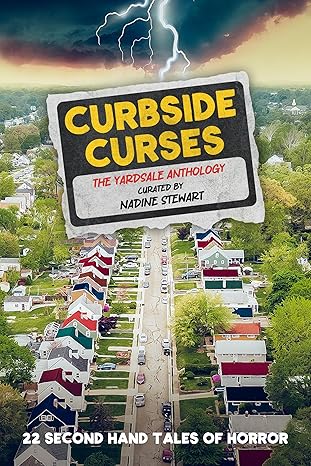
Nadine Stewart’s Curbside Curses is a compelling anthology of short horror stories. Each weaves together diverse characters and plots with a common thread: the eerie and unsettling consequences of items purchased from yard sales. This recurring motif serves as a clever vehicle to explore supernatural horror, infusing ordinary objects with malevolent forces and plunging readers into a world where the mundane becomes ominous.
The anthology stands out with its engaging stories, among which “Watered Down,” “Room for Two,” and “Huber” particularly shine. In Watered Down, Elaine grapples with disturbing visions triggered by a new waterbed while simultaneously trying to repair a strained relationship in the wake of infidelity. The narrative masterfully intertwines personal turmoil with supernatural terror, keeping readers on edge.
In Room for Two, Meg stumbles upon a mysterious box her partner Erin brought home from a yard sale, which seemingly possesses supernatural powers. The suspense builds as Meg unravels the dark secrets linked to the box, making for a gripping read. In Huber, at Jimmy’s housewarming party, an ordinary yard sale find, the Huber, reveals its sinister intentions, endangering all the guests. This story adeptly combines suspense and horror, resulting in a chilling and memorable conclusion.
Stewart brings the work of multiple authors together in this supernatural horror anthology that taps into the primal fear of the unknown, challenging the boundaries of reality and the rational mind. Everyday objects, such as a seemingly innocuous game cartridge or a harmless hairbrush, are imbued with a terrifying presence, provoking readers to question the familiar and the safe. The collection excels with its original and creative horror concepts, seamlessly blending supernatural elements, psychological dread, and physical terror. The authors’ finely crafted characters and unexpected plot twists contribute to an atmosphere of tension and unease, ensuring that the stories linger in the mind long after the final page.
Curbside Curses is a sophisticated and unpredictable journey through various facets of horror, making it a must-read for enthusiasts of the genre. While the mature themes and intense scenarios may not be suitable for younger audiences, adult horror fans will find Stewart’s anthology both captivating and deeply unsettling.
Pages: 332 | ASIN : B0D39QYRMV


