Blog Archives
Bad Americans: Part II


Bad Americans: Part II by Tejas Desai is a sprawling novel-in-stories set during the summer of 2020, after New York’s Covid lockdown, when billionaire dating-app magnate Olive Mixer gathers twelve Americans at his Hamptons estate for an experiment in romance, confession, competition, and moral exposure. Each night, a guest tells a story; in this second half, the book moves through Lisa’s #MeToo-inflected art-world account, Khassan’s provocation, Hayley’s modeling-world tale, Pritesh’s immigrant-professional odyssey, Sylvania’s fashion-and-identity chronicle, and Angela’s bruising finale, all while the frame narrative tightens around accusation, loyalty, illness, desire, and the question of who gets believed.
I admired the book most when it refused to let any character become a clean emblem. Desai is writing about America as a loud room where everyone has a grievance, a wound, a blind spot, and a microphone. The result can be abrasive, but productively so. The frame narrative has the nervous electricity of a reality show filmed inside a moral philosophy seminar: people flirt, sulk, posture, accuse, console, and revise themselves in public. I found that messy social weather more compelling than any single plot turn. The book understands that “discourse” isn’t abstract; it happens over food, sex, money, race, fear, vanity, and the old human need to be the injured party.
The novel’s appetite is almost gargantuan: it wants to absorb pandemic politics, gender conflict, race, class, immigration, celebrity, sexual harm, art, fashion, social media, tech money, and literary history all at once. Still, I would rather read a book that risks excess than one polished into anesthesia. Desai’s best scenes have a jagged vitality; they make the reader sit in contradiction instead of offering the soft chair of easy judgment.
I would recommend this to readers of literary fiction, social satire, contemporary American fiction, and frame narrative experiments, especially book clubs willing to argue rather than merely agree. Readers who enjoy the social sweep of Tom Wolfe or the polyphonic setup of The Decameron will recognize the pleasure of watching a whole culture refracted through competing stories, though Desai’s sensibility is rawer, more contemporary, and more quarrelsome.
Pages: 454 | ASIN : B0GGV7Q3TH

Breaking All the Rules

Bad Americans: Part I is a collection of interconnected short stories that follow 12 strangers who gather in a billionaire’s Hamptons mansion to date, compete, and tell stories during the summer of 2020 and the COVID pandemic. What was the inspiration for this book?
The inspiration actually started almost 25 years ago, in 2001. Right after the 9/11 attacks, I moved from New York City to the UK to study abroad at the University of Oxford. Right across from my College, Wadham, was Blackwell’s Bookshop, and sometimes I would explore books there. I started reading The Decameron, by Giovanni Boccaccio, in depth. I had already read The Canterbury Tales, by Geoffrey Chaucer, in high school, and in general, I really liked the exciting, satirical works of the past. At the time, I was also experimenting with narrative forms and basing them on the ancient and classic works I was reading. For my Fiction Workshop Tutorial, I tried to write a story within a story, but it didn’t go so well. I thought that one day I would have the narrative skill to do this–to one-up Boccaccio and Chaucer and write a frame novel with short stories where each reflected and reinforced the other, and our time.
So fast forward to 2019, I was finishing up the editing of The Dance Towards Death, the third book in The Brotherhood Chronicle, which was coming out in September 2020, and I started thinking about the next book in The Human Tragedy, my panoramic portrait of American society in short stories, the modern version of Balzac’s Human Comedy. The first volume, Good Americans (2013), was a highly provocative and challenging short story collection that definitely did progress its form, but it was also rather conventional in its basic structure. So I thought to myself, how do I one-up that? And that’s when I thought back to my original challenge from 2001. I already had 4 books under my belt, each with a different aesthetic or narrative challenge, so I figured I was up to the great task of writing a novel containing stories that worked both ways: as a novel and a short story collection. I came up with a basic sketch of 10 Americans quarantined in an academic library during a pandemic. Each day they would interact, and each night one would tell a story.
Then the pandemic actually hit us. In late January 2020, I became extremely sick and had to cancel my trip to SE Asia. NYC shut down, my parents got sick, and neighbors died. My mom was on the frontlines. And I followed everything that was happening. I saw the rich were moving to the Hamptons to escape, just like in The Decameron. And there were breadlines on the streets of Queens, riots in Manhattan. Assaults on Asian-Americans, a disproportionate toll on People of Color, especially frontline workers. Rhetoric about immigrants. So I realized, as someone who was dedicated to realism in my works as it was, that I had all the material in front of me for Bad Americans. I just needed to do background research, and eventually, after the first draft, get some opinions on the stories and the characters telling them. The setting moved to The Hamptons, I invented all the characters, and wrote a massive first draft, both frame narrative and individual stories. I got feedback on the individual stories from people I trusted who might have similar backgrounds. Some of the stories, and to a lesser extent, character details, changed a bit, though not dramatically. And the frame narrative just needed to be condensed, which I eventually did after successive drafts.
With twelve major voices, how did you keep each character distinct? Did any character surprise you as you wrote them?
It just happened, I don’t know. I did initially write a bunch of character sketches. There were a lot of details about each character in the first draft that were discarded in future drafts, and there were some concerns by beta readers early on about the characters’ needs and motivation to be in The Getaway. But in general, the characters stayed consistent and dimensional. All my books feature tons of characters, and each is multi-faceted yet vivid, so that wasn’t difficult per se. It’s just the way my imagination works. So I could already picture them all from the beginning.
I’m not sure any of the characters really surprised me. I guess my main dilemma was how to portray the billionaire Olive Mixer. The popular choice would be to make him into some evil rich person, a la Squid Game or something. But I didn’t want to do that. I wanted to make him dimensional and human too. He has his reasons for creating The Getaway, like each guest has for being there. Of course, he is Big Brother here, but nevertheless, he didn’t need to be overly evil or anything. Same thing with Taylor, or Ricard, or even Lisa and Hayley. They all have their good and bad sides. They might annoy you, but that just makes them more human and realistic.
The book doesn’t shy away from political and cultural clashes. What risks did you feel you were taking?
The whole book is a risk, as is all my work. So I figured, as long as we are breaking all the rules, we might as well go all the way. Of course, it’s basically prohibited to have political and, to a lesser extent, cultural clashes in mainstream literary fiction. With the latter, especially when you have someone of a particular cultural background, according to the unwritten rules, you can only write about that group. The truth is, we live in a cross-cultural society, especially in Queens, NY, so that’s absurd, especially if you’re trying to portray reality, and it also highly dilutes the possibilities of narrative content and form.
And really, the extent to which contemporary politics should play a role in the book’s conflicts was a dilemma for me early on. Other than being against the grain, I was also worried that such references would make the book feel dated for someone reading it 20 or 40 years from now. But I decided that if I was really going to make a realistic portrait of the time, there’s no way I could shy away from it. That was one of the major fault lines of the time, as it is today. So I embraced it, at least early in the book.
Each guest’s story changes how the group sees them. What does the book suggest about the power of storytelling itself?
We tell ourselves and each other stories all the time, and this is especially true in trying circumstances, especially when a bunch of people are forced to be together. But the short story collection has become a rather staid form. Everyone knows how a collection of stories is going to be structured at a basic level, even if it’s a novel-in-stories, like Winesburg, Ohio, and many books like it onwards (Olive Kitteridge, for example). And usually, we know that each individual story is going to end with some sense of character revelation. So one strength of having frame characters tell the stories is that it makes them and us see these stories as a dynamic, fluid, and even questionable form. Unless we have an unreliable narrator, to some extent, each story in a traditional collection is given somewhat holy and unimpeachable status. But you wouldn’t give that status to a story your barber or Uber Driver told you. Even while being thoroughly engaged and entertained, you would question its authenticity and its objectivity, wouldn’t you? So, on a basic level, that’s what the book is trying to get at: storytelling at its rawest and most realistic form.
Now, transfer that rawness to the immediacy and tensions of the pandemic, and you see the true power of storytelling emerge, which is the haunting effect of portraying the basic struggles of life: life and death, love and loss, privilege and want. And apply it specifically to characters from different walks of life quarantined in a mansion, and now you have a third dimension, which is context. The characters know each other on a basic level, many of them might even want to date each other, but they don’t necessarily trust each other, or know the context of their lives or positions. Now you are questioning and portraying, but you are also revealing. And you are seeing a picture of the lives of others who are not in the mansion either.
So each character has an objective for each story, each reveals themselves in each story, but not necessarily in the way they want to, and perhaps they have a different goal for each character listening. And the other characters will see them through a mix of their preconceived notions, and how they’ve been convinced or changed by the story in question. It’s an endlessly complex equation you can go over and over. Which is the point of the exercise.
So I think the book demonstrates the immense power of storytelling and also the complexities of the motivations of narratives told.
Author Links: GoodReads | X (Twitter) | Facebook | Bad Americans | Good Americans Collection | Tejas Desai | Website | Amazon
Winner of Bestsellers World Reviewers Choice Award in Short Story/Anthology (1st Place)
Critics and Readers Rave: “A Timeless Masterpiece” “A Landmark Literary Event” “A Genre-Defying Tour De Force” “A Masterpiece of Literary Fiction” “A Moral Reckoning” “A Panoramic Portrait of the American Experience” “A Literary Time Capsule and a Mirror” “Fearless, Thought-Provoking, and Utterly Absorbing” “A Must Read”
Summer 2020: the Covid-19 Pandemic is raging. A reclusive billionaire, Olive Mixer, calls twelve diverse & lonely Americans to his mansion complex in the Hamptons: nurses, lawyers, mechanics, social workers, students, financial analysts, soldiers, Uber drivers, engineers, hair salon operators. During the day, the guests meet, compete, date, dine, flirt and fight. Each night, one must tell the group a story.
Their tales range widely in subject, style, length and decorum. Many stories respond to each other. They trigger passionate debate and fiery resistance. They change how characters perceive each other and affect the trajectory of the frame narrative. They make us ponder the nature of storytelling itself.
Bad Americans is part Boccaccio and part The Bachelor, but it is a creation all its own. Both a novel and short story collection, Bad Americans is at once a powerful portrait of the American pandemic experience and an examination of narrative itself. Bad Americans: Part I includes the frame narrative and the first six stories. Bad Americans: Part II will conclude the frame narrative and include six additional stories.
These two books are the second and third volumes of the profound and daring anthology series The Human Tragedy, following the subversive classic Good Americans.
Bad Americans: Part I

Bad Americans: Part I is a big collage of stories wrapped inside a wild and strange summer retreat. Twelve Americans head to the Hamptons during the first Covid summer, brought together by a billionaire who wants them to share meals, go on dates, compete in games, and tell stories every night. Their tales reveal pieces of pandemic life, cultural friction, loneliness, and hope. The frame narrative follows the guests as they argue, flirt, bond, and judge one another. Inside that frame sit the stories they tell, each one capturing a different slice of American life during a time when everything felt fragile. The book moves from hospitals overflowing with fear to city streets full of noise and protest.
I was pulled in by the bold mix of voices. The writing jumped between tones and moods, and sometimes it caught me off guard in the best way. One minute I was laughing at a character’s dry remark, and the next I felt a lump in my throat as someone described a loss. The author writes with an energy that propels you forward, and I liked that. The moments with Andrea, the nurse, especially resonated with me. Her story about the ICU felt authentic and honest, and I could almost hear the alarms and taste the fatigue that soaked every shift. The book’s choice to set these heavy stories inside a glitzy mansion made everything feel even stranger, and somehow more real.
The author leans into the messiness of America. People squabble over politics, race, class, and identity. They misread one another. They cling to their own truths. I wished the dialogue would slow down sometimes, but I think that constant rush was the point. The country has not been quiet for a long time. The book mirrors that noise, and it does it with heart. I respected the risks it took.
I would recommend Bad Americans: Part I to readers who like big casts, sharp contrasts, and stories that jump from tender to chaotic without apology. Anyone interested in how fiction can capture a national mood would get a lot out of this book. It is not a simple read. But it is full of life, and it stirs emotions that stay with you for a while afterwards.
Pages: 390 | ASIN : B0FF5DZ7GV

He Must Bend The Rules

The Dance Towards Death follows a private investigator traveling the world trying to complete his mission. What was the inspiration for the setup to your story?
The Dance Towards Death is the third book of The Brotherhood Chronicle trilogy–although each book can be read independently, reading each successively can help one understand the evolution of the main character Niral Solanke and many of the other characters in the trilogy.
In the first book, The Brotherhood, Niral has lived a life of dissipation but he believes he can redeem himself through religion and spirituality. He struggles with this quest throughout as he experiences more of the world including its deep corruption. Considering he is indebted to several organizations, he loses his faith and also reconsiders what a true “dharmic” path is.
So by The Dance Towards Death, he realizes he must bend the rules to get out of his entanglements and do the right thing. Not everything goes as planned, of course.
Much of the setup is based on my personal experiences and lots of research I did over many years. I’m first-generation Indian-American, born in New York City to Indian immigrants and raised in Queens, NY, so while there are many differences between Niral and me, I could base him on a real background. I was raised Hindu although I am agnostic, and I grew up in a highly multicultural environment, so I’m knowledgeable about many cultures and backgrounds. I’ve taken many trips to Thailand, India, Australia, and the American south, so that’s helped with the setting details and bringing them alive.
Finally, New York City was a very dangerous place when I was growing up (seems to be reverting back now), so I’ve had a natural connection to its criminal elements and the working class, but also to the wealthy elite, from financiers to lawyers and politicians. While the book is fiction, just being in that environment helped me with details and bringing it alive, although there was plenty of research done and the majority is based on that, but elevated by the imagination into fiction. And Hindu philosophy, a multifarious tradition which looks at life as a whole, with its elements of kama (pleasure), artha (wealth), dharma (duty) and moksha (enlightenment), provided me the ingredients that I could play and build with regarding the book’s drama, both internally within characters and externally in terms of the plot.
I felt that there were a lot of great twists and turns throughout the story. Did you plan this before writing, or did the twists develop organically while writing?
I usually have a two-tier process: I plan everything out, and then I just write and develop things as I wish, rarely staying true to the original plan. Sometimes it takes a few rewrites of the book to get to what I want. The Brotherhood was rewritten from scratch over 20 times, whereas The Run and Hide and The Dance Towards Death were written in one continuous draft, though I did rewrite the whole draft once more, to tighten up the action, and then did another run through to clean up the language. Then copyediting, proofreading, etc. So it depends on the work, but for the most part, I’m best when I do some light planning and then let things roll as they will.
Were you able to achieve everything you wanted with the characters in the novel?
That’s a tough question. I think The Dance Towards Death is satisfying, and most characters achieve their arcs, but not necessarily in expected ways. The book leaves a lot open too, just like in life. There will likely be a fourth book, but probably not anytime soon.
What is the next book that you are working on and when will it be available?
Bad Americans, the second book of my anthology short story series The Human Tragedy, will hopefully be available sometime in 2023 or 2024. I achieved my New Years Resolution in January 2022 by finishing the first draft–a whopping 300,000 words (the length of three full-length novels). It’s a very ambitious book–a 12 story collection within an extravagant frame narrative set during the Covid pandemic–parts Boccaccio, The Bachelor, Big Brother and Upstairs Downstairs. I’m getting great feedback from beta readers and the rewrite is going very well, but such a large book will take a while to perfect, and then there’s the publishing process…
Author Links: GoodReads | Twitter | Facebook | Author Facebook | The Brotherhood Chronicle Series | Good Americans/The Human Tragedy Series | The New Wei Literary Movement
Niral Solanke is on a mission, but he’s not sure who to trust: the terrorist organization that wants him to carry out a political assassination, the criminal gang that has him locked in perpetual debt, the drug dealer who wants his help setting up a new enterprise, or the religious organization that wants him to heal society.
The ingenuous way he balances these interests and survives is the core of this remarkable noir epic that also features the captivating stories of detectives, financiers, politicians, political radicals, military generals, strippers, hired killers and many others across the entire world including Thailand, India, Australia, Russia, the American South, and New York City.
The Dance Towards Death is the third book of the bestselling The Brotherhood Chronicle series, but can be read independently.
The Dance Towards Death
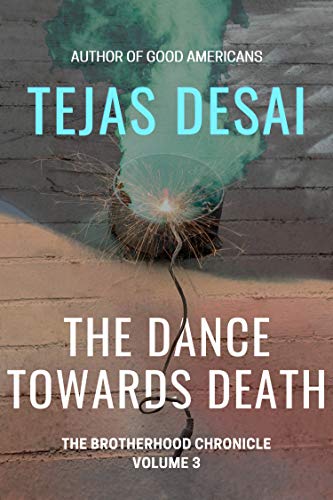

The Dance Towards Death, by Tejas Desai, is the third volume of The Brotherhood Chronicle. It narrates the story of some of the survivors in a criminal world. Among them, there’s the former private investigator Niral that is involved in drug affairs, and policeman Nat who’s looking for his son after having abandoned him and trying to understand what’s behind his parents’ death. Even being the third book in the series, it stands alone, and readers are given enough background in the opening chapters to not feel lost in this action-packed conclusion to the series.
Desai writes in a descriptive manner, taking readers to Thailand, India, Chiang Mai, and Queens, New York. Readers will experience the dramatically different cultures and ways of life from the images that Desai creates with his words. While experiencing the diverse cultures of the world, readers are given plot twists and suspense as the characters go through their thrilling adventures seeking to solve their own mysteries that have caused their lives to intertwine.
I really appreciated the insight into different cultures and religions, primarily focusing on different characters and their backgrounds from chapter to chapter. There are different stories that take place in different parts of the world, but they’re all interconnected. The respectful nature that Desai treated the different cultures and religions that he writes about is commendable.
The character’s backgrounds, such as Hinduism, Buddhism, and Islamism, are integrated into the storyline rather than just thrown out as information that may otherwise feel out of place. This is important to show a clash of cultures. We also get to see significant social problems such as racism and homophobia. In addition to that, many Indian, Thai, Australian and American terms are frequently used, making it feel more authentic. Still, readers won’t be lost in translation as at the end of the book, there’s a glossary with all the necessary terms.
This action-filled novel will take some time to experience all the characters’ journeys and follow them on their search for freedom or for relatives. However, in my opinion, the most meaningful point of this novel is the focus on what the characters find along their path, not necessarily what they’re looking for.
The Dance Towards Death is a riveting novel that will have readers in suspense as the characters navigate the thrilling adventures around the world. Readers looking for an authentic experience with different religions and cultures will find this crime thriller the perfect escape.
Pages: 417 | ASIN : B08BBGKHJX


