Blog Archives
Destiny of Daring: Never Forget


Destiny of Daring: Never Forget weaves the harrowing tale of an Armenian family’s endurance during the Ottoman-perpetrated genocide and the ensuing political turmoil post-World War I. Set against this historical backdrop, the novel follows Cassie in contemporary times as she embarks on a quest to reconnect with her relatives from the Gulumian lineage, piecing together their ancestral saga of resilience. Central to her discoveries is the story of Nazeli, a survivor who assumes the identity of Emine to marry into a Muslim family, and her sister Nane. This narrative portrays a world marked by hostility and brutality yet punctuated by instances of hope, courage, and human kindness.
As the third entry in Cathy Burnham Martin’s Destiny Trilogy, the book gains depth and realism from its basis on true recollections. This grounding in reality brings a poignant authenticity to the narrative, sometimes intensifying the emotional impact of certain passages. Martin carefully delineates between the actions of the Ottoman government and its people, highlighting the distinction between a tyrannical regime and the individuals under its rule. While the novel is firmly rooted in historical fact, its dramatization, particularly in character dialogues, adds a unique layer to the narrative. The verbal expressions, passionately focused on denouncing the atrocities, emphasize the emotional intensity of the story. This narrative technique reinforces the gravity of the events, echoing their deep impact on the characters’ lives.
Destiny of Daring offers a lens into the struggles faced by the Armenian community during a tumultuous era. Its educational value is notable, shedding light on a period that may not be widely familiar to global audiences, thereby providing both a compelling and informative reading experience.
Pages: 254 | ASIN : B0CK558SZB

Frank’s Shadow

In Frank’s Shadow, Doug McIntyre artfully intertwines the lives of Danny McKenna and his late father, set against the backdrop of a complex family dynamic and the gritty streets of New York City. The novel opens with Danny, newly married, grappling with the sudden death of his father. Tasked with delivering a eulogy, he faces not only the challenge of articulating his feelings but also the scrutiny of his discerning Irish family.
An intriguing thread runs through the narrative: the coincidence of Danny’s father passing on the same date as Frank Sinatra, Danny’s idol. This parallel prompts a deeper exploration into his father’s past, a journey that reveals more mysteries and complexities than Danny anticipated. McIntyre’s narrative style is reminiscent of the early works of Paul Auster, the poignant storytelling of Frank McCourt in Angela’s Ashes, and the raw realism found in Charles Bukowski’s novels. The book navigates themes of alcoholism, family discord, and buried secrets without veering into the realm of the overly sentimental. McIntyre skillfully balances these heavier elements with well-timed dark humor and insightful character development. The story unfolds layer by layer, revealing incredible depth. While it initially appears to be a journey of self-discovery for Danny, it gradually becomes clear that it is as much, if not more, about his enigmatic father. Central to the novel is the exploration of identity and the realization that our surface impressions of people can vastly differ from their true selves.
McIntyre’s work stands out for its robust characterizations, heartfelt emotion, and a confident mastery of language. Frank’s Shadow is not just a compelling read; it is a testament to the power of nuanced storytelling and character exploration in contemporary fiction.
Pages: 272 | ASIN : B0BZNR7KKS
Overlap: The Lives of a Former Time Jumper

N. Joseph Glass’s novel Overlap refreshingly reimagines the often-overused concept of time travel, presenting it as a complex and emotionally charged journey rather than a straightforward trope. Time travel is not a simple leap across quantum space but a path fraught with challenges, consequences, and profound human interactions. Glass excels in crafting a universe where every action is significant and where the mechanics of time travel are both logically sound and emotionally resonant.
The story centers around Marcus, who, after losing his wife Ellie in a tragic incident, dedicates himself to unraveling the mysteries of time in a bid to reverse his loss. His quest, driven by deep personal grief, leads him into a labyrinth of temporal experiments and business ventures. Glass’s portrayal of Marcus’s invention of time travel stands out as a highlight, evolving throughout the novel into a captivating and dynamic plot element.
Glass’s narrative prowess and character development in Overlap are commendable. His work rivals that of more established authors in the genre, showcasing a remarkable consistency in both the complex mechanics of time travel and the richly developed characters. The dialogue is clear and effective, skillfully driving the narrative forward. There are moments when the dialogue subtly invites the reader to engage more deeply with the text, offering an opportunity to discern the characters’ distinct voices through context rather than relying on dialogue tags. This nuanced approach adds a layer of sophistication to the narrative. This story is a standout example of time travel fiction, captivating in its execution and memorable in its storytelling. Glass has created a world where consistency in character development, narrative mechanics, and overall quality is paramount.
Overlap by N. Joseph Glass is a thought-provoking and intricately woven tale that challenges and redefines the conventions of time travel fiction. Its strengths lie in its well-crafted narrative, complex character development, and innovative approach to time travel mechanics. Glass’s work is a testament to the imaginative possibilities within the genre and a must-read for those who appreciate a story that combines intellectual rigor with emotional depth.
Pages: 235 | ASIN : B0CHBDLYD9

The Past is the Past

Eleonora and Joseph: Passion, Tragedy, and Revolution in the Age of Enlightenment follows an aristocratic woman who becomes an advocate for liberty and plays an important role in forming the Neapolitan Republic. What was the inspiration for the setup of your story?
Good question, thank you! Many years ago, one sunny Saturday morning, I was walking in the streets of Naples and found in the Spanish Quarter a school that bore the name of Eleonora Fonseca Pimentel. I was surprised: this was a Portuguese name, not Italian. I had never heard of Eleonora; she wasn’t well known in Portugal as I was growing up. So, I looked up her name. Later, I read The Volcano Lover by Susan Sontag; the novel takes place in Naples during the time of Eleonora’s life. At the end of the book Sontag has several monologues and one of them is by Eleonora. I enjoyed Sontag’s book but didn’t like Eleonora’s voice: it didn’t sound quite right to me. I thought I could do a better job with her literary voice, after all I am Portuguese like Eleonora. I hope I don’t sound presumptuous, but this is exactly how I felt. So, I decided to write the novel. It took me years to complete the job.
Your novel is rich with historical details that are not well-known to the average reader. What kind of research did you do for this novel to ensure you captured the essence of the story’s theme?
I am a very disciplined person, but writing a historical novel takes a huge amount of work. Huge! I also love history, and so, this combination of discipline and love for a given theme can be quiet rewarding. Moreover, I love the freedom of imagination that fiction allows me. For credibility’s sake, a historical novel needs to be both accurate and plausible. These are different issues. Accuracy has to do with knowing the period well enough not to make gross historical mistakes about events, dates and so on. Plausibility is about filling in the historical record in such a way that what we don’t know as an historical fact (or event), could indeed have occurred. Good historians share this approach with historical novelists: think of a book like Citizens by Simon Schama, a professor at Columbia University.
Therefore, you look at historical sources and go back and forth all the time about issues. Compare sources. Check again and again, look at information from different angles. Take notes, build private maps of many lives and historical facts. Then you create your own road map. If lucky, you get close to the truth. I wrote close to the truth – not the truth itself. That doesn’t exist and historians know this as well as historical novelists. That someone was born in such a such date is just a fact, but the truth of someone’s life is something very different. It requires digging up, examining that life in dept, looking at it from many different angles, with vision and perspective.
What was one scene in the novel that you felt captured the morals and message you were trying to deliver to readers?
Another good question! We can’t look at the past as if the events we are describing took place at the time we are writing. The past is the past, no way around it.
An example comes to mind, and it has to do with Jefferson’s Monticello.
We rightfully condemn slavery today but, as horrible as it was, it was an accepted practice for centuries. I read recently a great book, Wicked Flesh by Jessica Marie Johnson. Descriptions like those of the Middle Passage are gut-wrenching. But the book also shows how people in captivity were also able to take some advantage of the conditions they were in.
I needed to be very thoughtful when describing Joseph Correia da Serra’s views of Monticello when he and Jefferson go for walks there. Jefferson was a complex man, full of contradictions. To such an extent that when he died, his family had to sell his slaves to pay a few of his debts. And later, Monticello itself had to be sold, too.
This is, somehow, beyond belief, but it did happen. There were, however, much crueler slave owners in Virginia than Thomas Jefferson. Nevertheless, to say – as I read somewhere – that he raped Sally Hemings for a lifetime is a distortion of their lives. It represents a total lack of understand of the historical period. Slave owners did sleep with slaves, and the practice was much more generalized than one tends to believe. Reproachable? Yes, certainly, and also a crime in Virginia. But Sally Hemings did succeed in having her children freed when they grew up. She wasn’t sold either, she lived as a free woman in Charlottesville after Jefferson’s death.
So, the difficulty of this kind of analysis is to find the balance of a life, any life. In the past, as much as in the present. One only needs to consider one’s own life (one among many other lives, mind you!) to notice the challenges that ‘balance’ presents.
What is the next book that you are working on, and when will it be available?
I have just returned from Istanbul, where my next novel takes place. It’s another historical novel, the set-up is Constantinople in the late 18th century. I had a great time, and a dear Turkish friend helped me enormously, but I am dealing with an artist whose work is far greater than his extant oeuvres. That is not what I was hoping for…
The soul of a place is important, but the way it touches you as an author, that’s important too! I still need to figure out how to deal with my, somewhat, disappointment. How can I say this? I wanted a particular 18th-century garden to be still there – but it isn’t! Crazy, right? So, this is how it goes: you have to imagine a setting as accurately as you can, if your work is going to be any good. Again, you need to go back to the period you are dealing with and try to figure out how it could have been. I wanted clues to help me along the way with my writing, but I was left with very few, close to none.
I don’t really like to discuss what I am writing about; I will present the work when it is finished. Then, as now, Istanbul is a fascinating city, the true meeting of East and West. I love the set-up I chose. The city is grandiose, cosmopolitan, exotic, and adventurous. But I still have a lot of work ahead. If I work consistently, I might have the novel finished within a year.
Literary Titan, thank you so very much for this opportunity.
Author Links: GoodReads | Twitter | Facebook | Website
Eleonora and Joseph. Passion, Tragedy, and Revolution in the Age of Enlightenment. A Novel.

Eleonora and Joseph: Passion, Tragedy, and Revolution in the Age of Enlightenment by Julieta Almeida Rodrigues is a captivating debut novel that brings to life the stirring tale of Eleonora Fonseca Pimentel, a revolutionary and advocate of liberty in the 18th century. Her pivotal role in forming the Neapolitan Republic is a testament to her unwavering belief in equality and the power of education, even as she faced the dire consequences of opposing the ruling class.
Born into aristocracy, Eleonora’s early acclaim for her poetic genius and intellectual prowess sets the stage for a life less ordinary. Her heartrending love story with Joseph Correia de Serra—a young man from a humbler background, and her own journey through triumph and adversity—are poignantly chronicled in her memoirs, discovered posthumously in Thomas Jefferson’s library. Jefferson, an acquaintance of Joseph and a scholar of great repute, becomes the conduit through which Eleonora’s indelible impact is revealed.
The novel is a rich tale of young love’s exuberance and the complexities of human relationships, as seen in Joseph’s life choices, including his unexpected path to priesthood and the paradoxes that define his existence. Thomas Jefferson emerges as a beacon of intellect and kindness, while Eleonora herself is portrayed as a formidable and spirited force, her intellect and rebellious nature blazing against the backdrop of societal constraints. With its exquisite character development and compelling narrative, the book vividly portrays the social stratifications of the time, marked by class, religion, and economic divisions. The rich and elaborate dialogue complements the exceptional storytelling, showcasing the author’s deep dive into historical records to create an immersive and captivating experience.
For historical fiction enthusiasts, Eleonora and Joseph is a cornucopia of passion, tragedy, and the spirit of enlightenment. It’s a celebration of a remarkable woman whose legacy endures and a journey through a time that shaped the modern world. This novel is not just a read; it’s an encounter with history’s enduring echo.
Pages: 212 | ASIN : B08K3HGZYX
Bridge Between the Founders and Lincoln

The Middle Generation: A Novel of John Quincy Adams and the Monroe Doctrine acquaints readers with the life and lesser-known accomplishments of John Quincy Adams. Why was his story an important one to tell?
I started paying attention to Adams when I read that he was the bridge between the Founders and Lincoln. He also correctly prophesied how the Emancipation Proclamation would end slavery in America: that the election of an anti-slavery President would cause the South the secede and that President would abolish slavery with an executive order (this is discussed in the novel in a section titled “The Prophet”).
Additionally, Adams is ranked by historians as America’s best Secretary of State. Foreign policy and national security have been a large interest of mine since I was 15 (I earned a concentration in national security law). I suspected this part of his life would be featured prominently in my novel about him, and when I discovered that the Monroe Doctrine was the winning chess move in a showdown between Adams and Metternich, Europe’s greatest diplomat, I knew I had my tale. I threw out my outline for a ten episode arc that covered his entire life and got to work on what became The Middle Generation.
How much research did you undertake for this book, and how long did it take to assemble it?
I accumulated over 400 pages of research notes that I referred to when writing every paragraph. I started by reading two biographies of Adams, a book about the 1815-1848 era, biographies of important side characters, and other books and articles. The most important source was Adams’ 51-volume diary, which the Massachusetts Historical Society digitized. The diary influenced every scene of the book.
I started researching in March 2022, and the book was released in November 2023 (the Doctrine’s 200th anniversary), so the whole experience lasted 20 months.
Did you find anything in your research of this story that surprised you?
What surprised me the most was that Adams was allied with Calhoun and Jackson and opposed to Clay in this period. Calhoun was his generation’s leading advocate for slavery, and he set the ideological foundation for the Confederacy; Jackson ethnically cleansed Native Americans in what’s called the Trail of Tears; and Clay was a centrist who supported slavery’s gradual abolition and who shared Adams’ belief in infrastructure. This makes Adams’ partnerships with Calhoun and Jackson a weird alliance of opposites. The realignment of Adams and Clay joining together against Calhoun and Jackson is one of the major plotlines in the novel.
Will this novel be the start of a series about famous people in history, or are you working on a different story?
The Middle Generation started out as a sister novel to The Eisenhower Chronicles, my novel about Eisenhower that highlighted his role in defending the world from fascism, communism, and nuclear weapons. I view The Middle Generation as a culmination of my first four novels, all of which dealt with American foreign policy and presidential history to varying degrees. I’m not sure there’s much more room for me to grow as a writer on these topics, so I’m going to deploy my JD and start writing about historic legal cases that involve civil rights issues. I’m starting with the trial of an enslaved man during the American Revolution.
Author Links: GoodReads | Twitter | Facebook | Website | Amazon
Between these bookends lies the absorbing yet overshadowed epic of a new nation spearheading liberty’s cause in a world skeptical of freedom arriving at all, much less in slaver’s garb. M. B. Zucker takes readers back to that adolescent country in the care of an enigmatic guide, John Quincy Adams, heir to one president by blood and another, Washington, by ideology. Adams is the missing link between the founders and Abraham Lincoln, and is nigh unanimously regarded as America’s foremost Secretary of State. Through Adams’ eyes, readers will experience one of history’s greatest and most forgotten crises: his showdown with Europe over South American independence, the conflict which prefigured the Monroe Doctrine.
With his signature dialogue and his close study of Adams’ 51-volume diary, M. B. Zucker’s The Middle Generation is a political thriller and character piece that surpasses his achievement in The Eisenhower Chronicles and ascends to the cinematic heights of the historical epics of David Lean and Steven Spielberg. It is an unforgettable portrait and a leap forward for one of our rising historical fiction novelists.
The Middle Generation: A Novel of John Quincy Adams and the Monroe Doctrine
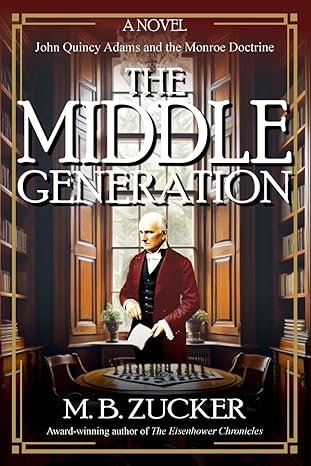

In The Middle Generation: A Novel of John Quincy Adams and the Monroe Doctrine, M. B. Zucker elegantly crafts a historical fiction narrative spotlighting the life and times of John Quincy Adams, one of the notable Presidents of the United States. Set against the backdrop of 1817, the tale plunges us into the heart of the White House, where Adams, serving as Secretary of State, aids President James Monroe in navigating the pressing diplomatic challenges of their era. Readers are introduced to eminent figures like Andrew Jackson, John Calhoun, and Henry Clay. Zucker also paints a compelling depiction of Adams’ wife, Louisa, highlighting the intricacies of balancing domestic responsibilities with public duty.
This meticulously researched novel not only provides a deep dive into history but also offers an engrossing portrayal of dialogues and deliberations involving European dignitaries like Lord Castlereagh, George Canning of Britain, and Metternich, the Austrian Foreign Minister. Taking information from Adams’ personal diaries, Zucker is able to immerse readers into the past and experience the conversations with these famous people from history. Themes such as the contentious issue of slavery are tackled with nuance, illuminating the diverse perspectives of that period.
While the novel is dialogue-rich and action-light, it offers a reflective experience that may resonate more with readers who appreciate a deep exploration of characters and their conversations. I yearned for a deeper insight into John Quincy Adams by the story’s conclusion.
The Middle Generation will undoubtedly resonate with enthusiasts of American political history, offering a fresh perspective on a crucial chapter of the nation’s past. This engaging work of biographical fiction provides readers a look at the life of this often-overlooked political figure.
Pages: 507 | ASIN : B0CKY9DKW3
Kids Being Kids
Better Be Home When the Streetlights Come On: Remembering the Summer of 1963 follows three eleven-year-old boys as they spend their summer going on adventures and making memories. There was a lot of time spent crafting the character traits in this novel. What was the most important factor for you to get right in your characters?
The three main characters and most of the supporting cast are loosely based on my childhood friends. Brain, the Jewish kid, was the smartest among us and Chief an African American kid was simply our friend – we didn’t care about race. The important traits are just ”kids being kids” and navigating the challenges and landscape of 1963.
What were some themes that were important for you to explore in this book?
I wanted to give the reader a sense of what it was like growing up in Braddock 1963. Beginning with a macro view of Braddock as a steel town shaped by Andrew Carnegie, steel-making technologies, and the environmental advantages of proximity to the Monongahela River and the rich coal seams. Next, I focused in closer on the neighborhood, stores, and the culture of the times. From then on through the rest of the book I follow the major events of their summer vacation. Another theme is the challenges of aging with the older versions of the friends as they reflect on the childhood memories.
What is the next book that you are working on, and when will it be available?
I am going to go in a completely different direction and write a non-fiction book. I had the honor and privilege to serve in Chief Information Security Officer (CISO) roles in several iconic organizations including but not limited to the Naval Nuclear Program, US House of Representatives, American Red Cross (from 9-11 to Hurricane Katrina), and AMTRAK. Over 40 years of experience, I will write about the evolution of the CISO vocation in the context of meteoric advancements in technology and the means to protect the organization against internal and external threats. As to when it will be available, TBD.
Author links: GoodReads | Facebook



 LITERARY TITAN