Blog Archives
Little Creatures: Rise of the Thrangrim
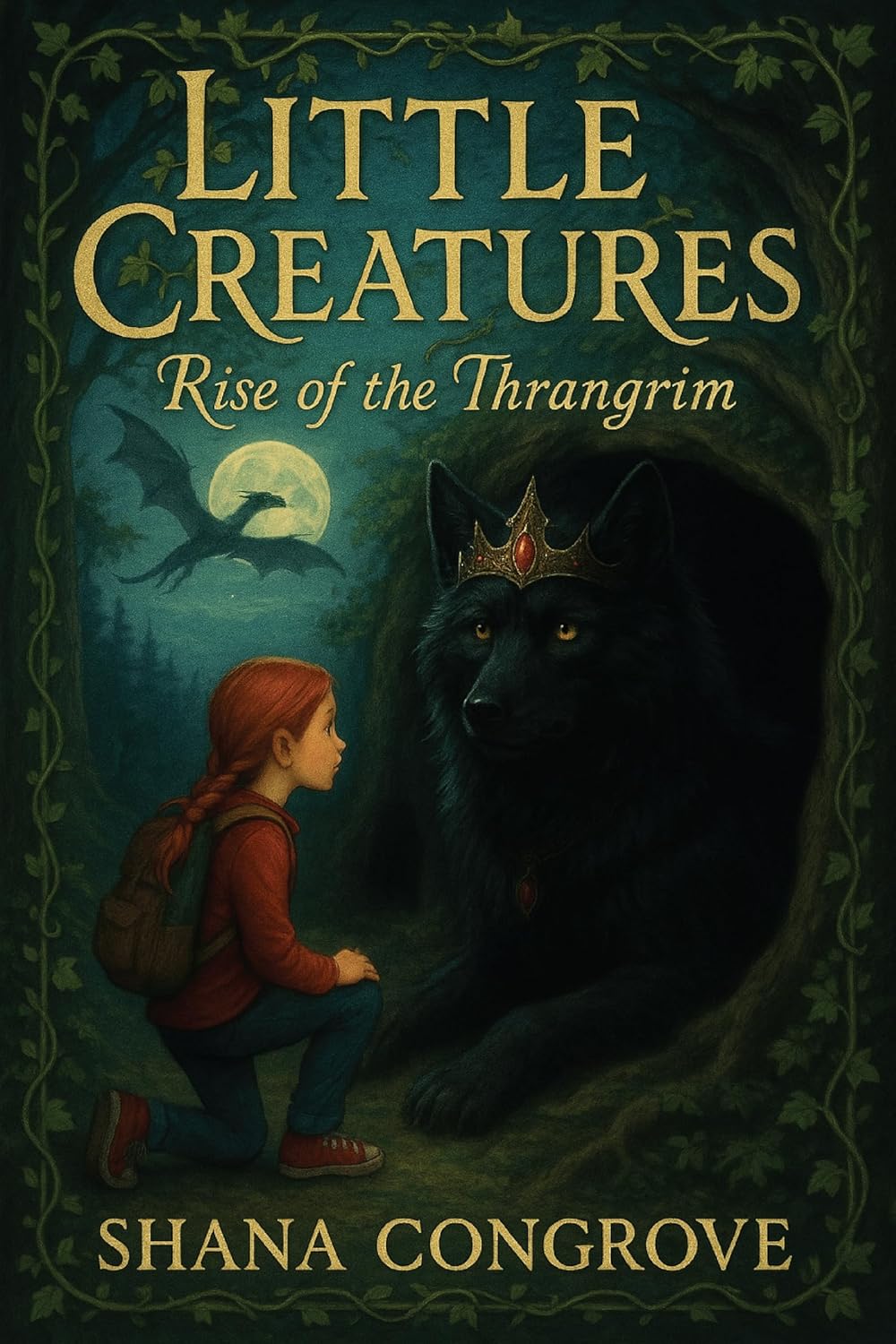

In Little Creatures: Book Two — Rise of the Thrangrim, Zowie’s “normal life” barely gets a foothold before two Little Forest Elves show up at her window with bad news: the Sky Fairies have been captured by the Thrangrim—stone-and-shadow brutes led by Grallok, who broke an ancient dream-binding spell by poisoning the fairies’ dreams with nightmares. Zowie and her dad, Daniel, slip into the supernatural realm through a tree-portal, meet the last free Sky Fairy (Aurora), and follow a living map across strange territories to gather allies and, ultimately, awaken Vortharion the Flamebound—an old, sleeping dragon whose return might be the only real answer to a threat this big.
My favorite emotional connection in this book is the father-daughter pairing. Daniel isn’t window dressing; he’s a presence, protective, a little sarcastic, and deeply tender in that “I’ll be brave because you’re watching me” way. When the quest yanks them apart (and it does, sharply), the story suddenly feels riskier, like the training wheels came off and Zowie has to discover what courage feels like in her own body, not just in her intentions. I also appreciated the book’s straightforward and earnest spirituality. Zowie begins in prayer, and the story keeps that sense of reverence without turning every page into a sermon; it’s more like a soft lantern the characters carry.
Stylistically, this reads like an episodic fantasy road trip: meet a new species, learn their rules, earn their help, move on. That structure is comforting, almost bedtime-story adjacent, even when the stakes are “everyone gets conquered by nightmare trolls.” The tradeoff is that the book sometimes pauses to explain lore in big, neat blocks (Grallok’s dream-corruption backstory, the rules of realms, the prophecy weight of the Golden Oraya). Still, the creature design has a gleeful weirdness, Glowtails, Scuttle Bugs, dire wolves with royal gravitas, and the wonderful illustrations reinforce that tactile, penciled-in fairytale mood. And when the finale hits, it delivers a clean, kid-thrilling payoff.
Kids who like middle-grade fantasy, portal fantasy, quest adventure, mythic creatures, and clean, faith-leaning fairytales will really enjoy this story, as well as parents who enjoy reading aloud without bracing for cynicism. If your shelf has The Chronicles of Narnia (or you grew up on C. S. Lewis’s blend of wonder and moral clarity), this will feel like a gentler, more creature-catalog-forward cousin. It’s a story that believes that bravery can be small and still be seismic.
Pages: 112 | ASIN : B0GGJCZPQR

Blurred Lines Between Reality & Nightmare

The Dreaming at the Drowned Town follows a haunted Filipino translator whose nightmare-plagued diary unravels a deadly expedition to a newly risen island where history, paranoia, and ancient horrors collide. What was the inspiration for the setup of your story?
We’ve always been drawn to overlooked corners of Philippine history, especially the transitional period of the 1920s, when cities like Cebu were rapidly modernizing under American rule while remaining at the cultural crossroads that decided the modern Filipino identity–between the legacy of three centuries of Spanish-style hacienda communalism and the enduring influence of the Church, the new American nation envisioned by the suit-wearing, English-nicknamed Sajonistas, and the vision of a country free from both that endured in places like Eastern Visayas. We’ve wanted to write a story in that setting for the longest time, portraying the interaction between people trapped between any of or perhaps none of the paths the Philippines was on the verge of walking, and the conflict that would arise from the clash between their different values and cultural contexts.
The core of the novel, however, came from two major sparks. The first was a love for early 20th-century cosmic horror, particularly the works of H.P. Lovecraft. Kyle has been a devoted fan for years before we ever started writing professionally, and he always wanted to craft a proper homage grounded in our own cultural landscape. The second—and more unexpected—inspiration came from real life. Around the time of the 2024 Manila International Book Fair (MIBF), when we launched our debut novel, Answering the Human Question, Kyle had come up with the concept of a protagonist troubled by vivid and terrible dreams, inspired partly by his own string of nightmares that he had been dealing with at the time through journaling. This entered the story as the main character and narrator of Enrique, who would write about his dreams as Kyle did. It also shaped in some aspects the book’s dream logic–its many false awakenings and the often blurred lines between reality and nightmare.
We also pulled from real historical curiosities like the desolate, sunken town of Pantabangan, the very real Drowned Town that exists here in the Philippines. It’s located in Luzon and in the province of Nueva Ecija, and it resurfaced during the El Niño droughts of both 2020 and 2024. We also combined the aesthetic of that place with Dawahon Islet, which, like the titular Drowned Town, is found near Leyte. Dawahon is a tiny yet densely packed community built on a reef that Kevin often flew over during pilot training. The distant glances and later images of empty, almost liminal spaces in both locations created an uncanny timelessness. It immediately planted in our minds the place where the book’s central mystery would unfold: a drowned town rising again after centuries beneath the sea.
The atmosphere is incredibly vivid. What research or techniques did you use to capture the sensory overload of the island and Enrique’s nightmares?
Much came from layering real-world observation with psychological insight. Research and a little bit of Kevin’s background in biology gave us a foundation for sensory detail—how bodies react to exhaustion, how coastal environments smell, sound, and move. Our travels to parts of the Visayas gave us firsthand experience of environments that feel both crowded and isolated, which helped shape the island’s suffocating atmosphere.
On Kyle’s end, his study of psychology—as well as a few readings of old court decisions for Philippine Law—taught him how perception breaks down under stress. Around the time of MIBF 2024, he was having recurring nightmares, and journaling them became the seed for Enrique’s dream sequences. Those dreams were chaotic, absurd yet vivid, and he translated that rawness into the book’s “dream logic.”
In addition to being partly inspired by Kyle’s own journaling, we employed Enrique’s diary as a framing device. In doing so, we hoped to keep the nightmares disorienting but maintain that they were narratively coherent. The diary form lets us narrow the focus to Enrique’s senses: the heat sticking to his skin, the sulfur that burns the throat, the texture of the drowned town rising from the sea. When those sensory details begin to distort or repeat, the reader feels Enrique’s unraveling in real time.
How did you approach blending real historical tensions of the American-occupied Philippines with cosmic or supernatural horror elements?
We began by grounding the story firmly in Philippine history. The 1920s was a pivotal transitional period in our hometown and province—Cebu was rapidly modernizing under American rule, yet memories of the Philippine-American War and the Revolution before it still lingered. A younger generation of Sajonistas emerged, eager to embrace American culture and modernity, and they often clashed with their elders, who had been shaped by centuries of Spanish influences and even hateful opposition to the betraying, conquering Americans themselves. Naturally, we wanted readers to feel that political and cultural tension in every scene, long before the supernatural appeared.
From there, the horror grew from two sources: Lovecraftian atmosphere and Filipino folklore. Lovecraft shaped the tone and structure—the slow unraveling of sanity, the tension between logic and the unknowable. But we never wanted to imitate Western cosmic horror wholesale. Filipino folklore, possessing tales of otherworldly spirit realms and the phantasms of the restless dead in spades, also played an important role in shaping the story’s identity. In our culture across its history, dreams have often held great power and importance, heralding either auspices of fortune or warnings of a coming malevolence. The sea has long been the place of both the dead as well as the living, and so it seemed natural as well as Filipino for us to portray the water with that same mystic aura.
When these folkloric themes collide with the real political tensions of the American occupation, they amplify each other. The characters themselves reflect this clash–to name a few, the American who believes he brings enlightenment and progress, the Western-educated Filipino guide plagued both by nightmares and generational trauma brought on by war, the old revolutionary who compromises his morals by relying on the wealth of his oppressors, and a corrupt constable armed by the law of a distant empire to fulfill his personal depravities. All of them come together in a chaotic misalliance of pathologies and dysfunctions beneath the cross of a condemned Spanish village, in the caves where the ancestors before told their stories, and above the depths of what came before them all.
Lita’s character goes through some of the most surprising twists. What was your process for constructing her arc?
When we were constructing the original skeleton of the story for Drowned Town, we wanted to explore imperialism—not just as the domination of one country over another, but on a smaller, interpersonal scale through the abuse and conflict that occurs between people. Every character written in this story speaks to or personifies that concept in some way, and Lita began as no different. The age gap between wife and husband, the bursts of passion punctuated by periods of ignorance from one side and betrayal from the other—she represents the country in her own way, a young and beautiful person being taken advantage of by a much older figure. We wanted another victim of imperialism, and in her case, we told the story of a kind of sex tourism and all the sordid perceptions that come with being someone in that world. However, we also wanted her to be aware of that dynamic, so she could play that game and defeat those who would take advantage of her or hold her in low regard. She needed to bear an innate refusal to be victimized, so that by the end she could be the true writer of the story—the architect of her own fate—rather than simply a supporting role in someone else’s narrative. That’s where her most surprising twists come from: the realization that she was never the object of the story, but its author all along.
Author Links: GoodReads | Facebook | Website
When an ancient town mysteriously emerges off the coast of Leyte, Enrique has no choice but to follow his employer to investigate. But as the expedition unravels, so too does the boundary between dreams and reality. With the island’s dark secrets coming to light, Enrique must face the horrors of its past before he too is claimed by the Drowned Town.
Bringing Magical Worlds to Life

Little Creatures follows a science-loving twelve-year-old girl who recently moved from the city to a quiet town and discovers that her backyard and bedroom wall are hiding a magical mystery. What was the inspiration for the setup of your story?
“From an early age, I was captivated by tales of fairies and elves—”Peter Pan” was my favorite. Alongside my love for stories, I had a deep passion for art, often spending hours sketching in my room. Around the age of twelve, I dreamed of writing a story about tiny elves hidden within the walls of a house. Life moved on, and that idea remained just a dream.
Today, as an author of adult fantasy, I decided to challenge myself by creating a children’s book. Instantly, my imagination returned to that twelve-year-old version of me—the one who longed to bring magical worlds to life. Now, I’ve finally fulfilled that dream and proudly checked it off my bucket list.”
In fantasy novels, it’s easy to get carried away with the magical powers characters have. How did you balance the use of supernatural powers?
“Because “Little Creatures” is a children’s story, I aimed to keep the supernatural powers simple and the narrative easy to follow—engaging young readers without overwhelming them with excessive detail.”
What were some themes that were important for you to explore in this book?
“The central theme of “Little Creatures” is that good always triumphs over evil. In a world often filled with chaos and destruction, I believe it’s important for children to experience stories with hopeful, fairytale endings—nurturing their imagination and reinforcing the power of positivity.”
Will this novel be the start of a series or are you working on a different story?
“Absolutely! I’ve already completed the sequel, “Rise of the Thramgrim,” and I’m excited to share that a third installment, “Curse of the Sandman,” is also in the works. This series is just beginning to unfold, and I can’t wait for readers to experience the journey ahead.”
Author Links: GoodReads | X | Facebook | Instagram | Website
Can a science-loving girl save a place where magic rules?
When twelve-year-old Zowie Lillian Saintclair moves from bustling Houston, Texas, to the quiet town of Greenwood, Arkansas, with her family, everything seems normal until she begins to spot little creatures that only she can see hiding in the shadows of her backyard.
And just as she thought things couldn’t get any more bizarre, she discovers something otherworldly living within her bedroom walls. That’s when she realizes her life is about to change in ways she never imagined.
Perfect for readers of all ages who love fantasy, adventure, and a smart heroine who isn’t afraid to explore the unknown.
Little Creatures

Twelve-year-old Zowie Saintclair arrives in Greenwood, Arkansas with deep uncertainty. Houston had shaped her world, and this quiet town shares almost nothing with the life she left behind. Her doubts fade quickly, though, when an unexpected mystery draws her in. Strange, miniature beings begin appearing in her backyard. The sightings unsettle her, and she questions her own reason. The oddities escalate when she realizes her bedroom walls may shelter hidden life, creatures that seem impossibly magical. A science-loving girl suddenly stands before a truth she never imagined: not everything fits inside the boundaries of logic.
Little Creatures, written by Shana Congrove, speaks directly to young adult readers. The story carries more depth and length than very young children might prefer, yet older elementary and middle-grade audiences will likely find themselves engrossed. Its spirit recalls Lynne Reid Banks’s beloved classic The Indian in the Cupboard, with a similar sense of wonder and discovery.
The delicate, fairy-like beings Zowie encounters begin as timid observers. Over time, they recognize something familiar in her and gradually step into the light. Their world comes with a mythology of its own, layered, imaginative, and fully realized, yet never so dense that it burdens younger readers. The history behind these creatures gives them warmth and dimension, making them surprisingly relatable despite their magical nature.
From the opening chapters, fantasy and practicality collide. Zowie’s devotion to science shapes her thinking, yet her youth allows her an openness that adults often lose. Congrove suggests that maturity can narrow the imagination, leaving grown-ups tethered to a rigid sense of reality. Zowie lives outside that constraint, and it’s precisely this flexibility that invites the creatures closer.
Her willingness to accept what she sees makes her an appealing guide through the story. Curious, intelligent, and deeply empathetic, she anchors the novel with a strong emotional center. The magical company she keeps adds charm and excitement, but Zowie herself remains the heart of the narrative. Following her journey turns Little Creatures into a rewarding and memorable read.
Pages: 144 | ASIN : B0FTZ9HLNL
Compassion and Vulnerability
Dark District Primer: Duology on the Lore and Lure of the Dark District combines two novellas, Sojourn and Take Me Now, weaving personal identity with fantasy, Filipino folklore with urban life, and spiritual questions with surreal encounters. What was the inspiration for these stories?
For Sojourn, I wrote it in a time of grief when my father passed away. And so most of the things that I wanted to say and wanted to do were all poured into that novella as well as the emotions involved in such a given circumstance. Writing it was both an affirmation for me in being the son that I am and the son that he wanted. He was the first one to acknowledge my writing growing up. Perhaps he already knew something even before I knew who I was.
For Take Me Now, I wanted to incorporate the world that I have established and expound on it and give it more spice and relationship-driven. While Sojourn was written first, it was Take Me Now that was first published and I had to go back and tweak Sojourn in order that it would mirror the world that I wanted to establish.
What are some things that you find interesting about the human condition that you think make for great fiction?
I love it when we show our humanity both through compassion and vulnerability. Compassion when we are able to put ourselves in the shoes of others to either feel their weakness in order to give them a little bit of our strength so that we help sustain them and what they need to do and vulnerability when it is our time to be on the receiving end of the help and empathy we give to others.
What were some themes that were important for you to explore in this book?
As my father’s passing was the catalyst for me to be more introspective and re-examine my writing, it was both my feelings of grief, honesty and self-identity that I wanted to explore more in Sojourn while framing it within a created universe that has touchpoints in Philippine Folklore. In any relationship, being true and comfortable with oneself is one of the pillars in making it work. Lose that or postpone that form of self-affirmation then the foundation to establishing a relationship with another falls apart.
What is the next book that you are working on, and when can your fans expect it to be out?
My next book is the next installment of the Tales from the Dark District series, entitled Take My Heart, and is being targeted for a FALL 2026 release. Along with that I shall also resume work on my New Adult series, which will also be set within the Dark District Universe.
Author Links: GoodReads | X | Instagram | Facebook | Website
By C.J. Edmunds
Welcome to the Dark District. A place where magic hides in plain sight, and desire leads you deeper into the unknown.
In this atmospheric duology by C.J. Edmunds, two queer protagonists are drawn into the same hidden world—but under very different circumstances.
🌀 In Sojourn, David Lansing, a half-Filipino call center trainer, suddenly begins seeing visions and a mysterious spirit guide. Haunted by creatures from Philippine folklore—Tikbalang, Aswang, and the White Lady of Balete Drive—he embarks on a magical and existential journey that becomes one of purpose, ancestry, and an invitation to a place where people like him finally belong.
✅ Recommended for ages 16+ due to complex parental and identity themes and supernatural tension.
🔥 In Take Me Now, Alvin is tired of the wrong men, wrong choices, and wrong timing. Until the Dark District opens its doors and gives him more than he bargained for. Steamy encounters, eerie magic, and dark truths collide in this sensual tale of love and self-worth.
⚠️ Recommended for ages 17+ for sensual scenes and mature emotional content.
Whether you crave introspection or intensity, Dark District Primer invites you to step through the veil—and explore what’s waiting on the other side.
This lush and haunting collection explores:
Filipino urban legends reimagined
Queer identity and transformation
Steamy encounters and emotional awakenings
A universe where fantasy, myth, and reality blur
Welcome to the Dark District. You might not want to leave.
Perfect for fans of Neil Gaiman’s The Sandman, Philippine mythology, and magical realism with queer narratives.
📘 Includes the complete novellas “Sojourn” and “Take Me Now.”
The Dark District Primer: Duology on the Lore and Lure of the Dark District


C.J. Edmunds’ Dark District Primer is a strange, soulful, and genre-bending exploration of myth, memory, and magic rooted in the Philippines. It combines two novellas, Sojourn and Take Me Now, weaving personal identity with fantasy, Filipino folklore with urban life, and spiritual questions with surreal encounters. The main narrator, David Lansing, acts as our curious guide, relaying his disorienting journey through magical encounters, visions of cultural archetypes, and confrontations with hidden truths. These experiences are framed through a personal, at times confessional, lens as he is summoned by a supernatural Council to explain his strange awakening in the Dark District.
Reading this felt like peeling through layers of memory, myth, and grief. The writing style is introspective and poetic at times, with bursts of long, flowing paragraphs that spill over with emotion and insight. Edmunds has a real knack for setting scenes that feel alive. The haunting streets of Manila, the hidden halls of the Council, even the surreal blankness of the otherworldly realms. At its heart, though, what struck me most was how much Dark District Primer is about identity, especially queer identity, cultural identity, and spiritual reckoning. I could feel the author writing through pain and purpose, and while some parts meandered or repeated themselves, the raw honesty kept me hooked. The lore is fascinating, especially the blending of Filipino myths like the Tikbalang and Manananggal with modern, urban queer life.
The ending of Take Me Now leaves just enough unanswered that I found myself eager to dive into the next chapter of the story. That brings me to Take My Hand, the upcoming installment teased at the end of the book. The preview promises bigger stakes and deeper dives into the lore. Take My Hand promises to have more world-building and capitalize on the lore in the introspective tone that I enjoyed.
There were times when whole pages spiraled into inner monologue, and the pacing slowed in the second half of Sojourn, where narrative momentum gave way to philosophical reflection. Edmunds isn’t just telling a story, he’s sharing something personal and vulnerable. You can feel the care and love he has for the lore, the community, and the craft.
I’d recommend this book to readers who want something different. If you like urban fantasy with depth, or if you’re curious about queer stories grounded in Southeast Asian myth, this will hit home. It’s not a quick read, but it rewards with a haunting and heartfelt experience. Especially for queer readers, Filipino readers, or anyone feeling caught between two worlds.
Pages: 298 | ASIN : B0FDGS86JT
It Started with a 1968 Impala

Automobilia is an anthology of short stories and poems that use automobiles as a central motif to explore a tapestry of human experiences. What was the inspiration for the original and fascinating idea at the center of the book?
I’ve loved automobiles since the day my father bought a new 1968 Impala from a dealer and drove it home. I was seven years old. He pulled into the driveway with the shiny, big car and it was a huge moment of excitement for the family. I still have that car today. In my early years of writing–when I was learning how to write a good story or poem–I had experiences related to automobiles that made me write about them. One was a poem I wrote about a high school acquaintance who was killed in an automobile crash just a few years after our graduation. A few years later I had a dream about someone killed by an automobile. And then I read a poem in a copy of Modern Maturity magazine that featured a writer’s memory of being a boy riding in the backseat of the family car, watching the moon following along on the ride. Those three things made me think that assembling an anthology of stories (and poems) by others featuring the automobile might be a cool idea that some readers might enjoy.
What were some goals you set for yourself as the editor of this book?
I wanted to assemble a collection of stories featuring automobiles as an integral part of the plot from famous or established authors like Matheson, Finney, and Nolan, along with newer writers. I also included some poems because the first professional sales I made as a new writer were poems to a couple science fiction and horror magazines. Stories from all genres were welcome in the anthology — from mainstream to science fiction to ghost stories — since the automobile is such an influential technology on the planet. Just about every perspective for a possible story can be connected to an automobile.
What was the process you used to collect the stories and poems for this collection and then narrow them down?
First, I set about looking for stories from known writers I might be able to buy reprint rights from. Each of those authors–or their agents for those no longer living–were very accommodating. I cannot thank them enough. Then I issue a call-for-submissions to the major writer’s markets listed on the internet, like Duotrope. I believe in paying writers (since I’m a writer too) a fair wage for their work. So, I offered the Science Fiction Writers Association per-word minimum at the time, which was eight cents per word and a dollar a line for poems.
I hope the series continues in other books. If so, where will the next anthology take readers?
Thank you for that good hope! There were so many GOOD stories featuring automobiles I could not get the rights to or include in a single volume I plan to publish two more anthologies featuring autos to make a trilogy. Right now, however, I already have a call for submissions out for the next two thematic anthologies. One is ALIENS AMONG US and the other is TRAIN TALES. I’m open for submissions for those until November 30, 2024. I’m paying a little more this time: 10 cents per word and $2 per line for poems. Publication for both books is planned for the first quarter of 2025.
Author Links: GoodReads | Facebook | Website
41 stories • 9 poemsSince the first automobiles rolled down a street, the range of human emotions attached to these machines has run from love to hate, humor to horror, joy to sadness. This book is a sampling of how fiction writers have viewed the automobile, from yesteryear to tomorrow.
Famous writers, experienced story tellers, and new literary voices are mixed together between these covers.
Automobilia is the first in a trilogy of stories and poems featuring that one machine that has changed the face of the earth, for the good and for the bad…the automobile.
Authors include: Jack Finney, George Clayton Johnson, Richard Christian Matheson, Richard Matheson, J. P. Seewald, Bruce Boston, Marge Simon, Kevin David Anderson, Katherine Tomlinson, James S. Dorr, William F. Nolan, Dean Wild, Sarah Key, Robbie Sheerin, and J.R. Hayslett, among many others.
Automobilia


Automobilia, compiled and edited by Jason J. Marchi and Jeffery L. Buford Jr, is an intriguing anthology that interweaves short stories and poems, using automobiles as a central motif to explore a tapestry of human experiences. This collection skillfully spans multiple genres, including thriller, drama, and horror, providing a varied literary landscape.
In this anthology, vehicles are not merely background elements but pivotal to the narrative structure. For instance, “Duel” is a gripping tale where protagonist Mann faces off against a relentless truck driver in a high-stakes road chase to San Francisco. “Passages” delves into the poignant story of Beth, grappling with the loss of her boyfriend Rick and his Mustang in a tragic accident. Meanwhile, “Homeless” introduces us to Max, whose late-night walk leads to an unexpected encounter at an accident site.
The stories in Automobilia are characterized by their exploration of themes such as loss, grief, resilience, redemption, courage, and the bonds of friendship. Each narrative offers a unique perspective on life’s complexities, enhancing the reader’s appreciation of the human condition. A standout feature of these stories is their unpredictability, which injects a sense of excitement and keeps the reader engaged. The use of automobiles as a unifying theme is not only original but demonstrates remarkable creativity. The stories are crafted with skill, demonstrating a keen eye for detail and a flair for capturing the reader’s imagination. While the anthology presents a rich variety of stories, a broader cultural context in some narratives could have offered an even more diverse and enriching experience. The writing throughout is concise and compelling, making each story a satisfying read.
Automobilia contains mature themes and hence, is more suitable for an adult audience. Readers who appreciate an inventive approach to storytelling and the exploration of human emotions and experiences will find this book particularly engaging.
Pages: 299 | ASIN : B0CVPZY4QV


