Blog Archives
Property of the Revolution: From a Cuban Barrio to a New Hampshire Mill Town—A Memoir
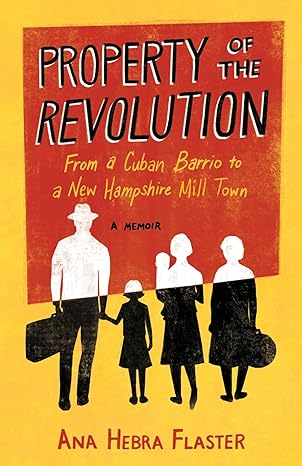

Property of the Revolution, by Ana Hebra Flaster, is a poignant memoir that explores themes of political upheaval, migration, family, and the relentless passage of time. Set against the backdrop of Cuba’s chaotic regime, the book chronicles Ana and her family’s arduous journey to the United States and their struggle to adapt to a new life. At its core, it is a story of resilience. We see a father, burdened with responsibility, sacrificing his dreams and taking on tedious factory work to secure his family’s future. Flaster vividly recalls Cuba’s political turmoil—a PhD holder forced to abandon teaching, a man condemned to harsh labor camps in Camagüey for resisting military registration—grounding the narrative in sobering realities. Alongside this, the book traces Ana’s personal journey—her adjustment to life in America, her pursuit of education, her deep familial bonds, and her own experiences of motherhood.
Flaster’s memoir is rich with layers, blending personal anecdotes and political history into a seamless, engrossing narrative. It remains busy and dynamic, brimming with moments that compel the reader forward. From suspenseful accounts of political oppression to heartfelt recollections of her father’s sacrifices, the book pulses with life. I found myself deeply connected to Ana’s struggles, particularly when she speaks of longing to take an art class but feeling unable to justify such an expense. Growing up in a household shaped by financial instability, she leaned toward practical paths, forsaking artistic dreams in pursuit of security—a sentiment that resonates deeply with many readers.
The memoir flows like a symphony of interconnected stories, each piece harmonizing with the next. Flaster introduces a cast of intriguing characters who traverse contrasting cultural worlds. Some stories reveal the challenges of being a minority in the United States—navigating language barriers, facing bullies who judge differences, and grappling with a sense of displacement. Other sections transport readers to the stark and unforgiving realities of life in Cuba under a cruel regime. The narrative immerses us in the emotional weight of leaving one’s homeland, enduring separation from loved ones, and searching for missing family members. Through these tales, Flaster captures the raw experience of destabilization and the relentless quest for belonging.
Property of the Revolution is a testament to survival, offering readers an intimate look at lives shaped by political unrest and migration. Flaster’s ability to merge historical context with personal reflection creates a story that is both informative and deeply human. Her writing is engaging, her characters vividly drawn, and her themes universally relatable. This book is perfect for readers drawn to stories of resilience, political strife, and cultural transition. Fans of historical memoirs and narratives about overcoming adversity will find themselves captivated from start to finish. Flaster’s account is an immersive, character-rich journey that lingers long after the final page. I highly recommend this thought-provoking and beautifully written memoir.
Pages: 312 | ISBN : 978-1647428266

My Own Family History Firsthand

Cuba, Your Children Cry shares your memories about growing up as a first-generation American of Cuban parents and your desire to experience Cuba for yourself. Why was this an important book for you to write?
I grew up with my parents having a love-hate relationship with Cuba. I did not understand why. The title came from my mom. My siblings would be at school, and I would be home with my mom. Under her breath, she would always say, Cuba, your children cry! And I used to think, why are there crying children in Cuba? I must have been 4/5 years old. We were a working-class family, so family dinners were a rare occurrence, and discussion of my parents’ time in Cuba was rare.
In my forties, I did quite a bit of traveling; I have traveled to over 100 countries. I had been to China and Russia but not Cuba. When the Obama administration started to open travel to Cuba, that is when I thought I should go to Cuba and close this family history circle. My spouse started working on his family history on ancestry.com and randomly asked me to do it too. At this point, I decided to travel to Cuba to discover my own family history firsthand. My parents were getting older, and none of my siblings had any information about my parents’ life in Cuba. On my first trip, I went alone; my parents refused to go; I journaled every day, and when I returned home, I made a photo book and included my journals, and gifted it to my family, thinking no one would ever go back to Cuba. My friend Laurin, who accompanied me on my first trip, also received the photo book, and she suggested I write a book. Brushing that suggestion to the side, I never thought of it again. My parents said they would go to Cuba when Castro died. When that happened, I started to plan our trip.
Two years later, I took my parents to Cuba and audio recorded their stories and journaled every day. When I returned, I completed another photo book and gifted it to my family. Laurin, who came with me on my first trip, asked me for a copy and again suggested I write a book. I did not think anyone would be interested in my book, so I said I would think about it. Then the pandemic hit, and my 50th birthday was right around the corner. And so, I thought, it would be cool to release a book on my 50th birthday. And the rest is history. In the process, I learned that my story resonated not only with Cuban refugees but also with anyone who was a refugee from different countries. It was important to me to discover my family history; writing the book was so cathartic, and in turn, it was important to me to tell this story of survival and tenacity.
What were some ideas that were important for you to share in this book?
The idea that love can be stronger than anything and it can be lasting. That being ousted from your country is probably one of the most challenging things that can happen to anyone, but perseverance and determination will get you through. That being different, having a different skin tone, and having an accent is ok. That even when English is your second language, you can still write a book!
I appreciated the candid nature with which you told your story. What was the hardest thing for you to write about?
The hardest thing to write about was interviewing my parents about their last days in Cuba. Then taking that information and putting it into words that told that story exactly as it happened. It took me a month to put it all into the correct words. I couldn’t imagine what my parents were feeling at that time. I remember taking pictures of them in front of their last homes before they left for the airport, not knowing about their future. It was such a sad moment. It was very difficult to get through that part of the book.
What is one thing you hope readers take away from your story?
I hope it encourages folks to investigate their own family history, travel to uncomfortable places, and have uncomfortable conversations. It will be worth every second and penny spent to complete their family puzzle.
Author Links: Goodreads | Amazon
It began when I was browsing through my parents’ vintage photographs of a free Cuba in the 1940s and 50s at my home in Hialeah, Florida. I learned everything about Cuba from them, but I had never visited the beloved island only ninety miles from Key West, Florida. They told tales of romantic nights on the streets of Havana, an island where Cuban music escaped from small cafes and filled the streets with people dancing and laughing. I was learning the lingo recognized only by fellow Cubans.
Political strife upended the Cuba of my parents’ childhood and ultimately prevented travel back to the island. It was a conflict so intense that thousands risked their lives to escape through shark-infested waters on man-made rafts to Miami, or anywhere for that matter, to reach land and claim political asylum.
Living this juxtaposition―love for the island and devastation at the collapse of a once beautiful society―was heart-wrenching. I felt as if I was being raised in a Cuban bubble while also being exposed to the elements of unfamiliar American traditions. A contradiction of sorts. For my entire life I craved a better understanding of where I came from, the details of how my parents fled Cuba and, most importantly, who I am.
I yearned to experience first-hand the Cuba of my parents’ memories, to stroll the Malecon, to immerse myself in the sights and sounds of that tropical paradise. After forty-six years of not knowing, I set out to learn the stories of the Iglesias family and to see the island through the tear-filled eyes of my parents. And finally, I accomplished that mission.
Cuba, your children cry! Cuba, tus hijos lloran

In Cuba, Your Children Cry, Otto H. Iglesias delivers a profoundly moving exploration of his first-generation American-Cuban heritage. This riveting memoir illuminates the plight of refugees through a deeply personal lens, a perspective that strikes an emotional chord in readers.
Imbued with the vibrancy of Cuban culture from a young age, Iglesias’s upbringing was steeped in his homeland’s traditional cuisine, language, and stories. Yet, an inherent longing to connect with his roots simmered within him, only to be initially quelled by his parents, Cuban refugees themselves, due to legitimate safety concerns.
The narrative takes a turn as, after forty-six years, Iglesias is granted permission to visit Cuba. Accompanied by two companions, equally passionate about travel and history, his journey into the heart of Cuba commences, revealing untold chapters of his heritage.
One of the book’s most striking aspects is the compelling depiction of human resilience in adversity. Iglesias paints a vivid tableau of Cuban endurance, persevering despite facing debilitating sanctions. Readers are drawn into the complex love-hate relationship his parents maintained with their homeland, eliciting deep empathy.
Cuba, Your Children Cry is a layered narrative, shedding light on the interplay of political decisions and individual destinies. It expertly melds historical occurrences with present realities, providing a unique viewpoint that merges the objective observer with the intimately involved.
Iglesias’s memoir stands as a powerful testament to silenced voices and the quiet strength of an oppressed people. His vivid prose breathes life into the Cuban landscapes and culture, effectively transporting readers to the bustling streets of Havana and various significant landmarks.
The memoir’s principal strength lies in its evocative depiction of the indomitable human spirit and an underlying narrative of love. It serves as a poignant reminder of the vital role of passion and perseverance in our lives. Cuba, Your Children Cry is an indispensable read, one that inspires readers to appreciate the complex yet fundamental human connections that define our collective and individual identities.
Pages: 270 | ASIN : B09XWFL4M9
FRANK PAÍS

José Álvarez (Cuba, 1940) nos presenta en FRANK PAÍS una extensa biografía del “revolucionario” cubano del mismo nombre. Hace un repaso de su corta vida (1934-1957) y de la importancia que sus actos tuvieron en la Revolución Cubana. Cómo después de su muerte el pueblo cubano sigue recordándolo.
Los primeros datos los obtenemos de mano del único hermano País que sigue vivo, Agustín País, quien ha residido en los EEUU desde la muerte de sus hermanos. En esta entrevista personal José Álvarez y Agustín País, nos hacen una introducción de los fechas más importantes en la vida de Frank. Relatan como la muerte de su padre les afectó y alaban la figura de su madre. Le sirve al lector para situarse en aquella época y descubrir los incios de Frank en la vida política.
A partir de aquí, José Álvarez se centra en la relevancia que tuvo Frank País en la Revolución Cubana. Nos adentra en su ideología y nos explica cómo se va “creando”, iniciando, ese sentimiento en el pueblo Cubano. Dicha Revolución (1953-1959) provocó la caída del régimen de Batista y la llegada al poder del líder del Ejército Guerrillero, Fidel Castro, con todo lo que eso supuso a nivel nacional e internacional. No quita importancia a todos aquellos que rodearon a Frank en este gran cambio.
Después de exponer todos los datos relevantes sobre la vida de Frank País: infancia, educación, familia, amigos… y la importancia que éste tuvo en este gran cambio histórico, José Álvarez incluye en el Libro II los escritos selectos de Frank País y sus cartas a Fidel Castro, documentos oficiales… Todo este tipo de escritos le sirven al lector para comprobar de primera mano la relación entre ambos, y porque después de su muerte, hace tantos años, la figura de Frank País sigue viva.
En el Libro III, José Álvarez ofrece una visión más intimista de Frank País. Incluye sus escritos más personales, sus poesías. Vemos el lado más personal y a lo mejor menos político del protagonista, a pesar de sus ideas por liberar al pueblo cubano.
Considero que es un libro recomendable para todos aquellos que estén interesados en conocer más en profundidad la importancia de Frank País en el proceso de cambio cubano. Ofrece esta información desde todos los puntos de vista posibles, de un modo neutral y utilizando todas las fuentes biográficas que están al alcance de su mano, destacando principalmente la información proporcionada por Agustín País.
Pages: 622 | ISBN: 1090437552



 LITERARY TITAN