Blog Archives
And The Cost Is Steep

The Society drops Damien and Emilia into a war against a system, not just an enemy, built on control, repetition, and old institutional rot. Damien opens with “I should be dead.” Why was that the right place to start Book Three, and what does that shift cost him?
From the very beginning, the moment we’re introduced to Damien in Book 1, The Orphan Maker, he’s already living on a literal deadline. His days were numbered from the start. So the fact that he’s still alive by Book 3 is nothing short of a miracle… or borrowed time. Grace, if you will.
And I think, deep down, all of us know we’re living on borrowed time too, even if we aren’t as painfully aware of it as Damien is.
That’s why “I should be dead” felt like the right place to begin Book 3. Beneath the supernatural conflict and the war against these massive systems of control, the story is really asking a very human question: what do we do with the time we’ve been given, especially once we become fully aware that it can run out?
For Damien, that awareness doesn’t soften him. It pushes him deeper into what he believes is his purpose. He doubles down on his obsessions, his convictions, and the consequences of the choices he’s been making since Book 1. He keeps moving forward even when the cost keeps rising.
And the cost is steep.
Readers who know my work already know that my stories don’t really operate with plot armor, and Book 3 explores that even further. The characters are forced to confront the weight of their decisions in very real ways.
Damien and Emilia’s dynamic is described as two dangerous people slowly learning where the other’s limits are. How do you write an alliance that has genuine tension without tipping into either forced antagonism or easy trust?
For me, the key is making sure both characters have valid reasons not to trust each other. Damien and Emilia aren’t being antagonistic just for drama. They’re both dangerous people with very different histories, loyalties, and survival instincts. They’ve both seen betrayal, violence, and manipulation up close, so caution feels natural to them.
At the same time, I didn’t want them constantly fighting just for the sake of tension. Real alliances, especially between capable people, usually form through necessity first. Then, they slowly begin to understand each other’s limits, principles, and patterns. They learn what the other person is willing to do, and more importantly, what they’re unwilling to do.
I think that’s where the tension becomes interesting. It’s not just “Will they betray each other?” It becomes, “How much of themselves are they willing to reveal?” Because both Damien and Emilia are constantly weighing risk against vulnerability.
And in a world as brutal and unforgiving as theirs, trust isn’t built through speeches. I actually make that point pretty clear throughout the book. It’s built through actions. Through surviving together. Through moments where one of them has every reason to exploit the other, but hesitates… or chooses not to, at least for that moment. Their relationship is constantly walking the line between trust, necessity, and self-interest. And I think that uncertainty is what keeps the dynamic alive and the story so thrilling.
Characters constantly weigh who gets sacrificed and who gets protected. Did you see the story primarily as a moral conflict as much as a supernatural one?
Yes, absolutely. I’ve always approached this story, and really all the stories I write, as moral conflicts first. To me, that’s the engine of great fiction. I genuinely love supernatural, fantasy, and horror elements, but those elements work best when they’re carrying deeper human questions underneath them. So blending moral conflict with supernatural storytelling felt very natural from the beginning.
What made The Society especially interesting for me to write was that these moral conflicts are happening through characters who technically aren’t human anymore, yet are still trying to hold on to some sense of humanity. I intentionally wrote Damien and Emilia that way. They’re both dangerous. They’ve both committed terrible acts. They’re both capable of brutality. But underneath all of that, I wanted there to still be this lingering question inside them of whether they’ve completely lost themselves or not.
That’s also why I wrote their dynamic around observation and restraint rather than easy trust. Subconsciously, they’re constantly measuring the humanity left in the other person. Not softness necessarily, because the world they live in punishes softness very quickly, but things like restraint, compassion, guilt, principles, and the ability to still care about something beyond themselves. Those qualities become signals. They become part of how Damien and Emilia decide whether the other person can still be trusted at all.
That’s why the sacrifices in the story matter so much to me. I didn’t want the tension to revolve only around survival. I wanted it to revolve around identity. What parts of yourself are you willing to sacrifice in order to survive? And once you cross certain lines, can you still meaningfully call yourself human? That moral tension is deeply embedded into how I wrote both Damien and Emilia from the very beginning.
What does “done” mean for Damien — and does he believe it’s possible by the end of this book?
That’s a difficult question to answer without stepping too far into spoiler territory. But for Damien, the idea of being “done” is deeply tied to redemption, especially redemption in light of all the damage that he himself has caused throughout the series.
I wrote Damien as someone who keeps convincing himself that there’s one more thing he needs to accomplish, one more sacrifice he needs to make, one more line he needs to cross that will finally give meaning to everything he’s done and everything he’s become. So in many ways, “done” becomes connected to purpose. To whether someone who has committed terrible acts can still leave behind something meaningful.
At the same time, I always try to write each book with a real sense of conclusion while still allowing the larger story to continue moving forward. Life rarely gives us perfectly clean endings, and I wanted the series to reflect that. The characters themselves genuinely believe they can accomplish their goals or finally put certain “ghosts” to rest. Whether they actually succeed is another matter entirely.
And that’s actually part of why I’m especially excited for the fourth and final book of this saga. A lot of the questions that have been quietly building since Book 1 will come full circle there. Questions about humanity, purpose, meaning, identity, and whether redemption is truly possible for people who’ve gone too far. I’ve always viewed the series as building toward those deeper questions beneath the supernatural conflict. So getting to finally close that journey is something I’m really looking forward to writing.
Author Links: GoodReads | Facebook | Website
Promises are easily made when power is distant; bound to be broken when blood becomes the price. In a world shaped by monsters, betrayal is not an exception—it is survival wearing a familiar face.
Alliances fracture, devotion turns dangerous, and every act of mercy carries consequences. Loyalty becomes a weapon, and trust becomes the first casualty. Danger no longer hides in the shadows. It is closer. Hungrier. And far more personal.
The Society is a dark supernatural thriller that brings the worlds of The Orphan Maker and Vexed into collision, where uneasy alliances are forged in blood and broken just as easily. As hunters and monsters are forced to stand side by side, ambition sharpens, loyalties fracture, and every shared goal hides a deeper betrayal. With a slow-burning tension that erupts into violence and atmospheric, razor-edged prose, this is a story where survival demands cooperation… until it demands betrayal.
Beloved by fans of visceral supernatural suspense, atmospheric horror, and psychological thrillers, this saga unravels the devastation of grief, the lure of vengeance, and the monsters born from both—where salvation is distant, mercy is scarce, and the only way to kill monsters is to become one.
The Society (Book 3 of the Blood & Flesh Saga)


The Society by D.A. Chan is an urban epic fantasy built around bargains, bloodlines, and people trying to keep promises that have already cost too much. As the third book in Blood & Flesh, it drops us into a world where Damien, Emilia, the Brotherhood, and the Society are all moving pieces on a board no one fully controls. Damien’s opening line, “I should be dead,” sets the tone right away. This is a story about survival after revenge, and about what comes next when revenge doesn’t fix anything.
What makes the book work best is its focus on uneasy alliances. Damien and Emilia don’t trust each other cleanly, but they need each other, and that tension gives the story a steady pulse. Damien is calculating, damaged, and often frighteningly practical, while Emilia carries grief, pride, fear, and loyalty in ways she can’t always hide. Their dynamic feels less like instant partnership and more like two dangerous people slowly learning where the other person’s limits are.
The plot is dense in a good way. The Society isn’t just a vague evil organization, it’s a system with habits, patterns, killers, Watchers, leverage, and old rot built into its structure. Damien sums up the strategy neatly when he says, “They control, repeat, predict.” This is a war story where information matters almost as much as violence.
The action is bloody and cinematic, but the book’s real weight comes from guilt. Characters are constantly asking what can be justified, who gets used, who gets saved, and what kind of person you become when the plan works but leaves bodies behind. The Brotherhood scenes add scale and personality, especially through members like Callum and Mateo, but the quieter moments with Emilia, Chrissy, Anja, Charlie, and Damien’s private doubts give the story its emotional shape.
The Society is a dark, busy, emotionally charged fantasy about monsters fighting monsters while still trying to protect something human in themselves. It’s at its strongest when it lets strategy and conscience collide, and when it treats trust as something fragile, useful, and dangerous all at once. The ending doesn’t feel like a door closing so much as a boat leaving the shore, carrying Damien and Emilia toward another version of the question that haunts the whole book: what does “done” even mean when the promises keep multiplying?
Pages: 322 | ASIN : B0FX5YT4X9

Stillness and Reflection

Shifting Sands follows the survivors of Sol Thalen in the aftermath of its fall as they try to rebuild their culture and society when everything has literally been destroyed. How did you approach writing about this destruction and your characters’ response to it?
For me, destruction is never just about the physical loss of a city—it’s about what happens to identity, purpose, and relationships in the aftermath. When Sol Thalen fell, it wasn’t just the loss of a home; it was the unraveling of legacy, belief, and the illusion of safety. I approached the writing with a deep sense of grief—both personal and communal. I asked myself, What do people hold onto when everything collapses? The characters’ responses came from that place of questioning. Just as some characters choose hope—clinging to survival and the chance to rebuild and dream of a future—others give up hope for themselves, often believing that their own death or disappearance might still serve a purpose. There’s this tragic tendency to justify surrender as a kind of sacrifice: If I fall, maybe someone else can rise. That contrast—between hoping for self and hoping for others—is the heart of the emotional conflict I wanted readers to feel. It’s rarely clean or heroic. It’s messy, human, and deeply personal. And it’s in those moments, I think, that the soul of a story reveals itself.
It seems you took your time in developing the characters and the story, creating a great emotional impact while the survivors process what is left of their world and civilization. How did you manage the pacing of the story while keeping readers engaged?
Thank you—that means a lot. Pacing is something I pay obsessive attention to. I wanted the emotional beats to land, but I also didn’t want the story to feel like it was dragging its feet. What I aimed for was a rhythm: moments of stillness and reflection followed by bursts of urgency. It’s like breathing. When the characters pause to mourn or reflect, the reader breathes with them. But when danger returns—and it always does—they’re pulled right back into the action. I layered multiple storylines so that even when one character is reeling, another might be scheming or moving forward. That way, readers never feel stuck. There’s always a heartbeat somewhere.
I also use an outline, and I’m meticulous about following it. That’s where I catch when there’s too much breathing space, when a chapter feels like it’s meandering, or when a sequence clearly needs to be tightened with rising tension or sharper stakes. The outline becomes a map of emotional flow and momentum, helping me keep that delicate balance. I layered multiple storylines so that even when one character is reeling, another might be scheming or moving forward. That way, readers never feel stuck. There’s always a heartbeat somewhere.
Are you a fan of the fantasy and adventure genres? What books do you think most influenced your work?
Absolutely, I’m a lifelong fan. Fantasy gave me the language to talk about things I didn’t always have words for—identity, grief, power, longing. I grew up reading Tolkien and C.S. Lewis like many others, but it was later on that I was deeply moved by authors like Brandon Sanderson, Cassandra Clare, J.K. Rowling, and Ursula K. Le Guin. Each of them, in their own way, showed me that fantasy could be epic and intimate. That worldbuilding could serve emotional truth. Their works taught me that it’s not just about dragons or swords or kingdoms—it’s about the people who bleed and hope in between. I try to carry that into every page I write.
I hope the series continues in other books. If so, where will the story take readers?
Thank you—and yes, it absolutely does continue. Shifting Sands is the fourth installment of a five-book saga, and the next book is the finale, where everything comes to a head. The choices made in Shifting Sands ripple outward, and readers will be taken to corners of the world that have only been hinted at until now. The political game gets even deadlier. Old wounds resurface. And the more fantastical elements take center stage in ways that force the characters to question not just their loyalties, but their very sense of identity.
If Shifting Sands was about surviving the collapse, Ancient Paths is about reckoning—learning who you really are when certain truths come to light, and deciding what kind of legacy you want to leave behind. Some legacies, after all, might be too broken to rebuild. And some people may discover they were never meant to serve themselves, but something far greater.
Readers have often told me they don’t know how the stakes could possibly get any higher—and to that, I say: I’m excited for them. Many have also noticed how I tend to plant seeds in earlier books that only bear fruit later on. Well, this fifth and final book is where all those seeds bloom. Every thread comes together. Every secret is revealed. This is the climax of everything.
Author Links: GoodReads | Facebook | Website | Amazon
THE DAWN OF A NEW ERA IS ALWAYS PAID IN GRAVES. And with the Sunken City subdued and Sol Thalen fallen, this truth has become undeniable. The Cycle of the Capitals has ended, leaving a world fractured by distance and silence. As Chris joins a people in exodus, he finds no victory left untainted—every gain paid for in blood, every cost sharpening like a blade. Joined by the new Chronicler, he journeys in a final attempt to save a scattered remnant from extinction—and soon realizes he must confront the creature within him… and accept that surviving the monsters around them may require becoming one himself.
Elline faces a different reckoning. With the Capitals isolated and every line of communication severed, mistrust coils behind every stone of Djarin Tor—ready to ignite a coup that would ensure their defeat in the widening war. To stop this collapse, she must embrace the birthright she has long avoided—even if it means defying the Magister. Meanwhile, Havet’s designs tighten with a precision that suggests his victory has already begun, and his cruelty shows no end. As an era dies in silence, the fate of the next will be written not by those who hope to endure it, but by those who dare to shape it from the ruins left behind.
A fast-growing favorite among epic-fantasy readers, this saga delivers cinematic battles, devastating stakes, and slow-burning bonds caught in the crossfire of a war that threatens to consume entire eras—set in a world where monsters rise and no victory comes without a price.
The Kindred Chronicles: Shifting Sands

Shifting Sands follows the survivors of Sol Thalen in the immediate aftermath of its fall. The story opens on a city crushed into ruins and a people clinging to hope by the thinnest threads. Chris, Grace, Elline, Raham, Camille, and the thalenar struggle through endless hours of digging through collapsed halls, pulling survivors from the rubble, mourning the dead, and trying to understand what comes next. Their grief shapes every choice. Their loyalty holds them upright. And the central tension of the book becomes clear early on. How do you rebuild a culture when the ground beneath it has literally vanished? The novel is driven by emotion and community and a sense that every character must decide who they are now that their world has been unmade.
I found myself slipping into the atmosphere without effort. The author leans into sensory details, and the rubble and smoke and sand build a world that is both beautiful and bruised. What struck me most was how the story rarely lets the characters breathe. Grief becomes a kind of weather. it’s constant, pressing, and shaping them in ways they cannot fully articulate. I enjoyed that the book doesn’t rush healing or transformation. It lets emotions sit heavy and raw, and that made the characters’ quieter victories hit harder. At times, the prose felt a little lofty for the scenes it described, but even then, it carried an emotional punch that kept me invested.
I kept thinking about what it means to lose not just people, but culture. identity. the songs and rituals that tie a community together. The thalenar blade lore and the meaning of song within their traditions stood out as some of the most compelling worldbuilding in the book. And I found Raham’s arc especially moving. the quiet strength, the slow cracking, the way he tries to hold others together while he’s barely holding himself. Grace’s exhaustion and determination also pulled me in. Her efforts to see the essence of life while losing pieces of herself felt intimate and aching. If anything, I wish the story had paused more often to let certain emotional beats land, but the constant urgency also felt true to the setting.
This book would resonate with readers who enjoy character-driven fantasy, stories about surviving loss, and worlds built through culture as much as magic. I’d recommend it to anyone who likes tales that sit with hard emotions and still reach for light. Fans of the series will find this entry in The Kindred Chronicles especially satisfying, since it deepens the world and the characters in ways that feel rewarding.
Pages: 488 | ASIN : B0G64WJHFQ
A Sandbox of Possibilities
Vexed follows the outcast twin of a royal wendigo house, living in hiding, who is thrust back into a world that feeds on power and control, where her ability to love is seen as a weakness, and her greatest fear is becoming a monster like the rest of them. What was the inspiration for the setup of your story?
I’ve always been fascinated by the darker side of folklore—particularly wendigos and skinwalkers. For a while, I wasn’t quite sure how to approach them without falling into the usual tropes. But then it hit me: why not lean into what I already enjoy doing—taking something familiar and reshaping it into something unsettling, emotional, and new? That was something readers appreciated in The Orphan Maker (Book 1 of the series), and their response gave me the confidence to push further. With Vexed, I wanted to continue subverting expectations, not just in terms of myth, but in how we portray monstrosity, love, and identity. Emilia’s journey is my way of asking: What if the real horror isn’t the monster’s form—but what we’re willing to become to survive?
It seemed like you took your time in building the characters and the story to great emotional effect. How did you manage the pacing of the story while keeping readers engaged?
Pacing is something I take very seriously—especially in a series where emotional stakes evolve across multiple books. In The Orphan Maker, the protagonist Damien was strategic, composed, and emotionally closed off. So for Vexed, I wanted a complete shift. Emilia, while equally intelligent, is emotionally raw—her turmoil is deeply internal. That contrast was deliberate. I wanted to disorient readers, to make them feel the weight of her silence and her slow unraveling. Structurally, I made sure every chapter carried either emotional or plot-driven tension, weaving personal revelations with external threats. It’s a careful balance—letting the characters breathe while still turning the screws. That tension keeps the pages turning.
In fantasy novels, it’s easy to get carried away with the magical powers characters have. How did you balance the use of supernatural powers?
Fantasy gives you a sandbox of possibilities—but too much freedom can dilute impact. So from the very beginning, I set hard rules for the supernatural. In my planning process, I define exactly what each creature or bloodline can and cannot do, and I document these limits religiously—post-its, diagrams, notebooks, you name it. Power in my world always comes at a cost. If a character uses an ability, there has to be tension or consequence, either physically, emotionally, or narratively. That way, the magic becomes part of the story’s weight—not an escape from it. I want readers to feel that powers don’t make a character stronger—they expose who they really are.
Where does the story go in the next book, and where do you see it going in the future?
I’m incredibly excited for Book 3. Without giving too much away, I’ll say this: the stakes will rise, and the lines between human and monster will blur even more. Readers who’ve followed Emilia’s journey will see her pushed further—to the edge of everything she once believed about herself. Expect more secrets, more betrayals, and yes, more of the world’s hidden lore unfolding. The series as a whole is about identity and inheritance, about what we carry from the past and whether we can ever truly choose who we become. Even in a world of vampires, wendigos, and ancient bloodlines, I believe the heart of every story is still about the choice to be kind… or cruel. That tension will only grow as the saga continues.
Author Links: GoodReads | Facebook | Website
In a world where ancient dynasties feed on control, lust, and carnality, Emilia must survive a court of predators that sees love as weakness and hunger as strength. But the real threat isn’t the creatures around her—it’s the one awakening inside her.
Vexed is a dark supernatural thriller that expands the mythos of The Orphan Maker, diving deeper into a world of secret societies, brutal inheritance, and seductive horror. With relentless pacing and prose that bites like a wendigo’s teeth, this is a story that won’t let go.
Vexed

D.A. Chan’s Vexed, the sequel to The Orphan Maker, plunges us back into a world ruled by ancient bloodlines, dark legacies, and monstrous truths cloaked in elegance. Emilia Vasa, the outcast twin of a royal wendigo house, is yanked from the fragile peace of a life she built in hiding. Forced back toward the cruel empire of her birth, she must navigate manipulation, political alliances, old wounds, and the ever-looming shadow of becoming what she fears most—a monster like the rest of them.
Reading Vexed felt like stepping into a gothic opera that never lets up. Chan writes with emotional urgency—his prose is sharp and immersive, always soaked in atmosphere. I was completely swept away by Emilia’s voice: bitter but vulnerable, regal yet scared. She’s a character I rooted for even as I wanted to shake her. The writing walks a brilliant tightrope—both lyrical and grounded, layered with real feeling. Every sentence carries tension. The emotions—grief, fear, longing—stab through in quiet, gut-wrenching moments, especially in scenes with Anja and Michael. I stayed up late flipping pages, chest tight, because I had to know what was coming.
But it’s not just the writing—it’s the ideas that stay with me. This book isn’t just about a girl caught between two worlds. It’s about legacy and survival. It’s about the cruelty of power disguised as tradition. The wendigo myth is used so smartly—not just horror, but metaphor. Chan explores the hunger for control, the rot at the heart of family, and the cost of being different. There’s a quiet brilliance in how Emilia’s “defect” becomes a kind of strength, even as everyone tries to strip her of agency. That conflict—between the lie she must perform and the truth of who she is—makes the book pulse with tension. It’s relatable, even when the characters are monsters.
I can’t recommend Vexed enough to readers who love dark fantasy with real emotional teeth. If you liked Leigh Bardugo’s Ninth House, or the political dread of The Hunger Games with a gothic twist, this will hit you hard. It’s intense and it’s cruel and tender in equal measure. This book is not for the faint of heart, but if you want something that cuts deep and lingers long after the last page, Vexed is it.
Pages: 335 | ASIN : B0FBV1PJ1N
Strength in Slow Growth
Gathering Storm is a lyrical and emotionally charged fantasy epic where a haunted hero and a fractured world face the rising storm of magic-infused corporate tyranny and buried personal truths. What were some new ideas you wanted to explore in this book that were different from books one and two?
I wanted to highlight something deeply personal—that there are times in life when we feel like we don’t quite belong like we’re out of place. Those moments, those seasons of disconnection, shouldn’t break us. Instead, they can shape us—if we’re willing to look closely enough or be patient enough to find the meaning behind them. In Gathering Storm, I tried to capture that quiet truth: that even pain, confusion, and displacement can serve a greater purpose if we let them.
Chris is a haunted yet determined protagonist. How did his trauma and resilience evolve through the writing process?
From the beginning, I knew that Chris’s journey would take time. Writing books one and two, I was always aware that his development needed to stretch across the entire five-book arc. His resilience had to be earned slowly, not rushed. I made a conscious choice to let his growth unfold at a more deliberate pace than some of the other characters. What I really wanted to reflect was something very human: we don’t all heal or evolve at the same speed—and that’s okay. There’s strength in slow growth. There’s truth in letting characters—and people—take their time.
The kindred tongue and its cadence added a rhythm to the dialogue. What inspired its creation, and how did you approach its development?
Tolkien has always been one of my greatest inspirations. Reading his works was probably the biggest spark behind creating the Kindred Tongue. I’m also multilingual, so I naturally gravitate toward how language shapes thought, culture, and identity. In developing the Kindred Tongue, I immersed myself in the sounds and rhythms of various languages—real and fictional—and imagined how my characters might speak if they came from that world. It became an act of fusion: drawing from linguistic influences and crafting something that felt unique to the Kindred, something that could carry weight, history, and emotion in its very cadence.
Were there any characters whose arcs surprised you as the story unfolded, diverging from your original outline or expectations?
My answer might come as a surprise, but honestly—no. Not at all. Before I even began writing the first book, I had already outlined all the major events, scenes, and character arcs from books 1 to 5. Every decision, every turning point, every emotional beat was planned and documented. There’s a very thick binder on my desk with the full roadmap, and I’m a serious planner when it comes to writing.
That said, what did surprise me wasn’t the plot—it was the emotional impact. Some scenes hit me far harder than I expected. I didn’t anticipate how deeply I’d feel the weight of certain moments until I was actually writing them. Getting teary-eyed while crafting those scenes reminded me I was truly on the right path. It made the journey feel even more meaningful.
Author Links: GoodReads | Facebook | Website | Amazon
YET WAR DOES NOT CARE FOR SYMBOLS, NOR DOES IT OFFER THE LUXURY OF GRIEVING LOST FUTURES. A NEW CHRONICLER OF WAR RISES, AND UNLIKELY ALLIANCES WITH OLD ENEMIES MAKE THE CAPITALS BELIEVE THEY FINALLY HOLD THE ADVANTAGE. BUT THE TRUTH UNRAVELS—HAVET’S PLANS WERE NEVER TRULY THWARTED, ONLY DELAYED. EVERY BATTLE, EVERY REVELATION, EVERY MOMENT OF PERCEIVED VICTORY HAS ONLY DRAWN THEM DEEPER INTO HIS DESIGN. AND AS THE TIDES SHIFT, ALLIANCES CRUMBLE INTO BETRAYALS, PROVING THAT ALTHOUGH LOYALTY MAY BE THE CURRENCY OF WAR, IT IS BOTH THE CHAIN THAT BINDS—AND THE BLADE THAT CUTS DEEPEST.
The Kindred Chronicles: Gathering Storm
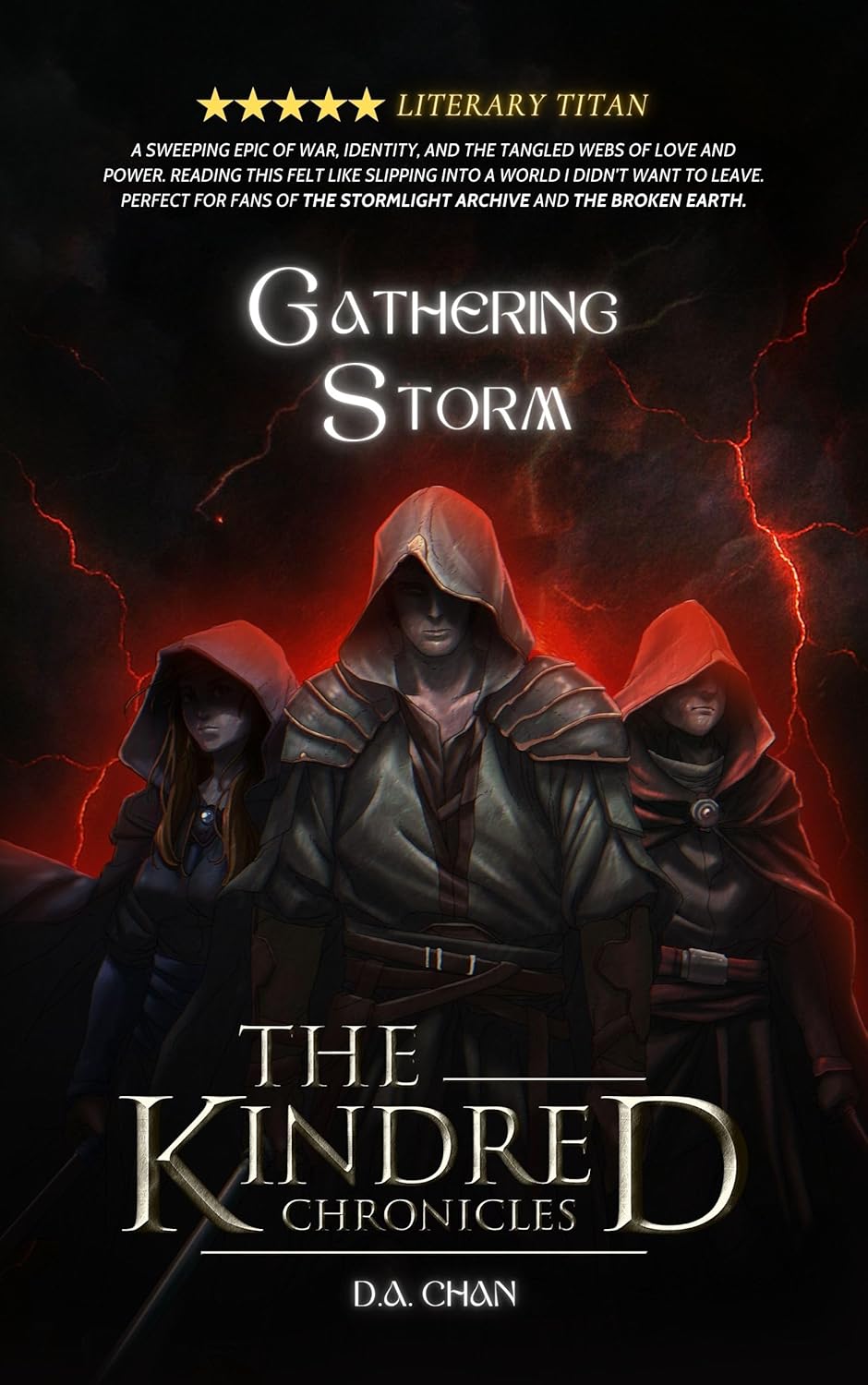
D.A. Chan’s The Kindred Chronicles: Gathering Storm is a sweeping epic of war, identity, power, and the complex webs of loyalty and love. Set in a rich and layered world teeming with fantastical cultures and mythic structures, this third installment dives into the aftermath of a major conflict and sets the stage for a larger confrontation with a corporate villainy that blends magic with modern industry. We follow Chris, a reluctant hero burdened with both trauma and responsibility, alongside a cast of warriors, mystics, and rulers, each with tangled motivations and deep emotional wounds. As the characters navigate political alliances and personal betrayals, the book pushes forward with high-stakes missions and wrenching personal decisions, all laced with lyrical prose and carefully built lore.
Reading this felt like slipping into a world I didn’t want to leave. The writing is confident and lush, but never overbearing. There’s something poetic about the way Chan strings his sentences together, even when he’s describing something as brutal as a blade through bone. The worldbuilding is top-notch. You can smell the marble in the war rooms, feel the dust of battlefields, and get lost in the shifting allegiances of ancient houses. The dialogue, particularly the kindred tongue, gave the book an almost sacred cadence. And those moments of silence between characters? They said just as much—sometimes more—than the battles. Sometimes the pace slows in philosophical musings or dense political mechanics. But even then, I didn’t mind lingering. I liked the thinking space it gave me.
Emotionally, this book hit me harder than I expected. Chris is haunted in a way that’s painfully familiar—trauma doesn’t just disappear, and Chan gets that. Watching him fight while shouldering his ghosts is equal parts heartbreaking and inspiring. Elline and Empyrean’s relationship, especially, brought a kind of intimate storm to the plot. Their love was more than just romance, it was a war of wills and ideals. I didn’t always like Empyrean, but I understood him. The jealousy, the pride, the grief, it all made him maddeningly relatable. And Grace is the wild card, the heartbeat of something new and unpredictable. I found myself caring about her more than I expected.
If you love your fantasy high-stakes and high-emotion, Gathering Storm is your kind of book. It’s perfect for readers who want more than just sword fights and magic—they want characters who bleed, who doubt, who love fiercely and fail spectacularly. It’s not a light read, but it’s a worthy one. I’d hand this book to fans of The Stormlight Archive or The Broken Earth series in a heartbeat.
Pages: 454 | ASIN: B0FB8J837R


