Blog Archives
Cats are Good at Hiding Illness

The Cat Owner’s Guide to Health Emergencies provides cat owners with concrete methods for coping with the most difficult feline crises, including solid answers on when to wait and watch and when to act quickly. Why was this an important book for you to write?
As an emergency veterinarian, I frequently witness the impact of the knowledge gap among cat owners, particularly when it comes to emergencies. Cats are notorious for hiding illness, making it challenging for owners to recognize when something is wrong. While we do see cats brought into the emergency room for minor issues that likely could have waited, we also encounter many cases where subtle, yet crucial, signs were overlooked, leading to unnecessary and often unsafe delays in care. Cats are not small dogs— they will conceal illness for as long as possible. That’s why it’s so important for owners to be prepared and knowledgeable about which symptoms may indicate a serious problem.
My goal with this book is to equip cat owners with the education and tools they need to confidently assess their cat’s health. This book offers vital insight into common emergencies and toxicities, while teaching practical methods for evaluating a cat at home. While no one wants to think about emergencies, especially when their cat is healthy, I strongly encourage a degree of advanced preparation to reduce stress when emergencies do arise.
I believe this book can be a valuable resource for all cat owners, but its greatest benefit may be for newer cat owners, adopters, and fosters.
What gap were you hoping to fill that other pet care books don’t address?
It’s no surprise that I love books, and I deeply respect and admire all those out there aimed at improving pet lives by supporting their owners. That being said, I noticed a few patterns in some of the existing books that I wanted to approach differently. Many books on this topic offer valuable and accurate information but can be visually overwhelming, often feeling like reading long articles or textbooks. Personally, I find those types of books challenging to get through, and I’m sure many pet owners feel the same. My goal with this book was to present information in manageable, digestible chunks that are easy on the eyes. To further enhance usability, I color-coded the chapters for quick reference, so owners can easily identify sections even when the book is closed.
Additionally, I’ve seen pet care books that are more story-based, using anecdotes to illustrate key lessons. While these books are excellent for teaching, I believe they’re not ideal for quick reference. My book is designed to serve as a practical guide, both to prepare owners before emergencies happen and to provide clear reference points if a concern arises.
What sets my book apart is my background as an emergency veterinarian. The scenarios highlighted in the book are ones I encounter regularly in my practice and conversations I have with pet owners often. The knowledge and expertise I bring to the table offer pet owners practical tools and a deeper understanding of their pets’ health, all presented in a way that is friendly to non-medical individuals and designed for quick, easy reference when it’s needed most.
You highlight specific dangers like urinary obstruction and open-mouth breathing. Why are these so frequently misunderstood?
Urinary obstructions and open-mouth breathing are two excellent examples in the book where misconceptions and lack of knowledge can result in missing vital signs. Let me explain why these issues are often misunderstood.
Urinary concerns, particularly in male cats, are extremely dangerous. Male cats can develop urinary blockages that, if not addressed quickly, can be fatal. Unfortunately, many people are unaware of this. A common misconception is that urinary changes in cats are always due to a urinary tract infection, which is more common in female cats. In fact, it’s really quite uncommon in males. This misunderstanding can lead to delays in seeking care, allowing the condition to worsen. Another factor is that cat owners don’t always pay close attention to their cat’s use of the litter box. Unlike dogs, whose bathroom habits are more noticeable during walks, cats’ litter boxes are often hidden from view, making it easy to miss important signs. While urinary obstructions can’t always be prevented, I believe that greater awareness could lead to earlier recognition and, ultimately, better outcomes.
Open-mouth breathing in cats is another issue where education can make a significant difference. Cats are not small dogs, and this distinction is crucial when it comes to respiratory issues. Many people mistake open-mouth breathing in cats for normal panting behavior seen in dogs. However, cats are obligate nasal breathers—meaning they breathe only through their nose. Since they do not breathe through their mouths effectively, open-mouth breathing (panting) is a sign of respiratory distress that should never be ignored. Note that overheating and pain can sometimes lead to short bursts of open-mouth breathing—which should resolve quickly.
Because cats are so adept at hiding symptoms, it’s important for owners to know how to assess their cat’s health. In the book, I not only highlight key warning signs like these but also provide practical tools for owners to evaluate their cat’s hydration, posture, gum color, behavior, and more. The goal is to help owners answer the critical question: Is this behavior normal or abnormal?
If a reader remembers just one thing from your book in a crisis, what do you want it to be?
There are a few key points I hope readers take away, but the most important is this: cats are incredibly good at hiding illness, often masking problems until they become serious. Even small changes in behavior or health can signal a bigger concern underneath. If you notice something concerning, it’s crucial to have a veterinarian assess the cat.
When preparing to transport the cat, safety is key. Make sure the cat is secured in a carrier, and if necessary, gently wrap them in a towel to get them safely into the carrier. Also, remember that the veterinary team is also invested in your cat’s wellbeing. Effective communication is essential, so share what you’ve observed at home in a clear, chronological order if possible. We’re always most successful when we work together—pet families and veterinary teams.
The Cat Owner’s Guide to Health Emergencies: Essential Tips to Recognize, Respond, and Prepare for Cat Emergencies


The Cat Owner’s Guide to Health Emergencies is a practical, veterinarian-written manual that tries to do something genuinely difficult: give anxious cat owners enough clarity to act fast without pretending they can replace a clinic. It moves from preparation into crisis, covering emergency planning, the ten most common feline emergencies, the ten toxicities Dr. Gal Chivvis sees as especially important, the signs that distinguish “watch closely” from “go now,” and a final toolkit of checklists and flowcharts meant to steady people when their nerves are likely to fail them. What stayed with me most was how concrete it is. This is a book that doesn’t just say “be prepared.” It asks you to know your nearest ER, keep a carrier ready, think through CPR decisions before panic takes over, and learn what a dangerous breathing pattern or an abnormal bladder actually looks like.
The book is calm without being bland, and authoritative without sliding into that chilly, overconfident tone that a lot of medical guides fall into. Chivvis writes like someone who has seen frightened people arrive at the worst possible hour and understands that information is only useful if it can still be absorbed under stress. The best sections have a sobering vividness. Her explanation of a linear foreign body, where swallowed string can make the intestines “accordion,” is memorable in exactly the right way. So is the repeated insistence not to pull visible string, not to dismiss open-mouth breathing, not to confuse urinary obstruction with constipation, and not to wait for toxicity symptoms before acting. I also appreciated the small humane details, like the note that visitation may sometimes be discouraged while a cat is in oxygen because seeing their owner can worsen distress. Moments like that give the book emotional credibility. It knows the medicine, but it also knows the strange helplessness of loving an animal you can’t fully question or comfort.
The prose is clear and serviceable, and the repetition built into the format can make the middle stretch feel instructional. Each section follows a familiar sequence of signs, causes, what to do, common interventions, and prevention, which is excellent for reference. I found that structure more helpful than limiting. It mirrors the thinking the book wants to teach. Notice. Assess. Don’t improvise recklessly. Call. Go. The ideas themselves are sensible and grounded in lived emergency practice. I especially liked the way the book pairs high-stakes warnings with prevention that feels doable: keeping cats indoors to reduce abscess risk, treating panting as abnormal, managing litter box stress, recognizing the danger of lilies and ibuprofen, and using simple observational tools like resting respiratory rate, hydration checks, and pain scoring. That practical intelligence gives the book its real force.
I found this to be a useful, reassuring, and refreshingly unsentimental guide. It offers preparedness, lucidity, and a steadier hand when things go sideways. I’d recommend it especially for first-time cat owners, multi-cat households, and anyone whose instinct in a crisis is to freeze, second-guess, or start doom-scrolling. It’s a caring and trustworthy book, and in a book about emergencies, that matters most.
Pages: 195 | ISBN : 978-1967320004

A Fun Reading Experience

What’s Wrong With Tom: A Veterinary Tale of Courage and Compassion follows a cheerful, free-spirited cat who loves to roam and explore his world, who develops a mysterious pain one morning, and relies on his caring parents to uncover the problem. What was the inspiration for your story?
I’ve wanted to write a children’s book ever since my daughter was born nearly ten years ago, but I never quite felt like I had the right story—until one day, a veterinary colleague casually suggested I write about what’s around me. As we spoke, I was just in the process of managing the care of a cat with a urinary obstruction. At first, I dismissed the idea of turning veterinary emergencies into a children’s story—it felt too complex, heavy, and difficult to translate into an educational but still a fun reading experience. But over time, I began to see a way to approach it creatively, and eventually, the concept for What’s Wrong with Tom? started to take shape.
As an emergency veterinarian, I’ve seen countless families come in with pets who just aren’t acting like themselves, and the owners don’t always know what signs to focus on and relay to the veterinary team. Urinary obstruction in male cats is a common and serious condition that can become life-threatening if not caught early, and some of the signs can be somewhat straightforward to note, if you know what you’re looking for. Families who are aware of this condition often recognize the signs quickly and are able to seek care before it becomes critical. That’s the kind of awareness I was hoping to spark with this book, and in future books.
I wanted to create a story that introduces the condition in a way that’s gentle, engaging, and age-appropriate—something kids could connect with and that families could learn from together. The inspiration for Tom came from the many real-life cases I’ve seen over the years—and yes, we really do seem to have an overabundance of slightly overweight male orange cats who come in with this condition!
What were some educational aspects that were important for you to include in this children’s book?
Children’s books, to me, are magical in the way they can introduce real-world situations while also helping kids learn about themselves. That’s why it was so important for me to include elements that children could genuinely connect with and draw lessons from—both emotionally and practically—while also introducing complex medical concepts in ways that kids can (hopefully) understand.
One of my primary goals in writing this book was to offer a gentle, age-appropriate introduction to what a real pet emergency might look like. I wanted to help children—and the adults reading with them—understand what happens medically, what signs to watch for at home, and that it’s important to seek veterinary care when something seems off. My aim was to present just enough clinical information to educate, without overwhelming or losing the warmth of the story.
Equally important was highlighting the role of the veterinary team as a trusted and compassionate part of a pet’s care. I wanted to reinforce the idea that pet families and veterinary professionals are all working together toward the same goal. In fact, I believe in this concept so strongly that I created a pet owner education platform built around the slogan One Team, One Goal: Collaborative Pet Care. That sense of trust, partnership, and shared purpose is at the heart of the story.
Beyond the medical and practical aspects, I also wanted to explore key social-emotional themes. In this story, stress plays a role in the disease process, so I used that as an opportunity to talk about stress awareness and coping strategies in a way that’s approachable for young readers. I also used the translator as a way to give Tom a voice and allow children to connect with his emotional experience: his courage in finding his voice and speaking up for himself.
My hope is that readers walk away from the book feeling entertained, learning something along the way—and that the adults reading with them also find value in the story.
The art in this book is fantastic. What was the art collaboration process like with the illustrator Mischa Pearson?
I was so thrilled to have found the amazing Mischa Pearson to be my illustrator and partner-in-crime through this book creation process. This was my very first children’s book, and I had a lot to learn. Mischa, on the other hand, has been an illustrator for a while—and also an author—so it was incredible to have her in my corner.
Despite us being in different time zones, we were able to communicate effectively throughout the process. We began by creating a general outline of what we wanted for each page… and then promptly changed almost everything. HA!
We definitely had some challenges and a few very comical situations, especially because some of the scenes were veterinary-specific and quite medical—and Mischa, unlike me, is not a veterinarian. There were a few illustrations that I had clearly in my mind but had a hard time conveying. I ended up creating a lot of very entertaining mockups using a mix of coworkers posing in real scenarios, reference photos, and random images to help set the scene. Most of the resulting mockups were pretty hilarious, and we’ve kept some of those behind-the-scenes gems in our personal folders for when we need a good laugh.
Just like in any situation where you have multiple creative minds involved, there were times we didn’t quite agree on how a page should look. We would go through different versions until we both felt happy with it—sometimes by adding more and more detail, other times by stripping it back. And in one case, we scrapped the idea completely and started over from scratch.
This was absolutely a learning experience for everyone, but I’m so thrilled I got to work with Mischa. I now consider her a friend, and I feel incredibly lucky that her talent helped bring this story to life so beautifully.
Is this the first book in the series? If so, when is the next book coming out, and what can your fans expect in the next story?
Yes! What’s Wrong with Tom? is the very first book in The Critter Care Crew series. The next book is already written and currently in the early stages of editing, with an expected release in 2026.
While I’m not quite ready to reveal the full plot just yet, I can say that readers will meet a brand-new main character—a sweet dog this time around! The setting remains the same, with the Critter Care Crew facility and our translator machine still in action. However, we’ll have a new veterinary team on duty, and we’ll be exploring a new set of social-emotional themes.
I’m also excited to share that this book will be brought to life by a new illustrator—the wonderfully talented Andi Ketch. I truly can’t wait to see it all come together!
Author Links: GoodReads | Facebook | Website
A veterinary tale of compassion, courage, and a cat in crisis.
When playful Tom the cat suddenly falls ill, it takes a devoted family, a clever vet crew, and a dash of feline courage to unravel the mystery.
Thomas LeBrat is a fun-loving cat who fills his home with joy and laughter. But when a sudden health emergency strikes, Tom’s carefree world turns upside down.
With help from his attentive family and the skilled team at the Critter Care Crew, the mystery of Tom’s illness begins to unfold.
Written in playful rhyme by a veterinarian and homeschool mom, What’s Wrong with Tom? is the first book in The Critter Care Crew series. This heartwarming story blends imaginative fun with real-world insight—helping children understand pet health, empathy, and the power of teamwork.
A surprise element tucked into the story gives readers a glimpse into Tom’s thoughts and feelings, creating a more personal connection, helping children feel like they’re part of his care journey, and deepening their understanding of the situation.
Perfect for ages 4–8, classrooms, and animal-loving families, this engaging picture book includes:A gentle introduction to veterinary care and pet emergencies
Social-emotional learning through empathy, advocacy, and teamwork
A memorable story experience filled with rhythm, heart, and humor
A creative and accessible way to start conversations about caring for others
Bonus content also includes:A kid-friendly glossary of veterinary terms
A visual stress management guide to support emotional resilience
Access to free educational resources for teachers, caregivers, and homeschoolers
Because caring is a skill every child can learn—and every pet deserves.
A gentle, engaging way to help kids build confidence and compassion around pet care.
What’s Wrong With Tom: A Veterinary Tale of Courage and Compassion
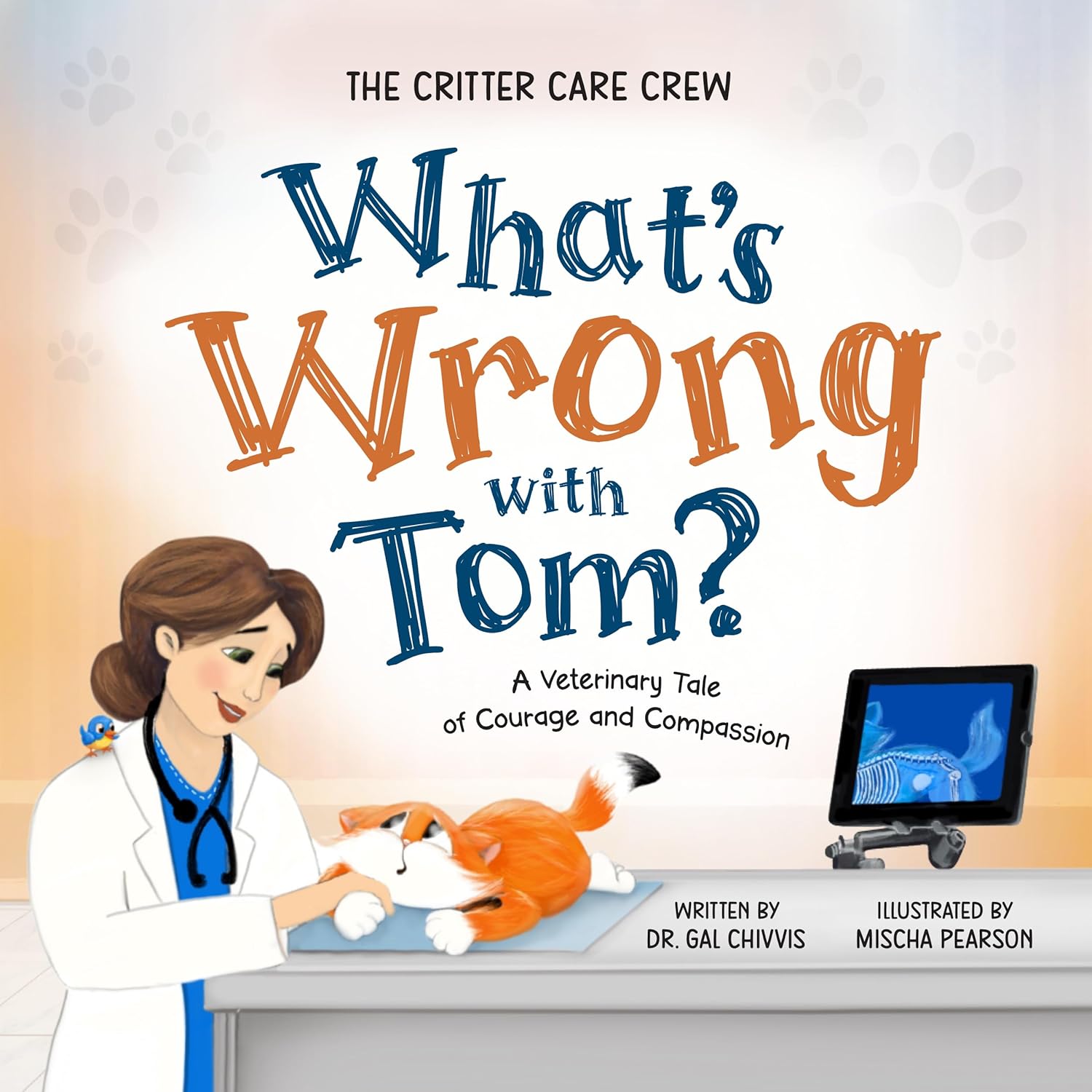
What’s Wrong With Tom: A Veterinary Tale of Courage and Compassion is a charming and educational story that’s perfectly tailored for young readers. At its heart is Thomas, a cheerful, free-spirited cat who loves to roam and explore his world. One morning, however, his playful routine is interrupted by a mysterious pain. Confused and uncomfortable, Thomas relies on his caring parents and the devoted Critter Care Crew to uncover the problem: he’s having trouble urinating.
Thanks to a minor surgery, plenty of support, and an extra dose of affection, Thomas recovers smoothly and is soon back to his old, adventurous self. His journey offers young readers a gentle, reassuring introduction to the idea of veterinary care and the healing power of compassion.
Dr. Gal Chivvis delivers a captivating narrative that balances entertainment with education. The language is accessible, the pacing is thoughtful, and the storyline keeps readers engaged without overwhelming them. One particularly delightful element is the inclusion of a machine that translates animal speech into words, an inventive touch that sparks imagination and adds a layer of whimsy.
The illustrations are vibrant and expressive, bringing Thomas’s world to life with warmth and humor. Each page invites young readers to pause, observe, and enjoy the visual storytelling, which complements the text beautifully. Thomas’s playful personality shines through, especially in scenes that depict his curiosity and love for exploration.
Chivvis masterfully conveys an important message: while medical procedures may seem frightening, they are often necessary and manageable with the right support. Through Thomas’s experience, children learn that recovery can be quick and that bravery comes in many forms.
The addition of a glossary at the end is especially thoughtful. It serves as a springboard for conversation between adults and children, clarifying medical terms in a way that is easy to grasp. This not only reinforces comprehension but encourages dialogue about health, care, and empathy.
What’s Wrong With Tom is both a delightful story and a valuable teaching tool. Whether read at home or shared in a classroom, it offers young readers comfort, knowledge, and inspiration. I look forward to more works from Dr. Chivvis, and her unique blend of heart and insight is a gift to children’s literature.
Pages: 35 | ASIN: B0FLZSL47R
Clear, Trustworthy Information

The Dog Owner’s Guide to Health Emergencies is a lifesaving resource manual for every dog owner that offers expert advice on identifying and managing canine health crises. Why was this an important book for you to write?
As an emergency veterinarian, I’ve seen firsthand how a lack of accurate, accessible information can impact both pets and their families. In some cases, owners wait too long to seek care because they mistakenly believe a situation isn’t urgent—only to arrive when the pet is much sicker and harder to treat. In other situations, well-meaning owners may unintentionally make things worse at home due to misunderstandings about what to do. On the flip side, I also see people rushing to the ER out of concern, only to learn the issue could have been safely managed at home. While it’s always better to err on the side of caution, that stress—emotional and financial—can often be reduced with a little guidance. Additionally, while ERs are here to help, keeping animals out of the ER that do not need to be there helps reduce overcrowding and waiting times.
I wrote The Dog Owner’s Guide to Health Emergencies to help bridge that knowledge gap. I believe that when pet owners are empowered with clear, trustworthy information, they can make better decisions, act with more confidence, and ultimately improve outcomes for their dogs. This book is about providing that support, in a practical and approachable way.
What were some ideas that were important for you to share in this book?
There were several key ideas I felt were important to include in this book. First, I wanted to give pet owners practical, hands-on skills they could use to assess their dog’s stability. I developed what I call the “Emergency Toolkit”—a set of basic but essential evaluation techniques like checking gum color, assessing hydration, monitoring breathing rate and effort, pain assessment, and more. These skills are designed to help owners assess critical markers of stability, communicate more effectively with veterinary professionals, and take action with greater confidence.
I also wanted to make sure pet owners are prepared before an emergency ever occurs. That includes having veterinary contact information readily available, leaving behind useful details when traveling or using pet sitters, and understanding what types of information are most helpful to share with the veterinary team. To support that, I created a collection of practical forms that guide owners through these situations. These resources are embedded in the book and also available for free through my website or by email request.
What advice do you have for new dog owners to help them be prepared for emergencies?
New and seasoned dog owners alike can sometimes feel uncertain when it comes to their pet’s health—and that’s completely normal. One of the best things you can do is take time to get to know your individual dog and learn a bit about the breed—common health tendencies, any predispositions, and what’s considered normal behavior. Establishing a relationship with a regular veterinarian is also key. Your vet is a valuable resource for guidance, preventive care, and answering the questions that naturally come up over time.
Most importantly, I always encourage owners to trust their instincts. If something doesn’t seem right, it’s okay to ask questions. And if you’re genuinely worried, it’s better to have your dog seen—even if the issue turns out to be minor—than to wait and risk missing something more serious. Being proactive is one of the best ways to care for your dog. Your veterinarians are here to support you!
What is one thing that you hope readers take away from The Dog Owner’s Guide to Health Emergencies?
The thing I hope readers take away from The Dog Owner’s Guide to Health Emergencies is that they can play an active, informed role in their dog’s care—even in urgent situations. Emergencies are never easy, but having a clearer understanding of what to watch for and how to respond can take away some of the uncertainty. My goal is to help pet owners feel more prepared, more confident, better able to support their dog when something unexpected comes up and trust their instincts when concerns arise.
Author Links: Goodreads | Facebook | Instagram | Website | Amazon
Emergencies can happen in an instant—would you know when to act?
Written by a seasoned emergency veterinarian, The Dog Owner’s Guide to Health Emergencies is a must-have resource for every dog owner. This practical and easy-to-follow guide gives you the knowledge to recognize warning signs, take immediate action, and seek veterinary care when it matters most. Whether your dog is facing a sudden collapse, poisoning, heatstroke, or severe injury, this book equips you with a clear and actionable emergency toolkit—so you can make informed decisions with confidence.
Inside, you’ll learn:
The 10 most common dog health emergencies—what they are and when to act fast
The 10 most common toxic exposures—what’s dangerous and how to respond
How to assess your dog’s condition at home and recognize when urgent care is needed
Proactive strategies to help prevent emergencies and keep your dog safe
Guidance that empowers you to trust your instincts when something feels off
Bonus Resources to Help You Prepare:
First aid supplies checklist to ensure you’re ready when it matters most
Pet care and medical authorization form for emergency situations
Sick visit information sheet to help streamline your veterinary visit
Decision tree for managing seizures, making it easier to take the right steps
Response charts for various situations, including pain, overheating, allergic reactions, breathing concerns, bite wounds, and more
Your dog depends on you in an emergency. This book gives you the tools, knowledge, and confidence to act—because every second counts. Get your copy today!
\


