Blog Archives
Invisible Tragedy

Driven follows a woman recovering from the brink of madness who discovers a man is searching for unammi survivors to experiment on, and humans are being kidnapped, leaving her determined to find a way to save them all. What was the inspiration for the setup of your story?
Our own world is beset with social issues. I wanted to take these two—slavery and medical experimentation on living beings (humans and animals)—and kind of push them into the reader’s face, so that they couldn’t be ignored. Slavery, also known as “human trafficking” or “sex trafficking,” takes place every day, but for those of us who are insulated in privilege, it’s an invisible tragedy and easy to overlook.
It’s the same with the experimentation; though that’s a bit harder to see in contemporary civilization, it’s definitely there, hidden behind closed doors and shuttered windows. Because we don’t see these problems, it’s easy to pretend they don’t exist.
There are many ways to fight these issues, not all of which are as bold as Alira’s choices. But here’s the thing: if we don’t face them with unflinching outrage, they will never stop.
Regardless of the methods we choose with which to fight, no one person can solve all these problems. Not alone. Yet even though one person can’t save everyone, they can help a few. And that can start a larger movement.
Alira is that person, the one who saves those she can reach. She’s already gone through so much; she is the unflinching (okay, she does flinch on occasion, but it doesn’t stop her from moving forward) individual who says, “If not me, then who?”
Alira is a fascinating character. What scene was the most interesting to write for that character?
That’s a tough choice. Alira’s whole character arc is so tightly woven that choosing a single scene as “most interesting” is like trying to choose a single favorite thread in a completed tapestry. And Alira has her peak moments in each book in this trilogy.
For Driven, I lean toward one of Alira’s “rescue” scenes—either of Bika (which has two parts, the rescue and the aftermath), the ikanne harvesters, or the brothel slaves. Each of those times gave Alira’s spur-of-the-moment creative problem-solving skills room to shine.
I find that authors sometimes ask themselves questions and let their characters answer them. Do you think this is true for your characters?
Definitely. Sometimes, their answers surprise me.
But at least one major focus of my writing is to ask big questions, sometimes even the ones we don’t want to face. I think The Founder’s Seed trilogy manages to do that. I feel like Alira’s answers to those questions came from a courageous heart and a strong spirit.
Where do you see your characters after the book ends?
Oh, their story continues in the coming follow-up trilogy, tentatively titled Nexus. That trilogy will be told through the eyes of non-POV characters that were introduced in The Founder’s Seed, but Alira, Botha, and Galen/Thrace will all be there. We see the start of that at the end of Driven, in the new secret colony Alira and Kilbee have established.
Stay tuned.
Author Links: GoodReads | Facebook | BlueSky | Website | Niveym Arts | Amazon
On Danua, acting Clan Admiral Knøfa experiments on his unammi prisoner. Except the squib isn’t healing any longer, and the medics aren’t working fast enough to save her. Knøfa starts searching for another unammi—maybe a male this time, so he can create all the test subjects he wants.
Stopping the Cartel is enough to keep Alira’s hands full. She doesn’t want to fight the Clan, too. Yet, when she learns Knøfa is searching for the unammi survivors, she races to warn them. As Knøfa’s ship approaches them on Earth, the council tries to force it to leave. But Alira knows that if the humans escape, the unammi are doomed. Knøfa’s “experiments” will escalate, and other humans will follow his example. To protect her people’s secrets, she must stop that ship. Her only hope is to attempt something no Founder’s Daughter has ever done.
A Broader Canvas
Broken centers around a shapeshifter plagued by the chaos of living as a human and enduring her own lost sense of self. What was the inspiration for the setup of your story?
I have to admit that my own experience has partly led to Alira’s story. While I don’t have dozens of voices in my head (other than the characters in my stories, that is), I always felt like an outsider among those around me. It took me many years to find my tribe, and to reach a place in my life where I felt I could be myself and not struggle to fit in.
I’ve known many others like this, and it’s hard. For all of us. Struggling to be the kind of person you think others expect of you can be soul-draining. That’s what started Alira’s tale for me. From there, it took off on its own.
What is it that draws you to the science fiction genre?
I like science fiction because it allows me to stretch reality in ways that drive home the point of the story. I feel like The Founder’s Seed books could also be called science fantasy, since there are elements of it (the harvesting of souls, for one) that can’t be supported by science. But these genres expand the boundaries of what is possible or probable, and allow the reader a greater leeway for suspension of disbelief.
My stories usually ask big questions; so far, science fiction and science fantasy have both offered a broader canvas for that work.
Do you have a favorite character in The Founder’s Seed series? One that his especially enjoyable to craft?
Of course, Alira is my favorite. She’s me in so many ways that count. She’s definitely the hardest to write, but also the most rewarding.
A very close second favorite is Botha; he’s a joy to write! Putting myself in his head, so that I can write him with authenticity, is always fun!
Where will the next book in the series take readers? When can we expect to see it released?
The next book, Driven, picks up where Broken left off; it gives a closer—and thoroughly raw—look at the new antagonist, Knøfa; follows Alira’s journey through her time with Botha, and what comes after (no spoilers!); settles Thrace/Galen in her/his role; and sets the threads for the follow-up trilogy that is already in the works.
Driven was released in late June and is now available for readers.
Author Links: GoodReads | BlueSky | Facebook | Website | Amazon
To make matters worse, the harvests of knowledge and memories she’s gathered from the dead aren’t adequate to fully understand her assumed role—unless she surrenders control to the one internal voice she thinks can make things right. But that harvest isn’t willing to share the space in her head, and soon Alira is no longer sure which voice is his, and which is her own.
Galen has vowed to help Alira succeed and follows her increasingly unbalanced directives, until he realizes that her harvests have corrupted her conscience, maybe even her sanity. Galen has never been a leader. But as the crisis screams toward them, he must make a choice: abandon their people to save Alira or sacrifice her to save them all.
Driven: The Founder’s Seed Book 3
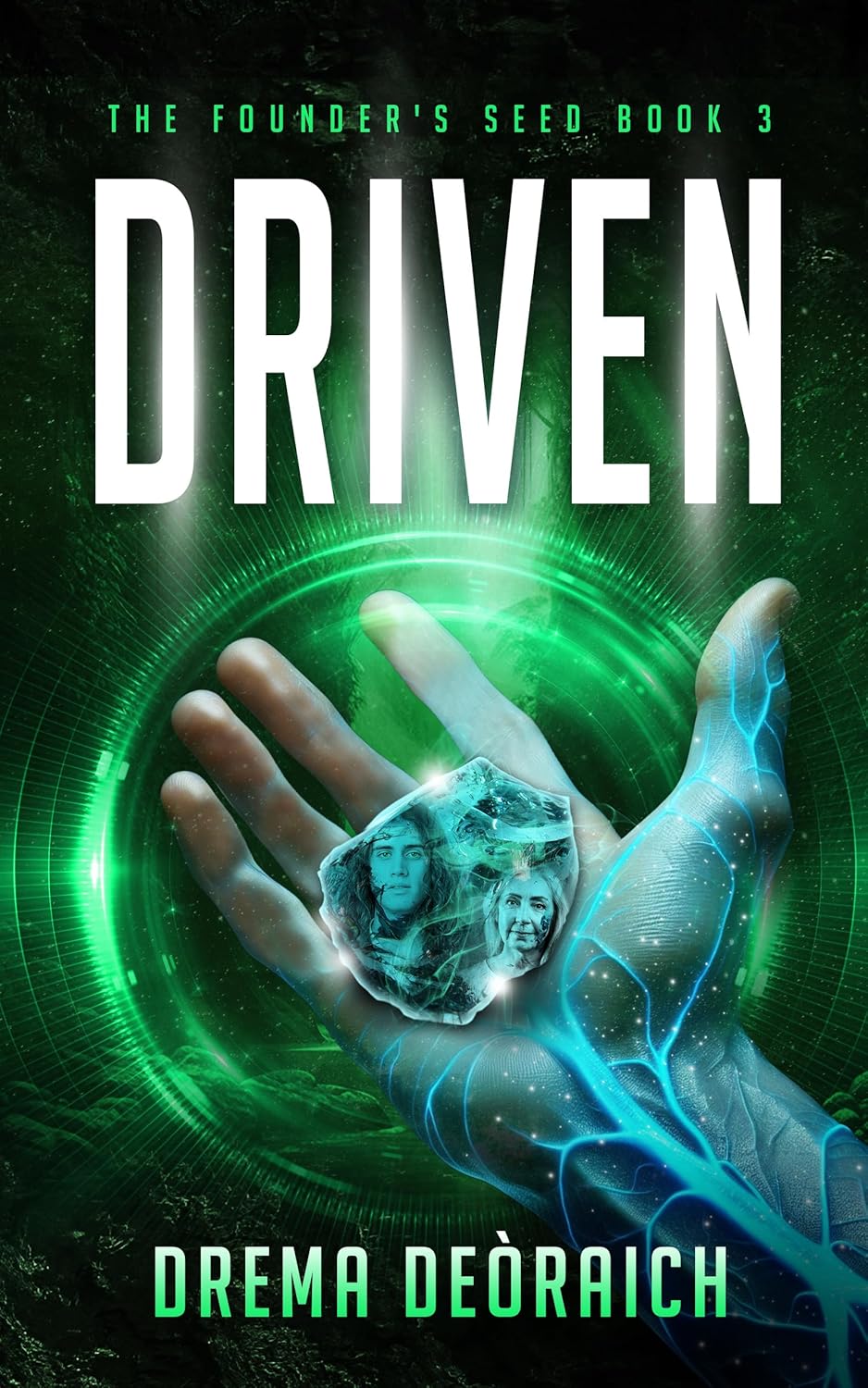

Driven is the third installment in The Founder’s Seed series, continuing the riveting saga with even higher stakes and deeper revelations. The book pulls you straight into a galaxy alive with politics, betrayal, and fragile alliances. Admirals, traders, and hidden survivors of a nearly lost people clash in a world where loyalty is currency and compassion is weakness. At the heart of it all are Alira, still wrestling with her fractured self, Botha with his quiet wisdom, and Thrace carrying the burden of leadership under constant threat. The novel moves between brutal experimentation on the mysterious Iridosians, tense negotiations among rival factions, and deeply personal struggles for survival. It is a story of ambition, cruelty, resilience, and the thin thread of hope that refuses to snap.
Reading this book stirred a mix of awe and discomfort in me. The clinical coldness of Knøfa’s experiments made my stomach twist, yet I couldn’t look away. The writing is vivid, even when it’s painful, and that’s part of its power. I found myself admiring the author’s willingness to go dark, to show how curiosity can turn into obsession, and how power can warp good intentions. At the same time, the quieter moments between Alira and Botha gave me room to breathe, to feel the warmth of trust slowly taking root in frozen soil. Their scenes lingered with me, like a candlelight after the storm.
There are a lot of moving parts here. Political factions, shifting alliances, plots within plots, and it took me a while to sort through them all. But once I settled in, I found myself hooked. The author doesn’t coddle the reader. She trusts us to keep up, and I respect that. What I loved most was the emotional honesty tucked between the battles and schemes. Fear, hope, guilt, tenderness, it all feels raw and real, even in the middle of starships and alien physiology.
Driven left me both unsettled and uplifted. It’s a rewarding read. I would recommend it to readers who enjoy science fiction with grit and heart, to those who don’t shy away from moral grayness, and to anyone who loves stories that ask what survival truly costs. If you like your space operas full of high stakes but also deeply human at the core, this book will leave a mark.

Broken: The Founder’s Seed Book 2


When I opened Broken, I was immediately pulled into a world brimming with tension, betrayal, and the complicated weight of carrying other people’s lives inside your own head. Drema Deòraich’s story follows Alira, Galen, and Thrace as they navigate shifting identities, political intrigue, and the brutal cost of survival among human and unammi factions. The author builds a layered tale of power struggles, loyalty, and moral compromise, where every choice feels like a thread tugging at the larger web. The book is about what it means to stay whole when you are forced to fracture yourself for the sake of others.
The writing has a pace that rarely lets up, and the dialogue carries a sharpness that feels lived-in. The shifting perspectives, the sudden bursts of violence, and the moments of quiet reflection all come together to create a rhythm that feels alive. At times, the narrative voices inside Alira’s head became almost overwhelming to read, but I realized that was the point. It mirrored her chaos, her crowded sense of self. I found myself admiring how boldly Deòraich leaned into that confusion, refusing to make it easy for the reader, because life inside a fractured mind is never easy.
Beyond the writing, I was moved by the book’s ideas. Questions about identity, about whether survival justifies the blood on your hands, and about how much of yourself you can give away before there’s nothing left. I was thinking about these ideas for a long time afterwards. I felt both sorrow and admiration for Alira. Her choices often frustrated me, yet I couldn’t help but ache for her struggle. The themes of slavery and exploitation, woven into the politics of the factions, hit me hard. They were ugly and uncomfortable, and that’s exactly why they mattered. Deòraich didn’t flinch from showing cruelty, and in that honesty, the book had teeth.
Reading Broken reminded me of Frank Herbert’s Dune in the way it blends political intrigue with questions of identity and survival, but it feels more intimate and raw, pulling me closer to the characters’ inner battles. I’d recommend Broken to readers who love science fiction that challenges them. If you like tales that balance heart with grit, that mix character-driven drama with political maneuvering, this book is more than worth your time.
Pages: 420 | ASIN : B0DLTLQMQP

Restrictive Societies
Fallen is an immersive sci-fi tale following a young woman torn between duty and defiance, navigating political intrigue, alien traditions, and the weight of inherited secrets that could reshape her entire civilization. What were some sources that informed this novel’s development?
I have always been a huge fan of Frank Herbert’s Dune trilogy (as well as the books that fleshed out the series after his death). I can’t even remember how many times I read that first book. Each time, I found Paul Atreides’ journey inspiring and motivational, especially the way he took each apparent challenge and turned it to his advantage, making him stronger and more resilient. I hope that Alira’s journey in The Founder’s Seed would offer that same kind of feeling to readers.
What inspired Alira’s character arc from idealist to survivor, and how much of her journey reflects personal experiences or broader themes you wanted to explore?
A lot of Alira’s journey reflects my own, only without the sci-fi details. Like Alira, I’ve never felt like I “fit” with others around me, regardless of how I tried. Both Alira and I stood firm in our belief that things could be (can be) different. Better. Both of us feel like an island in a vast sea of opinions and views that don’t reflect our own or, if they do, their opposition is too strong to resist. I know Alira and I are not alone in that.
It’s hard—sometimes impossible—to stay silent in the face of clear violations of a perceived Truth. Alira learns the consequences of speaking out and, eventually (by the end of book 3, Driven), she finds strength, balance, and peace with herself and those around her, but on her own terms. This is what I hope for myself, and for everyone like me who finds it challenging to be true to who we are inside while operating in a world that sometimes feels alien to us. I wanted to offer Alira as an inspirational hero, one who can show us that it isn’t easy to be true to yourself, but in the end, it is absolutely worth it.
In Alira, I also wanted to explore what would happen when something catastrophic broke down the walls that held her back and gave her the opportunity to stretch into her authentic self. I think that part worked quite well, though her journey to find that authentic self is…circuitous. But that’s like real life, isn’t it?
What were some themes that were important for you to explore in this book?
I wanted to explore the concept of restrictive societies, where there’s no room for those who don’t blend in, and how it affects not just those who are exiled (or otherwise penalized), but those who manage to hide their differences. I also wanted to explore how those many individual prices cost the society overall.
The theme of personal growth under pressure was also important to me in this trilogy. Most of us have a “line in the sand,” boundaries we’ve defined for ourselves and those we allow into our lives. I wanted to explore crossing that line, and what might motivate someone to push past that point of no return. Sometimes, the best and strongest growth happens in adverse circumstances and while it might not be predictable or proceed in expected ways, it’s often rugged and enduring. One doesn’t have to be carrying signs or weapons to be a revolutionary. Sometimes all it takes is to step off the beaten path toward the perception of a “better way,” and refuse to go back to accepted standards. It isn’t an easy choice, but it can be a very powerful one.
I also wanted to explore, to a lesser degree (at least in this trilogy), the long-term effects of the reasons for humans’ Earth exodus—the environmental destruction and resulting wars—and what that result would look like in their colonial world structures. These details are mostly in the background, but they are definitely there, if you look closely.
(The backstory of all this is in the works and will eventually be published as part of the Founder’s Seed universe saga.)
The inherited memories in the story are fascinating—what influenced your decision to weave the past so tightly into the narrative?
Well, the present is always built on the foundations of the past. What happened then will always affect what happens now, sometimes in subtle unseen ways. I wanted to make that a bit more stark, more jarring. Hearing about the past is one thing; actually seeing it through the eyes of someone who was there brings a whole new understanding to the situation. Lurien serves as the unammi’s historian, which is one reason why hers is the first voice on the council.
I also wanted that aspect of the story to serve as a fragile thread of connection between the “before” and “after” for the unammi. Since Alira’s view of that history is fragmented, she can only bring a portion of that history forward. Imagine what would happen if the human race was nearly wiped out, and all our history erased. We would have to start over from scratch. Alira’s inherited memories, incomplete as they are, give her people at least a whisper of hope that some of their past could be remembered, if not recreated. And her memories inherited from others widen the unammi perspective, at least for her. This more comprehensive view offers the potential to rebuild unammi society with a broader base, and a more accepting perspective.
Author Links: GoodReads | Facebook | BlueSky | Website | Drema Deòraich | Amazon
Alira knows the pilots—including her brother—who live among the humans will be the next target for enemies of the unammi, unless someone flies to the nearest colony world to warn them of the threat. And since Alira Harvested the last pilot on Iridos, she’s the only one who can do it. If she leaves, she’ll be outcast. If she doesn’t, her brother and the other pilots will die. To Alira, there’s no choice. She’s never going to fit in anyway.
As a shapeshifter, looking human is easy. Acting human is far more difficult, especially once her Harvests start arguing in her head. But she has to succeed. If her species is to have any chance at survival, Alira must take the form of her nemesis, Harvest souls never intended for her, and shelter the remnants of her race where her enemies would never look, in a place only a lunatic would go.
Can she succeed without going insane?
Fallen: The Founder’s Seed Book 1
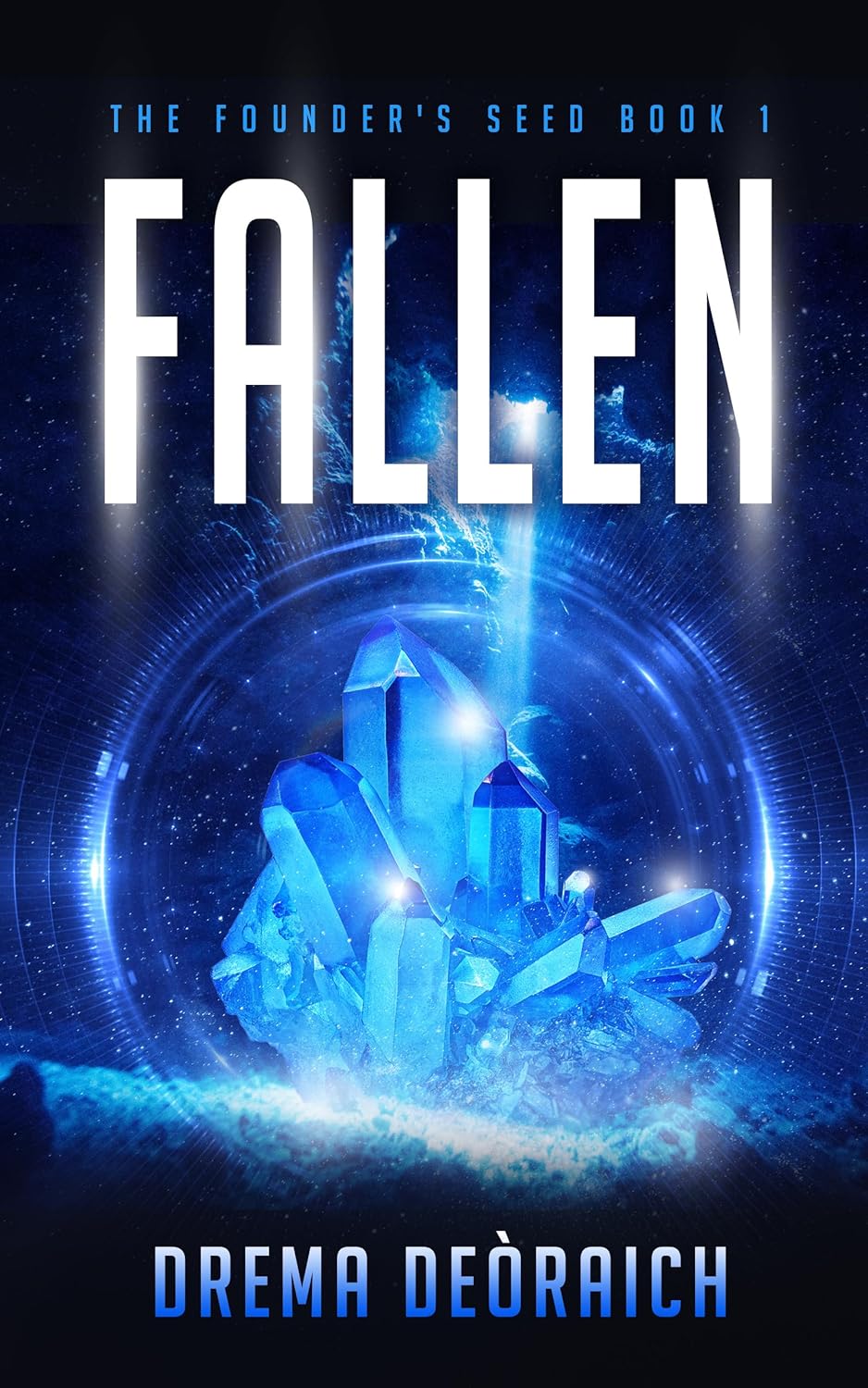
Drema Deòraich’s Fallen is a rich, immersive dive into a world where political intrigue, personal destiny, and deeply entrenched traditions collide. At its heart is Alira, a character caught between duty and defiance, burdened with a power she barely understands. As she navigates the shifting alliances and betrayals of her people, she unearths secrets that change not only her fate but that of an entire civilization. The novel is an intricate blend of sci-fi world-building and personal struggle, told through gripping prose and a keen eye for character depth.
The alien culture of the unammi is layered, full of history and social nuance, with a linguistic and political structure that feels real. From the moment Alira steps into the ruins of her past, determined to carve out her own path, I was hooked. The way Deòraich weaves the past into the present through Alira’s inherited memories and the revelations they bring, creates an eerie sense of inevitability. This is a story about identity and the weight of history pressing down on the present.
The writing itself is a highlight. Deòraich has a knack for sensory detail, making every scene vivid. The dialogue is sharp, with political conversations layered with double meanings and personal confrontations charged with emotion. One of my favorite moments comes when Alira, pushing past the resistance of her elders, insists on following the path she knows she must take, even as it leads her to terrifying truths about her lineage. Her growth from an uncertain idealist to a hardened survivor is nothing short of gripping.
The depth of the world, while impressive, can feel overwhelming at times, especially as new terms and cultural nuances pile up. However, the payoff is worth it. As the layers of deception unravel and Alira gains control over her fate, the story reaches a crescendo that left me both satisfied and eager for more.
I would recommend Fallen to readers who love immersive science fiction with strong character arcs. If you enjoy the political intrigue of Dune, the cultural depth of The Broken Earth trilogy, or the existential questions of The Left Hand of Darkness, this book will resonate with you.
Pages: 478 | ASIN: B0CYYPLWGW
No Easy Answers
In Entheóphage, children worldwide fall victim to a mysterious illness which reveals their compelling empathic connection to the coral reefs in the South Pacific. Where did the idea for this novel come from?
I’m a very Earth-minded person. It bothers me to see so many people ignoring the warning signs of environmental degradation and climate/habitat destruction. The idea for Entheóphage came to me when, in a moment of high frustration over these issues, I wondered what it would take to wake people up to the harm our actions are having on our world and the other beings who share it with us. It occurred to me in that moment that maybe, just maybe, if our children were being more immediately and directly affected or threatened by our actions, in ways no one could deny, that might finally wake us up to the consequences of our behavior.
The science inserted in the fiction, I felt, was well-balanced. How did you manage to keep it grounded while still providing the fantastic edge science fiction stories usually provide?
While I love science and read many articles about discoveries, I am an average layperson, not a scientist. I was fortunate enough to find specialists in the fields relevant to my story, professionals who were willing to help me get the science correct. But I also knew that I needed to keep it easy to read for lay readers like me, and not bog them down with too much detail.
I utilized a number of beta readers who provided me with honest feedback on the readability. They were so helpful in keeping the science approachable!
Even so, it was a delicate balance, one I played with over multiple drafts before I got it right.
What were some themes that were important for you to explore in this book?
I wanted to look at reasons why people (like Isobel, in the story) would damage fragile ecosystems without a second thought. Not just greed. Real-life reasons. Hard reasons. Not everyone who contributes to environmental destruction is a bad guy; sometimes there are no easy answers. We just need better, more sustainable ways to accomplish our goals, and too few of us–especially those in the corporate world, who have the means to really make a difference–have made it a priority.
In addition, I tried to explore the theme of ignorance so many of us share. Even Luk, when his daughter gets sick in the story, doesn’t believe the things she’s saying. It took a lot to convince him – like Kyndra’s knowledge of the wildfires, when she could not have known about them any other way.
Evolution and the interconnectedness of nature were important to the theme of this book, as well as how humans (to a large degree) have considered themselves to be disconnected from that web. I tried to imagine how Gala/Earth might speak to us if she could – and found it flowed well to show her using natural processes, as in accelerated evolution, to enable the phages to communicate with us through these children.
Can readers look forward to more work from you soon? What are you currently working on?
I’m about to release book two in a science fantasy trilogy called The Founder’s Seed, a story about a shapeshifter whose uniqueness sets her apart and, at the same time, puts her in the perfect situation to save her people—even if she’s still learning how to wield her special abilities. Book one, Fallen, is available now in paperback, ebook, and audiobook. Book two, Broken, is coming in November. Book three, Driven, is coming next summer.
I also have a dark ecofiction novelette entitled Deer in Headlights coming on State of Matter’s online webzine (https://stateofmatter.in) in November. I’m really proud of this story!
Author Links: GoodReads | Facebook | Website | Niveym Arts | Amazon
Dr. Isobel Fallon thinks she’s found a treatment that will help her son and others suffering from Milani Syndrome, a rare neurological disorder. What she doesn’t realize is that harvesting the source of this treatment in the only accessible place on earth it grows, a coral reef in the Nlaan Islands, is going to have consequences far beyond the disruption of the fragile ecosystem on one small reef.
CDC researcher Nadine Parker and her team are baffled. Lukas Behn’s daughter Kyndra has contracted a bizarre new virus that leaves her screaming in pain. But they can’t identify any physical, biological source for that pain, not in Kyndra, nor in the dozens, then hundreds, and finally millions of children worldwide succumbing to the same virus. And no one seems to have made a connection between what’s happening with the infected children and the events on a small coral reef in the South Pacific.
Eventually, Nadine has to face the unlikely truth, and the enormous implications of it. The children aren’t sick, they’re changing. But will anyone else believe her?



 LITERARY TITAN