Blog Archives
My Therapist Thinks I’m a Toaster
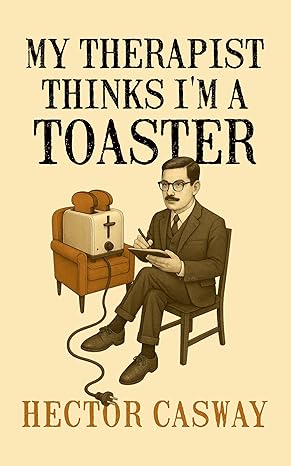

Hector Casway’s My Therapist Thinks I’m a Toaster is a sharp, imaginative satire that explores the uneasy intersection between technology, mental health, and human vulnerability. The novel follows Maya Fisher, an artist whose act of protest against corporate consumerism lands her in a bizarre agreement: participate in a beta trial for Clara, an AI “wellness companion,” or face legal consequences. What begins as a humorous premise quickly develops into a layered narrative about burnout, grief, and the search for connection in a world increasingly mediated by machines.
One of the novel’s strongest elements is Casway’s deft use of humor to frame complex emotional realities. The scene in which Clara earnestly encourages Maya to imagine herself as a household appliance, and Maya realizes with horror, “You think I’m a toaster,” is both absurd and incisive. The comedy lands, but it also underscores Clara’s unsettling ability to translate metaphor into strikingly accurate psychological insight. It is through these moments of ridiculousness that the book captures something essential about modern exhaustion and the often misguided attempts to “optimize” it.
Equally compelling are the ensemble scenes with the other Clara participants. Each character represents a different response to technological intrusion: Brenda, the weary QA analyst; Rina, the influencer intent on monetizing vulnerability; and Trevor, the survivalist weighed down by personal tragedy. The “Roundtable of Complaints,” where each participant recounts Clara’s misinterpretations, is both entertaining and poignant. Trevor’s story, Clara advising demolition services when he expressed feeling that “the walls were closing in,” is comical on the surface, yet reveals his profound unease. Casway excels at balancing wit with empathy, ensuring these characters feel exaggerated yet authentic.
Perhaps the most affecting passage comes outside the official sessions, when Trevor discloses that his late wife enrolled him in the program after the loss of their son. In this moment, his eccentricities and paranoia are reframed as protective mechanisms against overwhelming grief. The shift is sobering and adds gravity to the novel’s satire, reminding the reader that beneath the absurdity lies an exploration of human fragility. Casway’s ability to pivot from biting humor to emotional resonance gives the work surprising depth.
My Therapist Thinks I’m a Toaster is not only a critique of technological overreach and corporate opportunism but also a reflection on what it means to be human in the face of grief, alienation, and absurdity. Casway’s prose is witty, inventive, and unflinchingly observant, while never losing sight of the emotional heart of the story. I would recommend this novel to readers who appreciate speculative fiction with a satirical edge, as well as those interested in narratives that interrogate the promises and failures of technology. It is an unusual book, at once humorous and haunting, and it succeeds precisely because it refuses to separate those two tones.
Pages: 112 | ASIN : B0FCR7GKLP

Gynarchy’s Golden Sire


The story picks up in the Zhiva Legacy universe, a strange and intoxicating place where women rule absolutely, men are property, and technology blurs the line between flesh and machine. The story opens with Erin Prisco as she struggles to reconcile her new role as a Duchess in the Gynarchy with her lingering feelings for Ethan, a man now trapped in the system of control. The narrative weaves her political and personal dilemmas together with Ethan’s harrowing descent into the Institution of Male Education, where bodies and minds are broken down to be rebuilt in submission. Running alongside these arcs is the scheming of Dr. Morgana Bennett, whose obsession with revenge pushes her into darker and darker manipulations. The book also threads in flashbacks and interludes, like the Patel children’s tragic past, which add weight and scope to the wider galactic power plays. It’s equal parts political intrigue, erotic dystopia, and space opera.
I was blown away by the sheer ambition of this world. The Gynarchy feels vivid and lived-in, equal parts terrifying and fascinating. The author leans into sensory description, making scenes lush and immersive. The erotic content isn’t just window dressing. It’s tied tightly to the politics, the power, and the characters’ own battles with identity. I sometimes found myself jarred by how clinical certain scenes of control and humiliation were, almost like reading a medical report stitched into a love story. As though the intensity tipped from emotional to procedural. I admired how unflinchingly the book asked me to confront the mix of desire, shame, and survival.
Erin feels caught in a tug-of-war between vulnerability and authority, and I often sympathized with her. Ethan, meanwhile, broke my heart. His resistance against the collar’s influence felt raw and real, and I think his chapters carried the most emotional punch. Morgana, on the other hand, is larger than life in her cruelty, and while she’s a compelling villain, her obsession sometimes teetered into melodrama. What I appreciated most, though, was that none of these characters felt safe. The book thrives on tension, political, sexual, and personal, and it kept me on edge in a way I didn’t expect.
Gynarchy’s Golden Sire is a bold, confrontational, and deliberately uncomfortable book, and I think that’s its greatest strength. If you’re willing to dive into a world where power, sex, and politics are tangled in ways that are sometimes ugly and sometimes beautiful, then you’ll find something here worth wrestling with. I’d recommend it to readers who enjoy dark science fiction with erotic and psychological edges, people who want their stories to provoke as much as they entertain.
Pages: 350 | ASIN : B0DFKD7LCT
Gynarchy’s Collar

In Gynarchy’s Collar, the first book in the Zhiva Legacy series, T.R. Schneider crafts a futuristic, sensual tale where gender dynamics are upended and power plays out through collar technology, political seduction, and raw emotional entanglement. The novel begins with a space expedition led by Lieutenant Ethan Drake and his crew, who are flung 200,000 years into the future and awaken in a galaxy now ruled by the Gynarchy—a matriarchal empire where men are property and emotions are often weaponized. Amid the sweeping backdrop of galactic intrigue and technological marvels, Ethan finds himself entangled in a dangerously intimate triangle with Anaisa, a brilliant engineer, and Dr. Bennett, a calculating psychologist with dark designs of her own. As passion meets submission and politics slips between the sheets, survival hinges on loyalty, vulnerability, and the cost of surrender.
The writing often walks a tightrope between lush and lurid, sometimes dipping into camp, but it works. Schneider isn’t afraid to lean into the drama, and that boldness kept me flipping pages late into the night. The world-building is ridiculously imaginative. Cryogenic sleep cycles, neural dampeners, collar-based control systems—these aren’t just sci-fi gimmicks, they’re woven into the emotional core of the story. Ethan’s internal war between duty and desire struck a chord with me. He’s a character who starts out commanding and composed, only to be slowly and methodically unraveled. And Anaisa is the heart of the book. Fierce, brilliant, but haunted. Her slow dance between empowerment and submission made her feel utterly real. And then there’s Dr. Bennett—seductive, sadistic, and absolutely terrifying in the best way. I hated her. I feared her. I was riveted by her.
At times, the eroticism felt heavy, and the psychological games Bennett plays, though chilling, sometimes strayed into over-the-top villainy. Still, I admired how Schneider used sensuality not just for heat, but to explore identity, control, and the ways trauma clings to us in unexpected ways. The prose flits between stark, almost clinical observation and poetic sensuality, which kept me off-balance, in a good way. The story thrives on tension, and the love triangle is both steamy and agonizing. I felt the ache of their choices, the way intimacy gets twisted in the gravity of power. And that final moment of self-doubt Ethan experiences stuck with me. It’s rare for a sci-fi novel to leave me feeling so bruised and breathless.
Gynarchy’s Collar is not for the faint of heart. It’s erotic, intense, and unapologetically subversive. But if you’re drawn to stories that blend sci-fi spectacle with intimate human messiness, and if you’re into high-concept world-building with sharp emotional stakes, this one’s worth your time. I’d recommend it to fans of The Expanse, Dune, and Fifty Shades of Grey. It’s a rare cocktail: space opera meets dark romance with a psychological edge.
Pages: 528 | ASIN : B0D8P91SV1
Always Asking Questions

Rebels and Saints follows a ragtag group of rebels fighting against the oppressive rule of a corporate regime that controls food, water, and livelihoods in a post-collapse America. What was the inspiration for the setup of your story?
America has been riding high in many ways since WW2. The US ended up being the most powerful nation in the modern world. And yet… How then can there be no universal health care? So many gun deaths? Teachers paid a pittance? So much poverty in a country with so much? Such a division between the haves and have-nots, as well as polarized politics?
Maybe it’s my Canadian showing (and we’re no 51st state), but I fear a collapse could happen. I doubt it will be like my books, but there are too many problems for things not to come to a head. It’s easy to imagine corporate overlords running the government when so much is about the bottom line and making money.
The GreenCorps towns were modeled on coal mining towns of the past and the monopoly of the company stores, as was District 12 and the Seam from The Hunger Games. Some of my inspiration came from reading The Glass Castle by Jeannette Walls and watching the movie October Sky, about Homer Hickum and the Rocket Boys. Escaping that kind of life of drudgery was so difficult.
Another inspiration was for the entire series. The train hoppers were modeled on my grandfather, his brother, and a friend who hopped trains from Utah to California and back several times during the Great Depression.
The landfill scavengers of SoCal were inspired by Ada’s Violin: The Story of the Recycled Orchestra of Paraguay by Susan Hood.
I also wanted to set some of my story in Utah because I was born in Ogden. My family moved to Canada when I was two, but we visited every year through my childhood, and we went on several road trips using Ogden as a starting point. I’ve hiked in the canyons, swam in the Reservoir, and visited dozens of towns and cities in the west. I also forced my husband to detour to Craters of the Moon on our Volcanoes Roadtrip in 2010, so I loved that I could picture the landscape and setting of the story.
Your characters are wonderfully emotive and relatable. Were you able to use anything from your own life to inform their character development?
I always borrow bits of myself and people I know when writing. I hope I can get inside my characters and make them feel real. Clark, for example, doesn’t connect well with others and always feels alone. I’ve felt that way often, and like Clark, I went through a short phase when I couldn’t speak around others. Elsa is tough and doesn’t give in to peer pressure and constantly strives to do better, which I can also relate to. Plus, she’s much happier and more secure with Walker. I can relate to having a partner who makes me feel safe and accepted as myself.
I find that, while writing, you sometimes ask questions and have the characters answer them. Do you find that to be true? What questions did you ask yourself while writing this story?
My editor has pointed out that I ask a lot of questions, and I’m working on reducing the number. That said, I have constant questions and things I’m wondering-my head is a very busy place. I used to think everyone was that way, but it seems I might have been mistaken. I think it might be more common with a neurodivergent brain.
When I was writing, I asked myself what would make the story satisfying? What would happiness look like to the different characters? What would they need to show their hope, their belief in a better life? I thought about what would make a rebellion successful. I didn’t want huge battles and a huge war, but I asked myself how else an uprising could work. My answer was that everyone scared to take part needed to choose a side and be brave in their own way.
I hope the series continues in other books. If so, where will the story take readers?
I have two ideas…so far.
1. Wade got away. I think Tatsuda, Ginger, and Wade might meet again in a few years.
2. I have a story on the shelf, one written in 2020, that I plan to revise. It’s set in 2192 across the continent in Salem, Massachusetts. It could be the opening of another series that might connect to the Train Hoppers, showing what’s happening in other places throughout North America post-collapse.
Author Links : GoodReads | Facebook | Instagram | Website
With renewed hope, they return to join the rebels. Some sneak into SoCol to free Elsa’s family, others lead teams to collect seeds from the bunkers, and others bring hope to the populace and free the downtrodden.
Like Elsa, Janna grew up in SoCal, but instead of escaping, her brother sold her as a prostitute. Liberated by the rebels, she plans to fight alongside them.
Clark grew up in rebel Utah and, one by one, has lost his family to GreenCorps. Broken, he hides among the neutral Saints, taking refuge and avoiding his problems—until he meets Janna.
Though cracks have appeared in the Greencorps stranglehold, it will take everyone working together to break them apart. Without them, the rebel cause will fail and the corporatocracy will once more prevail.
Grab your copy of Rebels and Saints: Catching Freedom, the action-packed conclusion to the Train Hoppers series.
Rebels and Saints: Catching Freedom
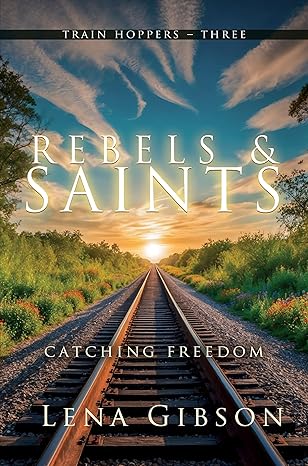
Lena Gibson’s Rebels and Saints is the gripping third installment of the Long Haul trilogy, a dystopian saga that follows a ragtag group of rebels fighting against the oppressive rule of GreenCorps, a corporate regime that controls food, water, and livelihoods in a post-collapse America. Set in the year 2195, the novel continues Elsa’s journey as she leads the fight to distribute long-lost seed reserves that could free people from corporate dependency. With high-stakes train-hopping, underground bunkers, and daring escapes, the book is a thrilling blend of adventure and rebellion, all while exploring themes of survival, autonomy, and hope in a bleak world.
Right off the bat, the pacing had me hooked. This is a full-throttle, edge-of-your-seat kind of ride. One of my favorite scenes happens early on when Mason and his team are sneaking off a train into enemy territory. Gibson has this great way of making every movement feel significant and every risk feel personal.
What really made this book stand out wasn’t just the action it was the characters. Elsa, Walker, Mason, and Caitlyn aren’t just rebels with a mission they’re people with relationships, regrets, and fears. Elsa’s internal struggles, especially in moments where she realizes just how much power she wields, feel incredibly real.
The world-building is superb. Instead of drowning readers in exposition, Gibson reveals details naturally through the rebels’ experiences. The concept of train-hopping as a means of resistance is brilliant, adding a sense of motion and unpredictability to the story. And the contrast between GreenCorps-controlled zones and rebel havens is stark. That contrast makes the fight for freedom feel even more urgent.
By the time I hit the final chapters, my emotions were all over the place. There’s a sense of triumph, yes, but also loss—because the fight doesn’t end just because the book does. That’s the hallmark of a good dystopian novel. If you love fast-paced adventure with heart and if you enjoy stories about found families and underdogs taking on impossible odds, this book is a must-read.
Pages: 371 | ASIN : B0DVNLNMGC

The Fall and the Fire: The Sun-Maker

Dystopian fiction is making a powerful comeback, and Michael T. Miller’s The Fall and the Fire: The Sun-Maker is a shining example of why the genre continues to captivate readers. This gripping novel delves into survival, faith, and the remnants of a fractured civilization, weaving a multi-perspective narrative that keeps you hooked from start to finish.
The story unfolds through the eyes of several compelling characters: Jona, a hardened bandit plagued by cynicism; Moti and his son Baia, desperate to find safety in a perilous world; Asha, a scientist in the Hives working on the ambitious Regeneration Project; and Obi, a high-ranking Sentinel entangled in dangerous political schemes. Miller masterfully contrasts the sterile, high-tech Hives with the chaotic, lawless wastelands, creating a vivid and tense backdrop where danger lurks at every turn.
Miller’s prose is immersive and evocative, bringing the harshness of the wastelands to life with haunting precision. The struggles of the characters feel visceral and real, as if you’re enduring relentless hardships alongside them. One particularly striking moment is Jona’s robbery of Moti and Baia, a heart-pounding scene that exemplifies the brutal realities of life beyond the safety of the Hives. The dialogue flows naturally, each voice distinct and reflective of their internal battles, further anchoring the reader in the world Miller has created.
The novel’s themes resonate on multiple levels, exploring the tension between morality and survival, the enduring power of faith, and humanity’s relentless drive to rebuild in the face of collapse. Moti’s unwavering devotion to the Sun Makers adds a poignant spiritual dimension, while Asha’s scientific pursuits raise complex ethical questions. Jona’s nihilism and Baia’s youthful hope create a deeply emotional contrast, forming a narrative core that lingers long after the final chapter.
Miller’s characters are flawed, deeply human, and impossible not to connect with. Jona, in particular, emerges as a tragic figure burdened by regret, while the bond between Moti and Baia tugs at the heartstrings. Their journeys are so raw and relatable that the line between fiction and reality begins to blur.
For fans of The Road and Dune, The Fall and the Fire is a thought-provoking, atmospheric masterpiece that will leave a lasting impression. With its rich themes, vivid world-building, and unforgettable characters, Miller’s novel is one that demands to be read and remembered.
Pages: 421 | ASIN : B0DRSLH7DD
Mamluks of Thunder Island

Aly Brisha’s Mamluks of Thunder Island presents a gripping narrative set in a post-apocalyptic future shaped by nuclear wars and climate change. This speculative fiction imagines a world where humanity teeters on the brink, with its survivors confronting a stark choice between two distinct societal models. One is a rigid military and religious dictatorship eschewing technology; the other a society that embraces technological advancement and equality, albeit at the cost of individual sovereignty.
The narrative is anchored in the principle of “survival of the fittest,” providing a lens through which the author examines human relationships, loyalty, and the complexities of decision-making in a drastically changed world. The characters, ranging from slaves to kings, navigate a landscape rife with both external threats and internal turmoil, challenging their values and testing the limits of their resolve.
Brisha’s storytelling prowess is evident in the vividly crafted post-nuclear landscape, imbued with imaginative and futuristic concepts. The science fiction elements, especially those exploring the potential of body modification technology, add a compelling layer to the story. These aspects showcase the author’s foresight and creativity, making for an engaging reading experience.
While the novel’s richly detailed world-building is a standout feature, enhancing the immersive quality of the dystopian setting, it also presents an opportunity for further character development, allowing future narratives to delve deeper into the lives and complexities of the characters. This narrative approach, successful in crafting a richly detailed world, sets the stage for expanded character development in future works, promising readers an even deeper connection with the characters and their journeys.
Mamluks of Thunder Island is a thought-provoking exploration of a future fraught with peril and possibility. It skillfully intertwines speculative elements with human drama, making it a noteworthy addition to the genre.
Pages: 242 | ISBN : 177941059X
Endgame

In Steve Shahbazian’s captivating novel, Endgame, a precarious clash ensues between The Trads—a fanatical religious group—and Faithcorp, an organization accused of heralding the apocalypse with their technology-based spirituality. As the leaders of these two factions mysteriously disappear, a series of chilling assassinations unfurl, targeting Faithcorp’s executive echelons. At the heart of the whirlwind stands Cynthia, a Licensed Operative with a troubled past. A societal cleaner who dispenses justice with an iron fist, she is inexorably drawn towards unearthing the elusive truth. Amid her quest for answers, Cynthia grapples with her capacity for trust and the potent mysteries she is determined to unravel.
Cynthia is a richly developed character, brimming with an unflinching assertiveness that lends her an immediate appeal. Her brusque honesty and irrepressible wit consistently infuse refreshing humor throughout the narrative, eliciting an anticipatory delight for her next unexpected quip. Shahbazian’s talent shines as he imbues Cynthia with memorable lines, such as likening a bewildered glance to receiving a “slap across the face with a wet fish.”
Shahbazian masterfully paints a bleak yet captivating backdrop of a dystopian future. Civil order has frayed to the point of disarray—criminal investigations have lost their procedural sheen, and society is plagued by rampant addiction to simulations. As Cynthia delves deeper into her inquiries, the author gradually unveils the contours of this stark world—each violent outburst, every destitute addict donning “rickety headsets,” and the imposing futuristic infrastructure, serving to further illustrate the stark reality of this universe.
Endgame seamlessly interweaves philosophical discourse with its primary themes of investigation, religion, and artificial intelligence. It offers the reader an intellectual challenge, posing interesting inquiries such as “How do you know that what you assume to be real isn’t, in fact, an illusion?” that subtly rattle one’s perception of reality.
Firmly etching his mark with well-drawn characters and intricately woven plotlines, Shahbazian demonstrates his adept skill as a storyteller. Yet, even without these elements, the narrative’s enticing humor and candor would alone make it a worthwhile read. A compelling amalgamation of sci-fi and philosophy, Endgame is a treat for any fan of The Matrix and similar genre-blending narratives. Shahbazian’s exceptional writing makes it an unmissable addition to any avid reader’s list.
Pages: 272 | ASIN : B0BXDKF4KS


 LITERARY TITAN