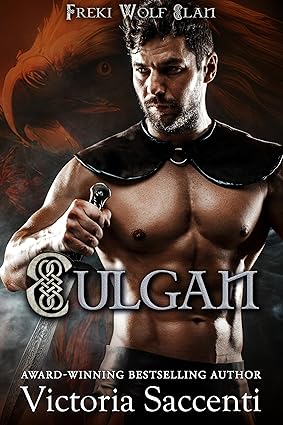
Victoria Saccenti’s Culgan is a rich and magical tale set in a world where direwolves, gryphons, and ancient magic exist in powerful harmony. The story follows Roisin, a young woman on the verge of discovering her destiny as a direwolf shifter, and Culgan, a seasoned warrior and heir to the Freki clan. As a dark force reawakens in the world, Roisin undergoes her shift with Culgan’s help, and together they find themselves bound by fate, ancient prophecy, and a rising evil that threatens the balance of their realm. The narrative weaves romance, fantasy, political intrigue, and supernatural battles into a tight, emotional adventure.
I found myself drawn in almost instantly by Saccenti’s worldbuilding. Her ability to blend myth, lore, and visceral details into a living, breathing world is impressive. The Freki stronghold, the gryphons’ bond with their riders, and the mystical laws of the universe all come alive with elegant precision. But it was the emotional depth of Roisin’s awakening, the fear, the wonder, the pain, and eventual triumph, that left the strongest impression on me. Her transformation didn’t feel like just another magical puberty metaphor. It felt real. And Culgan, stoic and noble, struck the perfect balance between protector and partner. Their connection had a slow-burn warmth that felt earned.
At times, the story takes a pause to dive deep into the background and inner thoughts, which can slow the pace a little. And I felt some of the dialogue leaned toward the polished side, feeling a bit more formal than the story’s otherwise grounded and emotional style. Still, these moments felt intentional and helped flesh out the world and its history. But these moments were few, and the rest more than made up for them. The villains felt truly menacing. The magic felt ancient and consequential. And when Saccenti brings in darker themes like abandonment, manipulation, and power struggles, and she doesn’t sugarcoat it.
Culgan is a heartfelt and exciting fantasy that reads like a coming-of-age epic blended with a deep, magical love story. I’d recommend it to readers who enjoy immersive fantasy worlds with strong female leads, loyal found families, and just the right touch of romance. It’s perfect for fans of Sarah J. Maas or Patricia Briggs, especially those craving more complex shifter lore and mythology. Saccenti writes with conviction, and her story pulses with emotion. I walked away from the last page feeling satisfied, hopeful, and more than a little tempted to dive back into her world again.
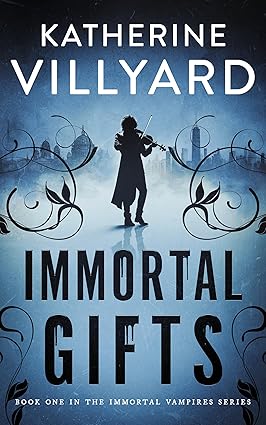
Katherine Villyard’s Immortal Gifts is a tender, layered, and unexpectedly intimate vampire novel that defies the genre’s usual brooding tropes. Instead of sleek, soulless predators, we meet Abraham, a centuries-old vampire who finds comfort not in shadows and bloodlust but in love, cats, and quiet domesticity. His relationship with his human wife, Destiny—a Wiccan veterinarian with a bleeding heart and a sharp wit—forms the emotional center of the book. Through alternating perspectives, we get a story that weaves deep questions about mortality, belief, identity, and love into a slice-of-life narrative where vampire myth meets real-world heartbreak and healing.
The writing is deceptively simple, yet emotionally precise. Abraham’s melancholy charm and Destiny’s fierce warmth play off each other perfectly. The prose flows easily but is filled with poignant moments that sneak up on you. There’s a real sense of lived-in love here, of two souls—one eternal, one ephemeral—trying to bridge an impossible gap. Villyard never glamorizes the vampire life; instead, she shows its weight. The grief Abraham carries for every lost pet, every lost love, feels real. I actually teared up more than once, especially during the sections with Victoria, their aging cat. That mix of supernatural elements with such grounded, human sorrow hit me hard. It’s rare to see a fantasy book so in tune with real emotional textures.
What I appreciated most, though, was how Immortal Gifts manages to be funny and soft even when it’s tackling grief, anti-Semitism, or ethical dilemmas around immortality. The characters talk like real people—awkward, earnest, sometimes ridiculous. There’s no need for purple prose here; the dialogue and emotional beats do all the heavy lifting. And can we talk about the Jewish and Wiccan interfaith wedding ceremony? It was weird, beautiful, and oddly hilarious. I was grinning one minute and choked up the next. Ludwig’s historical flashbacks were chilling, especially his origin story, but they gave the book depth and darkness without overwhelming it. Villyard handles historical trauma with care, and that care is felt.
Immortal Gifts is for people who’ve loved and lost, who find meaning in small rituals and shared quiet. If you’ve ever bottle-fed a kitten at 2 a.m. or struggled to hold it together at the vet, this book will feel like home. It’s for the weird, the tender-hearted, the spiritually curious. For those of us who like our love stories with equal parts warmth and weight, this book is a gift.
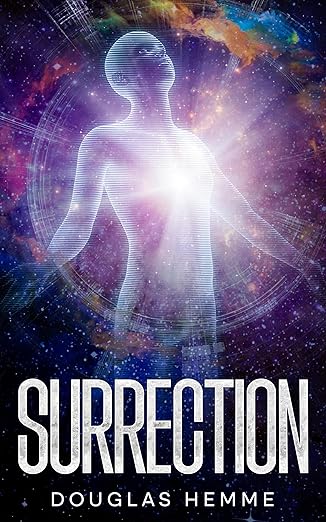
Surrection is a trippy blend of science fiction, philosophy, and espionage, following Malcolm Wallace—an eccentric, wealthy, and determined man obsessed with achieving what he calls “surrection,” the conscious separation of soul and body. Fueled by hallucinogens, sound frequencies, and a deep distrust of the establishment, Malcolm partners (begrudgingly) with two government operatives—Colin, the manipulative narcissist, and Macy, the no-nonsense pharmacologist. Together, they tiptoe along the edge of legality in pursuit of a breakthrough that could, quite literally, change how we understand reality itself.
Okay, first off: the writing is slick. It’s sharp and stylish, and it flows fast. I was hooked by Malcolm’s intense inner monologue and the weirdly poetic way Hemme makes a guy tapping a pencil sound like a cosmic ritual (“the beat of his lifeforce.”). Hemme does a great job keeping things grounded even as the story veers into the metaphysical. One of my favorite moments is when Malcolm first succeeds at surrection and finds himself free-floating above his own body, able to “see in all directions” while literally feeling space itself. It was equal parts beautiful and haunting. And the way Colin later replicates the experiment but ends up haunting the White House like some astral tourist was both funny and chilling.
Now, character-wise, this book hits a groove. Malcolm is weird but lovable. You root for him even when he’s off the rails. But Colin is the guy you love to hate—slippery, smug, and dangerous. His whole backstory—scamming universities, getting scooped up by the CIA, then crashing a Maserati just for the fun of it—was like something out of a Bond villain’s drunk diary. And Macy is the calm center of the storm. Ultra-fit, wicked smart, and low-key terrifying. The tension between her, Colin, and Malcolm adds this constant hum of paranoia that just works. Hemme nails that distrustful dynamic, especially when Malcolm starts hiding his breakthrough from them, and we’re all just waiting for the moment it explodes.
This book’s a mind-bender. It’s got techy stuff, sure, but it’s not overwhelming. It’s got drug-fueled dream science and astral projection, but it stays surprisingly human. I’d recommend Surrection to sci-fi fans who dig Black Mirror, readers who like their fiction with a dose of existential dread, and anyone who’s ever stared into the night sky and wondered what else is out there. Just be prepared to question a few things about your own consciousness.
Diana Townsend and David Hardie’s The Devil’s Footprints is a charming and imaginative story set in the Victorian era, blending folklore, history, and adventure. The story follows a secret world of small, humanoid creatures called dittos who live alongside humans in the coastal village of Dawlish. As Queen Victoria’s reign ushers in an age of scientific progress, the dittos face changes and challenges of their own. With a mix of whimsy and real-world consequences, the book explores themes of community, deception, and survival.
The writing style is easy to follow, though it has an old-fashioned charm that fits the historical setting. The story shines in its world-building. The village of Dawlish feels alive, both in its human and ditto forms. The authors do a fantastic job making us feel the size difference between humans and dittos. A simple horse-drawn carriage becomes a monstrous threat, and something as mundane as a wheelbarrow full of manure is an adventure in itself. I particularly enjoyed how the dittos see humans as these powerful, careless giants, oblivious to the tiny lives scurrying beneath their feet. The early chapters introduce us to young Dudley, who immediately captures sympathy with his struggles. His near-miss with the carriage is a heart-racing moment, and it sets the stage for bigger dangers to come.
William, on the other hand, is a fascinating contrast to Dudley. He’s older, hardened by experiences outside of Dawlish, and quick with a lie. His return to the village is filled with deception, and the way he spins grand stories about his time in Bristol, especially the fake tale about being enslaved by elves, is both entertaining and infuriating. The dittos are eager to believe him, which makes his manipulation even more frustrating to witness. It’s clear William sees himself as superior, and his smooth-talking ways make him a formidable presence. The authors make it easy to dislike him while still keeping him interesting. His speech on the beach, where he convinces the dittos to follow his plans, is a standout scene that shows his cunning.
The underlying tension of human expansion adds a deeper layer to the story. The arrival of railway workers, and the slow but inevitable encroachment of industry, feels like an unstoppable force. The dittos, who have lived hidden for so long, are suddenly faced with a problem they can’t ignore. The book does a great job of showing the contrast between those who see change as an opportunity, like William who wants to profit from human waste, and those who see it as a threat, like Emil the elf, who warns of dark times ahead. One of the most striking moments is when Kate and Dudley get stranded on the rocks, caught between rising tides and aggressive seagulls. The tension in that scene is fantastic, and Emil’s rescue flight is a great pay-off. The mix of small-scale action and larger, looming changes keeps the book engaging.
The Devil’s Footprints (The Dittos of Dawlish) is a unique and enjoyable read that I think is perfect for fans of folklore and historical fantasy. It has the feel of a classic adventure story, with strong characters, clever twists, and a world that feels rich and lived-in. Younger readers and fans of books like The Borrowers or The Secret World of Arrietty will especially enjoy it. It’s light enough for casual reading but has enough depth to keep you thinking.
Starfall by B.C. Charles is a gripping tale that opens with mysterious occurrences in the quiet town of Anne Falls, centering on Nathan Hawkins, a teenager juggling everyday struggles with the weight of supernatural secrets. The story weaves together local legends, paranormal investigations, and personal conflicts, exploring the fallout from a supposed extraterrestrial crash decades prior. Through Nathan’s encounters with cults, cryptic journals, and his latent pyrokinesis, the book delves into themes of identity, truth, and resilience.
I was immediately hooked by the atmospheric opening. The vivid description of a fireball crashing into Kingland Forest sets an eerie tone that persists throughout the book. Nathan’s first foray into the woods to investigate a cult gave me chills—Charles nailed the sense of danger and suspense. Yet, what I loved most was how grounded the story felt despite its supernatural elements. Nathan’s frustrations with school bullies and his strained relationship with his aunt added layers of relatability.
The writing style is straightforward yet evocative. Charles’s knack for painting tension-filled scenes shone brightest during Nathan’s confrontation with the cultists near Queen’s Lake. I found myself rooting for Nathan as he outwitted them while battling his own fears. However, I feel the dialogue among the secondary characters, like Mike and Angela, occasionally veered toward being more formal and in some instances slightly repetitive.
The ideas within the book, particularly the intersection of science, faith, and the paranormal were fascinating. I enjoyed how the AFUN archive files complemented the narrative, offering glimpses into a conspiracy bigger than Nathan. The concept of the “Daughters of Men” and their ties to Anne Falls’ history was compelling, though I wish the book had spent more time unraveling their motives. The inclusion of Nathan’s fire powers added a unique layer to the story, but it sometimes felt underutilized. I kept hoping for a deeper exploration of how his abilities connected to Starfall and his family’s mysterious past, however, this leaves an opportunity for future installations.
Starfall is a satisfying mix of coming-of-age drama and supernatural mystery. I’d recommend it to anyone who loves stories that blend small-town secrets with larger-than-life phenomena. Fans of shows like Stranger Things or books like The Outsiders with a paranormal twist will feel right at home here. The book’s heart and intrigue kept me turning pages late into the night.
St. Paul Goes to Spain follows three men bound by their shared faith and curiosity about the apostle Paul, who, after discovering a letter, they go on a journey to the places they think Paul could have visited in Spain. What inspired the setup of your story?
Well, I wrote it as an historian and a Christian, but I was long interested if Paul actually made a missionary trip to Spain which he mentioned in some other published Scripture, such as the Book of Romans. Plus, I have loved fiction ever since early-life discoveries of Steinbeck, Hemingway, etc. It is a way of reaching people and drawing upon your imagination to tell great stories that, in fact, usually reach a lot more people than histories! I did an earlier novel on early Christianity in the Americas (Columbian discoveries, conquests, and settlements) and how Jesus, or, more exactly, some of his followers and prophets may have reached the New World hundreds of years before 1492, and they left evidence (artifacts in the forms of the Cross), and I was off into the past again, this time inventing and tracing a story which I think could have actually happened. Ok, I’ll stop here. I’ve had a couple cups of coffee and it is Saturday morning and football games don’t begin until this afternoon!
What were some themes that were important for you to explore in this book?
I’ve always enjoyed the trajectory and messages of the Apostle Paul in the New Testament, especially since he produced more than half of the Books of the New Testament. He was, in fact, the writer who did more to write down the teachings of Jesus, or to create the theology of Christianity. So I suppose my principal interest was in exploring, one, the central themes of Christianity that Paul taught (love, forgiveness, salvation, etc.) and, two, how he probably took them to Spain, a country I have long loved and admired given my background and experiences, first visiting as a young Naval officer in the Sixth Fleet in the Mediterranean in the mid-1960s, and then over the years as a historian, where I especially learned about the land and its people while researching for my dissertation in the Archive of the Indies, Seville, 1970-71,.
What experience in your life has had the biggest impact on your writing?
Without a doubt, it has been the growth of my Christian faith, influenced especially by my marriage to my wife Louise more than thirty years ago. Without going into detail, she showed me that true worship in understanding did not come necessarily with reading and doing good works, but through the faith that comes when God in his infinite Grace accepts you into his world. You have but to accept. Secondarily, but no less important (although not as transcending as making the same discovery that Martin Luther made in the early sixteenth century when he discovered for himself, while teaching at Wittenberg on the Book of Galatians, the true power of the grace of God) was my teaching the history of Christianity over the last almost five decades to various forums, from my students at the University of Alabama, to mission trips into places like Honduras and the Dominican Republic, and my all-time favorite students, the prisoners of the Tuscaloosa County Jail where I’ve been ministering on a weekly basis for twenty-five years.
What is one thing that you hope readers take away from St. Paul Goes to Spain?
That the Christian message given to Paul by Jesus (beginning with his Road to Damascus conversion) was indeed aimed to the entire world, albeit a world circumscribed by the knowledge of geography of the world 2000 years ago. Taking it to Spain was just reaching the far Western end of the Mediterranean and I even hint that Paul may have voyaged into the Atlantic with some of the intrepid Phoenician mariners of the times and zipped across the Atlantic, about fifteen hundred years before Columbus!
St. Paul Goes to Spain
What if the Apostle Paul, after his release from imprisonment in Rome, embarked on a daring journey to the far reaches of the Roman Empire? “St. Paul Goes to Spain” by Lawrence Clayton is a riveting historical fiction novel that imagines this very scenario, blending meticulous research with engaging storytelling. Join Matthew Western, an intrepid archaeologist, as he uncovers ancient artifacts in the Sinai desert, sparking a quest to prove that Paul indeed traveled to Spain. His journey intertwines with the lives of several compelling characters:John Baldus, a former Army soldier and current Divinity student, who grapples with faith and doubt while investigating Paul’s journeys. Domingo, a Dominican priest in modern Spain, facing spiritual challenges and historical mysteries. Slate Watson, a daring crop-duster pilot with a rich military past, whose adventurous spirit leads him into the heart of biblical archaeology. Sarah Maxwell, an Englishwoman tracing her ancestors’ historic discoveries, contributing her own expertise to the mission. Together, they delve into historical sites, uncover ancient manuscripts, and piece together the lost chapters of early Christian history. From the dusty libraries of St. Catherine’s Monastery to the vibrant landscapes of modern Spain, their quest reveals profound insights and unexpected connections. “St. Paul Goes to Spain” explores the intersection of faith, history, and archaeology, offering readers a captivating journey through time and belief. It’s a story of discovery, adventure, and the enduring impact of one man’s mission to spread the Christian faith.
LAWRENCE A. CLAYTON was born in October 1942, in Summit, New Jersey. He lived in Peru for seven years. He attended Duke University (B.A., 1964), and earned his M.A. (1969) and Ph.D. (1972) at Tulane University in Latin American History. From 1964-1966 he served as an officer in the U.S. Navy on the USS Donner (LSD-20), cruising both in the Caribbean and the Mediterranean with the 6th Fleet. He was on the faculty of the University of Alabama from 1972-2013. He directed the Latin American Studies Program from 1980 to 1992. He was Chair of Department of History 2000-2007 and was Interim Chair, 2009-2010. His specialties focused on Latin American history and the history of the Christian church. He is now Professor Emeritus of History. He retired in 2013. He held two Senior Fulbright Lecturing Awards, one in 1983 to Costa Rica and one in 1988 to Peru. In 1983 he served as President of the South Eastern Council on Latin American Studies. In 1999 he held a year-long Pew Evangelical Scholars Fellowship.
St. Paul Goes to Spain by Lawrence A. Clayton is a captivating work of religious fiction that brings together history, faith, and intrigue. The story introduces us to three main characters—Matthew, John, and Domingo—whose lives, while seemingly different, are bound by their shared faith and curiosity about the apostle Paul. This shared religious fascination drives the plot, with much of the narrative centered on the discovery of a letter believed to be written by Paul to a church in Spain.
The novel’s premise revolves around the authenticity and location of this letter, sparking a journey of discovery for the characters and their companions. This quest takes them to places Paul could have visited if his journey to Spain, hinted at in the New Testament, had indeed taken place. This historical mystery gives the book its compelling edge, encouraging readers to reflect on Christianity’s roots while expanding their understanding of faith. One of the most fascinating aspects of St. Paul Goes to Spain is its grounding in real-world history. Clayton weaves in significant historical events, such as the fall of the Berlin Wall, and touches on modern political issues, including the ongoing turmoil in the Middle East. These references not only add depth to the narrative but also prompt readers to think critically about war, politics, and their impact on religion, both past and present. The question of whether Paul ever reached Spain is a topic of theological debate, and Clayton skillfully uses this ambiguity to drive the story. The characters explore regions Paul might have visited, offering readers a fresh lens through which to consider early Christianity and its spread. By blending history, religion, and politics, the author successfully creates a rich, thought-provoking narrative.
Clayton’s ability to merge these elements makes the book worthwhile for those interested in world events or religious fiction. St. Paul Goes to Spain offers a unique perspective, encouraging readers to contemplate both the historical and spiritual aspects of faith while providing an engaging exploration of Paul’s possible travels. I highly recommend it to anyone drawn to stories that intertwine history, belief, and current affairs.
Do You Believe in Miracles? follows a once shy teenage boy who discovers a hidden realm where he is a powerful wizard and now must decide to remain in that world or return to his mortal life.What was the inspiration for the setup of your story?
Two things stand out. My previous epic fantasy saga is titled The Death Wizard Chronicles, and it contains adult content that makes it appropriate for 18 and older. But I have five daughters, and the youngest one — who is a voracious reader — couldn’t bring herself to read DW. The ol’ you can’t picture one of your parents even thinking such things. So she asked me if I could write something appropriate for the 13+ age group. Hence, my teen fantasy adventure series Dark Circles was born. Do You Believe in Miracles? is book 3. The second thing that stands out is that the setting for Dark Circles is based on a small town in rural Upstate South Carolina that is near to where I currently live.
Were you able to achieve everything you wanted with the characters in the novel?
The short answer is yes. The long answer would go on forever. So I’ll give you the middle-length answer. 😀 I went to great effort to give each of my major characters real and recognizable traits such as their physical appearances, emotional responses, personality quirks, and their values, beliefs, and morals. For example, Charlie’s growth from a timid teen to a powerful wizard built slowly throughout the narrative. If you read carefully, you’ll be able to see this growth step by step, almost like walking up a long set of stairs.
What was the initial idea behind the Dark Circles Trilogy, and how did that transform as you were writing the series?
The initial idea came from the title. The trilogy is called Dark Circles for a specific reason. When teens from the real world enter the fantasy world, they are unable to sleep because an evil being haunts their dreams and is intent on killing them. Therefore, when they return to the real world, they have dark circles beneath their eyes from lack of sleep. I carried this theme throughout the series, though it became less important as the story picked up speed.
What is the next book that you are working on, and when can your fans expect it to be out?
I’m working on two books: a novel and a memoir. The novel is titled Bhayatupa the Great: The Dragon Wars and is a prequel to my six-book adult epic fantasy titled The Death Wizard Chronicles. It should be available by June 2025. The memoir is titled The Adventures of a Florida boy and it chronicles what it was like to grow up in the 1960s on the west coast of Florida, a time when kids roamed wild and free. I’ll be shopping this to publishers and agents soon, so I’m at their mercy as to when it will be available.
Dark Circles is the winner of ten prestigious international awards. From the author of The Death Wizard Chronicles comes an award-winning adventure suitable for teens and adults.Do You Believe in Miracles? is book 3 of Dark Circles, a fantasy trilogy for readers 13 and older. This is a fascinating coming of age series for fans of J.K. Rowling, Neil Gaiman, and Brandon Sanderson.
Book 1: Do You Believe in Magic? (May 25, 2023) Book 2: Do You Believe in Monsters? (Oct. 23, 2023) Book 3: Do You Believe in Miracles? (April 21, 2024)
Synopsis: When Charlie Magus enters a fantastical world hidden deep in the forest, his life is turned upside down. The timid 13-year-old transforms into a powerful wizard wielding formidable magic. In the real world, life goes on as usual. But in the fantasy world, a war is brewing that will dwarf all others. Charlie’s newfound powers stand between victory and defeat. But in which world does he truly belong? Dark Circles is an adventure of epic scope. Only those with a hero’s heart will dare to stand at Charlie’s side as he battles an army of monsters led by an evil being of immense power.