Blog Archives
Suppose We


In Suppose We, Geoff Nelder takes readers on a journey into the distant reaches of the Milky Way, centering around a crew of astronauts traveling to the Kepler-20h planetary system. The novel opens with Gaston Poirer, the ship’s somewhat quirky and philosophical crew member, waking from hibernation aboard the spaceship Suppose We. Their mission is to reach this newly discovered planet in hopes of establishing humanity’s future home. Things get interesting when mysterious objects start to follow them, making the crew question their safety and the intentions of potential alien life. Nelder brings readers a vivid and unpredictable space adventure that is filled with moments of tension, humor, and introspection.
What immediately grabbed my attention was the intriguing blend of humor and existential uncertainty that Nelder weaves throughout the book. The characters, especially Gaston, have a grounded, almost absurd quality that keeps the story from feeling too far removed from reality, despite the interstellar setting. Gaston’s French quirks, like his casual philosophizing even when facing life-threatening situations, added a lightness that I appreciated.
The tension between the characters also stands out, with Commander Penn’s brashness clashing with Gaston’s more measured and reflective approach. Their interactions feel real and are often amusing, particularly when Gaston is criticized for thinking like a philosopher instead of a survivor. The dialogue between the characters is lively, and I enjoyed the sporadic use of French, which added a unique flavor to their interactions.
One of my favorite elements of the book is how the AI communicates. Its quirky diary-like entries had me laughing every time, especially the way it humorously changes how it signs its name, from “Suppose We” to “Captain CAN?”—an example of the clever humor that permeates the novel. Another character, Penn, also stood out for his comedic charm, particularly when he indignantly suggests throwing himself on the alien “clicks” in a surprise attack after being ignored. Moments like these elevate the book’s lighter tone and add to its overall appeal.
Suppose We is a fascinating mix of sci-fi, humor, and philosophical musings. Geoff Nelder takes a fresh approach to the genre by blending human quirks with space exploration, giving us characters that feel authentic despite their extreme circumstances. The novel shines in its depiction of alien worlds and the personal tensions among the crew. I would recommend this book to readers who enjoy thoughtful, character-driven science fiction with a side of dry humor.
Pages: 184 | ASIN : B07RQW5LHR

Blue Anomaly
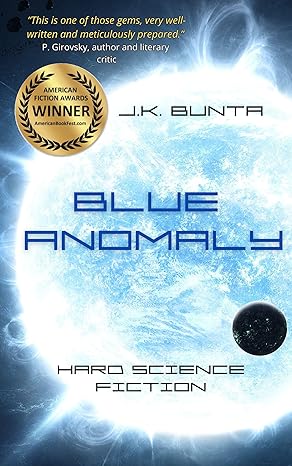

In Blue Anomaly by J.K. Bunta, astrophysicist Dr. Tristan Smolensky embarks on a mission as Earth’s primary representative to investigate signals from a distant star that potentially indicates intelligent life. As he approaches the star, Tristan’s reality begins to fragment, raising questions about whether the star or its signals harbor a more sinister nature or if the journey through space is inducing a hallucinogenic breakdown. The forthcoming answers defy both Tristan’s and the reader’s expectations.
Bunta’s novel falls under the category of hard science fiction, grounded in established scientific theory and existing technology. This genre strives for hyper-realism, with events that can be explained through biophysics, human biochemistry, and similar scientific disciplines. Bunta’s scientific background lends credibility to his storytelling, creating a narrative that is as plausible as it is captivating.
Fans of space madness films like “Moon” or Stanley Kubrick’s “2001: A Space Odyssey” may find familiar themes in “Blue Anomaly.” Despite its scientific foundation, Bunta skillfully weaves in literary elements that are both eerie and emotionally resonant. Tristan’s quest to uncover the source of the star’s signals leads to revelations, but it also opens doors to deeper mysteries. This interplay between scientific plausibility and imaginative storytelling is what defines exceptional science fiction. At its core, this book explores the pressing questions of human nature and existence while venturing into the unknown. The book masterfully balances scientific rigor with imaginative exploration, creating a journey that is intellectually stimulating and thought-provoking. The ending may leave some questions unanswered, but it solidifies the bond between protagonist and reader, ensuring that the journey is memorable.
Blue Anomaly is a compelling blend of scientific authenticity and literary creativity. Bunta’s expertise in science enriches the narrative, while his storytelling transports readers on an unforgettable journey through the cosmos.
Pages: 193 | ASIN : B0D5TM2VHD
PROJECT ÜBERMENSCH

Project Übermensch is a thrilling foray into science fiction that intertwines historical events with the supernatural. Set against the backdrop of World War II, the novel begins with a botched military experiment at the US Navy Yard in Philadelphia, purportedly based on Einstein’s Unified Field Theory. The failed test not only bends reality but also disastrously affects the crew of the USS Eldridge—leaving the protagonist, Peter Smithwick, with unnatural abilities and a curse of delayed aging. Author Lonnie Busch uses this gripping premise to launch into a tale that spans decades, exploring themes of identity, the ethics of scientific experimentation, and the quest for personal redemption.
Busch’s writing is sharp and engaging, blending detailed historical context with rich, imaginative storytelling. The narrative is paced like a carefully tuned symphony, with moments of quiet introspection contrasted against bursts of intense action that push the plot forward. However, while the prose is often compelling, it occasionally gets bogged down by technical descriptions and a multitude of characters that can be challenging to keep track of. I think this complexity enriches the plot but might not appeal to everyone.
The philosophical underpinnings stand out as one of the book’s most compelling features. Busch ambitiously explores the moral implications of playing God and the ensuing existential crises. The protagonist’s battle with his ‘gifts’ and his pursuit of a normal life are rendered with poignant clarity, offering readers a deep exploration of what it means to be human. While these deep philosophical inquiries are ambitious and may sometimes seem to stretch beyond easy grasp, they add a rich layer of complexity to the narrative.
Project Übermensch is an ambitious mystery novel that offers plenty of enjoyment, especially for enthusiasts of science fiction and historical narratives who dare to ask ‘what if?’ The fusion of factual historical events with science fiction elements creates a reading experience that is both intellectually stimulating and entertaining. Readers who savor complex narratives with a mix of action, science fiction, and philosophical inquiry will find this book a gratifying read.
Pages: 356 | ASIN : B0CYRRJLH6
Belonging and Diversity

Quantum Seed follows a neuroscientist with the ability to control brainwaves and see into the future who gets a shocking message from advanced beings that the end of humanity is imminent. What was the inspiration for the setup of your story?
I drew upon two things – my personal experiences in experimental neuroscience and a vivid dream I had about how our civilization has been steered off course.
Victoria struggles with fitting in, only to develop unique abilities that add to her challenge. What were some driving ideals behind your character’s development?
Initially, Victoria really wants to belong, to be understood, and to be accepted for who she is. Instead, she finds herself living a life of isolation because it’s safer and less painful than facing rejection by others. However, in order to survive, she must learn to lower her walls and trust others.
Also, her development shows that what sets us apart can also empower us. Of course, with her abilities, she faces the moral and ethical implications of how to use them.
What were some themes that were important for you to explore in this book?
Belonging and diversity – I see these as necessities for the survival of the individual and our civilization.
Living with artificial intelligence when it is less artificial was another big theme. The book is set in the future when AI is more organic matter like us. Thus, raising questions of rights and place in society.
Transforming ourselves is a prominent theme. Many people are disheartened by all the imbalances in the world, from inequality to a lack of value in human lives. I wondered if all of humanity depended on us transforming and evolving quickly, could we do it, and what would it look like?
The ethics of advanced interventions with the human brain is something the novel delves into, and it is a theme that won’t be confined to my novel.
Can you tell us a little about where the story goes in book two and when the novel will be available?
Book Two will be fast-paced as the team returns to save Earth in 187 days. They face unexpected challenges all along the way. There will be some big reveals.
Book Two will be available by the end of this year (2024).
Author Links: GoodReads | Facebook | Website | Amazon
This thought-provoking narrative explores the boundaries of human potential in the face of a looming global catastrophe. Through the eyes of Victoria Ottery, a neuroscientist with a unique ability to control brainwaves and glimpse into the future, the novel weaves the extraordinary with the familiar while tackling themes of belonging, human capabilities, and societal evolution.
Victoria finds it impossible to fit in, but this becomes the least of her worries when a brain-training session awakens her latent potential. Suddenly, she receives a shocking message from advanced beings. The countdown to humanity’s fate has begun—could the wisdom and technology of inhabitants in another world reshape our trajectory? What will they reveal about the true nature of Victoria’s abilities . . . and her destiny?
Our Place In The Universe

Intergalactica follows a neuropsychiatric after waking from a coma who joins an organization that is trying to find Earth 2 to save humanity, or so they say. What was the inspiration for the setup of your story?
I needed to find the most credible way in which a situation as heightened as this could happen in reality. As we know, her coma is related to the twist at the end of the book – so it all connects in a way that is hopefully rewarding to the reader.
Was the character’s backstory something you always had, or did it develop as you were writing?
Amanda is greatly inspired by another Amanda – from the TV series Nikita. Although Amanda from Nikita, played by Melinda Clarke, is a psychopath and the main villain behind the show. I wanted to create a new character – this time a heroine, that still had her commanding presence and icy one-liners.
What were some themes that were important for you to explore in this book?
I wanted the reader to reflect on our place in the universe, and to also be able to explore new worlds with actual new species and ecosystems. I feel the sci-fi genre can get too desolate and hopeless at times, and I am especially sick of barren planets.
Will there be a follow-up novel to this story? If so, what aspects of the story will the next book cover?
There are three other novels in the series, already published in Portuguese. I believe if the next three get translated, I might re-edit the entire product, revisit them, and adapt them to fit one full book. It would still be just slightly bigger than Intergalactica, so this idea has been on my mind for a while. We shall see.
Author Links: Twitter | Facebook | Instagram | GoodReads | Amazon
It’s launch day for NASA’s long-awaited manned expedition to explore Jupiter’s moon Europa!
Neuropsychiatrist Amanda awakens after months in a coma caused by acute meningitis…
Along with two patients, they discover themselves to be key pieces in an ever-growing puzzle involving an underground geopolitical corporation called The Firm, which plans to sabotage the mission, taking advantage of a new technology to hijack the ship and set a course for a habitable planet located seventeen light-years away from Earth.
Originally released in Brazil in 2016, the Intergalactica book series moved thousands of physical and digital copies in Portuguese. Discover a new Earth as you journey to the stars in the first volume of F. P. Trotta‘s saga.



 LITERARY TITAN