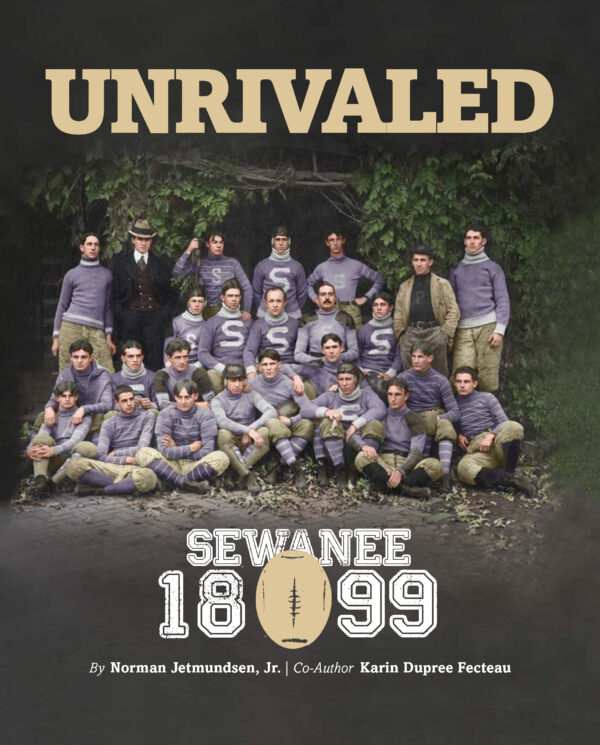
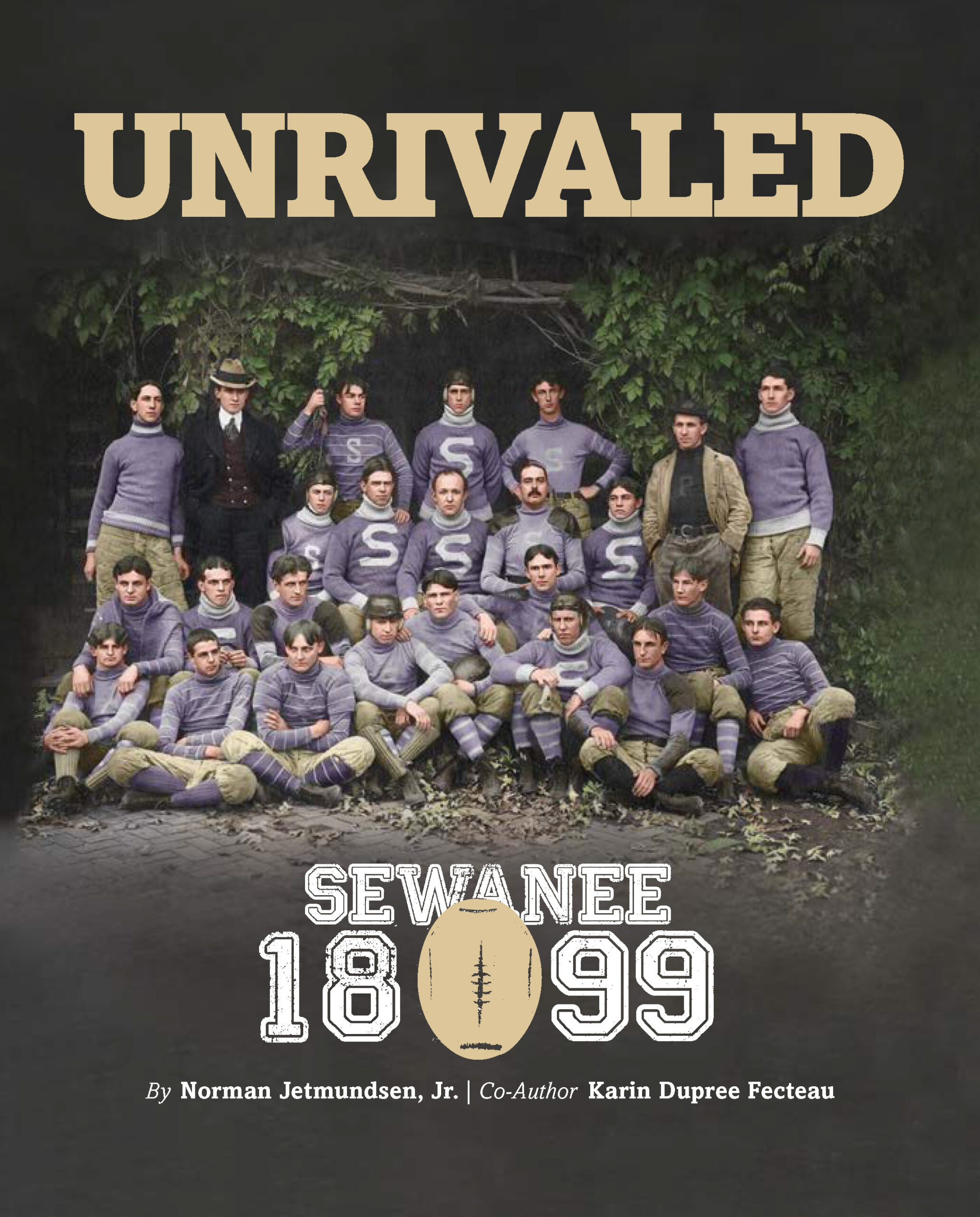
Unrivaled: Sewanee 1899 tells the story of a football team from a small college in post-Civil War Tennessee and their incredible accomplishments. What inspired you to share this story with readers?
I was a student at Sewanee in the 1970’s. Everyone there hears about this team. It’s a truly amazing story. Over the years, I kept thinking someone would do a documentary film about this team, but one never appeared. So, my classmate, David Crews and I decided to do it ourselves. Later, after the film came out, I realized we had a lot of original paintings and a unique music score, as well as a great deal of archival information. We decided this should also be preserved in a high quality coffee table book.
How much and what kind of research went into putting this book together?
We spent almost 5 years researching this story and doing interviews. This involved hours in the Sewanee Archives, as well as meeting with people who knew about the story, and doing research online as well. It also involved contacting the schools Sewanee played that year to see what information they had. Then, my co-author, Karin Fecteau, and I spent another two years creating this beautiful book to further preserve the history of this incredible accomplishment.
Did you learn anything surprising during your research process?
Yes, we thought we knew the story, but it was far richer and more layered than we ever imagined. We also uncovered materials and photos no one had discovered before, which was exciting. Finally, we thought we’d mainly explore the lore of the 1899 team, but what we learned was that the facts were even better than the lore.
Can we look forward to more history selections from you in the future? What are you currently working on?
Would love to but right now I’m focused on selling these books.
Unrivaled, by Norman Jetmundsen and Karin Fecteau, chronicles the legendary 1899 Sewanee Tigers football season, a feat of athleticism and endurance unmatched in sports history. This small Southern college’s team embarked on a grueling journey of 12 games in six weeks, including an astonishing streak of five games in six days across 2,500 miles. They remained undefeated, outscoring opponents 322-10. The book dives deep into this epic season, providing a vivid portrayal of the players, the societal context, and the sheer grit required to achieve such greatness.
From the moment I started reading, I was hooked by the palpable passion and depth of historical detail. The writing brings the era alive, especially when describing how the players contended with brutal physical conditions. Chapter 7, “The Season,” is a highlight, vividly illustrating the no-huddle, non-stop nature of football in 1899. The way the players managed to triumph despite minimal protective gear and relentless injuries is simply inspiring. It gave me chills to imagine men like Henry “Ditty” Seibels and Ormond Simkins pushing through bone-deep exhaustion with an unshakable will.
The book also does a fantastic job of weaving in broader cultural narratives. For example, the chapter on the societal ties between the Civil War and Southern football traditions was eye-opening. Jetmundsen shows how the region’s pride and resilience were mirrored on the gridiron. This made the Tigers’ victories feel even more monumental.
What stood out most to me, though, were the unsung heroes. The chapter on Cal Burrows, the team’s African-American rubdown man, was incredibly moving. It underscored the invisible labor that made the team’s success possible. It’s humbling to think about how much these contributions mattered, even though they’ve often been overlooked in the broader story.
Jetmundsen and Fecteau’s Unrivaled is a testament to the human spirit. I’d recommend this book to anyone who loves sports history, particularly those who appreciate a good underdog tale. Whether you’re a fan of football or simply someone who enjoys tales of resilience, this book will stick with you.
Unrivaled by Norman Jetmundsen and Karin Fecteau is one of those books that makes history feel alive. It’s all about the incredible 1899 Sewanee football team, a scrappy underdog group from a small Tennessee college that defied every odd to dominate the season. They played five games in six days, traveling 2,500 miles by train, and they never lost. They outscored opponents 322-10 that season! It’s a wild mix of perseverance, teamwork, and sheer grit, set against the backdrop of a South still recovering from the Civil War.
The historical context of Jetmundsen’s work reeled me in. Jetmundsen does a fantastic job describing what life was like back then—horses and buggies, no forward passes in football, and players tackling in wool uniforms. The connection to broader Southern culture was fascinating, too. Football wasn’t just a game it was like a stand-in for battlefield glory. That kind of emotional weight gave the story so much depth.
What I liked most were the characters. The players felt real, even heroic. Ditty Seibels, the halfback who bulldozed through defenses, and “Wild Bill” Claiborne, with his pirate-like eye patch antics, were larger than life. I also loved reading about Luke Lea, the 20-year-old manager who orchestrated the whole season with nothing but a telegraph and sheer willpower. That’s the kind of quirky determination that feels cinematic.
Some parts of the book flow like a gripping documentary, while others are somewhat heavy with details. Jetmundsen’s admiration for the team is palpable. There are golden moments of vivid storytelling, like descriptions of the brutal conditions or the camaraderie among the players, and I’d be hooked again.
Would I recommend Unrivaled? Absolutely. If you’re a history nerd like me, you’ll adore the rich cultural context and the underdog story. Sports lovers will eat up the football lore. Anyone who values stories about resilience and teamwork will find something to admire here. It’s a reminder of what people can achieve when they set their minds (and muscles) to it, and honestly, it left me inspired.
Play For Her presents an intimate portrait of Melissa Strother, a gallant warrior in professional American football. The narrative captures her audacious journey through myriad challenges, vividly depicting a life characterized by relentless training, the paradox of having to pay to pursue her passion, and the formidable struggle against the disorganization plaguing the women’s league. Amidst the backdrop of an unpredictable global pandemic and mounting political tensions, Melissa’s unyielding resolve shines bright, a testament to her love for the sport, her teammates, the aspiring young athletes who idolize her, and the unquenchable spirit of the young girl within, who refuses to relinquish her dreams.
Regardless of one’s affinity for American football, Melissa Strother’s saga is a potent infusion of inspiration and motivation. She imparts valuable insights on harnessing the power of the present moment and fostering personal growth. Her words resonate with unfiltered joy as she vividly recounts her immersive state and absolute concentration on the game. This enthusiasm transforms into fiery indignation when she touches upon the haphazard way the league acted. Initial impressions may suggest a bitter woman venting, but as readers delve deeper, they discover a brave character who candidly articulates her sentiments and, notably, channels her emotions into actions.
Play For Her boasts a captivating writing style in which Melissa pens each chapter in real-time and retrospects on prior sections, lending the book an unparalleled sense of authenticity and intimacy. Including photographs of Melissa and her matches adds a delightful personal touch. However, a comprehensive explanation of the technical terminology would be beneficial for readers less acquainted with American football. Nevertheless, I wholeheartedly endorse this empowering narrative to all, especially women who have experienced feelings of inadequacy or discouragement in pursuing their objectives.
Mumentous is a fascinating book about the history and the culture surrounding homecoming mums. Where did the idea for this book come from?
Thank you!
Before I decided to write a book, I was first drawn to homecoming mums as a subject matter to photograph. They are, after all, visually stunning! But I really just wanted to understand why without judgement, and I think the only way to do that is to be quiet and pay attention. The camera lens helps me be present in this way. I can hone in on details I might never have otherwise noticed, zoom out and take in relevant context, and begin to discern what is tertiary or immaterial. Another way of saying this is that when I decide to take a photograph, I’m making a promise to look for the story inside the story.
As I mention in the book, it all began when I asked a good friend if I could join her at a mum-making session hosted by a local high school marching band booster club. The club was selling mums as a fundraiser for the band in which her daughter was a member. I helped cut ribbons, but mostly I took photos and listened to the group, all women, whose camaraderie and work ethic were equally palpable. It was like I had discovered a secret quilting bee, which completely surprised and enchanted me. I realized then that I not only needed my camera to fully unpack the tradition but it would take lots of conversations and research, too.
In terms of taking a creative direction, I made one decision early on that made all the difference. If you search the internet for images of people wearing homecoming mums, you will only see one kind of photo: kids in mums standing still and smiling for the camera. A homecoming mum is many things, but it is not still. From the beginning, I avoided depicting a mum as a “still life”, trying instead to capture it as the fully animated expression that it is. That decision drove me to be thorough, which led me to so many wonderful and unexpected discoveries.
How much research did you undertake for this book and how much time did it take to put it all together?
I’ve been shooting photos, collecting personal stories, and conducting research on the tradition since 2016, but only during fall football season.
Should you want more detail:
Those photo sessions with the booster club took place in Fall 2016. In Fall 2017 and 2018, I shot photos at several different locations. I conducted considerable online research on the historical evolution of mums in Fall 2018 and 2019 while also interviewing people across the state, which validated the online research and vice versa.
In the second half of 2019, I served as the inaugural Artist-in-Residence at the Arlington Museum of Art in Arlington, TX, a position which allowed me to broaden my reach considerably and create an exhibition of my work to date. There’s a chapter in my book which goes into detail about the exhibit and how I turned it into an opportunity for the community to participate. It was during that time I decided Mumentous needed to become a book.
In Fall 2020 and 2021, I watched the tradition refuse to yield to Covid, then I wrote about it and shot a few more photos. By early 2022, my research wasn’t yielding any new revelations, which told me it was time to write “The End” and seek a publisher. The book is being released by Atmosphere Press on April 25, 2023, just as “mumtrepreneurs” across and beyond Texas are ramping up for the 2023 football season.
I joke with friends that if universities gave out degrees in “mumology,” I’d be ready to defend my dissertation.
Did you find anything in your research of this story that surprised you?
Yes. In the first half of the 20th century, throughout the United States, it was common practice for a boy to give his date a chrysanthemum corsage before the annual high school or college homecoming football game. I find it fascinating that this tradition has all but vanished, except in Texas (and a few adjacent states) where it not only held fast but evolved into a version of itself that would be unrecognizable to its originators.
What is one thing that you hope reader take away from Mumentous?
As readers dig deeply inside the very unique tradition of homecoming mums, I hope they will discover that like so many traditions, its driving force is utterly universal: women.
The closest you’ll ever get to seeing someone actually wear their hearts on their sleeves is in Texas, every fall, at the local high school homecoming game.
They’re called homecoming mums. They are as bodacious as football, as irresistible as a juicy rumor, and as deep as a momma’s love. Over a hundred years ago when the custom began, mum was short for chrysanthemum, a typical corsage that boys gave to girls before taking them to the big football game. But through the decades, mum went from a simple abbreviation to a complicated shorthand for an eye-popping tradition that’s as ingrained in the culture as it is confounding to outsiders.
Through her original photography and collection of stories from across and beyond the Lone Star State, Amy J. Schultz takes us deep in the heart of mum country. You’ll meet kids who wear them, parents who buy them, and critics who decry them as just another example of consumerism gone wild. But mostly, you’ll discover that just like every ritual which stands the test of time, someone is keeping the tradition alive. Someone like Mom.
The beauty about Gary Evans and his book SOL: Still Our Lions – The Rise, Fall and Renaissance of Detroit and its Pro Football Team is that you do not need to be a football fan, or even a sports fan, to enjoy his introspective book. The author writes in a way that is moving, and every sentence he pens is more attention-grabbing than the former. His way of expressing his thoughts on the subject matter is well thought out and stated directly. Gary Evans writes from the heart, and that is what makes his writing so appealing. He is authentic and candid in all he writes about. In between the sports discussions, readers get life lessons that the author shares while telling his story and the stories of others.
This informative book is about the Detroit Lions team in the NFL. The author writes about the football team’s history, major events, wins, losses, relationships with fans, the community, and everything in between. Gary Evans chronicles forgotten events, little-known heroes, and the role sports play in communities. The author explains how he believes sports loyalty works, writing that the Detroit Lions were loved through both their accomplishments and failures. The rise of the team, the challenges, and the goals achieved are what make the Detroit Lions special. Reading from a fan’s point of view is the magic in the entire book.
This book may focus on sports, but as you read on, you see that other themes arise. The other themes are politics, family, freedom and independence, race relations, policy making, and love. I appreciate that the author compiled notes about unheard-of history icons as he shared inspirational tales in his narrating. Reading this book gives one a feeling of nostalgia, even if not from the area being written about. The author has created an entertaining book that will give readers an appreciation of history and get them to see sports competitions in a different light.
Apart from learning about football as a sport and the Detroit Lions, the author also enlightened the reader on how to preserve culture and how to build a community with people that share the same interests. At the start of every chapter is a quote from historical icons. Two of my favorite quotes are “Time Slips away, leaves you with nothing, mister. Just stories of glory days,” by Bruce Springsteen, and “There is a fine line between honoring the past and losing yourself in it” by Eckhart Tolle. The lessons about life doubled with the impeccable storytelling skills make this book an interesting read. The reader gets to reflect on the past and appreciate the present.
SOL: Still Our Lions is more than a sports history book; it is a well-crafted and deeply thoughtful look at how sports impact and influence the communities they are part of. More than just a game, football is an avenue to bring people together that would otherwise not cross paths.
Myth or urban legend? Not at all. This is the true story of senior citizen Michael Lynch and his inspirational journey back to the gridiron and glory. In his mid-sixties, he played on one of the best semi-pro football teams in America, and was coached by a former NFL veteran.
After seeing his nephew play in a high school All-Star game on Long Island during the summer of 2012, Michael Lynch had an epiphany. He wanted to play football again. In the late 60s and early 70s, he had been a football star in high school, college, and in the semi-pro leagues on Long Island. Forty years later, he decided to turn back the clock and risk life and limb to play football again in one of the toughest semi-pro leagues in America: the Florida Football Alliance.
This is a story of courage, redemption, tragedy, and love as Lynch played for four years in over fifty football games. He was a game captain, an Honorable Mention on the 2014 Florida Football Alliances All-Star team, and was honored at the leagues’ banquet in his final year in 2018 for his inspiration and dedication to the game he loves. He played on two championship teams, in 2015 and 2018.
Michael Lynch was inducted into the Guinness World Records in 2019 as the oldest American football player ever, and the oldest American football player to catch a touchdown pass—which he did at the age of sixty-eight.
Hero or antihero? You decide, but first read Michael Lynch’s epic tale, his Iliad and Odyssey of football journeys—the true story of . . . the Golden Gladiator.
The Golden Gladiator is a memoir about one football player’s life, and how he refused to give up on his dream just because of his age. Why was this an important book for you to write?
It was important to write it to show everyone that it is important to dream and to follow that dream. Of course, sometimes following that dream takes hard work and sacrifice and only the individual pursuing it can determine if all of the work is worth it. It also let me get back in the time machine to go back and fondly recall the place I always love the most, home.
I appreciated the candid nature with which you told your story. What was the hardest thing for you to write about?
The hardest thing for me was just trying to STOP writing. When I sat down and started writing it was very easy and I put the story down in linear form. My editors change it around and when I told them it was complete, I kept adding more and more story and details. They told me in the end that I had added almost thirty pages to the first manuscript by the time it was ended.
What is one piece of advice someone gave you that changed your life?
My father told me to when you do a job do it as perfectly as you can. You may never be perfect, but strive for it. My mother told us as children that the battles of our adult lives would be won on the playing fields of our youth.
What do you hope is one thing readers take away from your story?
That is easy, to never give up and always remember as you face adversity to remember that each and everyday you wake up that day is the beginning of the rest of your life. You cannot change the past, but you can control the present and the future.
The Golden Gladiator. . . . Myth? Urban legend? Hero? Antihero? Myth or urban legend? Not at all. This is the true story of senior citizen Michael Lynch and his inspirational journey back to the gridiron and glory. In his mid-sixties, he played on one of the best semi-pro football teams in America, and was coached by a former NFL veteran. After seeing his nephew play in a high school All-Star game on Long Island during the summer of 2012, Michael Lynch had an epiphany. He wanted to play football again. In the late 60s and early 70s, he had been a football star in high school, college, and in the semi-pro leagues on Long Island. Forty years later, he decided to turn back the clock and risk life and limb to play football again in one of the toughest semi-pro leagues in America: the Florida Football Alliance. This is a story of courage, redemption, tragedy, and love as Lynch played for four years in over fifty football games. He was a game captain, an Honorable Mention on the 2014 Florida Football Alliances All-Star team, and was honored at the leagues’ banquet in his final year in 2018 for his inspiration and dedication to the game he loves. He played on two championship teams, in 2015 and 2018. Michael Lynch was inducted into the Guinness World Records in 2019 as the oldest American football player ever, and the oldest American football player to catch a touchdown pass—which he did at the age of sixty-eight. Hero or antihero? You decide, but first read Michael Lynch’s epic tale, his Iliad and Odyssey of football journeys—the true story of . . . the Golden Gladiator.











 LITERARY TITAN