Blog Archives
A Black Magic


Joseph Stone’s A Black Magic is an expansive work of historical dark fantasy that combines Gothic horror, a multigenerational family saga, and a coming-of-age story. Set primarily in 1974, the novel follows Fran and Mary Jane as they investigate Daedrian, the possessive spirit bound to Fran’s maternal bloodline. Their research leads into the memories of Máirín and Violet Ralston, two eighteenth-century women whose encounters with violence and witchcraft shaped the family’s inheritance. Stone develops the supernatural system through three linked forces, blood, intention, and spiritual light, giving the mystery both emotional significance and coherent internal rules.
The relationship between Fran and Mary Jane provides the novel’s strongest foundation. Their handwritten exchanges combine analytical discipline, mordant humor, and profound loyalty, allowing them to investigate experiences that can scarcely be discussed aloud. The line “You will be the grief. I will be the clock” captures how effectively their contrasting temperaments work together. Fran possesses the inherited power and bears its physical cost, while Mary Jane supplies structure, skepticism, and strategy. Their gradual shift from frightened researchers to deliberate adversaries gives the narrative a satisfying sense of intellectual and moral progression.
Stone also places the supernatural conflict within a richly developed family drama. Laura’s struggle with widowhood, Richie’s experience as a gay teenager in a volatile Catholic household, and Carla’s attempt to rebuild a life after abuse broaden the novel’s consideration of secrecy and survival. These storylines show how domination can pass through families without magic, while acts of recognition can interrupt that inheritance. The novel treats sexual violence directly and at considerable length, but its deeper concern is the aftermath: how survivors interpret memory, recover agency, and decide which truths can safely be shared. As Fran observes, “The truth was a house with no doors,” a metaphor that aptly expresses the burden carried by nearly every major character.
A Black Magic has the scale and patience of a family chronicle. Its alternating timelines steadily clarify Daedrian’s history, Máirín’s tragedy, and the flawed act of witchcraft that binds them all together. Stone’s prose is atmospheric and frequently lyrical, particularly in its descriptions of houses, weather, grief, and unseen attention, though the density of figurative language occasionally slows scenes that already carry substantial dramatic weight. The conclusion rewards the novel’s long preparation by resolving its central conflict through character, knowledge, and sacrifice, then extending its consequences across fifty years. The result is a thoughtful, unsettling novel about inherited harm, the ethics of power, and the difficult work of seeing another person clearly.
Pages: 561 | ASIN : B0HJ78S7BS

Fast-Paced, Cinematic Narrative

ȚEPEȘ is a dark historical war novel that follows Vlad Dracula’s rise from hostage and prince to ruthless ruler as he navigates Ottoman expansion, political betrayal, warfare, and the brutal struggle to defend Wallachia. What was the inspiration for the setup of your story?
It was a combination of a lifelong fascination with the myth and deep frustration with how modern pop culture treats it. I had loved Bram Stoker and the atmosphere of classic gothic darkness since childhood. Yet, sitting in a cinema watching another film adaptation, I realized that after a century of repetition, the “fanged monster” had lost all its sharpness and weight.
I refused to be just another passive critic complaining on social media about how it should have been done. I decided to act. I immersed myself in the study of the fifteenth century and the life of the real Vlad III. The deeper I probed into the archives, the clearer it became that the reality of his existence was incomparably more brutal and terrifying than any fictional myth.
Intertwining his fate with my writing became an obsession. I lived in isolation, researching and writing into the early hours of the morning to capture the raw atmosphere of Wallachia—a realm of despair, betrayal, and bloodshed trapped between two great powers. I wanted to forge a fast-paced, cinematic narrative grounded in uncompromising historical fidelity that would strip the real Vlad of pop-culture clichés.
You portray Vlad as a prince, hostage, strategist, ruler, lover, and eventually legend. Which aspect of his character was most important for you to explore?
This cannot be answered in a single word. The novel charts Vlad’s entire life and evolution so that the reader understands where his hatred for the enemy was born—that it was not merely a duty to defeat a foe, but a deeply personal feud.
We witness his formative years, from his childhood captivity under the Ottomans to his study of Western strategy under János Hunyadi in Buda. Without this trajectory, Vlad would appear as a flat superhero who materialized out of nowhere with full mastery. The reader must see the ordeal he endured to acquire this knowledge and how he later deployed it against the Ottoman Empire—whether as a feared warrior in the chaos of battle or as a cold strategist over maps.
At the same time, exploring his human anchor was vital. His relationship with the Ottoman girl Zeynep was not intended merely to satisfy the expectations of Stoker’s fans. Though she appears only briefly, she is essential to understanding Vlad’s inner world. She, alongside his most loyal companions, Dragan and Mircea, and his friendship with Stephen the Great, represents his sole connection to humanity. Without them, Dracula would be nothing more than an unfeeling machine of slaughter, devoid of emotion and conscience.
These aspects are linked into a single entity. It is an equation—remove any part, and the outcome falls apart. The final portrait is that of a brilliant, fanatical Voivode who sacrificed his own soul out of devotion to his land.
What research went into recreating fifteenth-century Wallachia and the political tensions between the Ottomans, Hungarians, and neighboring powers?
The research was painstaking and exhaustive. I refused to deviate from historical reality, spending months studying Vlad III before writing a single line.
It was meticulous work. I was surprised to discover that despite Dracula’s global renown through Stoker, historical records contain glaring gaps—for instance, the exact day and month of his birth and death remain unknown to this day. Where history fell silent, I had to employ my own creative vision to make the story even more profound. That is precisely why this book is classified as historical fiction rather than non-fiction.
My research extended far beyond Vlad himself. I conducted an in-depth study of his adversaries and allies—Sultans Murad II and Mehmed II, János Hunyadi, Matthias Corvinus, and many others. Understanding the geography and the shifting frontiers of the fifteenth-century Balkans was equally demanding. For months, I studied period maps, academic papers, and historical documents to plot the precise boundary changes year by year. I needed to understand exactly what Vlad was defending and where the Sultan was striking in any given year.
The result of this research was an immense chronological timeline that I had to reshape into a fluid narrative. My aim was not to write a dry textbook. My task was not merely to recount what Dracula did, but above all to reveal why he did it.
What do you hope readers understand about Vlad after finishing the novel that they might not have understood from the familiar Dracula legend?
In a single word: patriot. He was a man carved by his enemies, who turned himself into a rampart of Ottoman corpses. He and the whole of Wallachia—a beautiful yet impoverished realm perpetually torn apart by foreign rulers—stood against the overwhelming force of a finely tuned Ottoman military machine. Direct confrontation was impossible; it meant certain death. Yet Vlad did not flee, surrender, or bow to the Sultan. He wielded every strategic and physical skill at his disposal, and with a handful of loyal men, terrified one of the most powerful rulers on Earth so profoundly that the Sultan turned back, retreating home to Constantinople in disgrace with heavy losses.
What I want the reader to grasp is that the driving force behind this Wallachian Voivode was love. Not the romantic devotion depicted by Stoker—love for a woman—but an uncompromising love for his homeland. A love so fierce that he was willing to sacrifice his soul and his life to protect it.
ȚEPEȘ: VLAD III DRACULA


Sebastian Valerius’s Țepeș: Vlad III Dracula is a sprawling historical war novel that treats Vlad Dracula as a political creature before anything else: prince, hostage, strategist, son, lover, prisoner, ruler, and finally legend. The book moves through the brutal machinery of fifteenth-century Eastern Europe, where Wallachia is squeezed between Ottoman expansion and Hungarian ambition, and where nearly every alliance carries the possibility of betrayal. Valerius calls the novel political and historical fiction with Gothic horror elements, and that combination fits it well. The Gothic quality comes less from the supernatural than from the atmosphere of dread surrounding power itself. Courts become cages, diplomacy becomes coercion, and the landscape of Wallachia gradually turns into an extension of Vlad’s mind: defensive, scarred, watchful, and terrifying.
The book’s strongest achievement is the way it builds Vlad. His childhood as an Ottoman hostage gives him language, discipline, military knowledge, and an intimate understanding of the empire he’ll eventually fight. His relationships with Murad, Mehmed, Radu, Hunyadi, Zeynep, Anastasia, Matthias Corvinus, Stephen of Moldavia, Dragan, and Mircea keep changing the meaning of loyalty around him. Some people teach him strategy, some offer tenderness, some use him, and some stay loyal long after loyalty makes practical sense. That accumulation matters. By the time Vlad turns terror into policy, the reader understands the chain of experiences that brought him there without being asked to mistake understanding for absolution. His conversations with priests and chroniclers sharpen this tension beautifully, especially when the novel asks whether a ruler can deliberately sacrifice his own soul for the survival of his country.
Valerius writes at full pressure. The prose is physical, dark, and intensely sensory, filled with mud, iron, smoke, winter, blood, wolves, cages, maps, and the constant shadow of the stake. Battles aren’t treated as decorative action scenes. They’re problems of terrain, intelligence, supply, deception, morale, and timing. Some of the most gripping passages concern poisoned wells, destroyed granaries, blocked mountain passes, false retreats, disguises, cavalry traps, and the sheer logistical impossibility of feeding an enormous invading army. That attention to strategy gives the famous 1462 campaign a genuine narrative engine. The violence is just as deliberate. It grows increasingly difficult to witness because the novel makes Vlad’s methods progressively more extreme, culminating in acts that show how thoroughly the weapon he created has begun to consume the man who created it. Valerius keeps returning to the uncomfortable question beneath every victory: if fear saves the state but destroys the ruler’s humanity, what exactly has been saved?
That question gives Țepeș its emotional weight. Beneath the military campaigns and political maneuvering is a tragedy about a man who craves control because nearly every formative experience of his life taught him what it means to be powerless. Vlad can defeat armies, discipline a country, manipulate enemies, and turn his own reputation into a weapon, yet he can’t command loyalty from kings, reverse betrayal, recover lost years, or return to the person he might once have become. Zeynep is especially important in that respect. She represents a private life Vlad could imagine but never inhabit, which makes the vision surrounding his death unexpectedly moving. When the dying Vlad finally imagines peace, home, love, and children, the novel reveals how small and human his deepest desire has always been. The later epilogues then pull outward again, showing the man giving way to rumor, propaganda, an empty tomb, and finally the name by which history will remember him.
Țepeș is an ambitious, ferocious historical epic about the manufacture of a legend and the terrible usefulness of fear. Its Vlad is tactically brilliant, emotionally damaged, politically perceptive, capable of profound loyalty, and increasingly capable of horror. That combination makes him fascinating because his victories and his moral collapse are part of the same story. Valerius gives the reader war from the council chamber to the supply wagon, politics from the marriage bed to the dungeon, and a portrait of Dracula shaped as much by those who betrayed, loved, feared, and exploited him as by his own choices. By the final pages, the familiar historical figure feels less like a distant emblem and more like the result of a long, brutal process in which survival becomes ideology and reputation becomes immortality. Savage, intelligent, and darkly absorbing, Țepeș turns Vlad Dracula into a living argument about what power costs when survival becomes the only law.
Pages: 307
Ultimate Test of Faith

Eclipse: The Silence of Heaven centers on a warrior known as the Holy Avenger who faces a city that has mistaken silence for divine judgment. What was the inspiration for the setup of your story?
The entire novel started with one historical fact. I was reading about the volcanic winter of 536 AD, when the sun was dimmed for roughly eighteen months. Historians have called it one of the worst times to be alive. Crops failed, famine spread, disease followed, and entire civilizations struggled to survive.
My first thought was, “What a perfect time for vampires to thrive.”
But as I dug deeper into the period, I realized something even more interesting. Religion was at the center of everyday life. People looked to God for answers, protection, and hope. When the sun disappeared and the world seemed to be falling apart, I started wondering how people would react if they believed Heaven had simply gone silent.
Some would lose their faith. Others would cling to it even more fiercely. Then I added vampires to the equation, creatures that had suddenly inherited a world without sunlight, and it became the ultimate test of faith. What happens when everything you believe about God, good, and evil is challenged by the impossible?
That’s where Eclipse was born. The historical event gave me the setting, but the characters and their responses to that silence became the heart of the story. It’s a novel about faith, doubt, sacrifice, and the choices people make when they can no longer tell whether Heaven is watching.
The novel explores what people do when they believe their prayers go unanswered. Why did that idea become the emotional center of the story?
I think everyone has experienced a moment where they’ve prayed for something and the answer never seemed to come. Whether you’re religious or not, we’ve all had times when we’ve wondered if anyone was listening.
In 536 AD, people didn’t have science to explain why the sun disappeared. Their faith was their foundation. They looked to God for meaning, protection, and hope. When the world descended into famine, plague, and darkness, I couldn’t help but wonder how they reconciled that with everything they believed.
That’s why unanswered prayer became the emotional center of Eclipse. Every major character responds to Heaven’s silence differently. Some lose their faith. Some become angry. Some convince themselves God has abandoned them. Others continue believing even when they have every reason not to.
Then I introduced vampires into that world. They don’t just threaten people’s lives. They challenge everything people believe about God, good, evil, and salvation. The monsters become the external conflict, but the real battle is happening inside each character.
Which aspect of Veyne’s character proved the most difficult to write?
Veyne was by far the most difficult character to write because I wanted his relationship with faith to feel authentic. It would have been easy to make him either completely lose his faith or remain unwavering from beginning to end. Real life usually isn’t that simple.
At his core, Veyne is still Brother Sebastian. That part of him never truly disappears. He’s a man who has witnessed unimaginable horror, carries tremendous guilt, and questions God more than once, but he never completely abandons the man he once was.
Finding that balance was the hardest part. I wanted readers to understand why he struggled without ever feeling like he had become someone else. His doubts are real, his anger is real, but so is the compassion, humility, and sense of duty that defined Brother Sebastian from the beginning.
I think that’s what makes him relatable. Faith isn’t the absence of doubt. Sometimes it’s choosing to keep moving forward even when you don’t understand why God seems silent. That, more than anything, is Veyne’s journey.
How do you see Eclipse fitting within the tradition of religious horror?
I think Eclipse fits within religious horror, but it approaches the genre from a different direction. A lot of religious horror focuses on possession, demons, or the conflict between good and evil through the lens of the Church. Those stories can be fantastic, but I wanted to explore something different.
In Eclipse, the horror doesn’t begin with evil. It begins with silence. The greatest fear isn’t that God doesn’t exist. It’s that He does, but He isn’t answering.
I also wanted faith to be more than a backdrop. It’s the emotional foundation of the novel. Every major character has a different relationship with God, and the darkness exposes who they really are. Some lose hope, some become consumed by fear, and others discover a faith they never knew they had.
The vampires are certainly the monsters of the story, but they’re also a way of asking much bigger questions about suffering, sacrifice, redemption, and what it means to keep believing when everything around you suggests you’ve been abandoned.
Author Links: GoodReads | Website | X (Twitter) | Facebook | Amazon
For centuries, Sanctum Eterna has stood as the last fortress of divine order. Its towering cathedrals, sacred covenants, and ancient vows have kept darkness at bay—or so its people believed.
Then the eclipse arrives.
As the kingdom descends into chaos, Veyne, a battle-hardened hunter burdened by doubt, is drawn into a war older than history itself. Across the battlefield stands Seraphine, once destined to become humanity’s salvation, now transformed into the most feared force the world has ever known after betrayal shattered everything she believed. Behind them both waits Kharion, an ancient being determined to erase the boundary between heaven and oblivion.
Haunted by forgotten prophecies, cursed bloodlines, sacred relics, and impossible choices, heroes and monsters collide in a breathtaking struggle where loyalty is tested, faith is broken, and redemption comes at an unimaginable cost.
Rich with gothic atmosphere, unforgettable characters, and cinematic action, Eclipse blends dark fantasy, supernatural horror, epic battles, and emotional storytelling into an unforgettable reading experience.
Perfect for readers who enjoy:
Dark epic fantasy
Gothic fantasy
Supernatural horror
Religious mythology
Vampire fiction
Monster hunters
Grimdark fantasy
Character-driven fantasy
Dark romance undertones
High-stakes fantasy adventures
When heaven falls silent…
Who will remain?
Eclipse: The Silence of Heaven
Eclipse: The Silence of Heaven, by Richard Blackthorn, is a dark fantasy novel with strong gothic horror and religious horror elements. Set in 536 AD, when the sun has dimmed and Sanctum Eterna begins to collapse under hunger, fear, and faith, the story follows Veyne, a scarred warrior known as the Holy Avenger, as he faces Seraphine, Kharion, Malcrius, and a city that has mistaken silence for divine judgment. It is a grim, blood-soaked story about belief, power, ruin, and what people become when Heaven does not answer.
I was pulled in by the book’s atmosphere. Blackthorn writes like someone who wants every stone, bell, relic, and wound to feel cursed. The book is heavy, no question. It does not tiptoe. The prose leans into ash, frost, blood, cracked icons, dead light, and sacred spaces turned rotten. Sometimes that intensity works beautifully, especially when the city itself feels alive and afraid. I admired the commitment. This is not a novel trying to be gentle or tidy. It wants to drag the reader through a ruined cathedral and make them look up.
The book is not simply asking whether God is gone. It’s asking what people do with that absence. Malcrius turns fear into control. Seraphine turns pain into doctrine. Veyne turns abandonment into endurance. That triangle gives the story more bite than its monsters alone could provide. I liked that the vampires and werewolf-like horror are not just creatures dropped into a historical setting. They feel tied to the book’s argument about corrupted worship, inherited violence, and the terrible comfort of certainty. It is bleak stuff. But it has purpose.
I would recommend Eclipse: The Silence of Heaven to readers who enjoy dark fantasy that is grand, grim, and theological in its concerns. Fans of gothic horror, apocalyptic fantasy, vampire lore, religious symbolism, and morally bruised heroes will find a lot to sink into here. For readers who appreciate a brooding genre novel that treats faith, monstrosity, and survival as tangled parts of the same wound, this one has a strong and memorable pull.
Pages: 233
The Antiquarian
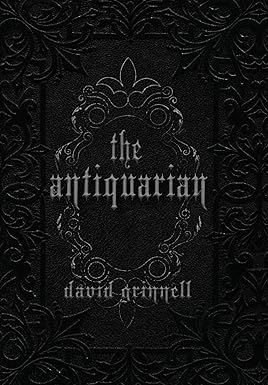

David Edgar Grinnell’s The Antiquarian is a gothic horror novel wrapped in layers of historical research, romance, and creeping dread. Told through the diary entries of Nicholas Ainsworth, a young archaeology student in 1930s England, the book follows his descent from academic ambition into eerie obsession as he investigates deviant burials and unexplained phenomena tied to folklore, vampires, ghosts, and haunted ruins. Set largely in London and Romania, the story blends scholarly curiosity with gothic thrills, all anchored by Nicholas’s emotional entanglements with two women, one from his past, and one disturbingly present.
This book proved far more emotionally immersive than I initially anticipated. The writing is intimate and affecting, owing much to its diary format, which lends a raw, unfiltered quality to the narrator’s voice. Nicholas begins as an idealistic and somewhat innocent student, eager about etiquette, fashion, and academic pursuits, but gradually unravels as his fascination with vampire folklore deepens into an obsessive search for meaning. The tonal shift is subtle yet deliberate. One moment he’s trading quips with his flamboyant uncle over proper dinner attire, and the next he’s recounting a dream of dancing with Irene, his lost love, in a scene that blurs romance and death. The recollections of Whitby Abbey, particularly the rain-soaked farewell, are profoundly melancholic, evocative, atmospheric, and genuinely moving.
The romantic subplot unfolded in a way I did not expect. Sasha, a reserved and enigmatic Russian student, emerges not merely as a romantic figure but as a survivor of profound trauma. Her fixation on deviant burials is not presented as an eccentricity, but rather as a means of processing her past and reclaiming agency. One particularly affecting moment occurs as she and Nicholas conduct research in a dim, sweltering archive. Their quiet rapport, marked by hesitant humor and growing trust, offers a rare glimpse of tenderness amidst the surrounding gloom. Yet, this intimacy is complicated. Nicholas remains burdened by the unresolved sorrow of his first love, Irene, whose memory casts a long, spectral shadow over his developing feelings. The interplay of romance, grief, and an ever-present sense of the uncanny maintains a charged and uneasy tension throughout the narrative.
What stands out most in The Antiquarian is its masterful use of setting and atmosphere. Grinnell evokes a distinctly Jamesian sense of antiquarian horror, complete with shadowed libraries, decaying records, forgotten castles, and legends murmured more than told. One particularly memorable scene involves Sasha reciting reports of vampire burials while Nicholas, initially skeptical, finds himself gradually and unwillingly drawn into the enigma. The narrative expertly sustains an air of uncertainty, never confirming whether the forces at work are spectral, vampiric, or psychological. This refusal to offer a clear resolution enhances the novel’s gothic sensibility. The ambiguity is deliberate, and it lingers long after the final entry is read.
I would recommend The Antiquarian to readers who appreciate historical horror that is both intellectually rich and emotionally resonant. Those drawn to the works of M.R. James, The Historian, or similar narratives where scholarly protagonists confront ancient terrors armed only with their wits and fragile resolve will find much to admire here. The novel is haunting, atmospheric, and surprisingly moving. It stirred a blend of nostalgia, unease, and quiet sorrow, an emotional complexity that elevates it well beyond conventional genre fare. For those seeking a gothic tale that engages both the heart and the mind, this is a compelling and rewarding choice.
Pages: 424 | ISBN : 1959860232

To End the Night: Julius Caesar’s Secret War

Julius Caesar, a man of ambition and unparalleled intellect, stands at a pivotal moment in his quest to shape Rome’s future. Driven by a profound love for the Republic, he aims to secure its prosperity while navigating treacherous political landscapes. Yet, beyond the schemes of mortal adversaries, a darker force emerges: Vampyres—supernatural beings of insatiable hunger and ruthless intent. Confronted with threats both human and otherworldly, Caesar must wield his military genius and strategic brilliance to safeguard not only Rome’s destiny but also his enduring legacy. Success could immortalize his name, while failure would condemn him and the Republic to oblivion.
In To End the Night: Julius Caesar’s Secret War, LLuew Grey masterfully blends historical fiction with gothic horror, delivering a unique narrative reminiscent of Anne Rice’s evocative prose and Seth Grahame-Smith’s inventive Abraham Lincoln: Vampire Hunter. The novel offers a rich tapestry of historical detail interwoven with macabre elements, creating a gripping tale that feels both familiar and refreshingly original. Grey’s deep understanding of Roman history shines through, with authentic references to pivotal events and figures from Caesar’s life. At its core, the story hinges on Caesar himself—a figure as formidable in battle as he is in political maneuvering. Beset by visible political intrigues and shadowy supernatural foes, he becomes the axis on which this darkly imaginative tale turns. Watching him navigate these dual threats provides both tension and satisfaction, as his resourcefulness and resilience are tested to their limits.
The novel’s pacing is bolstered by thrilling set pieces that keep the action brisk and compelling. Meanwhile, the dialogue is sharp and purposeful, breathing life into the characters and grounding the fantastical elements within a credible framework. Though the book may not aspire to the sweeping grandeur of epic historical fantasies, it doesn’t need to. Grey understands the specific tone his narrative demands and approaches it with precision and confidence, ensuring an entertaining and cohesive reading experience.
To End the Night succeeds as a captivating blend of history and horror. With its intriguing premise, compelling protagonist, and intelligent execution, the novel carves out a unique space in the realm of historical fiction. It’s a brisk, enjoyable read that delivers on its promise to entertain and surprise.
Pages: 95 | ISBN : 978-1998315123
Where Is My Blood Going?

Vampires in BC follows a man who has been partially transformed into a vampire as he grapples with his new identity and the moral questions he faces in this new form. What was the inspiration for the setup of your story?
I was in the hospital waiting for a delayed operation, so I caught up on reading. I decided to re-read Bram Stoker’s Dracula. It awakened a long-hidden fascination with vampires, and then, as my blood was being taken twice a day, I wondered what they were doing with it. The idea of vampires stalking the corridors emerged as we were a sitting target for bloodsuckers to take advantage of. At night in my ward, there were times when patients screamed, which awakened my creative side.
However, I have always been fascinated by the animal and human worlds from different standpoints. My dog’s perspective on life is very different from mine, and I wonder how an intelligent animal would react to what we have done to the environment. I wanted to bring that up, not to lecture about it but to introduce it as an idea for people to consider. Jude also faces a moral dilemma as Vampires in BC depicts the struggle between instinctive behaviour and human compassion.
Did you plan the tone and direction of the novel before writing, or did it come out organically as you were writing?
The first draft emerged while I was writing the book, but the characters created the novel’s direction. A lot of re-writing took place, and ideas surfaced as I was writing. As I said, the characters come alive and know how they behave. They develop, and for example, I’ve tried to show how Gav comes across as a wise-cracking, arrogant teen, but he has another side to him, and although Jude doesn’t acknowledge this openly, he benefits from Gav’s interventions.
What were some themes that were important for you to explore in this book?
The underlying sexuality in the book resonated with me. If you can shape change as Vampires do, what’s to stop you from becoming a woman, a man, or an animal? With vampires, their overwhelming need to survive is to feed on blood, and the most desirable blood comes from us. However, they have to attract humans, seduce and overwhelm them. You may notice that with those they want to turn, they ask permission first, but at other times, when they have a different objective, they don’t.
Transformations from human to vampire and the lure of longevity are fascinating topics to explore. Don’t we all want to live longer? The lure of wealth and unlimited power is bubbling under the surface of our psyche, which leads to the question: What are we prepared to do to achieve those aims? It’s the age-old dilemma of selling your soul to the devil for riches. Christopher Marlowe’s play Doctor Faustus explores this wonderfully.
The changes we are experiencing due to climate change because of human exploitation gave me a chance to look at it from another species’ point of view. Change, however, is frightening and has repercussions that may not always be positive. So, how does Jude try to balance his love for his vampire life with vestiges of his human empathy?
Can fans look forward to more books from you soon? What are you currently working on?
The first book scattered seeds that could be followed up in a sequel but are still in the embryo stages. I’ve also got an unfinished book waiting for me to return to. However, I found writing about vampires was a lot of fun, as you can create a fantasy worldview around them. In a potential sequel, I would like to concentrate on how vampires are similar to humans with complex characters. One of the younger vampires I’ve introduced could be developed, along with the mission Jude and Gav set for themselves. I also need to develop the roles of the Children of Sasquatch and the Canadian Special Forces. But I’d also like to get reactions from readers to get their perspectives.
Author Links: GoodReads | X | Facebook | Website | Instagram | Book Review
Although Jude loves the power of being a partial vampire, which includes shapeshifting into whatever he wants, he struggles with guilt over the harm his vampiric nature may cause. His human side clings to his past, but as a vampire he has access to a world of power, immortality, and liberation from human limitations.
Should he work to destroy the world he lives in and dominate the planet, or side with humans in fighting the vampires that control him?


