Blog Archives
A Modern Theme

Zara’s Gothic follows a paramedic who, after a life-altering road accident, retreats to a secluded property where she lives in a handmade van beneath the shadow of an abandoned Victorian house. Where did the inspiration for this novel come from?
I have always wanted to write a gothic novel, being most inspired by Daphne DuMaurier’s Rebecca and The Beckoning Fair One by Oliver Onions. I was taken by the sight of an old, crumbling house, now in its last stages of collapse. It spoke to me. Maybe the story is a way to preserve the house’s memory.
What drew you to combining paramedic trauma with Gothic haunting?
Although I love the standard repertoire, I wanted a modern theme people could relate to. And, something different, something unique.
Zara’s inner world feels intensely sensory and unstable—how did you approach writing her perception?
It is said that there is a normal. I believe there are other ways of perception. Zara’s on the outside because she’s not like ‘normal’ people. The book is dedicated to Professor Elaine Aron, whose pioneering work on HSP, highly sensitive people, tells us that there is nothing wrong with ultra-sensitivity. It exists in humans and animals; it is not a mental disorder. No more of this “you’re just over-sensitive” rubbish.
If a reader remembers only one image from the novel, what should it be?
Oh, there are many. Without spoilers, it’s when Zara is hit with the reality that the immutable laws of physics no longer apply. Imagine how abjectly terrifying that would be!
Author Links: GoodReads | Website | X (Twitter) | Facebook | Amazon
Guilt ridden accident survivor Zara Wilander thinks she is taking on the renovation of a crumbling mansion. But instead, the house takes her on—Zara is progressively haunted. Or, is she simply losing her mind?
Flamboyant estate agent Jenner Reid believes this to be the case and encourages her to continue. But Reid has history with this house. When Zara learns his dark secret, and those of the old house, it may be much too late.
Mounting horror and astonishing word craft result in a masterpiece of the macabre, with all the elements of the classic romantic Gothic style. It is, however, refreshingly different. In the best traditions of The Beckoning Fair One and Rebecca, Zara’s Gothic will thrill your mind and chill your blood.
If you dare…
Zara’s Gothic: A Thrilling Journey Into Adventure, Horror, Mystery, and Romance


Zara’s Gothic opens with a woman already half-shattered. Zara Wilander, a paramedic in upstate New York, is wrecked by guilt after a road accident kills a dog and nearly kills a pedestrian; when work, therapy, and ordinary housing all fail her, she ends up living in her handmade van on a secluded property dominated by a derelict Victorian house that seems less abandoned than watchful. From there, the novel widens from trauma narrative into Gothic haunting: a lonely, hyper-attuned protagonist, an eccentric real-estate man named Jenner Reid, and a decaying house whose pull may be supernatural, psychological, or some unnerving braid of both.
I found myself most taken with the book’s atmosphere and with the way it inhabits Zara’s consciousness. McRoberts doesn’t give her a clean, tasteful suffering; she gives her jagged perception, sensory overwhelm, intrusive memory, odd wit, and a genuine estrangement from the social world. That makes the novel feel intimate. The prose often leans baroque, but in this case, the excess is part of the weather system: rot creaks, trees thrum, sound wounds, silence has grain. When the book is working at full voltage, it feels less like reading a plot than like walking through a feverish interior architecture.
What I really liked, though, wasn’t just the haunted-house apparatus but the tenderness threaded through it. Zara’s bond with her van, her craftsmanship, her ache for solitude, and her unstable reliance on Jenner give the novel an emotional undercarriage sturdier than its melodrama. Some scenes sprawl, and some flourishes arrive in clusters. This book has a peculiar pulse. It wants grandeur, morbidity, vulnerability, and sentiment all at once, and more often than not, it earns that ambition.
I’d recommend Zara’s Gothic to readers of Gothic fiction, psychological horror, haunted-house novels, women-centered dark fiction, and literary supernatural suspense, or anyone who likes their genre work emotionally raw rather than mechanically slick. It reminded me, at moments, of Shirley Jackson by way of Mexican Gothic: not because it copies either, but because it understands that a house can become an accomplice to grief. This is a strange, bruised, haunted novel that turns damage into atmosphere and atmosphere into destiny.
Pages: 224 | ASIN : B0H6JL2WX7
Fly Stone, Fly
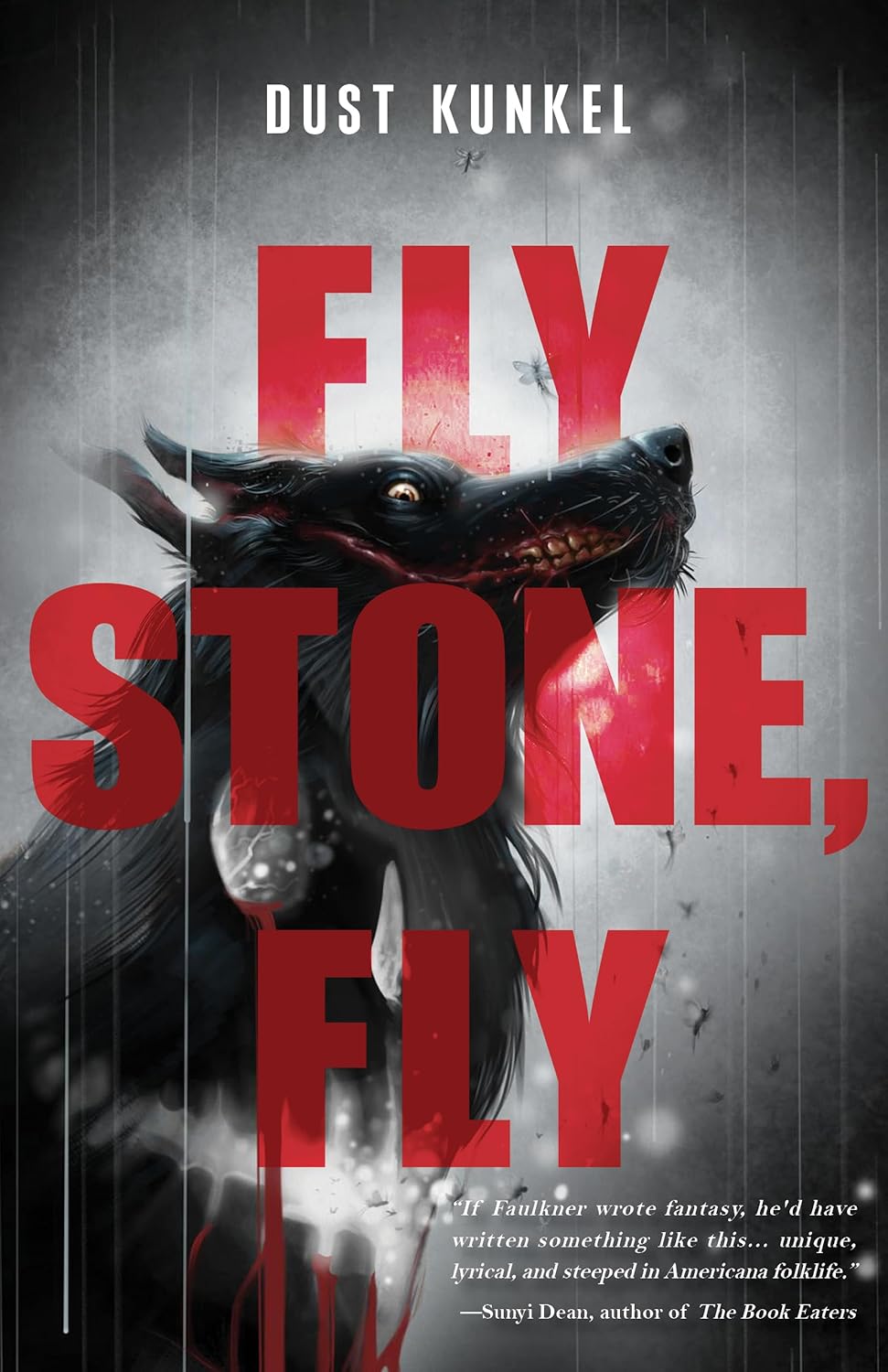

Fly Stone, Fly by Dust Kunkel is a feral, river-haunted dark fantasy about Clayton Bergmann, a boy left alone in the Idaho wilderness after his parents disappear, who grows into grief, prophecy, and revenge with a foul-mouthed dog named Dammit, a Shakespeare-soaked mind, and a family curse snapping at his heels. The story moves from survival tale to Western Gothic blood-feud, with Big Jim looming as both villain and nightmare, and with stoneflies, river water, old stories, and bad dogs carrying more meaning than they first seem to bear.
I admired how strange this book is willing to be. Its voice has burrs on it: funny, wounded, profane, lyrical, and sometimes gloriously overgrown. Clayton narrates like someone trying to lash a broken raft together while already in the rapids, and that urgency gives the novel its pulse. The Shakespeare references could have felt ornamental, but here, they’re weighty, private, and handled often. The book’s best passages do not merely describe wilderness; they make the canyon feel sentient, accusatory, almost liturgical.
What I enjoyed most was the book’s refusal to sand down pain into easy nobility. Clayton’s loneliness is not pretty. His friendships are not tidy. Dammit, Lina, MK, and the rest feel carved from contradictions: loyal and dangerous, comic and damaged, ridiculous and mythic. The novel’s maximal style asks for patience; it can wander and double back. But that excess is also part of its charm.
The target audience is readers who want dark fantasy, Western Gothic, revenge fantasy, mythic coming-of-age, and literary fantasy with a rough comic streak. Readers who like Neil Gaiman’s myth-in-the-modern-world sensibility or Stephen King’s gift for giving childhood terror a local address will find something kin here they enjoy, though Kunkel’s voice is more backwoods-baroque and river-drunk.
Pages: 498 | ASIN : B0DTDDG3T8

Shadows Amongst the Threads

Shadows Amongst the Threads is a haunting, soul-baring collection of poetry that plunges headfirst into the murky depths of the human psyche. Written by J.A. Santana, the book explores the concept of the “shadow” — that darker half of our personality Carl Jung warned us not to ignore. The poems are a tapestry of anguish, longing, introspection, and myth. The collection moves through surreal landscapes—withered forests, shadowy corridors, dreamscapes, and apocalyptic ruins—while reflecting on fear, identity, sin, love, and collective moral decay. Santana threads together classical references, psychological insights, and raw emotion, pulling readers deep into a world where monsters wear familiar faces, often our own.
I enjoyed how immersive and atmospheric the writing is. Santana’s voice feels ancient and modern all at once—like a lost prophet speaking in riddles. The rhythm and word choice at times feel Shakespearean or Biblical, yet there’s also a grounded emotional rawness in many of the lines. Some pieces like “Darkness,” “Doppelgänger,” and “Rain I” are unsettling in their vivid imagery but unforgettable in their truths. You can feel the poet wrestling with shame, existential dread, and an aching thirst for meaning. And it isn’t just gloom for gloom’s sake. There’s an undeniable urgency behind the words—as if Santana is begging readers to confront their own shadows before they become monsters.
The language, though beautiful, is dense. I found myself needing to take breaks, reread stanzas, and sometimes simply sit with the weight of it all. A few poems are abstract or metaphor-heavy, and the emotional intensity sometimes overwhelms the clarity. But even when it was hard to follow, I never doubted the sincerity. There’s a strange kind of beauty in getting lost in Santana’s bleak, lyrical universe. It’s not for everyone, but for those who’ve stared down their own darkness, it will feel eerily familiar.
Shadows Amongst the Threads is a collection that rewards patience and introspection. I’d recommend it to anyone who loves poetry that digs deep into the soul and isn’t afraid of getting their hands dirty. It’s especially powerful for readers interested in shadow work, trauma, mythology, and the emotional weight of existence.
Pages: 94 | ASIN : B0BKGZ6L6V
The Haunting of Wellsley Manor

Len Handeland’s The Haunting of Wellsley Manor is a gothic horror novel that follows William Martens, a young man seeking to escape the dead-end monotony of his hometown by attending Cornell University. But his aspirations are soon entangled in a series of ghostly encounters at his grandfather’s decaying estate in Ithaca. As he settles into his new life, William is haunted—literally and emotionally—by family secrets, unresolved trauma, and spectral figures that begin to cross the veil between the living and the dead. The deeper he digs into the house’s eerie history, the more he realizes that some legacies come with strings attached and blood on their hands.
I was drawn in from the very beginning. The dialogue felt natural and raw—sometimes even painfully real, especially during the tense moments between William and his bitter, emotionally distant father. There’s something incredibly satisfying about a story that doesn’t rush. The buildup is slow and deliberate, and that pacing works here. It lets you soak in the atmosphere—the creaking floors, the dusty corridors, the strained silences. The house itself becomes a character, and not just a spooky backdrop. What Handeland nails is the eerie tension between generational pride and inherited guilt. His prose has this honest, almost nostalgic warmth when depicting William’s relationship with his grandfather, Isaiah. Those moments hit me hard.
Sometimes the writing dipped into the overly descriptive, and while the story’s emotional arcs were compelling, the scares occasionally felt more atmospheric than truly chilling. I didn’t mind that too much—this is more The Sixth Sense than The Conjuring—but readers expecting non-stop frights may be left wanting. Still, the dream sequences and ghostly children were deeply unsettling in a quiet and lingering way. The mirror scenes especially gave me the kind of slow-building dread I love in horror fiction.
I’d recommend The Haunting of Wellsley Manor to anyone who enjoys a slower burn and emotionally rich storytelling. It’s a ghost story wrapped in a coming-of-age tale, laced with regret and second chances. If you liked The Others or even older Stephen King novels like Bag of Bones, you’ll probably enjoy this. It’s not just about ghosts. It’s about how the past clings to us, follows us, and sometimes, if we’re not careful, swallows us whole.
Pages: 236 | ASIN : B0DTBZNRV9

A Literary Hero

Dracula: Finding of a Shadow is a bold reimagining of Bram Stoker’s gothic masterpiece, presenting it as a stage play that mingles dark comedy, high drama, and an intriguing exploration of vampiric lore. What were some ideas that were important for you to share in this book?
Dracula – is one of the most successful heroes of mass culture, who came to us from the pages of the famous gothic novel by Bram Stoker “Dracula”, written over 125 years ago. This book (“Dracula: Finding of a Shadow”) is dedicated to the image and character of Dracula: how it was formed, how it has transformed over the years, its future, and further development in the world of literature, film, and theatre.
Did you find anything in your research of this book that surprised you?
In the recently discovered Bram Stoker’s diaries and notes, published by the great-grand-nephew of the famous author – Dacre Stoker, I have found for myself a number of answers to questions about how this literary hero was born, why the author awarded him particular characteristics and qualities. I’ve also discovered information about Bram’s attitude towards theatre in general and the staging of his novel in particular. You can read all about it in the Foreword, written by Dacre Stoker himself, and also in the exclusive interview with Dacre included in the book.
In my original play “Dracula: Finding of a Shadow” the character of Count Dracula is presented as a collective image, based not only on the original novel by Bram Stoker, but also the prequel and the sequel, co-authored by Dacre Stoker, who used Bram’s notes and diaries to create them.
What is the next book that you are working on, and when will it be available?
My next book – “Teach Me How to Die. A Novella and Other Stories” – is currently being published. It is my first prosaic experience. The novella “Teach Me How to Die” is dedicated to a very important issue of our time – suicide and its prevention. I believe the book will be released this summer.
Author Links: GoodReads | Facebook | Website | Instagram
as the 175th anniversary of its author, Bram Stoker. In the foreword, written by the great-
grandnephew of the writer, Dacre Stoker, we discover that Bram Stoker worked in theater, loved
theater, and was inspired by the dramatic art. Dacre’s exclusive interview introduces the results
of his detective-research of various documents and Bram’s personal journals and notes — all of
the many discoveries led to the creation of the prequel, Dracul, and the sequel, Dracula the Un-
Dead.
Lisa Monde’s play Dracula: Finding of a Shadow was inspired by the original novel by
Bram Stoker, as well as both – the sequel and the prequel. The play had several Off-Broadway
productions. This current edition also includes an original play by the guest-playwright Thomas
R. Gordon – Dracula: Bloodlines. Both plays premiered at the Gene Frankel Theater in New
York City.
Over ten years ago, Lisa published her first scientific article on the evolution of the image
of Dracula in literature and art. Besides the plays, two essays by Lisa Monde are also included in
this book, both shedding light on the mystery of the birth of the stellar literary character and the
evolution of the image of Dracula.
In the Epilogue, Lisa summarizes the stages of the path traversed by Dracula in literature
and other types of art, as well as shares her ideas on Dracula’s future.
Dracula: Finding of a Shadow


Dracula: Finding of a Shadow is a bold reimagining of Bram Stoker’s gothic masterpiece, presenting it as a stage play that mingles dark comedy, high drama, and an intriguing exploration of vampiric lore. Through layers of theatricality and clever dialogue, the book serves as both a tribute and an expansion of the Dracula mythos. It’s packed with eccentric characters like the sultry vampiresses and the enigmatic Alucard, blending modern humor with classic gothic intensity. The narrative weaves moments of levity and horror, making it an unconventional but engrossing continuation of the Dracula legend.
One of the main values of this anthology lies in its deep study and research into Dracula as a subject, meticulously carried out by the author. This commitment to exploring the Dracula mythos elevates the work beyond mere storytelling. The book is enriched with an interview featuring Dacre Stoker, the collector and keeper of Bram Stoker’s literary legacy. This fascinating addition offers insights into the theatrical potential of the novel and the importance of theater in Bram Stoker’s life and work, making the anthology not just a play but an immersive dive into the world of Dracula.
The anthology also includes two thought-provoking essays that delve into the origins of Dracula as a literary character and his enduring legacy in cinema, theater, and musical theater. These essays give readers a unique opportunity to see Dracula from multiple perspectives: his birth, evolution, and lasting cultural impact. This exploration of Dracula’s image across different mediums adds layers of context and richness to the experience, allowing fans to appreciate the depth and breadth of the Count’s influence.
At the heart of the anthology is the play Dracula: Finding of a Shadow, which draws inspiration not only from the original novel but also from the prequel and sequel written by Dacre Stoker. The play captures the essence of the gothic classic while blending it with contemporary themes and dramatic innovation. The Epilogue offers a visionary take on Dracula’s future, presenting him as one of the most successful heroes of mass culture over the last two centuries, a perspective that feels both fitting and ambitious.
What struck me first about the play itself was its playful tone, especially in the scenes featuring the vampiresses. Their banter about trivialities like fashion or misunderstandings of modern vocabulary adds a quirky charm that offsets the brooding atmosphere. One particularly memorable scene was the Tango sequence between Dracula and Mina. It was strange and theatrical, but it effectively captured Dracula’s hypnotic allure while also hinting at his underlying vulnerability. These creative choices kept me entertained.
The character of Alucard is a standout. As Dracula’s estranged shadow, his mix of resentment, mischief, and strange loyalty gave him depth. His philosophical musings about shadows and freedom resonated with me more than the main plot.
Dracula’s raw, unyielding yearning for his lost love, Elisabeta, remains compelling. Lines like, “I wanted to forget her, but she comes to me once again,” highlight his tragic romanticism and elevate the character beyond a stereotypical villain. Yet, I couldn’t help but wish the script balanced these emotional beats better.
While I appreciated the modern twists, some elements felt overdone. The vampiresses’ slapstick antics and their convoluted schemes occasionally derailed the tension. At times, I wanted the story to focus more on Mina and Jonathan’s arc. Their rushed wedding at a corrupted church was both eerie and heart-wrenching, especially with the subtle hints that Father Dominic might not be human. That scene was masterfully creepy, though it left me craving more development of Mina’s perspective and her growing ties to Dracula’s world.
Dracula: Finding of a Shadow is for fans of gothic theater who enjoy modern flourishes and a bit of camp. It’s a work that doesn’t take itself too seriously but still delivers moments of intrigue and poignancy. By including not just the play but also essays, an interview with Dacre Stoker, and a rich examination of Dracula’s influence across art forms, the anthology becomes a must-read for anyone fascinated by the vampire legend. If you love quirky reimaginings with the freedom to not always stay true to the source material’s tone, you’ll likely enjoy this.
Pages: 220 | ASIN : B0CN9QNSSZ
Ashes

Alice Reaper’s past clings to her like a shadow. Ever since the haunting night at the funeral home, her life has been consumed by nightmares and the oppressive weight of unseen terrors. Isolated from those she once loved, Alice resigns herself to a life devoid of joy or peace. But when Viviana enters her world, a glimmer of hope cuts through the darkness. For a moment, everything feels possible—until it doesn’t. Can Viviana pull Alice from the depths of despair, or will the shadows swallow her whole?
Ashes, by David Edgar Grinnell, is an evocative exploration of grief, despair, and the journey toward healing. Told in the raw, intimate perspective of first-person narration, readers experience Alice’s turmoil as if it were their own. Her father, Oscar, and other supporting characters add layers to the narrative, showing the different ways people live with—and sometimes succumb to—trauma. Grinnell doesn’t just present pain; he holds a mirror to it, reflecting its complexity and its power to shape lives.
While Ashes dives deeply into themes of sorrow and loss, it offers solace to readers who see their struggles mirrored in the characters. Tarot card readings and philosophical exchanges between Alice and Viviana provide moments of introspection and guidance, carving a path toward hope. The story is as much about finding light in the dark as it is about acknowledging the darkness itself.
Grinnell deftly weaves elements of Gothic tradition, paganism, and tender romance into the narrative, adding depth and dimension to the story. Viviana, with her Gothic charm and fascination with the dark arts, brings an air of mystery and intrigue. Though the spark between Alice and Viviana feels sudden, their unfolding relationship is both poignant and deeply satisfying. The romance balances the novel’s weightier themes, offering warmth and connection amid the bleakness.
One of the novel’s standout features is its cast of characters. Despite their youth, they carry a profound sense of wisdom. Their voices resonate with thought-provoking reflections, often quoting classic literature in ways that feel both meaningful and natural. These moments of insight elevate the story, offering readers not just entertainment, but inspiration.
At its core, Ashes, by David Edgar Grinnell, is more than a tale of grief—it’s a story of resilience, hope, and the transformative power of love. Readers drawn to Gothic themes, explorations of mental health, or heartfelt LGBTQ+ romances will find much to cherish in this beautifully crafted novel. It’s a reminder that even in life’s darkest moments, there’s a chance to heal and move forward.
Pages: 368 | ISBN : 978-1736867587


