Blog Archives
The Map Colorist
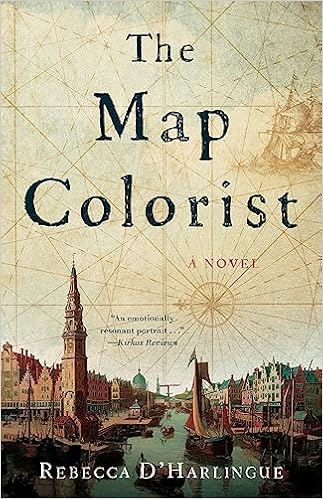

“The Map Colorist”, penned by Rebecca D’Harlingue, is a remarkable historical narrative that intricately portrays the life of Anneke and her family, nestled in the heart of seventeenth-century Amsterdam. Anneke, born into a family of mapmakers and colorists, is captivated by her father’s youthful tales of African explorations and develops a yearning to map the enigmatic African continent herself. This family of map artisans, nestled in the close quarters of their Amsterdam abode, experience a shift in dynamics when Anneke’s extraordinary talent earns her a coveted position at the esteemed Baleau map printing firm. Anneke’s journey henceforth, marked by her employment under the affluent Willem de Groot, spirals into a labyrinth of deceit, with ramifications that reverberate throughout her family.
D’Harlingue masterfully captures the ambiance of the period, fostering a strong emotional connection between the reader and the naive yet ambitious Anneke, with her forbidden aspirations of joining the male-dominated profession of mapmaking. “The Map Colorist” is thus a captivating read for enthusiasts of historical fiction, as it artfully intertwines the personal with the historical.
This breathtaking novel effortlessly earns a full five-star rating. D’Harlingue’s narrative prowess shines as she evokes empathy and investment in her beautifully fleshed out characters, along with their aspirations, triumphs, and tribulations. This subdued, yet potent tale will resonate with discerning readers, particularly those with a penchant for rich historical detail. The Dutch setting may remind some of “The Miniaturist” by Jessie Burton, yet “The Map Colorist” carves out its unique narrative trajectory.
My singular critique is that I wished for a more extensive exploration of Amsterdam’s bustling city life. This would allow readers to truly immerse themselves in the vibrant streets amidst the prosperous merchants. The compelling narrative arc leaves readers on tenterhooks as they wonder whether Anneke will fulfil her dream of creating a map or have her aspirations crushed under the weight of a tumultuous world riddled with adultery, murder, and duplicity.
Pages: 312 | ASIN: 1647425476

A Moment of Life

In his compelling historical romance novel, “A Moment of Life,” Pavel Mahdjik transports readers to a pivotal instance in time when two souls unexpectedly discover love and passion.
Set against the backdrop of Victorian England, Lady Helen and her husband, the youthful Lord Albert Granville, consciously take the time to unfold the layers of their personalities, delving into crucial conversations that redefine their relationship. From the sanctuary of their expansive balcony, amidst the grandeur of their ancestral abode, the young couple boldly embarks on a journey of self-discovery and mutual understanding that transcends their immediate environment to explore the quintessential facets of existence. Despite the bond of matrimony, their relationship stands on the precipice of unfamiliarity, an abyss they courageously cross to uncover compatibility, shared beliefs, and the seeds of lasting intimacy.
Mahdjik’s intent is lucidly articulated right from the onset of this concise narrative: to elucidate the significance, beauty, and invigorating energy embedded in life’s seemingly trivial moments. The protagonists, Lady Helen and Lord Granville, engage in a poignant dialogue that serves as the pulse of this novel, contemplating their personal histories, emotions, and passions. As the veil of guarded vulnerability lifts, a profound connection emerges, casting the couple in a fresh, illuminating light and revealing a hitherto unseen beauty shrouded within the commonplace canvas of life.
“A Moment of Life” provides an immersive platform for readers to intimately acquaint themselves with the main characters, decipher their fundamental beliefs, and relive pivotal life moments saturated with a spectrum of intense emotions, from love and passion to fear and shame. The characters’ introspection of past reactions fosters a shared understanding, a cathartic process that paves the path towards self-forgiveness, emotional healing, and personal growth, fortifying their bond as a couple.
Mahdjik’s narrative style is brisk yet absorbing, with a central discourse that can comfortably be savored in a solitary reading session. The dynamic interplay of dialogue not only captivates readers but also actively encourages them to partake in the philosophical exploration of personal experiences, relationships, and life in its entirety. “A Moment of Life” captures the essence of simplicity, inviting us to appreciate the nuances of mundane interactions and daily life, gradually steering us towards a realm of serenity, tranquility, and profound bliss.
Pages: 111 | ASIN: B0BXLYN58J
Bucharest Legacy: The Rise of the Oligarchs

The Bucharest Legacy by William Maz is a riveting and captivating novel that delves into the aftermath of the Romanian revolution, a momentous event in the nation’s history as it fought to liberate itself from the grip of Communism. Set three years later, Romania is experiencing a transformation, yet it remains plagued by deep-seated corruption and treacherous power plays within its leadership.
Protagonist Bill Hefflin, whose life has settled into a tranquil existence following his instrumental role in the Romanian revolution, finds himself thrust into a whirlwind of unforeseen circumstances when he embarks on a new mission, his second in just three years. As he embarks on this perilous journey, he stumbles upon dangerous intelligence that casts suspicion on his mentor and close friend, Boris. This revelation not only jeopardizes Hefflin’s credibility within the agency but also places his life at risk as he becomes entangled in the web of accusations, branded a potential mole. Nonetheless, Hefflin possesses privileged knowledge about Boris that eludes others.
In its entirety, The Bucharest Legacy unravels an exhilarating narrative that centers around the relentless pursuit of a double agent in a world defined by falsehoods and duplicity. Its pages are imbued with an irresistible sense of excitement, effortlessly guiding readers through the unfolding events. A notable example is the gripping opening scene that introduces Hefflin’s character, showcasing his resourcefulness and adaptability in carrying out his duties. Throughout the book, an ever-present atmosphere of suspense keeps readers on the edge of their seats, while the author, William Maz, deftly handles the substantial amount of information, skillfully weaving it into the narrative. The plot is enriched by a plethora of surprising twists and turns that continually captivate and engross the reader, making it exceedingly difficult to put the book down.
The Bucharest Legacy stands out as an exceptional literary work that demands recognition. It is a must-read for enthusiasts of historical and suspenseful literature, offering a mesmerizing glimpse into a captivating era.
Pages: 433 | ASIN: B0B92V82GK
For All Of Us To Contemplate

A Story follows an amateur paleo-archeologist who discovers an ancient tiger skin with mystical properties that imparts to him the story of two early hominids. What was the inspiration for the setup of your story?
The setup for the story reflect a life long fascination with ancient artifacts. Although I have spent a good deal of my life outdoors, I have only found two arrowheads. The one on the cover the book and another smaller one I lost many years ago. I don’t go out on arrowhead hunting trips, I found them purely by chance. I am a geologist by training and spend lot’s of time outdoors. Over the years, I developed a passion for our ancient world. As we have begun to unfold our genetic code, I see the powerful linkages in our species and the path of evolution as our planet evolved. It is remarkable to me how nature has charted our genetic path. I wanted to frame the story of something that was tangible. Human nature, being what it is, is more tangible than we realize. I wanted to frame the story to be something more real than fiction based on what we observe and what traces of humanity we can find. Ancient tools, dwellings, and paintings give us the roots of our ancestry. Hamster Dunnigan, the protagonist in the beginning of the story, is symbolic of our human curiosity and the powers of good and evil. I wanted to project him as an anti-Indiana Jones who find redemption by sharing the story he tells and the physical similarities he shares with the characters in the story. Finding ancient artifacts is both good and bad, depending on what you do with them. A good example of this is Dr. Lee Berger of the University of Witwatersrand in South Africa, Taylor McCoy of Eastern New Mexico University, Dr. Leaky, Dr. Jane Goodall, and so many other researchers that share their findings with the world and helped frame “A Story” for all of us to contemplate. We humans are more than the sum of our parts and awareness of this fact is important to understand. I am trying to make that connection. But…this is just “A Story” to reflect on.
With the early hominids having different cultures and communication skills it was interesting to see their interactions. What was your approach to writing the interactions between characters?
We all share common traits and abilities. In my mind, the evolving brain was capable of lots of things we no longer access. Just as we have physically changed through evolution the changes of course include our brains. I use the term evolution loosely. I think it is totally possible that we carried lots of abilities to communicated purely by intuitiveness and understanding survival in a world and environments today’s humans would find extreme. Using what assets we have (and still carry with us, such as being able to make vocal sounds and using parts of our bodies to communicate,) has been a trait we carried and used since early evolution in our species. It is the same with all of the animal phylum and plants phylum as well. We all use the assets we have. It is a matter of survival.
What were some themes that were important for you to explore in this book?
Racism was one theme. In my book, the fact that the reader will not have to acknowledge race, because it did not matter, should resonate behind the scenes. Just because I did not say it specifically, one should view the interactions of the characters with a sense of bonding. Each one of the characters should reflect an emotional and physical linkage we all share. The characters should reflect an awareness of self, others, and spirituality. That includes shamanism, our earliest adventures into our sub-conscience mind and religious awareness. The discovery of Homo Naledi and research on those remains will open doors to so many possibilities and question connection to our ancient ancestors. We are more alike than different. We always will be, so stop the stupidity of thinking we are different just because of our skin color.
Will there be a follow-up to this story? If so, what aspects of the story will the next book cover?
Yes. But in truth, it depends on how this book is received. I have several aspects of the story that dive deeper into our collective past and the manifestation of our self-awareness, and cultural similarity. For example, what made an early hominoid successful and how did that genetic mutation present itself in our earliest ancestors lineage? My belief is that it was based on spirituality and not necessarily the strongest or the fittest. There is a story around that and I think it generates a lot of questions ripe for creative thought. But don’t misunderstand me. We are all unique individuals and I totally respect our ability to think freely and become contributing members of our planetary community. We should embrace our subtle differences, and embrace our collective humanity.
Author Links: GoodReads | Twitter | Facebook | Website
As the story evolves Noolan and Caek are two competing species of early hominoids, but separated from their clans, they depend on one another and become emotionally attached. Journey with them through many harrowing events as they try to reunite with their families. Making their way through an unrelenting environment with determination and grit, they grow closer together and closer to their ultimate enemy, the Jakkar. It is only through an intuitive power, deeply honed survival skills and a bit of luck that these two craftly and cleverly overcome the odds. As you get to know Noolan, Caek and their clans, you’ll reconsider what you thought you knew about our early ancestors.
The genesis of problem-solving abilities and what may happen with earlier hominoid ancestors demonstrates they were a lot smarter than we give them credit for. It was a human who created the wheel, and prayer and relational understandings.
Pulling The Lens Back

Transformation Summer follows a teenage boy into adulthood who reflects back on the experiences he had at a camp and how those experiences impacted his life. Where did the idea for this novel come from?
This is probably going to sound like something out of a paranormal/sci-fi TV series, but it really did happen: One winter morning, I was returning to Boston from a visit to upstate New York and driving east on the Massachusetts Turnpike through the Berkshires. There’s usually not much traffic on that part of the Pike, certainly not at that time of day, so you can kind of unlatch your brain. And I just had a flash of inspiration, of two people having an encounter of some kind in one of those wooded mountain vistas I was seeing through my windshield.
I couldn’t even tell you what that original “flash” entailed, because I immediately started trying to pin it down, pulling the lens back to lend more context. Who are these people? Why are they there? How do they know each other? I just kept going through different possibilities and scenarios.
By the time I got to Worcester – roughly 45 minutes from my exit – I’d hammered out some basics: These were two people at an all-ages camp of some kind, not an ultra-wilderness setting or a vacation resort but a locus of activity with a purpose to it. Yet I didn’t want this camp to be affiliated with a specific organization or faith tradition or behavioral/personal-growth philosophy, either. I thought of it as being a grassroots, DIY-driven initiative that drew people from many different backgrounds.
In the weeks that followed, I decided the story would work better as a memoir, of somebody – Seth, our protagonist – remembering his time in that place (I thought “Toward Transformation” was a good 1970s kind of name for it) when he was a teenager; and that this experience was during a period of great emotional upheaval for him. Seth had not gone there willingly but at the behest of his mother, and at the outset was very skeptical about the whole business. And years later, he’s still trying to process it.
Was there anything from your own life that you put into the characters in your novel?
Not specifically, although I do remember the 1970s (when, like Seth, I was in my teens) as being awash in various personal growth-type programs and opportunities. You’d read or hear about them through TV, movies, magazines, or word of mouth, and it’s fair to say it wasn’t just “hippies” or people into alternative lifestyles who were involved, but middle-class Americans, too.
That said, I did reflect on the weekend youth programs I’d participated in as a teenager that were run by the Quaker meeting my mother and I attended (just to clarify, I did not formally become a practicing Quaker). At these programs – which dealt with aspects of personal growth – you’d see a lot of the same people, develop friendships or closer relationships over time, and you’d have your shared customs, rituals, in-jokes, etc. You also cultivated a set of behaviors and expectations around these gatherings: unlike at school, you felt you could truly open up and “be yourself,” and not suffer any consequences.
So I thought of those programs as the essence of an “intentional community,” a concept we normally associate with, say, housing cooperatives, collective households, communes, and the like. But I stretched the definition to include those instances in which we withdraw, temporarily, from the larger world into a setting that is its own ecosystem: a camp, a retreat, even an annual music festival.
So that’s how I envisioned Toward Transformation, and how Seth experiences it. In fact, he sees that the kids there his age, most of whom have been attending since they were in grade school, have formed their own intentional community within the larger adult one. Even as he’s struggling with his issues, and is wary about his mother’s involvement in Transformation, he’s intrigued by what he observes around him.
What were some themes that were important for you to explore in this book?
Certainly one theme concerns the hold that a memory can exert on us, even years after the fact. And implicit in this is the question, can a memory become an end in itself, ultimately more important than the actual people, places, or events it evokes? Can a memory keep us from moving on, moving forward, even as it enriches us?
Another salient theme in the book is how, at some point in our youth, we come to realize that adults – especially including our parents – are fallible, imperfect, even vulnerable. We may find this revelation perplexing, unsettling, and empowering, maybe all at the same time. That’s certainly true for Seth and some of the other characters in the book.
Yet another theme relates to what I said about intentional communities, specifically those that are formed around short-duration gatherings: After you’ve gained some fresh insights and ideas, or you’ve simply reveled in being in the company of like-minded others, how do you go back to the real world? Can you incorporate the qualities of that special community, that experience, into your everyday life? If you try to explain what it was like to a co-worker or classmate, will they get it?
This theme is more in the background, but I think it’s also worth considering: the downfall of a unified vision, of consensus. Through Seth, we can see that things are starting to come apart at the seams at Toward Transformation. People are expressing dissatisfaction with the camp’s direction or questioning some of its basic tenets. There’s also the suggestion of more deep-seated differences, notably in personal beliefs and political outlooks, that may further jeopardize its future. Was all this inevitable? Is there a way ahead?
What is the next book that you’re working on and when can your fans expect it out?
Well, I have two unfinished novels, one of which I started before Transformation Summer. That particular one is about a young man fresh out of college who goes to work at a weekly newspaper in early/mid-1980s Central Massachusetts — which, by an amazing coincidence, happens to resemble my life trajectory. It’s a coming-of-adulthood story, I suppose, exploring how we become our own, independent selves, however tentatively or shakily. I also try to depict the days and works of a small-town reporter in what now seems — sadly — like a long-ago-and-far-away era for journalism. I really want to finish that one, and I’m about two-thirds of the way through; I just have to decide how happy I want the ending to be. Wish me luck.
The other unfinished novel is a love story set in early-1980s Boston, which is where I lived while finishing up my undergraduate degree – another incredible coincidence. I already have the ending figured out, more or less, so I have to clear the path that will get me there.
I also took a short story I’d written and expanded it into a novel; technically, it’s finished, but I think I want to go back in and make some changes, because it has some similar elements as Transformation Summer (e.g., 1970s teenage boy with divorced parents). And believe it or not, I recently started mulling over an idea for another novel; I’ve tried to chase it out of my metaphorical yard, but the idea keeps coming back to the door.
It would probably be easier to pursue these various projects if, you know, I didn’t have full- and part-time jobs, both of which involve writing. But then again, I never – and I mean never – expected to finish writing, let alone publish, a book. Yet here we are. I welcome any and all encouragement.
Author Links: GoodReads | Facebook | Website
But Seth finds unexpected camaraderie with other kids there: brash, self-appointed leader Rafe; gorgeous, daunting Diana; quirky, endearing yet unsettling Morgana; and enigmatic Grace, with whom he forges a strong, emotional connection. He’s also heartened, intrigued and sometimes disturbed by what he encounters at Transformation, which after 10 years is showing signs of dissension among its participants. Well into his adulthood, Seth continues to process what happened during those two weeks at Transformation, and long afterwards.
Sean Smith’s Transformation Summer is not just a coming-of-age novel, but an exploration of how we experience memories of youth — from the perspective of accumulated years and wisdom, or as if we were still that same young person trying to make sense of the world. This poignant and thought-provoking book invites readers to consider the enduring influence of our past experiences on our lives.
Three People, Three Countries, One Path
In Three People, Three Countries, One Path, Cara A’Court demonstrates exceptional prowess in crafting an adventure-filled narrative that deftly evokes a myriad of emotions within its readers. It is the hallmark of a truly talented author to elicit a genuine emotional response, and A’Court undeniably achieves this feat. I found myself engrossed in the book to such an extent that it demanded more time and attention than most others I have had the pleasure of reviewing. As an ardent reader, I reveled in this immersive experience.
The author masterfully weaves together various elements, including mystery, suspense, and revelations that elicit awe, particularly when delving into familial matters within the intricate tapestry of the settings. What truly left an indelible impression on me was the author’s skill in showcasing how even those we perceive as spiritually enlightened individuals grapple with the mundane concerns of everyday life. Ms. A’Court reminds us that life shows no partiality, irrespective of one’s status. If there lies a destined path waiting to be traversed, it matters not who or what the individuals are; the journey will unfurl before them.
Three People, Three Countries, One Path is a remarkable literary work that seamlessly blends adventure, emotion, and profound insights. Cara A’Court’s writing style resonates deeply, tugging at the reader’s heartstrings and provoking introspection. This book stands as a testament to the author’s mastery of her craft, leaving an indubitable impact on anyone fortunate enough to embark on its pages.
Pages: 327 | ASIN: B0C412ZZXB
A Dream From Years Before

The Hunt for The Peggy C follows a merchant ship captain who agrees to help a Jewish family escape Amsterdam during WWII. What was the inspiration for the setup of your story?
Strangely, the inspiration for the novel was a dream from years before. When my daughter Allison was young, we watched a terrible action-adventure film together — I don’t remember which one — and I kept telling myself I could write a better screenplay. That night I had a dream, and when I woke up, I knew the first and last scenes and the name of the ship. That was all.
So, like Michelangelo used to say, I knew there was a figure in that block of stone — in my case, a story — and all I had to do was spend years trying to chisel it free. The “Hunt for the Peggy C” screenplay and other scripts and TV pilots I wrote attracted some interest in Hollywood but no sales. So, when Covid hit, and my wife Margo and I were stuck at home, I decided it was time to live up to the dream that had been the reason I had become a journalist: to learn how to write so I could become a novelist.
Miriam is a woman with strength. What do you think makes her a valuable and worthy heroine?
Miriam, the oldest daughter of the Jewish family being rescued, was a medical student until the Nazi-occupiers kicked all Jews out of universities. She is a bookworm–like our hero and her love interest, Captain Jake Rogers–as well as a healer who is frustrated by men’s cowardice. She is the moral backbone of the story and the one who has to courageously save Jake and the others
What were some themes that were important for you to explore in this book?
There is a fine line between honor and immorality. Does doing your duty and fighting for your country mean there is no limit to the atrocities you can commit? Does not doing your duty and defending your country mean you are a coward? And what are you if you refuse to make a choice and remain indifferent? The bottom line is that it takes real courage to do the right thing.
What is the next book that you are working on and when can your fans expect it to be out?
I stunned myself when I immediately started writing a sequel after selling The Hunt for the Peggy C to Bancroft Press. I was even more stunned when I finished what I’ve titled “Captain Rogers’ Long Watch,” which will be published by Bancroft Press in October 2024. I am now working on the third volume with many of the same characters in different phases of World War II.
Author Links: GoodReads | Twitter | Facebook | Website
The normally aloof Rogers finds himself drawn in by the family’s warmth and faith, but he can’t afford to let his guard down when Oberleutnant Viktor Brauer, a brutal U-boat captain, sets his sights on the Peggy C., Rogers finds himself pushed to the limits of his ingenuity as he evades Brauer’s relentless stalking, faces a mutiny among his own crew, and grapples with his newfound feelings for Miriam, the young Jewish woman whom, along with her family, he must transport to safety.
When Rogers is seriously wounded, Miriam must prove she is as tough as her rhetoric to save everyone as the U-boat closes in for the kill. THE HUNT FOR THE PEGGY C is a masterpiece laced with nail-biting tension and unexpectedly heartwarming moments that any reader, not just fans of naval fiction, will enjoy.
The 12 Days of Christmas and a Pirate

The Lost Books: Romance and Adventure in Tudor Times follows a squire and his friends who set out to recover stolen books and take down the corrupt taxman. What was the inspiration for the setup of your story?
The idea for this novel began with a “prompt” from one of the writing workshops I attend. The (optional) prompt was to write about a holiday song. This did not interest me and I was prepared to write on another topic.
Wait a minute, I thought; what if I have some fun with a song, turn it on its head? That appealed.
I decided on the song “Twelve Days of Christmas.” I would set my story in Tudor Times. I imagined a love-struck swain, young Henry Truelove, wooing his heart’s desire, Morwenna Goodwin, with cartfuls of partridges, waterfowl and other presents that, as it turns out, are unwanted and burdensome.
Soon, Morwenna’s small farm in Cornwall is awash in bird squawks. Morwenna demands that Henry desist sending the birds, though she is willing to keep the gold coins with which to buy a pig for the small free-hold she runs with her Ma and Da.
Henry is undeterred in his determination to win her. But she is of an independent mind, and he will have to go to great lengths to convince her to marry him – or to marry anybody.
This part of the story was fun to write. Soon I began to fall in love with my characters and imagine what their larger lives might hold. I have always enjoyed reading about Tudor times – but most of these books are about royalty and court life and intrigues. I wondered what else was going on, for the more common folk.
One thing that was going on, egregiously so, was the seizure of the monastery and convent lands and goods by Henry VIII, their subsequent destruction and – this is where my heart became engaged – loss of thousands of precious illustrated manuscripts preserved in these holy houses. Fortunately, not all the books were lost and so have come down to us in present times.
I envisioned the rest of my story as a hunt to find and save the holy books. Morwenna, Henry, old Tom who has been cast out of his monastery; Hilda, uprooted from her convent; a former pirate and a gaggle of milkmaids become the “holy pirates” sworn to save the books.
What were the morals you were trying to capture while creating your characters?
I see in my characters courage, determination, and ingenuity – this despite the oppressive laws of the times and, often, terrible events.
Friendships and family sustain them. While royal families are involved in intrigue and murder, these characters love and support their families, and become a kind of found family to each other.
The Tudors were obsessed with religion. While religious issues are being fought about at court, with nobles losing their heads, the holy pirates try to reason out what is best to do in any circumstance. When some of their efforts to protect the holy books stray over the line, such as purloining the ledger of an unscrupulous taxman, they decide to do what tends toward the greatest “good.” They have faith in God, but theirs is a practical, rather than dogmatic or political, religion.
Friendship is another strength of my characters. It is the offer of friendship that wins over the nefarious tax collector Godfrey Blount. He makes friends among the holy pirates. And, he learns to dance.
In a time when one’s given station in life was set in stone – commoners were forbidden to wear fancy clothing, so as not to appear above their station – these holy pirates are equals in their mission. They use their wits, their artistry, friendship and faith in their mission to prevail.
What kind of research did you do for this novel to ensure you captured the essence of the story’s theme?
I have read many popular books about the Tudor era, such as those written by Philippa Gregory, Hilary Mantel and others. I have seen the many Tudor-era films and series. I also ferreted out more scholarly books about the times, such as The Hidden Life of Tudor Women, by Elizabeth Norton; Black Tudors – An Untold Story, by Miranda Kaufmann; and Tudor Cornwall, Portrait of a Society, by A.L Rouse. Writing in the era of Google makes research so much easier, as well.
My most important and influential resource is a large, beautifully illustrated book, The Smithsonian Book of Books, by Michael Olmert. This is among the most treasured books in my own library. It describes in detail how these early illustrated manuscripts were made and who made them. The book is lavishly illustrated with dazzling photos of pages from the illuminated manuscripts.
What is the next book that you are working on, and when will it be available?
I am working on a sequel to The Lost Books, featuring the same characters and some new ones. The precious books come under additional threat, which marshals the holy pirates once again to their defense.
There is more romance, and more about life in Cornwall in Tudor times. I cannot seem to let these characters go.
Author Links: GoodReads | Facebook | Website
Squire Henry Truelove of Cornwall, hero of this novel, has simpler ambitions: to win the hand of his reluctant ladylove, Morwenna. But life takes a bad turn for the squire when his family’s estate faces ruinous taxation. Truelove and his friends form a band of “holy pirates” to bring down the corrupt taxman, and to rescue the precious lost books.
This tale of tumultuous Tudor times will especially please readers who enjoy little known histories and interesting language. The narrative is often lighthearted, with amusing repartee. The mission of the Holy Pirates, though, is vital and dangerous — to save the precious books and their own skins.



 LITERARY TITAN