Blog Archives
The Savior and the Shadow Queen: A Fantastical Tale Told Through Sequential Poems


The Savior and the Shadow Queen is a story told through poetry, unfolding in layers that mix fantasy and raw human emotion. It begins as a mythic tale of Eselli and Nabseatsi, two friends who set out to defeat a terrible enemy called the Shadow Queen. Their world feels ancient and mystical, full of prophecies, weapons, and dark magic. But as the story progresses, that fantasy begins to fade, and the truth emerges. Eselli is Leslie, a young woman living in the real world, grappling with grief, guilt, and the haunting weight of loss. The Shadow Queen becomes something much deeper than an external enemy; she is the darkness inside us all, the reflection of our pain and self-hatred.
McAfee writes with such openness that it’s hard not to feel what Leslie feels. Her pain, her confusion, her desperate hope for healing, it all comes through in the rhythm of the poems. The fantasy world works beautifully as a metaphor for mental illness and self-discovery. I loved how the story shifts from myth to memory, from sword and prophecy to hospital rooms and recovery. That transition hit me hard. The writing itself is simple, almost deceptively so, but it carries deep emotion. It’s the kind of poetry that doesn’t need fancy words to make you feel something, it just does. The pacing feels natural, the imagery vivid, and the emotions raw enough to make you pause and sit with them.
I could feel the compassion in McAfee’s voice. The book doesn’t wallow in sadness, even though it’s born from it. It offers forgiveness, for oneself, for others, for the past. I appreciated that McAfee didn’t sugarcoat the pain, yet she gave it meaning. The real-world sections are written with quiet strength. There’s hope tucked between every line, and I found myself rooting for Leslie as if she were someone I knew. The author’s choice to end the book with a direct message to the reader was perfect. It felt intimate, like a friend reaching out to say, “You’re not alone.”
I’d recommend The Savior and the Shadow Queen to readers who loved The Alchemist by Paulo Coelho. Both books explore inner transformation through journeys that seem external at first but reveal themselves as deeply personal. Like Santiago’s search for his treasure, Leslie’s quest to defeat the Shadow Queen becomes a metaphor for finding meaning after loss. But where Coelho’s story leans on destiny and spiritual discovery, McAfee’s feels more grounded in real emotion like grief, guilt, and the slow rebuilding of self-worth.
Pages: 102 | ASIN : B0CH411ZSP

AmerAsian: My Journey to Becoming Whole as a Mixed Korean-American

Kimberly McAfee’s AmerAsian is a heartfelt collection of poems that moves through childhood pain, cultural confusion, and the long climb toward self-acceptance. The book unfolds in three sections: The Beginning, An Emotional Journey, and Sweet Self-Acceptance. Each poem reads like a small window into McAfee’s soul. Through vivid imagery and references to Korean folklore, mythology, and family memories, she traces her path as a biracial woman learning to embrace both halves of herself. The voice is deeply personal, sometimes tender, sometimes raw, always honest. By the end, what began as a record of struggle becomes a love letter to identity, belonging, and transformation.
Some poems stung with their simplicity, like Monsters Within and My Collection, which capture the ache of growing up different in a world that craves sameness. Others, like A Bittersweet Return and Dokdo, filled me with quiet awe, showing how home can be both a place and a feeling. McAfee’s words don’t hide behind complexity. They’re plain, heartfelt, and striking because of that. The mix of personal reflection and mythological imagery made me pause more than once.
What stayed with me most was her voice. It’s gentle yet unflinching. She doesn’t pretend the road to self-love is easy. She admits to doubts, to shame, to hoping that a plane ride to Seoul might fix what was broken. It didn’t, and that honesty hit hard. When she finally finds peace in her own identity, the relief is contagious. I loved that she never forces resolution. Instead, she lets acceptance come quietly, like a sunrise after a long night. The rhythm of her poems felt natural, unpolished in the best way. There’s a vulnerability in that, a truth that can’t be faked.
I’d recommend AmerAsian to anyone who’s ever felt like they didn’t fit anywhere. Mixed-race readers, immigrants, or anyone searching for self-understanding. It’s a mirror for people who’ve lived between cultures, between expectations, between who they were and who they’re becoming. McAfee’s writing may be simple, but her emotions run deep.
Pages: 60 | ASIN : B0BZSK5W6F

The Savior/Shadow Principle: A Self-Help Technique and Philosophy Using Archetypes
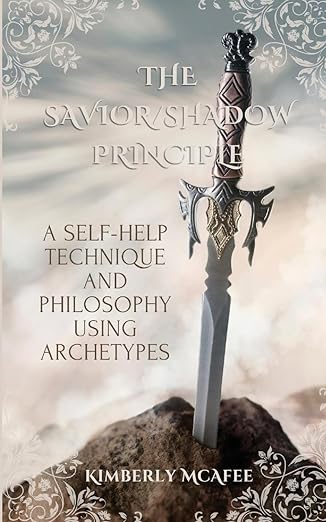
The book is both a personal memoir and a guide to a self-help technique the author calls the Savior/Shadow Principle. It blends mythology, psychology, and spirituality, drawing especially from the figures of Hekate and Jesus. McAfee takes readers through her journey from traditional Christianity into ChristoPaganism, then back into a reimagined Christianity. Along the way, she shares how she developed a meditative practice that uses archetypes of light and shadow to encourage self-honesty, growth, and healing. The book weaves in Jungian psychology, mythological parallels, and personal reflection, while offering readers practical ways to explore their inner lives through story and symbol.
I didn’t expect the writing to be so approachable. The author’s voice is warm, even when she’s discussing heavy topics like shame, fear, or midlife crises. She doesn’t hide behind theory or pretend to be an expert. Instead, she writes like someone who’s been in the dark, stumbled around, and finally found a lantern worth sharing. That sincerity resonated with me. At times, the language wanders, especially in sections heavy with history or myth, but that wandering matches the subject. The whole book is about exploration, so the digressions feel more like trails branching off a main path rather than distractions.
I loved the emotional undercurrent. I could feel the author’s vulnerability, her wrestling with faith, and her refusal to gloss over contradictions. That gave the philosophy weight. When she described Hekate lighting the way through shadow, or Jesus pulling someone into the light, it didn’t read like fantasy; it read like a relatable metaphor.
This isn’t a book for someone who wants a neat formula or a rigid system. It’s for seekers. It’s for people who are tired of shallow answers and who want to dig into the messy mix of spirituality, psychology, and story. If you’ve ever felt caught between belief systems, or if you’re curious about how myth and archetype can help uncover truth about yourself, this book has something to offer. It’s personal, heartfelt, and comforting.
Pages: 174 | ASIN : B0F8PLQMJB



 LITERARY TITAN