Blog Archives
Doll God


Luanne Castle’s Doll God is a poetry collection about the things we make, keep, inherit, damage, lose, and sometimes ask to stand in for us. Dolls are its most visible objects, but Castle quickly expands their meaning beyond childhood play. They become doubles, bodies, relics, artworks, containers of memory, and sometimes unnerving little witnesses. The collection is arranged in four sections, and its imagery moves outward from dolls and domestic objects into lakes, animals, family histories, marriage, illness, death, art, and questions of the sacred. Castle is especially interested in the strange border between an object and the life we invest in it. A doll can be tender, comic, damaged, threatening, or holy, sometimes within the same poem.
One of the pleasures of Doll God is how physical these poems are. Castle notices chipped paint, satin pillows, tangled hair, lake water, bird wings, scars, bones, cactus, glass, mud, thread, and household clutter with the eye of someone who understands that objects accumulate meaning simply by surviving beside us. In “Vintage Doll Buggy,” a child’s toy made from scrap metal carries the history of a factory that later produced rifle components, letting war, fertility, childhood, manufacturing, and memory occupy the same small object. Elsewhere, a Hakata figure becomes a way of seeing a husband and a marriage, while a jar of collected pebbles registers loss without needing to explain it away. Castle’s poems often work this way: they look closely at something ordinary until another emotional reality begins showing through it.
The collection grows more intimate as it goes. Family stories and remembered childhood scenes mingle with grief, strained relationships, aging, bodily vulnerability, and the knowledge that almost everything we love is temporary. Water keeps returning as lake, ocean, memory, danger, inheritance, and a place where the living search for the dead. In “A Bone Elegy,” childhood lake memories intertwine with surgery and the navicular bone, whose name comes from its resemblance to a small boat. The poem joins anatomy and memory so naturally that the body itself begins to feel like a vessel carrying earlier versions of the self. Castle also has a sly, surreal streak that keeps the book from settling into solemnity. A marriage becomes a business packaging arguments on meat trays, a morning cup of tea turns into an Alice-like trap, and God himself appears as a peculiar handmade figure with a notepad and a sighing pen.
By the final section, Doll God has widened into a meditation on creation itself: who makes whom, what survives its maker, and what kind of meaning can be fashioned from a mortal body in a mortal world. Castle’s spiritual imagination is grounded in animals, weather, plants, scars, ghosts, domestic rituals, and art. Her poems keep returning to the possibility that holiness may be less a distant answer than a way of paying attention. In “Focus,” the sacred finally resides in the palo verde, the cactus, the hummingbird, the burros and jackrabbits, while the elaborate religious apparatus falls away. That movement captures what the whole collection does so well: it takes the handmade, the wounded, the remembered, and the living seriously enough to let them become mysterious. Doll God makes a world of dolls, bones, scars, and memories feel charged with the startling possibility that everything we touch is already touching us back.
Pages: 118 | ASIN : B0H8B39LCL

Evenings on the Edge of Death


Evenings on the Edge of Death by Theodore McDowell is a collection of what the author calls “poeticized non-fiction,” built from memory, family history, trauma, aging, faith, dementia, and grief. The book arranges its poems into collages centered on the author’s mother, father, sister, marriage, and final goodbyes. That structure suits the subject especially well because memory itself is fragmented here. A childhood scene, a nursing home room, a beach, a cathedral, a marriage, or a deathbed can suddenly open into something that happened decades earlier. The result feels less like someone recounting a life from beginning to end and more like sitting with someone as certain memories keep returning because they still haven’t finished speaking.
The strongest thread running through the collection is the complicated relationship between love and injury. McDowell writes about an abusive father without reducing him to a single act or characteristic, and he writes about his mother with equal parts tenderness, frustration, guilt, and awe. Dementia makes those relationships even more complicated. In “The Storm of Dementia,” for example, his mother searches desperately for her dead husband and eventually mistakes her son for a young man while insisting that her husband is resting in the back bedroom. Similar tensions shape the poems about his sister Rachel, whose childhood abuse, mental illness, alcoholism, and eventual suicide become part of the family history he keeps trying to understand. The book is deeply interested in what happens after trauma, not just in the original wound. Shame gets inherited, anger resurfaces, children repeat behaviors they once feared, and forgiveness becomes something much more difficult than simply deciding to let the past go.
McDowell’s imagery gives the book much of its personality. Water, storms, winter branches, birds, wheat fields, roses, graveyards, fishing, stained glass, and fading light appear again and again, creating a kind of private symbolic language. Christian imagery is especially prominent, but the poems also reach toward Buddhist and other spiritual traditions as the speaker wrestles with questions about suffering, memory, redemption, and whether anything about a life survives being forgotten. Some of the most affecting moments are also the most ordinary: combing a mother’s thinning hair, remembering a baseball glove, planting flowers with a wife, watching someone breathe, or holding a hand that will soon grow cold. McDowell repeatedly brings enormous questions about God and mortality down into physical things that can be smelled, touched, heard, or held. Because certain images and ideas recur so persistently, the collection develops an almost ritual rhythm. The reader begins to recognize the beach, the river, the cathedral, the nursing home, and the garden as emotional places as much as physical ones.
I’d recommend Evenings on the Edge of Death most strongly to readers who appreciate confessional poetry, memoir in verse, and writing about family relationships that allows affection, resentment, guilt, faith, and grief to exist at the same time. It will likely resonate especially with people who have cared for a parent with dementia, survived a difficult family history, lost someone to suicide or mental illness, or found themselves reconsidering childhood after becoming older themselves. It’s also a natural fit for readers interested in spiritual writing that treats faith as an ongoing struggle. What stays with me most is the book’s idea of remembering as a form of care. Again and again, McDowell writes because somebody is disappearing, has already disappeared, or may someday be forgotten. By the final poems, preserving those lives through language has become one of the collection’s central acts of love.
Pages: 171 | ASIN : B0CVJ4PR85
Through the Shadows

Carroll Blair’s Through the Shadows is a collection of compact philosophical poems that asks readers to examine how they’re living, what they’re pursuing, and whether the noise of the world has pulled them away from the deeper work of being alive. From the opening meditation on solitude to the title poem’s invitation to step out of passivity and begin engaging with life, Blair establishes a voice that’s reflective, urgent, and deeply concerned with spiritual growth. These pieces are brief, but they’re built to linger, often turning a familiar human habit into a larger question about purpose, courage, or truth.
Much of the book focuses on the distance between motion and meaningful action. Blair writes about people waiting without doing, wanting rewards without effort, surrendering control of their lives, and spending precious time on distractions that leave them feeling empty. His criticism can be sharp, especially when he addresses conformity, corruption, social indifference, and the hollow routines of modern life. Still, the poems aren’t simply observations about society. They keep turning the question back toward the reader: What are you doing with your attention, your energy, and the limited time you’ve been given?
The collection becomes especially engaging when Blair moves from cultural critique into scenes of ordinary life. A conversation in a supermarket, a robin bathing in rainwater, a sudden burst of violent weather, or a road sign announcing “men at work” becomes an opening into questions about awareness and creativity. These moments give the book warmth and texture, and they reveal Blair’s gift for finding spiritual significance in what others might pass without noticing. His use of repetition, brackets, pauses, and extended phrasing creates the feeling of a mind thinking on the page, revisiting an idea until it gives up something more.
By the final poems, Through the Shadows has gathered its concerns into a clear call for inner discipline, creative commitment, silence, self-knowledge, and persistence. The closing piece presents the inward journey as difficult but rewarding, leading toward a richer experience of love, purpose, and being for those who refuse to give up. This is a book to read slowly, a few pages at a time, with enough space afterward to consider where its questions land. “Through the Shadows doesn’t merely ask readers to seek the light; it challenges them to become worthy of it.”
Pages: 84 | ISBN : 1936430304
Literary Titan Gold Book Award: Poetry

The Literary Titan Book Award recognizes poets who demonstrate exceptional artistry and proficiency and push the boundaries of language and expression. The recipients are poets who excel in their technical skills and evoke deep emotional responses, challenge thoughts, and illuminate new perspectives through their work. The award honors those who contribute to the literary landscape with their unique voices and powerful words.
Award Recipients


Visit the Literary Titan Book Awards page to see award information.
Well, Life Inspired Me

Love Her Blind & Other Poems is an emotionally-centered collection focused on themes of romantic betrayal, childhood violence, family memory, aging, faith, & mental illness. What inspired you to write this collection?
Well, life inspired me to write this collection, as pointedly, and as honestly as I can articulate. You see, while I certainly read and always loved poetry as a kid and as an adult in college, I have to say that my actual poetry instructors in college played a larger influence to me, upon me, as a young adult and later as an older adult; because they were there, literally and metaphorically, in my face. And what I got from my poetry instructors, meeting Amiri Baraka, and Nikki Giovanni, was more than just “write what you know” but also write what haunts you, what you vividly recall, what you yearn for and why, be bold with it and don’t hold back. Let it all out there on the page and acknowledge that it just isn’t for everyone. It’s for the select few who get it and want to get it. So in a long answer, life inspired me to write this collection, albeit alot of it in hindsight.
Were there poems that were especially difficult—or especially healing—to write?
Most were difficult, some more than others. “My Grandfather’s God” was about how I perceived this nearly mythic man, who was the first man, perhaps only man, who showed me through his actions, that a man doesn’t have to bully others or even necessarily manifest physicality (although he did) to be a man, and that a man can be quite kind, shockingly gentle to the point of perhaps seeming feminine at times, but able to do so and be very secure in that overall encasement of masculinity, humble yet confident, small but strong, empathic but able to go a few rounds if need be. Other poems were more difficult to write, such as “Bicycle Rider,” because even typing this response, I can feel the stiffness of my back against the car interior as I pedaled. But it’s through releasing and sharing that we ultimately grow and creativity is espoused and concurrently strengthened.
Do images usually arrive before the poem’s meaning, or does the meaning lead you toward particular images?
Oh, absolutely! And this is as true, if not more so, with fiction, as it is with poetry. But I remember my poetry instructor in college, whom I can’t and won’t forget, told us once that a poem, a single poem, should strike the reader in the head like a sudden, shocking bolt of lightning. That bolt can communicate love, compassion, awe, a stark memory, whatever, but a poem should carry and give at least one vivid image the reader can’t shake even if they wanted to. And if I did that, than I did my job in poetry. For fiction, it’s tougher, to me at least, because each scene should function as a short story in a way, that’s part of much broader, wider thesis about the human cycle. But we learn through imagery, we communicate through them, we absorb them on social media, on TV, online; and if we write, we tell stories through images written out and when we read we absorb images that the brain creates. And those images we create in our brains are often stronger and more long-lasting than anything we could ever see literally.
What do you hope readers are still thinking about after they close the book?
Well, I hope they come away feeling moved, maybe angered, maybe saddened, maybe enlightened or entertained; but I don’t want them bored or apathetic, because you can get that anywhere; and if something I’ve written or will write, causes fear, than I want that fear married to reflection on where that bottomless pit exists for them and why its so dark for them. The best poetry, I think, and the best fiction, too, is like a mirror the author holds up to you and says “Look into this. I’ve been where you were, where you’re headed, where you’ve thought and I get it. I want to share the both sides of this mirror with you. Let’s both dive in, from our own sides.” I want readers motivated to feel. And that’s the very least, the very least, job of anything any writer writes whether it’s poetry, fiction, or even non-fiction.
Author Links: GoodReads | X | Facebook | Website
Where long, black rivers shine like tarred-out wine.
Sunflowers hold bold gold; with winter’s bite mighty tight,
Icicle tears fall and break with each breath of brittle night.
Here love is an iron, barbed, and rusted key;
It cuts, then brightens, binding readers to see.
A hammer-fist on glass makes spidered pain anew,
And memory rains, then dries to ash-streaked stain.
Rocking chairs, once meant to soothe, turn to dread now;
They swing like storms above a child’s cold head.
Birdsong with beeps; crows counsel, sharp and rough;
They ask what you will bear, and how much is too much.
Roots drink red blood; the silent forests pray;
A Grandfather-God lifts stars like lambent clay.
A Tall Man waits there; streetlights blink and fade;
The searing needle steers your will through shade.
These poems are matchflames in the midnight room;
They stitch your heart with light, to loosen doom.
Pray, Muse, let broken visions rise,
To summon forth rising sea tides deep within inspired eyes.
The Wholeness of Humanity

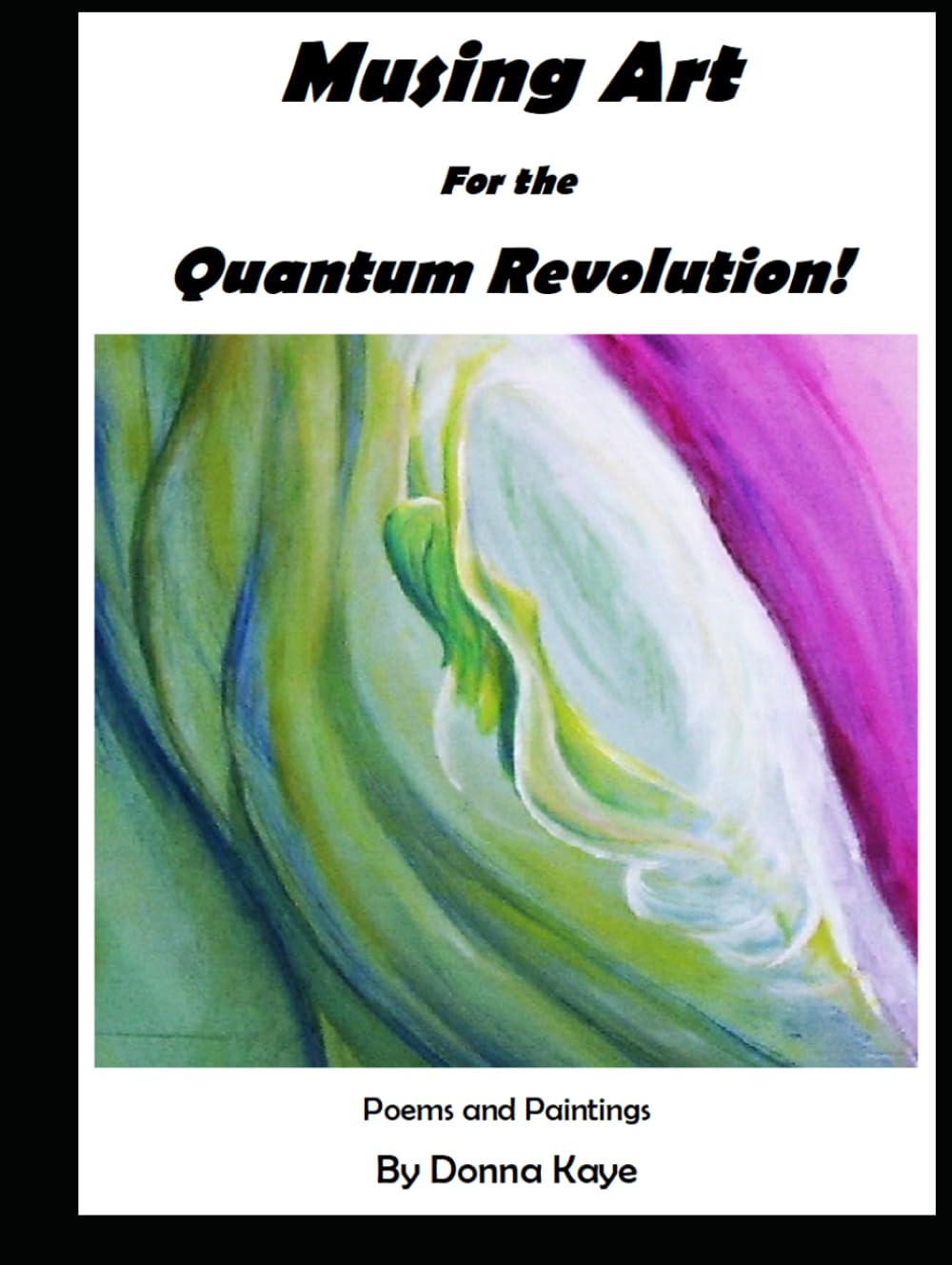
Musing Art for the Quantum Revolution! is a collection of poems, spiritual reflections, political meditations, and artwork centered on themes of healing, freedom, & human unity. How did you decide on the themes that run throughout your poetry book?
Throughout my life, I’ve used art to record important lessons of understanding and insight. I share these now because humanity is at a pivotal moment in history where we can rise to build a wonderful future together, or degrade into extinction. Each one of us is an important part of the wholeness of humanity, and what we say and do has a ripple effect in the world.
The collection moves between deeply personal reflections and broader political and social concerns. How did you decide on the balance between the inner and outer worlds?
Healing our inner traumas gifts us inner strength and wisdom, creating a foundation for positive change in the outer world. If we don’t do the inner work, we risk giving our personal power away to outside triggers and subconscious manipulation.
Your artwork is rich with symbolic imagery, bright colors, and metaphysical themes. How do you hope readers engage with the visual elements alongside the written pieces?
Many of the paintings are meant to be a meditative contemplation that blends different aspects of a theme like forgiveness or rebirth. Some of the newer work simply tries to capture the feelings of Joy and Freedom.
If readers finish Musing Art for the Quantum Revolution! carrying one idea into their own lives, what do you hope that idea will be?
Our personal healing from past wounds, creates space in our lives for Joy, Love and Peace. We can then use this wisdom to help others heal, and together we can build a beautiful world.
Author Links: Amazon | GoodReads
Our scientific capabilities must merge with the wisdom of the heart
if we are to survive our death spiral of war and aggression.
If we want a better world, we must heal our inner traumas and become better people.
Only then can we stand in the true power of compassion and effective change.
Thank you for letting me share my healing journey!
May we All find deep Healing, Peace and Love!
After Years On The Road

To Say Goodbye Again is an emotionally candid poetry collection that turns grief, memory, love, labor, and trauma into language strong enough to bear what silence could not.1. What inspired you to write and publish this collection?
Writing To Say Goodbye Again wasn’t something I planned—it was something I needed. After years on the road as a truck driver, hauling freight across the continent, I carried a lot more than cargo. Grief, memories of family, lost love, the weight of hard work, and old wounds that never quite healed—they all rode shotgun with me. When I finally retired and had time to sit still, those things started demanding to be spoken. Poetry became the way I could carry what silence couldn’t hold anymore.
I also wanted to prove to myself that I could start a project like this and finish it. I needed to leave behind something for my children to remember me by—something more than just the constant reminders to be responsible, the harping on obligations and discipline. I wanted them to know they had a father who was a dreamer, a goal setter, and who lived for humanity rather than just himself.
Publishing it was about turning private survival into something shared. If one person reads it and feels less alone in their own mess of love, loss, or regret, then it was worth laying it all bare. It’s my way of saying: here’s what the road, the years, and the heart taught me. Take what you need.
How did the structure of the book evolve as you moved from grief and family memory toward “Princess”?
It started as fragments—short pieces about saying goodbye to people and dogs and old versions of myself. The early poems circle grief and family the way you circle a wound that won’t close. I didn’t force an order at first; I just let the memories come out as they needed to.
The strange thing about the final chapter is that I was sidestepping around the idea of adding “Princess” at all. I was more focused on creating a poetry collection that was uniquely universal. I wanted the book to find readers who needed the roller coaster of emotions—that way I was certain to provide something for everyone. “Springtime,” which is a popular piece, was going to be the last chapter.
Ironically, it was during that same week I first started seriously entertaining the thought of publishing the work that the trauma of my childhood came to a head. It was a serious week of hell. I felt that at this point in my life, if I didn’t face all the toxic emotions I carried with intelligence and in a reasonable way, I would rot and die with it inside me—and my family would continue to wonder why I was so sad and withdrawn.
After a week of dealing with it head-on, I finally made the decision to incorporate “Princess.” What I felt, however, was that if I was going to write that piece, I wanted to convey a message to the reader without vitriol and without sounding like a victim seeking sympathy. It needed to be written with wisdom and to lead the reader calmly through the storm. Nothing is learned if we shock the reader and force them to close the book. My desire was to meet people where they were, and that doesn’t work if we chase them away.
Once “Princess” was in there, the whole collection felt heavier, truer. The structure evolved naturally from protection to reckoning. It had to end where the deepest silence had lived, because only then could the goodbye feel complete.
In what ways do work, masculinity, and self-acceptance connect for you across these poems?
For a guy who spent decades behind the wheel, work wasn’t just a job—it was how I proved I could carry weight, provide, and keep moving no matter what. Masculinity, in my experience, often meant swallowing the pain, staying steady for the people counting on you, and finding dignity in dirty hands and long hours. A lot of these poems wrestle with that: the pride in the labor, the loneliness of the cab at 3 a.m., the way it shapes a man.
Though we write for others, the truth is we are often writing for ourselves first. Reflecting on the years as a father, husband, and coworker—all of that was so deeply stitched into me that there was no way my poetry was going to be anything but lived truths. I was always known over the years as a straight shooter. It wasn’t always favorable, but those who knew me understood that they were getting someone who wears his heart on his sleeve and will never be anything but me.
So, my writing reflects all those incredible and heartbreaking experiences.
Self-acceptance came later, after the miles and the losses. It meant admitting I didn’t have to be unbreakable. That it’s okay to feel the grief, the regret, the softness I used to hide. The poems connect those threads—work as both armor and teacher, masculinity as both strength and limitation, and finally the hard-won peace of letting myself be human. Vulnerable but still standing. That’s the real haul.
What do you hope readers carry with them after finishing To Say Goodbye Again?
I hope they carry the permission to feel it all—the grief, the love, the anger, the tenderness—without shame. Life breaks us in places, but those cracks are where the light gets in and where we learn to speak truthfully.
More than anything, I want readers to walk away knowing they’re not alone in their goodbyes, whether to people, to old selves, or to the versions of life that didn’t work out. There’s resilience in naming the hurt, and there’s renewal on the other side of it.
I also want those who seek my work to trust that I am not self-serving. I may not know exactly what they are going through, but I will be there for them if they need me. Whatever they read, they will know that I had them in mind and not just myself.
If this book leaves them with a little more courage to say what needs saying—or to finally say goodbye again—then I’ve done what I set out to do.
Author Links: Goodreads | X | Facebook | Website
Shadows, Roads and Redemption: the Memoir and full story are scheduled for a 2026 mid-summer release.
In To Say Goodbye Again, he distills that long journey into powerful poetry. What began as private verses in 2017 cracked open decades of fear, confusion, and anger—revealing the arduous road to reconciliation and peace.
A Titan Gold Book Award recipient, this collection offers an intimate prelude to his forthcoming memoir. Through heartfelt poems born from the cab of a truck and the endless black ribbon of highway that kept him moving forward, Jac pays quiet homage to resilience, redemption, and the simple joy of trucking.
These words are for anyone carrying their own silent burdens. You are not alone.”
An Overwhelming Feeling of Mourning

We the Mourners is a poetry collection with themes centered around grief, love, embodiment, and surviving loss. Was there a particular experience or realization that first led you to write these poems?
These are themes that always seep into my writing life, especially love! One of my favourite quotes, by one of my favourite authors, Elizabeth Strout is: “You will have only one story,” she had said. “You’ll write your one story many ways. Don’t ever worry about story. You have only one.” (From the book, My Name is Lucy Barton.) I believe my ‘one’ story is a love story. When I write it is often an ‘embodied’ experience, so that seeps in as well!
The particular experience that triggered the poetry in this collection, however, including the first line that repeats (‘We the mourners’), came from an overwhelming feeling of mourning that I felt when I was reading the novel Peggy by Rebecca Godfrey. I’d read that Rebecca had been working on the novel for ten years, and then was hit by the horrors of cancer, and she passed away before the book was finished. While she was in-hospital, she had her husband record her speaking story notes… and then she requested that her friend finish writing the book for her. There was a collective creative completion of this stunning novel… and I felt this deep sense of mourning for this incredible writer who I’d never met but felt so connected to through her writing and her life story. I felt it in my body, in my heart and I used a poem to hold the mourning energy I was feeling.
Your poems suggest that mourning is something we actively do rather than simply endure. Why was that distinction important to you?
Great question! Thank you for deciphering this important point. Yes, I believe that mourning is a choice. It’s an ‘active’ experience we can choose to have on our own and/or as a collective (even between two people!) sacred, spiritual expression. I believe that one way to embrace the power of mourning, especially for global suffering, is to use one’s love ability through the body, to hold whatever pain/suffering they see another experiencing, and use prayer or creativity or crying—an act—to acknowledge and support that pain/suffering. It may sound counter-intuitive, but when experienced, I believe, it puts more love into the world by choosing to face the ways humans suffer, despite the knowledge that we can actually choose not to hurt each other, as one example. Disease, natural disasters, accidents, and other ‘destructions’ that are (more) out of human control also deserve acknowledgement and mourning energy.
The distinction is important because, unlike grief, which is an emotion, an undeniable part of the bodily human experience, mourning comes from a consciousness, an awareness of pain in others, unhindered by competition or ego. It is a language of love.
The book carries a strong spiritual current without belonging to any single tradition. Was that openness intentional?
Oh yes. In fact, I was very aware of how easily my own religious upbringing wanted to sweep in and take the lead on the ‘right’ way to mourn, to pray, to love. I used this dissonance to shake up, loosen and release any ‘single tradition’ of beliefs because so much hatred and death can be a result of traditional religious belief systems. The gorgeous irony, of course, is that love is an integral part of traditional religious belief systems, but the way we interpret these beliefs can become a devastating battleground. I wanted to acknowledge this possibility, and elevate above it by writing peaceful, unconditional-love-centric language. And, suggest (with love!) the, perhaps, radical idea that if we are able to recognize how our bodies use emotions to stay alive, how emotions trigger our nervous systems which affects our choices… that in the same way we can choose to put love in the world towards each other, we can choose to mourn suffering and pain for each other as well. When the love-putting (if I may!) is too difficult or we simply can’t ‘see’ or ‘feel’ it, be then, with the pain and suffering, hold the tragedies, the losses, the sadnesses for each other. I truly believe it matters.
What conversations do you hope We the Mourners inspires among readers?
Hmmm. Another great question! I hope that it inspires conversations about the body, about heart-led choices, about belief systems that are not unconditional… I hope readers give themselves grace as they read, just as I gave myself grace when I wrote to ‘be’ in the powerful, profoundness of mourning. I hope that conversations about the sacredness of being a human ensue! I hope there are conversations about souls and love, and the delightfully terrifying truth that being alive means we are also dying, and quietly, each of us is engaged in the mourning of our own body’s love life. I hope that there are conversations about shifting out of competitive suffering, out of the belief that one person’s pain is different than/more important than/deserves more attention than someone else’s. Even the human being who makes the most horrific choices that result in the deaths of other humans can be mourned. What is that human’s love story? These are difficult thoughts to stand in, to feel in. But, I believe, there are mourners who choose to take on these realities, and hold them. That we can each stand in, and feel, and mourn the extraordinary possibility that each human is here to love and be loved—yet will not or cannot. What then? That’s something to talk about.


