Blog Archives
Literary Titan Book Award: Poetry

The Literary Titan Book Award recognizes poets who demonstrate exceptional artistry and proficiency and push the boundaries of language and expression. The recipients are poets who excel in their technical skills and evoke deep emotional responses, challenge thoughts, and illuminate new perspectives through their work. The award honors those who contribute to the literary landscape with their unique voices and powerful words.
Award Recipients


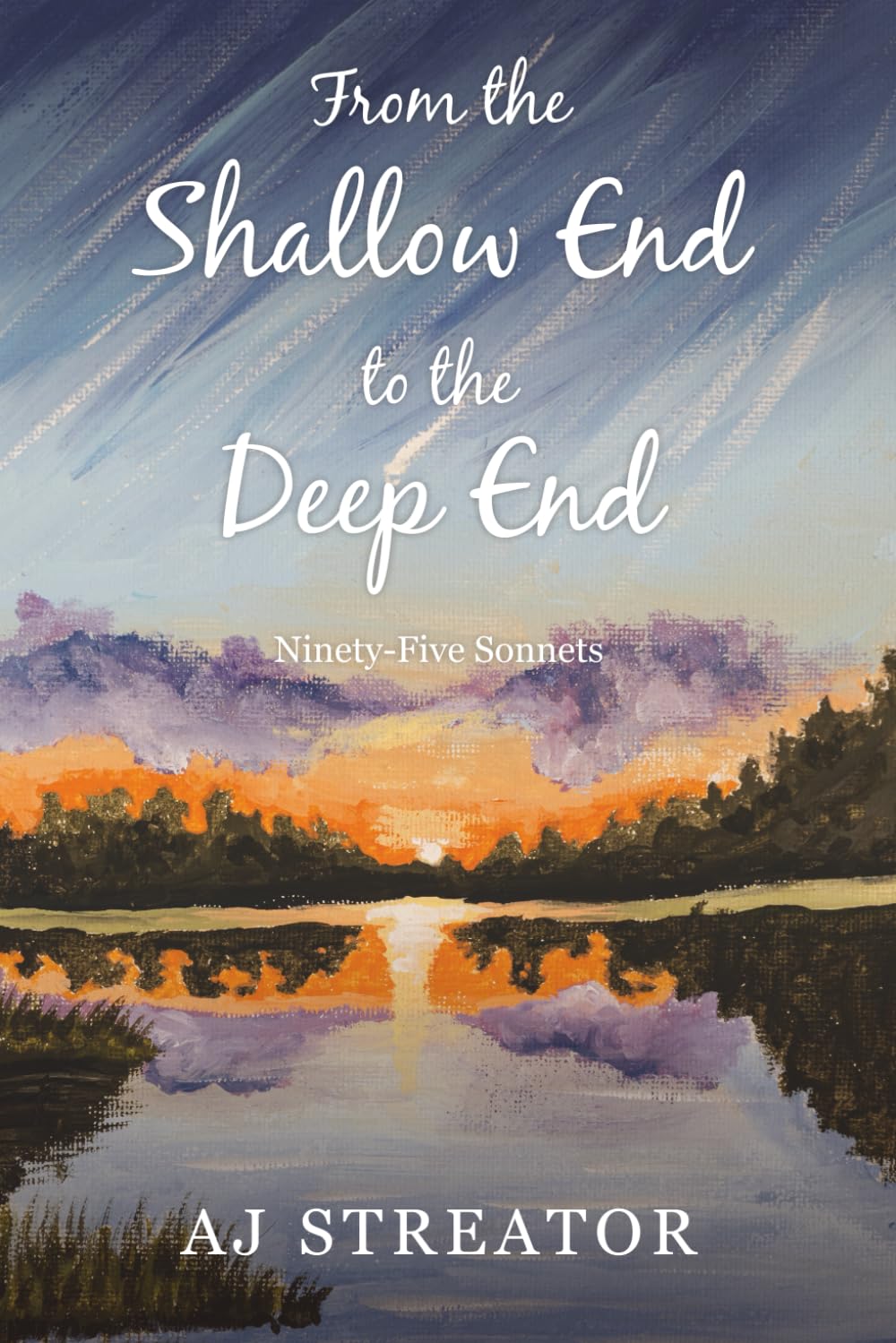

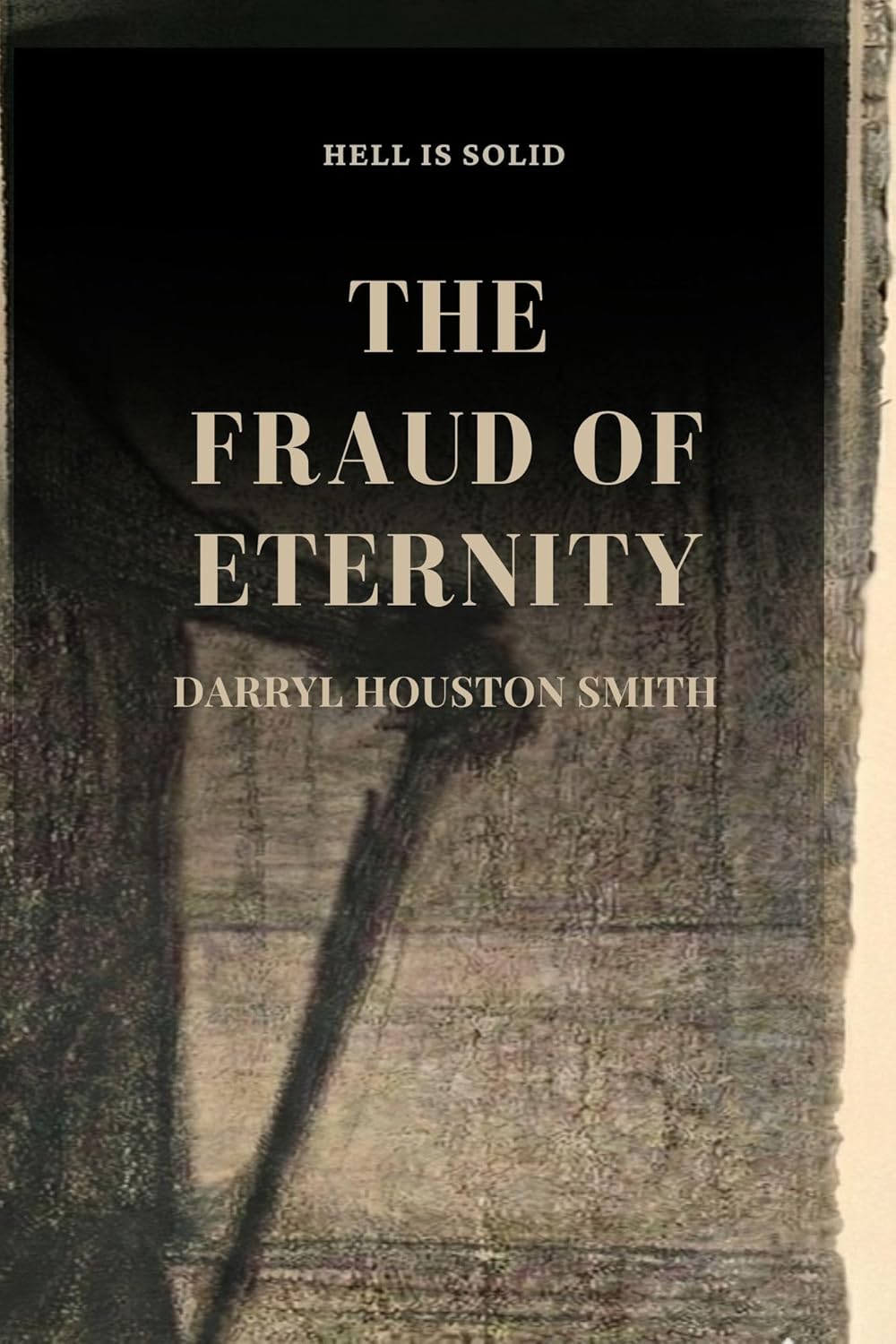


Poetry to Ponder: Joy in the Morning—Hope on the Horizon by Joy Steward
Visit the Literary Titan Book Awards page to see award information.
All Told


All Told is a big, loose, lived-in gathering of poems that tracks a whole life, not in a straight line, but in loops of memory, travel, politics, love, and aging. Kenne starts by greeting the reader in a plain kitchen where “the beans are simmering in the pot” and cornbread is in the pan, then moves through childhood on the Gulf Coast, work on farms and in gins, long nights in bars, years in Mexico and Turkey, and into late-life classrooms and quiet rooms where the poet waits for the phone to ring. Sections like “South,” “The Scene Today,” “In a Country of Cars,” “The Art of Facing Oneself as a Ghost,” “The Way of the Fool,” “All Told,” and “I’m in Your Hands” give the book a loose arc from place and family toward wider public life and finally back to intimate friendships and love. The whole thing feels like a story told over many long evenings.
I enjoyed how sturdy and grounded the writing feels. Kenne likes real rooms, real weather, real work. In “This House” he watches the “gray ghost” of his father ride a lawnmower past mesquite and blue norther wind, then lets time jump so the same house lifts and settles in summer heat. The language stays simple. The images do the heavy lifting. A poem about a timing chain in a car, a night shift, or a mechanic’s bad news turns into a little parable about fear and delay without any fuss. His long piece “Smitty, Wallace and Me” circles around a neighbor rewiring his stereo and Wallace Stevens on the bookshelf, and somehow it becomes a quiet essay on communication, performance, and the way our “systems” of living barely touch each other. I liked the relaxed, talky tone. It never felt like the poems were trying to impress me. They just kept showing me things until I started to care.
I also liked how wide the book opens out into the world. Kenne writes beautifully about Istanbul, standing at his window over the Bosporus while birds spin like white confetti and traffic roars across the bridge, and he slides from that scene into music, Turkish poets, and the weird parade of late-century life. The poems in “The Scene Today” and “In a Country of Cars” keep running this line between wonder and annoyance, affection and disgust, as he watches consumer culture, car culture, war memorials, and election years roll past. There is real bite in titles like “America, You Son-of-a-Bitch,” “Election Year,” and “Against Monotheism,” yet the poems almost always come back to one human voice, tired and worried, trying to stay honest inside all that noise. The long sequence about “The Fool” lets him poke fun at himself and at power in mythic language, but underneath the jokes I heard real loneliness, a man who says his main power now is to sit, wait, and be “an empty room / waiting for you to walk in,” and I felt that in my gut.
Under the craft and the travel and the politics, the book feels tender. The early section “South” holds family ghosts, drought, letters from his mother, and awkward boyhood memories. Later on, in “I’m in Your Hands,” he turns toward teaching, old students, old friends, love poems, and a cat named Kestane who becomes a way to think about God. The tone softens without losing edge. I felt a steady ache running through these later poems, but also a kind of rough gratitude. The book accepts confusion and keeps talking anyway. I found that comforting.
All Told is better taken in sections, like a long road trip with stops in little towns, diners, and old neighborhoods. I would recommend it to readers who like narrative, place-rich poetry, to people who grew up in or around the American South, to anyone who has lived abroad and still feels torn between worlds, and to teachers and writers thinking about their own long haul. If you want clear, humane, often funny, often bruised poems that let you sit in the room with a working poet and see what a whole life looks like from the inside, this book is worth your time.
Pages: 193 | ASIN : B0FRB1W1WD

Everlasting Time

Triskele is a dreamlike collection of sensory poems where childhood memories resurface in fragments, inviting readers to linger in the quiet glow of memory and meaning. Did the collection begin with a theme or with individual poems?
The collection began when my rock covers band (as a drummer) folded with a bereaved member (my late wife). I had a stack of my original lyrics and decided to try a hand at poetry using some of my works, going through the stages of grief, and then finding a second chance and remarrying has opened up a new world in my word play, I now understand that if you experience something dramatic, then you can write about it with a true feeling to it.
How did the number nine shape the creative process?
The ‘ennead’ was a group of nine deities in Egyptian mythology; in poetry it refers to a set of nine poems. With no logic to it, it just happened that I grouped each chapter into nine. To be aware the poems are in the same order as were written with no rhyme (pun) or reason as to the order of appearance, they are in the books just how they fell from the grey matter, mostly unabridged, and as they were originally penned.
What fascinates you about memory’s persistence?
I have a poor memory (due to a head injury when young). When something pops into my head, an idea, a poem, a lyric, if I don’t write it out immediately, it is soon lost in space forever.
I’ve captured many an idea in the middle of the night, at work, and when that happens there comes a hankering to add to it until it is finished, the poems mostly spontaneous, don’t ask me why or how these come about, they just appear.
An occasional snipped of my childhood returns when I see a picture, or someone mentions something, that may be the clue to the persistence, to discover more of the missing past.
I took unusual liberty to add explanations to the poems as many people taking them at face value (which is great), may not get author’s intent, or understand in my whacky sense of humour of what they are about.
Why choose the title Triskele? What does the spiral symbol mean to you?
A triskele is a symbol of ‘everlasting time’, the pattern when followed repeats back onto itself, I love the graphic of it and wear a Celtic style bracelet with a triskele on it instead of a watch ( no batteries), so in my sense of humour, if anyone asks the time, I can point to it saying, “Everlasting”.
A hope that it is, however, the reality of life one discovers that we are all mortal, and this indeed has inspired some of the poems.
The collection of Triskele never stopped, to follow have come more books in similar format titled ‘Mousanisms’, ‘Thrice’, ‘A Fifth of Four’, ‘Sarah in Dippidy’, and currently coming together is ‘Rhyme to Pass Thyme’.
It has been a lot of fun, a hope that someone else enjoys them when starting a fire.
Triskele
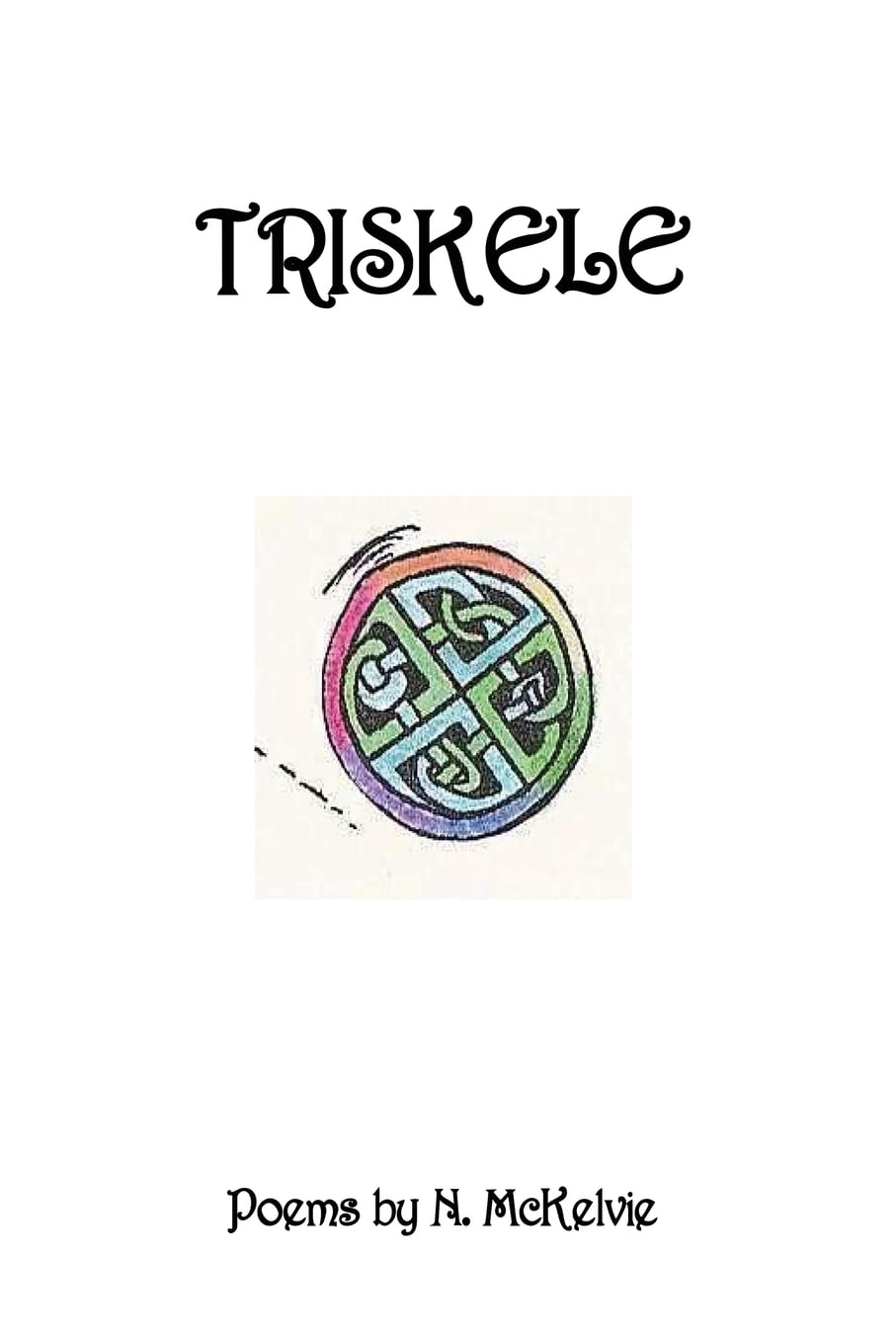

With poetry collections, it’s natural to read with an eye for repetition, for the motifs that surface, vanish, then return in a new light. Here, the clearest throughline is the way childhood keeps its grip on adulthood. Memory doesn’t stay neatly archived. It wanders. It resurfaces without warning. Many of these poems circle the experiences we gather early and never fully release. Like half-remembered dreams, they rise from deep storage as the years pass, arriving as phantom scents, stray tastes, sudden images. What are they to us? Simple recollection? Or signals from an earlier self, coded, persistent, and asking to be understood?
Triskele, by Neil McKelvie, is a poetry collection that feels, at times, reminiscent of A Visit to William Blake’s Inn. The pieces are brief yet vivid. They lean into food, childhood, love, memory, and the quiet pleasure of ordinary moments. Nothing is overworked. Nothing is forced. The language often lands like a small sensory discovery.
Poetry also invites a familiar question: are we meant to read literally, or to hunt for symbol? In this collection, either approach can stand. McKelvie shows a steady command of a dreamlike mode. The themes arrive on soft edges. Meaning glows rather than declares itself. There’s an esoteric, ethereal charge to much of what’s offered, suggestive, elusive, and deliberately unpinned.
That quality makes the reading experience pleasurable, even soothing, yet it also creates a persistent sense of distance. The poems open a door into the speaker’s inner world, then stop short of full access. You can see the room. You can’t quite cross the threshold. Some selections, such as “Red Skies Rainbows” and “The Vanishing,” are heartbreakingly lyrical, rich with beauty and ache. Others, including “IX The Ninth,” turn toward violent historical events, remembering and mourning what cannot be undone.
For readers seeking the most immediate enjoyment, it may be best to accept many of these poems at face value. Let them be what they appear to be. Let the images stand. That choice often brings you closer to the author’s emotional frequency. It also gives you the best chance to meet the collection in its intended mood, which, for poetry, is often the point.
Pages: 116 | ISBN : 1300762756
Seek Him in Faith
Poetry to Ponder: Joy in the Morning – Hope on the Horizon is a deeply personal collection of poems that traces moments of your life through heartbreak, faith, illness, loss, and eventual hope. What first moved you to put these poems together as a collection?
Some of these poems were published in my first book, “Journey to Joy: An Inspirational Memoir”. It is a compilation of poetry and prose. A critique received from another editor was that he would like to see the poems as a stand-alone book. Because I kept writing through new experiences of pain and loss, I decided it was time for a new book. As noted, this book not only focuses on my personal crises but also on the cultural crises we are all experiencing currently. It includes many new poems as well as some previously published ones that happen to fit the overall theme. I also wanted to offer a solution to the human crises, which, I believe, is found in my faith. As I am getting older, I also did not want the poems to be left in my desk drawer. I wanted to share my message of hope with the world while I am still able.
Were there poems that felt especially difficult to write or revisit?
Yes. “Laughing Stock” reminded me of the confusion and pain of not being taken seriously when, as a teenager, my barely formed self-identity was being derailed by vision loss, and no one took me seriously. “No Voice” was also extremely hard to relive. I have forgiven but not forgotten the pain of that experience. The poems that reflect the stresses of single parenting and heartbreak, such as “Heartburn”, “Why?”, and “I Broke My Heart”, all caused me to relive the pain that gave rise to those poems. Recalling my cancer diagnosis is not so painful anymore as I am in my 30th year of survivorship. The memory of abandonment still stings when I re-read “Shattered Joy” and “Deedless Words”.
How do ordinary moments help sustain faith during extraordinary pain?
A visit or phone call from a friend, a moment of laughter, or even recalling some precious interactions with my children when they were small, reminds me that there can be joy even in the midst of tragedy. A moment of humor, even when poked at me, can momentarily alleviate pain. Above all is the knowledge that God is always accessible through prayer and that I can bring my burdens to Him at any time.
What message do you most want readers to carry with them?
Trials and hardships are part of the human condition, but our Creator is never far away and offers help to those who seek Him in faith. Endurance builds character, and our time of suffering is redeemed when we can offer hope and encouragement to others who are currently where we used to be. In God’s economy, pain is never wasted.
Despite the turmoil, division, and unrest in our world, my prayer is that the reader will embrace the grace, truth, and love Jesus offers and experience the joy and hope He promises to those who find refuge in Him.
Cardinal or Crow
Cardinal or Crow by Molly Myriah is a short, intimate collection of prose poems and lyric fragments that circle around grief, faith, motherhood, trauma, and everyday wonder. The book moves through hospital rooms, kitchen floors, beaches, churches, and garden paths, and keeps returning to weather, trees, birds, tides, and small animals as anchors. It tracks a speaker who has lost her mother, survived betrayal and poverty, raised children, wrestled with God, and still finds reasons to laugh, plant flowers, and notice butterflies and hydrangeas. The pieces are brief, often only a page or two, and they gather into a loose story about being broken open and then learning to live with a tender, alert heart.
As a reader, I felt close to the voice on the page right away. The writing is simple on the surface, and that choice works. Short lines, plain words, small scenes. It feels like someone who has lived a lot is just talking to me across a table. I liked the steady mix of sharp one-liners and soft images. A poem will crack a joke about “be cool” and then turn and punch straight into the cost of pretending to be fine. The free verse feels loose, but the book has clear patterns. Nature shows up again and again. Trees that feed the weakest roots, yellow butterflies, hydrangeas that change color, the shore as medicine, the tide that covers and then pulls back. That repetition gives the book a spine. I also enjoyed the small structural tricks. Titles like “Maslow,” “Goliath,” or “Road to Emmaus” drop in big ideas, then the poem itself stays grounded in very human scenes. The tone stays conversational, but the images are often bright and odd in a good way, like a pink canoe across a golden grid or a leaf caught in a window screen.
Emotionally, the ideas in this collection really resonated with me. The book sits with grief without rushing to fix it. Death of a mother, the long ache after a breakup, the strange life of being a single parent, the weight of childhood trauma. All of that shows up, and it feels honest. I appreciated the way the speaker talked about faith, too. God is here, but not as a neat answer. The poems question, argue, and still lean toward hope. There is a lot of talk about free will, courage, and choosing to keep going when the tide of pain pulls you under. The collection also takes care with attention. It keeps saying, in different ways, that small acts matter. Picking up an earthworm, asking how someone really is, planting loud flowers for angels, noticing rain or a dog’s steady presence. I found that idea comforting and also a little challenging, since it asks me to wake up more in my own life. The mix of tenderness and hard truth felt believable. I never felt preached at. I felt invited.
Overall, I would recommend this book to readers who enjoy reflective, accessible poetry and who are open to spiritual language that lives beside real hurt. It will likely speak to people who have lost a parent, left a painful relationship, or carried old family wounds. It will also suit readers who love nature writing and small, daily moments more than big plot twists. If you want clean, spare lines that feel like a friend talking, and you do not mind sitting with heavy feelings along with little flashes of joy, this collection is a good fit.
Pages: 150 | ASIN : B0FJPPHMNN
A Revolution of One
A Revolution of One gathers the poems, prose, fragments, and messages of James Munro Leaf into a raw and startling portrait of a mind fighting to stay open to beauty while battling its own darkness. The book moves through friendships, love affairs, political fire, theatre, travel, and long stays in psychiatric institutions. It circles again and again around one central idea. That art and courage might hold back despair for a moment, even if they cannot defeat it for good. The pieces feel found rather than polished, scattered like notes left on a desk after a long night. They come together into a kind of memoir told sideways. A life seen in shards.
The writing has this mix of clarity and frenzy that left me wide awake. Some lines felt soft and tender. I kept feeling pulled between admiration and sadness, almost like watching someone run full speed into a storm because they refuse to bow their head. Leaf’s honesty is so bare that I sometimes had to pause just to take a breath. He writes about love like it is a lighthouse. He writes about mental illness like it is a hunt he must survive. And he writes about ordinary people with such respect that even a stranger on the subway feels illuminated. His voice has a kind of youthful fire that doesn’t feel young at all. It feels ancient and worn at the edges.
I also found myself moved by his beliefs about art. He refuses to treat it as decoration. He wants it to matter. He wants it to change something inside a person. And I felt a kind of ache too. His desire for meaning often bumps up against a world that shrugs back. His political anger hits the page with a force that made me nod one moment and wince the next. His love poems feel fragile and wild at the same time. His pieces from psychiatric wards hit with an honesty that left me quiet for a while. Nothing here feels moderated or smoothed. It is all edge and pulse and longing.
A Revolution of One is messy in the way real lives are messy. It left me grateful. I think this collection will speak to readers who have struggled with mental illness, to artists who feel trapped between idealism and daily life, to anyone who has ever tried to hold onto hope while the world shakes under their feet. If you want something that feels alive, frightened, brave, and stubbornly human, then this book will be perfect for you.
Pages: 167 | ASIN : B0G8KJ7Q9F

Poetry to Ponder: Joy in the Morning—Hope on the Horizon

Poetry to Ponder: Joy in the Morning – Hope on the Horizon is a deeply personal collection of poems that traces the author’s life through heartbreak, faith, illness, loss, and eventual hope. Across three sections, Joy in Crisis, Culture in Crisis, and Hope on the Horizon, the author shares raw moments from vision loss and divorce to cancer and grief, all anchored in her Christian faith. The poems move back and forth through decades of lived experience, showing how suffering collides with belief, and how trust in God becomes her lifeline when everything else falls apart.
What hit me first was how honest this book feels. There is no polish-for-show here. The pain is right on the page. I felt it in poems about broken relationships, motherhood, betrayal, and sitting alone with fear in the middle of the night. Some lines made my chest tight. Others made me nod quietly like, yes, I know that feeling. The writing is simple and direct, sometimes almost conversational, and that worked for me. It felt like someone sitting across the table telling me her story, not trying to impress, just trying to tell the truth.
Emotionally, this book took me on a ride. I felt sad, angry, encouraged, and strangely comforted, sometimes all in the same section. The author leans hard into her faith, especially when facing cancer, divorce, and deep family wounds, and while that may not land the same for every reader, I respected how unwavering she is. Her belief is not soft or vague. It is bold. She talks about God like someone she has wrestled with, cried with, and leaned on when she had nothing left. That kind of spiritual grit stayed with me. I also loved the moments of humor and everyday life sprinkled in, kids making messes, awkward memories, and small joys. Those lighter bits gave me room to breathe between heavier poems.
The book reminded me that suffering does not cancel purpose, and that telling your story matters, even when it hurts. I would recommend this book to readers who enjoy faith-based poetry, anyone walking through grief or illness, and people who want something real, reflective, and hopeful to sit with slowly. This is not a book you rush. It is one you dip into, one poem at a time, especially on hard days. If you want heart, honesty, and a steady message of hope through pain, this one is worth your time.


