Blog Archives
The Sinister Nature of Power

The Bent Nail follows a man born into filth and neglect who becomes both a victim and an instrument of a shadowy organization bent on reshaping the world through brutality. What was the inspiration for the setup of your story?
The inspiration for The Bent Nail, or its predecessor, Nails, came from a sole source. The initial story structure stemmed from a challenge made by a close friend to see if I could develop multiple, separate plot lines and weave them together into a single, coherent, exciting story line. Challenge accepted.
What came from that challenge was the original Nails, a story that introduced the reader to three truly flawed individuals: Tau, Gideon, and Simon; three individuals who erroneously thought they were the uncontested wielders of power in their respective worlds. In effect, they thought they were the hammers of society; individuals who could pound on others and rule with impunity, only to discover their power was an illusion. They were merely nails just like anyone else.
The inspiration for the main character, Tau, is personal experience. I had the opportunity to work closely with an organization whose cause was helping the hopeless. That effort brought me elbow to elbow with people society had cast out into the streets because that was easier than looking for productive alternatives. These people were the products of an unforgiving world, chemical abuse, mental instability, or just bad luck. That was where Tau came from. Tau represents those in our society who are forgotten, lost, and disposed of, but he refuses to be dismissed. He resorts to violence because it’s the advantage he possesses. We fear him because he has nothing to lose. His character hits us hard, not just because he’s a repugnant and vicious individual, but also because he’s so damaged and we see his potential for good.
The story is motivated by what we experience contemporarily. We are bombarded by streams of questionable, repetitive soundbites intended to manipulate, separate, and control. What we end up with is a powerless people subjugated to the will of others. I wanted to portray the sinister nature of power and those individuals who use this to their advantage. Some readers consider The Bent Nail as a warning of the future, others, a reflection of today.
The violence in the book is raw and sometimes difficult to endure. What role does discomfort play in your storytelling?
I wrestled with this. You use the term raw, and it is. And that is very intentional. The violence was necessary to drive home the idea that the world we know is not the comfortable place we believe it to be. A veil of civility might cover up the violent, self-serving nature of man, but that rawness still exists. We see violence, greed, and the desire to control in almost all aspects of society when we look close enough. The Bent Nail challenges us to check ourselves so as not to be seduced by power and wealth.
For me, storytelling requires emotional engagement. Comfort rarely seems to fit with that concept. That’s not to say that my stories are all violent or even troubling. I would suspect many would suggest my Countenance of Man, a touching story of man rediscovering his father through the eyes of others, is emotionally wrenching, but hardly troublesome. The Bent Nail deals with power and corruption; it would be unfair to treat this kindly.
The book challenges the idea of freedom itself. Do you believe freedom is real, conditional, or illusory?
Superb question. Certainly, The Bent Nail would suggest that freedom is illusory, something we think we possess even when the evidence would suggest otherwise. Do I believe that? Not really. In our western society, freedom is absolutely real, not just an abstract concept; however, it is continuously under attack. The struggle is that freedom is not an immutable idea. We have become too comfortable with the notion that freedom never changes, something that once we have it, it will always be there. It’s not. The Bent Nail throws that reality in our face. It challenges us to continuously fight for it even when the consequences might be frightening. In this story, I hope the reader grasps that however frightening it might be to stand up for one’s rights, the alternative is far worse. If not, The Bent Nail becomes something more than a novel; it becomes prophecy.
To quote Benjamin Franklin, “Those who can give up essential liberty to obtain a little temporary safety, deserve neither liberty nor safety.
If The Bent Nail leaves readers unsettled long after they close it, what do you hope they do with that feeling?
I hope it leaves the reader unsettled. We live in an unsettled world filled with warring factions fighting for power. The Bent Nail surfaces that and it should bother us all. It illustrates how easy it is for those in authority to manipulate us, be it through engendering class envy, spoon feeding us with blatant misinformation, seducing us with the promise of power, or imposing their will through coercion. Our challenge is to understand who is behind the manipulation and to stand up to them.
The second point I want to leave with the reader is the need to be objective in assessing the world. Not everything is as it seems; adopting the beliefs of friends and neighbors merely because it seems easy and comfortable is dangerous. Of course, if one desires to be nothing but a nail, hammered into acquiescence, in a world similar to one I’ve invented, just keep capitulating to those who desire to control us through power.
Lastly, speaking of power, it is insanely seductive – for all of us. It can overwhelm the desire to do what we know to be right. People might look at these comments in light of what is going on in our society today and assume that The Bent Nail is either right wing or left wing. That’s a perspective thing and would be a tremendous mistake. Neither political side has a monopoly on being correct. Don’t let others tell you what to believe.
M.D. reintroduces the three flawed characters you hated in Nails: Simon, a journalist without a conscience; Gedeon, a murderer without a heart; and Tau, a man without hope. In this masterful sequel, their lives collide as they each struggle to avoid becoming nothing more than hammered nails underpinning a centuries-old, secretive family committed to world dominance. Through deceit, mass murder and economic control the Family seeks to establish a new and lasting world order under their direct and unquestioned authority. Corruption and the seductive nature of power provide the backdrop as Tau, Simon, and Gedeon wrestle with their personal demons as they seek to survive.
Although The Bent Nail is a story that will disturb and frighten even the boldest of readers, it is one that will pull you in and capture you from the first page, a story you won’t be able to put down… and one that you will remember forever.
The Bent Nail


M.D. Nuth’s The Bent Nail is a dark, unflinching exploration of power, corruption, and the human cost of control. It begins in the chaos of a Delhi marketplace and spirals into a global web of political manipulation, personal ruin, and moral decay. At its center is Tau, a man born into filth and neglect who becomes both a victim and an instrument of a shadowy organization bent on reshaping the world through brutality. From street-level despair to the high offices of government, the novel draws a line between the powerless and the powerful, showing how desperation and authority twist into something monstrous.
Reading this book felt like riding a rollercoaster. Nuth’s writing hits hard. The language is raw and often brutal, but it feels right for the world he’s built. I could almost smell the filth of the streets and feel the emptiness in Tau’s heart. The dialogue is jagged, messy, and alive. It sounds like people breaking apart, trying to make sense of what’s left of their lives. The pacing is relentless. There were moments I had to pause just to breathe, especially in scenes that blended violence with eerie calm. It’s not an easy read, but it’s gripping.
What surprised me most was how much I cared for characters who probably didn’t deserve it. Tau, especially, is a walking wound, and even as he kills, I felt something like pity. Nuth doesn’t excuse evil, he shows how it’s born. The story’s ideas about government control, manipulation, and the illusion of freedom hit close to home. It’s a political thriller, yes, but it also feels like a prophecy, a mirror held up to our worst tendencies as people.
I’d recommend The Bent Nail to readers who like their fiction sharp, ugly, and honest. It’s perfect for those who aren’t afraid of dark themes or moral gray areas. If you want a story that challenges you, unsettles you, and makes you question the world you live in, this one’s worth every page.
Pages: 294 | ISBN : 1681607840

Pandora’s Box Has Been Opened

Liberator: The People’s Guard follows the Liberator as he faces off against two new super villains, one has the ability to take any form, both organic and not, and a being that absorbs the life force of others. What was the inspiration for the setup of your story?
It was really just the natural evolution of the story. Volume 2, left off with the idea of the various nations ramping up their eugenics experiments, so it naturally led to the question of “what would happen if someone were accidentally exposed to this super soldier serum?” Like the book says, Pandora’s box has been opened and there’s no closing it now. Plus it was also a case of creating a rouges gallery for the hero. A hero is only as good as the villains they fight. The Liberator really doesn’t have a main adversary the way Superman has Lex Luthor, Batman has the Joker, or the Ninja Turtles have Shredder. I just needed some more villains for him to fight and I decided to make these two female for a more gender balanced story. Incidentally, several months ago I was in a store at a mall, talking with one of the staff about my books. When I told her about Oksana and her ability to absorb the life force of others, she loved the irony of the fact that women are the live givers, and here’s this woman who’s essentially taking that life force energy back. Something I never even thought about when writing, or at least I wasn’t consciously aware of it.
What were some ideas that were important for you to personify in your characters?
In the case of the villains, as stated above, it was really just a matter of creating a rouges gallery for the hero. Upon creating the villains the first question was “How did they get these powers?” Then I went from there. With Oksana, it was about a plant operator who hated her job, her life, who was under constant stress and upon getting her powers her reaction was basically, “Now’s my chance to get back at everyone who ruined my life.” As for Mistika, I’ve often read about how in the Soviet Union they would brag about how they evolved beyond “capitalist/materialist greed”. While that was the official government stance, the reality was quite different. For Mistika it was just a case of, “With these powers I can have/do whatever I want and no one can stop me!” As for Tovarich, it was really hammering home the fears and doubts in the back of his mind. The idea that maybe he’s not the hero everyone thinks he is. He’s the guy who’s staying up at night wondering “What if the state I’m supposed so serve is actually the REAL bad guy here?”
How did you balance the action scenes with the story elements and still keep a fast pace in the story?
I always put the story first. For me it’s a question of “does this scene serve the overall story?” I’m not the type of person to just put random action scenes just for the sake of having an action scene. It’s like with a movie, having gratuitous violence, sex, language, CGI, special effects for no reason other than “Hey, look what we can do,” doesn’t make for a good story. It’s like my script writing teacher in college (the late Michael Monty) often said, if your story is garbage, no amount of violence, special effects, sex and so on will save it. Basically I play the scene out in my head as if it were a movie, then I try to find the words to properly describe what I’m seeing in my mind, so I can give you as clear a picture as possible when you’re reading the book. Particularly when the Liberator was fighting Oksana. When it begins, you’ve basically got Superman fighting a normal woman only for it to end with him being the normal man fighting Supergirl. It was a case of how do I realistically make her drain his powers without him figuring it out too soon. The idea of her messing with his mind seemed like a logical way to throw him off. That and I like it when a story goes into the character’s heads; what are they thinking? Why do they think/feel this way? What do they believe in and so on. For me personally, that’s more exciting than giving them cool powers and seeing what they do with them.
Will there be a follow-up novel to this story? If so, what aspects of the story will the next book cover?
Oh yes volume 4 will continue the story. (Don’t tell me you didn’t notice the “sneak peek at volume 4” part in the book!) I actually wrote both together as one story, but I was having a bit of writer’s block, so the story as a whole wasn’t finished. I was debating, “should I wait until I finish it all, or just put out what I’ve got so far and make it like a two-part episode of a TV series?” In the end I decided, since I’ve got most of the first half done, I’ll finish that part up and come back to finish the rest later. I don’t write in a linear fashion. I’ll often just jump between parts in no particular order, writing and playing connect-the-dots with the different scenes in the book. If I can’t think of something, I’ll just write down “add more later” in brackets, then come back to it. While I don’t want to give away too many spoilers, it will feature some unexpected twists and a villain team up with Mistika, Oksana and the Intellectual.
Also I naturally have to throw in a plug for my other series “Mystical Force”, as I’m currently writing volume 7 of that one. That will introduce a character I’ve been teasing for the last few volumes, the “descendant of the darkness” mentioned in the prophecy all the way back in volume 1. Hopefully that one will be out around spring of 2026.
Author Links: Twitter | Facebook | Instagram | LinkedIn | GoodReads | YouTube | Website
While trying to fight her, she ends up draining the Liberator of his powers, leaving her the super- powered being while he’s nothing more than an ordinary man. The Liberator’s super-strength and invulnerability left many criminals cowering in fear. Now it seems he’s about to find out what it’s like to be on the receiving end.
Included in this book is a special bonus story: “The Misadventures of Captain Communist,” a humorous parody of the Liberator series. Meet Vladimir Prokov, dictator of the Soviet Union and its greatest hero (by decree of the Central Committee), Captain Communist, along with his trusty sidekick (and real hero of the story), Socialist Boy. Together, they fight to protect the workers of Russia from the icy hand of that cold-hearted capitalist, Mr. Free-Enterprise, who wants to run his own business selling frozen treats. It’s camp comedy and political satire blended with superhero shenanigans for flavour. See good triumph over evil, or evil triumph over good, or one form of evil triumph over another form of evil. It really all depends on where your social/political/economic views lie . . .
Liberator: The People’s Guard Vol. 3 Metamorphic-Humans


The third volume of Liberator: The People’s Guard throws us straight into a harsh world where ruthless politics, dangerous science, and volatile new powers keep clashing. Early scenes in Cherbosk show terrified workers drowning under impossible state demands, then the chaos explodes when a catastrophic chemical spill sets off a chain of events that births new metamorphic humans. Soon after, a violent shapeshifter named Mistika tears through banks and museums while the Liberator scrambles to understand her powers and the government’s role in creating beings like her. The story mixes political fear, personal struggle, and huge action in a country desperate to control forces it barely understands.
As I read through these chapters, I felt pulled in by the sense of pressure everyone seems to live under. The writing made me feel that tight knot of stress in my stomach, the one you get when you know something terrible is coming, and there is nothing you can do but watch it arrive. Oksana’s frantic attempts to please her superiors hit me hard. She rushes, she panics, she breaks things, and she pays the price. Those scenes made me feel frustrated and sad because you can see her fear coming off the page. Then you have Mistika, who storms into a bank like a comic book villain brought to life. Her scenes are intense and sometimes brutal, and I was shocked at how casual she is about killing. The casualness made her feel more real and more frightening.
The political tension is strong, and I kept feeling uneasy about how often the government hides the truth. The conversations about the super soldier serum made me pause, especially when Tovarich realizes he might not be the only one or even the first one. That whole debate around a genetic arms race made the story feel bigger than a simple superhero fight. It gave me this weird mix of worry and curiosity. I liked that the book did not give easy answers. Instead, it let the fear simmer while the characters tried to keep moving forward.
This volume would be perfect for readers who enjoy superhero stories that lean darker and more political. If you like action mixed with fear, moral tension, and characters who feel trapped by forces bigger than they are, this is a strong fit. I would recommend it to fans of gritty comic book worlds and anyone who likes stories about power that comes with a cost.
Pages: 116 | ASIN : B0FTV1KZ2X

Deadly Vision
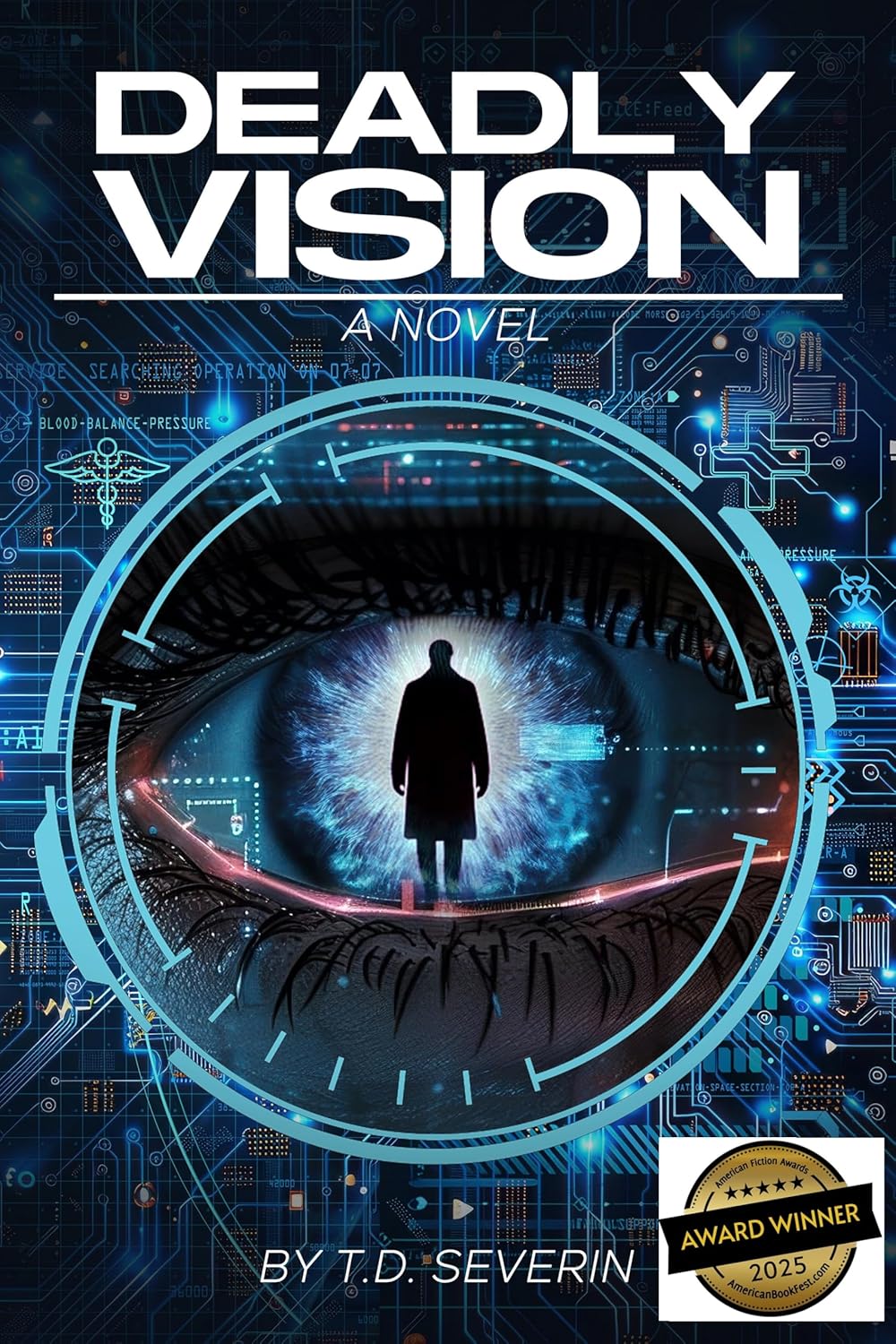
Deadly Vision starts like a high-tech thriller but unravels into something much deeper and darker. It follows Dr. Taylor Abrahms, a driven ER doctor whose research into virtual reality medicine collides with political greed, corporate secrets, and moral decay. From a Silicon Valley conspiracy to a presidential campaign in chaos, author T. D. Severin stitches together the worlds of science, power, and human frailty with an eerie sense of realism. The story opens with a murder and keeps up a relentless pace, jumping between operating rooms, campaign dinners, and backroom plots. At its heart, it asks one big question: how far would we go in the name of progress?
Severin’s writing has a cinematic quality. Scenes move like quick cuts in a film, filled with blood, urgency, and political swagger. The dialogue feels authentic, sometimes clinical, other times sharp enough to draw blood. The medical details are vivid and intense, almost uncomfortably real, and the moral tension keeps you off balance. Abrahms is compelling, but he’s also hard to love, too focused, too numb from exhaustion. And that’s the point, I think. Severin doesn’t romanticize science or heroism. He shows their cost.
What struck me most wasn’t the tech or the politics but the fear under it all. The fear of losing control, of letting machines replace human touch, of progress turning against its maker. The book hums with that dread. It’s ambitious and messy and alive. The villains feel terrifyingly real because they believe they’re doing the right thing. And Severin has a knack for making every ethical question feel personal. There’s a sadness that lingers after the last page, the kind that stays with you longer than the plot itself.
I’d recommend Deadly Vision to readers who like their thrillers with brains and bite, people who enjoy Michael Crichton’s scientific tension or Robin Cook’s medical intrigue but want something a bit grittier. It’s not a light read, and it doesn’t hand you easy answers. But if you like stories that make you squirm, think, and wonder what’s really possible when science meets ambition, this book will grip you from start to finish.
Pages: 468 | ASIN : B0DZ3JWVYX
Black Sun Rising

Black Sun Rising kicks off with a brutal explosion at a shelter in Washington, DC, and from there, the pace never lets up. Marko Zorn, the homicide detective at the center of it all, is thrown into a case that spirals far beyond what seems at first like an isolated act of terror. Political intrigue, extremist violence, and shadowy forces collide as Zorn and his partner, Latasha Powell, find themselves pulled deeper into a world of conspiracies and deadly power plays. The book blends police procedural grit with the breathless urgency of a thriller, building toward threats that could destabilize not just the city, but the entire nation.
I found myself struck by how alive Zorn’s voice feels on the page. He’s sardonic, weary, sharp as a blade, and relatable all at once. The author writes him as a man who wrestles with his own demons but never loses his edge. That mix of cynicism and determination hooked me right away. I also appreciated Latasha. Her optimism offsets Zorn’s brooding tone, and their partnership gives the story warmth amid the chaos. The writing itself moves with snap and bite. Scenes never linger too long, and there’s always this current of tension beneath the dialogue. It reminded me of noir in some ways, but updated with a contemporary urgency.
The flood of conspiracies, high-ranking officials, billionaires, and hidden organizations kept the story charged with energy. Each new twist raised the stakes and added to the sense that danger was everywhere. Rather than slowing things down for quiet reflection, the book leans into the chaos, and that frenzy becomes part of its thrill. This is a book about a city on edge and a detective who refuses to play by anyone’s rules. The excess, in a strange way, matched the paranoia and adrenaline running through the story.
Black Sun Rising is a sharp, breathless ride. It’s for readers who love thrillers that don’t flinch from big stakes and who enjoy characters that live in moral gray zones. If you like your crime stories tangled with politics, secrets, and the pulse of real danger, this one’s worth your time.
Pages: 280 | ASIN : B0DZXWKWSM
Real Life is the Inspiration
Rough Diamond, Rough Justice follows a former professional photographer turned MI5 surveillance agent who winds up in the diamond trade, where killing is not optional; it is the only way to survive. What was the inspiration for the setup of your story?
Real life experiences was the inspiration. As it says at the beginning of Rough Diamond, Rough Justice: This book is a work of fiction, inspired by several real-life events and real people. Names, characters, incidents, and places are the product of the author’s imagination. Any resemblance to actual events, locales, or persons, living or dead, is coincidental.
There was a lot of time spent crafting the character traits in this novel. What was the most important factor for you to get right in your characters?
Reality was the most important factor. As it says in Rough Diamond, Rough Justice when Cain was talking to his best friend:
‘We will have to write that book when we retire,’ Cain suggested.
‘All those secrets,’ said Detective Sergeant Jerry Davis (a member of The Royal Protection Team). ‘Perhaps we will.’
In real life, my best friend unexpectedly died, so I wrote our book alone.
I felt that the action scenes were expertly crafted. I find that this is an area that can be overdone in novels. How did you approach this subject to make sure it flowed evenly?
In real life action can only go so far. Seeing too much in movies, TV series – and having a karate black belt – plus a couple of personal experiences helped me craft the action.
Is this the first book in the series? If so, when is the next book coming out and what can your fans expect in the next story?
This is my first book. I have written an initial 40,000 words of a sequel about Cain, set in South Africa & England. Will I finish it? Time will tell.
Recovering from injuries sustained protecting the Royal Family, Cain embraces a new life and romance in sun-drenched Australia, leaving his past life behind.
But when tragedy strikes, he is on the move again. This time to a new career in the world of diamond dealings in Florida.
Curiosity takes Cain to the diamond world in South Africa, where his past finally catches up with him, the criminal world allies against him and he becomes a killer again.
In Cain’s action-packed escapades, a spectacular betrayal takes him into the rigours of a Chinese prison where the truth about his past begins to unravel.
Aided by a loyal band of friends from the shadowy world of intelligence, he delivers his own particular brand of rough justice.
However, with enemies closing in on all sides, will Cain prevail?
Rough Diamond Rough Justice

Avien Gray’s Rough Diamond, Rough Justice is a gritty and cinematic thriller that follows Cain, a former professional photographer turned MI5 surveillance agent, as he navigates a world of espionage, betrayal, and violence. Starting in early 1990s Britain, where the digital world had yet to take over, the story opens with a stakeout gone wrong and spirals into a bloody encounter that sees Cain commit his first kill. What follows is his slow, reluctant descent into a covert government agency known as the Bureau, an off-the-books group tasked with eliminating threats to national security. Alongside his best friend Jerry, a member of the Royal Protection Team, Cain undergoes a transformation from observer to executioner, trading in his camera lens for a Beretta.
I enjoyed the writing style. It’s punchy and full of swagger, packed with banter, dry wit, and sharp observations. The dialogue pops. There’s a real rhythm to it, almost like watching a well-rehearsed play where the pauses and timing matter just as much as the lines. The early scenes between Cain and Jerry crackle with believable camaraderie. I felt like I was eavesdropping on two lifelong mates who’d seen far too much and still managed to laugh at life’s mess. And the pacing was great as well. It hits the gas early and never really lets up. Even the quieter moments carry a tension, like something’s about to go sideways. And often, it does.
But it’s not just the action that carries the weight. The book dives deep into moral gray areas like what it means to kill, how one justifies it, and what’s left behind after the blood dries. Cain isn’t a gung-ho hero. He’s thoughtful, even reluctant, but deadly when pushed. His reflections after his first kill, mixed with dark humor and flashes of raw honesty, got under my skin. I found myself rooting for him and questioning him at the same time. That tension between duty and humanity gave the story its real punch. I also appreciated the nostalgic backdrop. The pre-digital details, the analog grit. It grounded everything in a tangible, almost tactile realism.
Rough Diamond, Rough Justice is a fierce and memorable read across the world. In Britain, Australia, the United States, South Africa, and a Chinese prison in 2005. It blends old-school spy grit with a modern sense of psychological depth. I’d recommend it to fans of The Spy Who Came In from the Cold who don’t mind a bit more blood and banter, or anyone who enjoys fast-paced thrillers with brains. If you like your action served with sharp edges and a stiff drink, this one’s for you.
Rough Diamond, Rough Justice is a recipient of the Literary Titan Book Award.
Pages: 516 | ASIN : B0DDW2C1XP



 LITERARY TITAN