Blog Archives
MASTERING THINKING: Reasoning, Psychology, and Scientific Methods
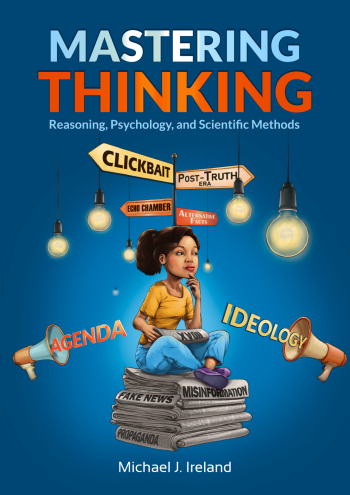

Michael Ireland’s Mastering Thinking delves into the intricacies of critical thinking and scientific reasoning. It’s a comprehensive guide that’s equally enlightening and demanding, aimed at giving readers a robust toolkit for dissecting arguments, examining beliefs, and thinking more effectively. From the get-go, Ireland emphasizes the sheer complexity of the human mind and its vulnerabilities, exploring concepts like cognitive biases and the importance of self-reflection. Each chapter meticulously unpacks ideas, from understanding our mental limitations to employing Socratic questioning and logical reasoning in everyday life.
One of the book’s strengths is its candid and engaging writing style. The author doesn’t pretend that thinking is easy. He’s quick to point out how easily we can deceive ourselves and fall for cognitive traps. His humor and humility shine through, like when he admits to the daily mental lapses we all experience, such as searching for your phone while it’s right in your hand. This honesty makes the dense material approachable. The chapter on the power of questions really resonated with me. Ireland compares learning to ask the right questions to mastering a new art form, reminding us that even Socrates needed practice.
While informative, the discussions on language and logical fallacies occasionally get bogged down in terminology and technical details that might overwhelm casual readers. The detailed breakdowns sometimes feel like a double-edged sword because I found them helpful for depth but difficult to digest all at once. However, Ireland tries to break up the complexity with personal anecdotes and historical examples, like Aristotle’s outdated beliefs or Galileo’s pivotal experiments, which breathe life into abstract ideas.
Another high point is the book’s emphasis on applying critical thinking to our own beliefs. The author makes a compelling case for examining our assumptions rather than critiquing others. I found the section on confirmation bias particularly eye-opening, as it was a sobering reminder that we’re often our own worst critics. These sections challenge readers to think about thinking, which, let’s be honest, is a mental workout.
Mastering Thinking isn’t light reading, but it’s a must for anyone willing to dig deep and improve how they process information. I’d recommend it to students, professionals, and anyone who’s tired of being swept up by the modern world’s information overload. If you have the patience, the insights and mental tools Ireland provides are more than worth the effort.
Pages: 375
Living With No Regrets

Mt. ؟!…shing: A Journey to Reconstructing Life and Its Meaning drawing inspiration from Martin Seligman’s Flourish theory and Eastern transcendental teachings, leading readers on a symbolic ascent up the mountain of life exploring psychological theories blending with spiritual teachings. What were some ideas that were important for you to share in this book?
The ultimate desire for every individual is to live in such a manner that at the end, they will have no regrets. Many times, people try very hard and do a lot, but still don’t get what they want. Dr. Martin Seligman, a former president of the American Psychological Association (APA), explored and defined five pillars of flourishing. Unfortunately, his work is hard to understand, not only for non-English speakers but also for native English speakers. I’ve taken it upon myself to present his theories in a manner that is more accessible. Populist ideas, usually spread by some authoritative personalities, form one of the major threats in the modern world. Similarly, popular psychologists have not always been so effective at getting their research across to an ordinary audience. To do this, I try to make these more complex psychological theories, such as those concerning Dr. Seligman’s work on flourishing, understandable to ordinary people.
How much research did you undertake for this book and how much time did it take to put it all together?
This book took me over three years to complete, involving vigorous research into theories of flourishing and well-being, many of which were shared with me by Dr. Seligman himself or referenced in his works. I collaborated with the R&D team to fully explore and distill these ideas. Initially, the book had seven chapters, but it was overwhelming. To this end, I decided to condense it, yet every chapter still stands alone as a comprehensive piece on the subject. That’s why I often say that by reading this book, you’re essentially reading six books in one. This project, I honestly believe, is one of the most important contributions to psychology today—at least for myself. It represents the culmination of my best work.
What do you hope is one thing readers take away from your book?
I hope readers walk away with a better understanding of the theory of flourishing. It is deceptively simple on the surface, but becomes more complex when explored in depth. I would also like people to recognize that many principles of today’s psychology were already touched upon by Eastern thinkers hundreds of years ago, proving that the lessons in flourishing aren’t just modern ideas but have stood the test of time. We should appreciate the wisdom of those ancient scholars who grasped ideas still being explored today. Ultimately, I want readers to understand how important flourishing theory is—its relevance has endured for over a century, and it remains a powerful tool for well-being.
Author Links: Website | Twitter | Instagram | Book Review

Mt. ؟!…shing: A Journey to Reconstructing Life and Its Meaning

Mt. ؟!…shing: A Journey to Reconstructing Life and Its Meaning delves deeply into the realms of personal growth, self-discovery, and the philosophy of flourishing. Ali Mirsadeghi, drawing inspiration from Martin Seligman’s Flourish theory and Eastern transcendental teachings, leads readers on a symbolic ascent up the mountain of life. This narrative seamlessly blends storytelling with philosophical inquiry, posing profound questions about existence and delivering transformative insights along the way.
Mirsadeghi’s writing captivates and stimulates thought, though its complexity may challenge some readers. His distinctive style is characterized by fluctuating tones and intricate language, inviting readers to engage thoroughly with the text. The book opens with an enigmatic introduction featuring characters like Mrs. Meaning and Mr. Hope embarking on their journey up Mt. Shing. The initial storyline, referred to as “story zero,” effectively immerses readers in a world where the ideas of flourishing and decline are not merely abstract concepts but actionable paths one can navigate in life. A standout aspect of “Mt. Shing” is its innovative integration of Eastern philosophies with modern positive psychology. Mirsadeghi excels in weaving these diverse teachings into a cohesive narrative, demonstrating his ability to harmonize seemingly disparate ideas. The intricate nature of the concepts presented might be overwhelming, especially for those unfamiliar with Seligman’s work or Eastern thought. The use of allegorical characters to convey psychological principles, while creative, may require multiple readings to fully appreciate their depth.
Mt. ؟!…shing: A Journey to Reconstructing Life and Its Meaning is an essential read for those interested in personal development, philosophical exploration, and the fusion of psychological theories with spiritual teachings. This book is particularly suited for individuals familiar with or curious about positive psychology and Eastern philosophies and those ready to embark on a journey of self-discovery.
Pages: 340
Phil Was the Real Deal
That Man in the Gold Lamé Suit delves into the complex life and career of Phil Ochs, exploring his steadfast dedication to music and his unwillingness to conform to popular trends. Why was it important for you to tell his story?
There were several reasons why I felt Phil’s story had to be revisited.
First, one of the courses I used to teach was “Music & Politics.” Phil’s name & music kept popping up as I looked for materials for this class. As I looked at this material and became familiar with his music, politics, and who Phil was as a person, I had the epiphany that Phil Ochs was the person that everybody believed Bob Dylan was in the 1960s. Phil was the real deal–a committed topical songwriter and political activist, neither of which Dylan ever was.
Second, Phil’s story often gets told with too much emphasis placed on his alleged bipolarism, his alcoholism, and his suicide. They became the centrality of how his story was told rather than be presented and understood as simply parts of a very complex artist who struggled with a sense of who he was. These three circumstances in Phil’s life allowed people to glaze over that his very search for self was essential to understanding who he was, how Phil saw himself, and how that search was central to both his artistic creativity & his politics.
Third, I met his older sister, Sonny Ochs who is a force of nature in her own right and a champion in keeping her brother’s music alive and being played at the grassroots level. After my first meeting with Sonny, I knew I had to write about Phil.
Phil Ochs was an influential musician in his time. What were some goals you set for yourself as a writer in this book?
One of the goals I’ve already mentioned in response to the last question, and that was to address the imbalance in how Phil’s life story is usually told.
Beyond and above that is that I set for myself the goal of telling Phil’s story through his eyes and to present it as much as possible as he would if he was still here. That is why I employed the theory and method of Self Psychology in writing this book. By relying as much as possible Phil’s own words, he was then able to reveal to me what his search for self entailed; the triggers for this search; for what voids he was trying to compensate in this search; how his search manifested in his music, politics, and relationships to others; and how it ultimately led to his suicide.
Did you find anything in your research of this book that surprised you or a story that stood out and left an impression?
It’s not too far from the truth to say just about everything stood out and left an impression. Phil was not an easy person for me to get to know. There were times when I would pour over his words for hours only to have it take days for him to reveal what it was that he wanted me to know and write. However, one of the biggest things that stood out was how much his desire to be a hero and to see heroism in others defined his search for self, his music, and his politics. Phil desperately wanted to be like his heroes of the Silver Screen such as John Wayne. He embraced people based upon their perceived heroism. That’s why he could idolize both John Kennedy and Che Guevera. His own politics was defined by heroism. For instance he saw America in heroic terms. His opposition to the Vietnam War wasn’t an opposition to war per se, but to an unheroic war that wasn’t worthy of his heroic America. I could go on and on but I won’t.
Also what also stood out to me was just how much Phil needed and craved affirmation from others. He simply wasn’t secure enough in his self to see how talented he was and how worthwhile his own life was. This need and craving were scars left from early childhood trauma of parents unable to respond with the affection & affirmation their young son needed. That need & craving for affirmation drove Phil as much as did his desire to be a hero. Frankly, they are interconnected. That comes through throughout the various chapters in the book.
What is the next book that you are working on and when will that be published?
Hmmm—this book on Phil took 6 1/2 years of my life so I’m not certain if I have another one in me at the time being. Phil was a calling, a type of destiny, and I haven’t felt a similar calling yet. But never say never. I’ve got a couple of possible subjects if that call ever comes in. One would be a book on Kris Kristofferson. Another would be a book on Michael Nesmith.
In the short term, I’m focusing on music. I’ve got a new band called Calico Bunny, and I am trying to get back into songwriting again. For the curious, I have 3 CDs of original music on Spotify, Apple Music, and the other streaming services. Their titles are “Tequila Lips,” “No Apology,” and “Seeking Calm Waters.”
Author Links: GoodReads | Website
That Man in the Gold Lamé Suit explores who Phil Ochs was as he saw and understood himself to be; how he wanted to see himself; and how he wanted to be seen by others. In presenting this exploration of Phil Ochs, author Jim Bowers delves deep into Ochs’s personality to craft a narrative that allows the singer/songwriter to tell his own story rather than the story others would impose upon him. In letting Ochs tell his own story, Bowers in That Man in the Gold Lamé Suit provides the reader with insights into how Phil Ochs’s search for self came to define who Ochs really was and how it, in turn, shaped his music, his politics, and his relationships with such contemporaries as Bob Dylan.
That Man in the Gold Lame’ Suit: Phil Ochs’s Search for Self
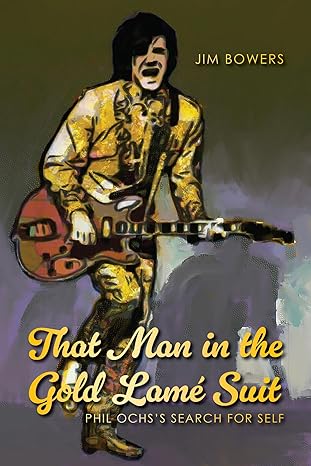
That Man in the Gold Lamé Suit by Jim Bowers delves into the complex life and career of Phil Ochs, exploring his steadfast dedication to music and his unwillingness to conform to popular trends. Bowers presents Ochs as a musician with a clear vision, unyielding in his artistic integrity. The book intertwines Ochs’ musical journey with his political views, shedding light on his perspectives on notable figures such as Mao Zedong and John F. Kennedy. It also highlights his admiration for icons like Elvis Presley and Bob Dylan.
The narrative begins with Ochs’ early influences, chronicling his struggles with addiction, turbulent relationships, and the challenges he faced with his fan base. Bowers meticulously portrays Ochs’ life, connecting his emotional experiences to his lyrics and providing readers with a deep understanding of the stories behind his songs. For instance, the song “First Snow” is illustrated to depict Ochs’ acceptance of his role in a romantic breakup, adding depth to his musical expressions. Several features make this book particularly engaging and informative. Each chapter opens with a quote that sets the tone, and a comprehensive reference section at the end offers additional resources for further exploration. Bowers effectively weaves together opinions from various individuals, Ochs’ own words, and insightful analyses, creating a rich tapestry of historical, political, and cultural contexts. Reading Bowers’ detailed account of Ochs’ life feels like a personal journey, fostering empathy for his struggles with depression and alcoholism. Despite these challenges, Ochs emerges as an admirable figure, passionate about his art and committed to authenticity. This book serves as a poignant tribute to Ochs’ legacy, emphasizing the importance of artistic integrity and balance in life, free from the pressures of public approval.
That Man in the Gold Lamé Suit stands as a comprehensive, creative, and enduring homage to Phil Ochs, offering valuable lessons for musicians and artists worldwide. It is a must-read for anyone seeking to understand the heart and soul of a true artist who remained unwavering in his commitment to his craft.
Pages: 360 | ASIN : B0CLKYF15N

Upward Mobility

In This Is How We Heal from Painful Childhoods, you provide readers with a guide for dealing with childhood traumas that leave an impact far into adulthood. Why was this an important book for you to write?
Throughout the doctoral program for my PhD in clinical psychology, I searched for a comprehensive program to address the many complex issues present in family environments that allowed for repeated trauma and dysfunction. While I learned many fantastic therapeutic approaches to treating trauma, I found that they addressed several key parts of the trauma picture while ignoring other critical components. And so I set out to create a more complete list of variables, along with solutions and guidance to address each variable. And it only took me 14 years to complete!
What is a common misconception you feel people have about growing up with a dysfunctional family dynamic?
So many young adults believe that all they have to do is get free of their dysfunctional family by getting a solid job and their own independent place to live, which usually works for about a decade until their late 20’s and early 30’s when the less obvious (but very damaging) lingering habits and unhealthy thinking prevent personal thriving and happiness. It is not until they learn about self-sabotaging cycles, interpersonal control dynamics, and other natural consequences of the dysfunctional family dynamic that these survivors are able to truly break free from their family’s trauma history.
Can you share with us a little about the research required to put your book together?
First of all, for many years I have directly served clients struggling with complex post-traumatic stress disorder (C-PTSD), like at the National Center for PTSD at the Veterans Affairs Palo Alto Healthcare System (amongst other places) where I studied and worked for 4 years in graduate school. Secondly, through continuing education programs, I purposefully learned many of the empirically validated therapies for treating trauma (EMDR, biofeedback, mindfulness, ACT, DBT, etc.). Third, by 2015, I had created my curriculum that included 13 variables that I turned into ‘rules’ that were easier for my clients to memorize and integrate into their lives. By 2017, the list had grown to 20 rules. By 2020, the 20 rules curriculum was highly refined and had successfully helped my clients and me address their family dysfunction in a comprehensive and detailed fashion. It was time to put the curriculum into book format!
What is one thing you hope readers can take away from This Is How We Heal from Painful Childhoods?
The lifestyle of upward mobility!! There is no one technique, one concept or skill, or one action that will heal a survivor and prepare them for a healthy, stable, happy life with their own successful relationships and family. So, much like the lifestyle of the martial artist, thriving survivors of childhood struggles have adopted a lifestyle of self-education, training, and self-empowerment that comes with tremendous challenges and victories throughout their lives. They just keep learning in their therapeutic activities–year after year–the many skills and insights that enable them to successfully handle life’s many challenges, as well as pass on their hard-learned education to the next generation!
Author Links: GoodReads | Facebook | Website 1 | Website 2
During prolonged periods of chronic stress, family traumas, or dysfunctional family dynamics, your young brain likely created deeply ingrained physical and mental habits to help you survive. Unfortunately, these habits and core beliefs work against your adult life and relationship goals.
Even if you did not directly experience childhood abuse or neglect, you have likely felt the harmful effects of intergenerational (generational) trauma from your family, inherited as genetic issues or passed along through skills deficits and dysfunctional relationships. When these ancestral issues go unaddressed, we hand them down to the next generation. Natural responses to childhood stress can include:Chronic anxiety symptoms
Unhealthy, chaotic, or toxic relationships
Survival-based thinking (short-term, defensive, distrusting)
Personal or family substance abuse (or addictions like gambling, work, porn)
Unstable work life
These perfectly normal reactions to a painful childhood do not automatically go away when you grow up! Recovery from such childhood experiences is challenging but quite possible when motivated survivors utilize self-education, therapy, and skills building to empower themselves.
This book presents 20 key concepts for comprehensively thriving past your stressful childhood. While many books focus on two to three of these issues in depth, they typically leave out entire concepts critical to beast-mode thriving! This book offers guidelines for you to develop yourself as an individual before moving on to enhancing your interpersonal functioning. Each chapter explains key concepts before offering solutions with realistic healing exercises to develop healthy habits that will help you heal and ultimately thrive! Here are just a few of the 20 rules:Trauma lies are just that…LIES
We must slow down to speed up
Practice treating yourself in a self-loving and self-respecting fashion
We are responsible for the decisions that we are aware of
It’s us against trauma world
This encouraging and reality-based guide was authored by Ernest Ellender, PhD, who has worked directly with trauma survivors from all walks of life since 1995. He combined insights from his clinical psychology doctorate education and career with training methods from his martial arts career (Jiu-jitsu black belt instructor) to create this comprehensive and effective curriculum for those on a healing journey toward emotional wellbeing.
Clients benefiting from this curriculum have included those struggling with mental health instability; those in codependent and dysfunctional relationships; single parents wanting to do better for their children; divorced parents struggling with healthy co-parenting; clients diagnosed with C-PTSD (complex post-traumatic stress disorder), ADHD, bipolar disorder, major depression, or dissociative disorders; clients whose prior therapists were poorly trained in trauma counseling and cptsd treatments; and parents seeking parenting tips to strengthen their family to prevent or minimize the impact of future traumas.
Following the guidelines of this book will lead to…More control, stability, and self-esteem
A daily life free of toxic shame!
Empathic and mature self-care and coping skills
Advanced self-advocacy and communication skills
Healthier, mutually supportive, and deeply engaged relationships when desired
The ability to articulate, set, and enforce healthier boundaries with both loved ones and toxic individuals
Positive parenting that fosters healthy families
A healthy lifestyle of healing and pursuit of long-term goals
Read less
Hello Flower

Hello Flower: A Real Life Story of Narcissistic Love and Invisible Abuse, by Martina Gruppo, is a compelling and insightful non-fiction biographical account that delves into the pervasive and insidious nature of narcissistic abuse. Gruppo’s narrative is a stark reminder that narcissism, an often unseen and underestimated form of abuse, can ensnare even the most resilient individuals. The subtlety and unpredictability of this psychological manipulation make it a particularly dangerous form of harm.
In Hello Flower, Gruppo provides victims and readers with the tools to recognize and recover from narcissistic abuse, offering practical advice for those currently in abusive relationships or those who have managed to break free. Her writing is raw and genuine, showcasing her talent as a storyteller and her bravery in recounting her own harrowing experiences of manipulation, humiliation, and mental abuse at the hands of a narcissist. Gruppo’s candid reflection on her youthful naivety adds a poignant layer of vulnerability to her story. Gruppo’s publicized recounting of her experiences is both urgent and captivating, making the book a gripping read. Her words serve as a soothing balm for those who have endured similar trauma, helping them to identify and understand the disorder. She encapsulates the despair of dealing with a narcissist in a powerful statement: “It doesn’t matter what you do, say, how you dress, or how hard you try—you simply aren’t there. You don’t matter.” This painful truth, especially when the narcissist is a close family member or partner, is the first step toward healing.
This book is an invaluable resource for anyone seeking to understand narcissism and its effects. Gruppo’s work is not only an educational tool but also a guide for those looking to reclaim their lives and self-worth after enduring narcissistic abuse. Her insights and encouragement help readers emerge stronger and ready to live life to the fullest.
I highly recommend Hello Flower to anyone seeking to learn about narcissistic abuse or to find solace and guidance on their path to recovery. Martina Gruppo’s book is a testament to resilience and a beacon of hope for those striving to heal from invisible wounds.
Pages: 258 | ASIN : B0D4VTQLDK
This Is How We Heal from Painful Childhoods: A Practical Guide for Healing Past Intergenerational Stress and Trauma
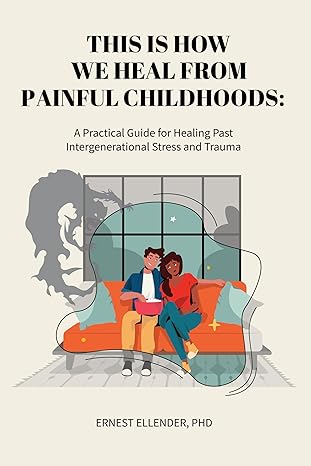
In This is How We Heal from Painful Childhoods: A Practical Guide for Healing Past Intergenerational Stress and Trauma, Ernest Ellender delves into the profound impact of childhood experiences on our adult lives. It’s a well-established notion that early childhood shapes our character and drives us through life. However, the journey is rarely without its challenges, and many of us carry the weight of childhood trauma into adulthood. Ellender’s book offers an insightful exploration of this trauma, particularly transgenerational trauma, and provides practical examples for beginning the healing journey.
Ellender emphasizes that transgenerational trauma doesn’t always stem from violence or horrific events; rather, it often arises from dysfunctional family dynamics that persist through generations. He asserts that now is the time to heal and grow from these inherited mistakes. The book is structured around 20 key points, or “rules,” designed to help readers overcome childhood trauma and live free from behaviors learned as self-protection mechanisms in childhood. One of the most compelling concepts in the book is the idea that “We must slow down to speed up.” This rule centers on the necessity of introspection. In our fast-paced lives, trauma doesn’t simply disappear; it requires deliberate and sustained effort to address and heal. To become stronger individuals, both for ourselves and those around us, we must take the time to engage in thorough self-work, allowing us to heal from our wounded pasts.
What sets Ellender’s work apart is its accessibility. Despite his academic background, the book is written in a relatable and comprehensible tone. It feels like a conversation with a trusted friend or a therapy session, making it easy for readers to connect with and learn from the material.
As someone with a background in psychology, I cannot overstate the importance of this book. Ellender’s career and expertise have culminated in a work that is invaluable for professionals in the psychology and mental health fields, as well as anyone struggling with past trauma or simply curious to learn more about the healing process. This is How We Heal from Painful Childhoods is a must-read for anyone on the journey to self-discovery and healing.
Pages: 367 | ASIN : B0CW1MJ1NH


 LITERARY TITAN