Blog Archives
A Comitragedy In Five Cantos

Theoryland: A Tragedy In Five Cantos follows an ambitious academic who dives headfirst into the world of highbrow theory only to have his arrogance grow, leading to his collapse into disillusionment. What inspired you to write this very unusual poem?
The date was roughly 1999. I was studying the falderal (H. L. Mencken’s word) in our public schools. I learned about flashy Academic trends such as Post Structuralism. My alumni magazine rejected an article on sophistry. A winter of discontent. I was broke. The more I read about the theories rampant at our universities, the less impressed I was. I always admired honesty and brevity as opposed to the strutting of pretenders.
I thought some of our professors ripe for mockery. You can see Theoryland start as a straight takeoff of T. S. Eliot, then you see it shift gears. Why? I was worried it would get stuck in a narrow rut so I jumped into a new car. A new ride, you might say.
In the rooms the critics come and go
sneering at the status quo.
On the dry grass, in a dry wind,
students throw a frisbee, joking.
I didn’t want to be predictable or pinned down by any particular tone. I wanted to surprise myself. The poem erupted. Abruptly, the janitor laughs, smoking. The subtext was always madness. I didn’t want to lose that at any point.
How long did it take to write?
I finished this wild thing in two or three weeks. I didn’t know what to make of it. Where do you place a very long poem? I put it on the shelf for almost 10 years! Then, one fine spring day, I took it out in the backyard and plunged in. To my surprise, I laughed and cried at all the same places. I decided this may be strange but it’s good.
Conventionally, many long poems obey traditional schemes and rules, so they are safe but also boring. Isn’t that the challenge? I took lots of chances. I had a lot of Eliot in my brain and careened from one souvenir to another. Maybe, I hoped, I could entertain people who normally don’t read poetry. This has enough story to be a play or a small arty movie. I think it would be so much fun to watch.
Were there any poets or other writers who influenced your work on this collection?
Early on my favorite poets were Walt Whitman. e e cummings. A Roman named Catullus. Ezra Pound. Lawrence Ferlinghetti. Walt Whitman coined the phrase “my barbaric yawp.” I think Theoryland is “my very own barbaric yawp.”
Eliot created the hero’s personality. J. Alfred Prufrock is a passionate but timid man. And we have all been there. Prufrock remains the same throughout his poem, but the narrator of Theoryland knows conquest and as well defeat.
What was one of the hardest parts in Theoryland for you to write?
To a great degree, it wrote itself. I worried about getting in my own way. Let it go, I kept telling myself. Take chances. What’s the most interesting thing that could happen now??? I’ve read this poem almost 50 times and every time was fun.
What is the next book that you are working on, and when can your fans expect it to be out?
I have two novels out now that were inspired by AI: Frankie and The Boy Who Saves The World.
I think they’re both excellent for telling people what scary things could happen.
In 2026 I hope to release Art and Beauty, detective mystery, and Carla –Manhattan Love Story.
Six Stories Up- Tales of Whimsy, Imagination, and Hey, A Little Satisfying Comeuppance


Six Stories Up is a lively collection of short tales that bounce between playful fantasy, sharp humor, and a soft punch of moral comeuppance. Each story stands on its own, from the rain-soaked artistic swirl of 1920s Paris to a Vietnam vet’s barroom confession, to a smart-mouthed seagull convincing a fisherman to take a swim. The book wanders through imagination with a kind of wink that says, stay loose, anything can happen here. There is trickery at times and reflection at others, and by the end of each tale, I felt that small, satisfying click of a truth landing where it should.
I enjoyed the author’s voice. It feels relaxed and mischievous, almost like someone at the far end of a bar spinning stories just for the fun of it. The writing moves fast and never takes itself too seriously. I got pulled in by the rhythm of it. Scenes like the boisterous café in Paris or the smoky bar in Seattle feel alive because the dialogue snaps and the characters talk like people who actually exist. I was grinning at the chaos around Tinkham in Paris, and then sinking into the slower, thoughtful mood of the old veteran’s tale in The Doppelganger War. The book shifts tones with ease, and I enjoyed that unpredictability. It kept me alert, never quite sure where the next turn would land.
And the ideas, honestly, surprised me. At first, I thought I was settling in for pure entertainment. Instead, I found myself thinking about belief, about luck, about the lies we tell ourselves to get through life. That talking seagull cracked me up, but it also made a point about trusting the wrong voices. The stories play with morality in a lighthearted way, but they still sting a little when the consequences show up. I liked that combination. I could sense the author having real fun with these characters while still nudging me to look a little closer. That balance made the whole collection feel richer than I expected.
I would recommend Six Stories Up to readers who love quirky short fiction with personality. People who enjoy clever twists, fast dialogue, and a mix of humor with heart will get a kick out of this book. It is great for anyone who wants something playful yet thoughtful, something that can make them laugh and then make them pause for a second. I had a good time with it, and I think anyone who likes stories that wander off the well-worn path will too.
Pages: 251 | ASIN : B08KXSX4WP

Dollartorium

Ralph earns his living in a modest Kansas shop, frying corndogs that are undeniably good and reliably popular. The work keeps him afloat for a while. It offers routine, modest comfort, and a sense of pride. Eventually, though, the numbers stop working. Sales stall. Bills pile up. Stability slips away.
At that moment of strain, Ralph’s wife introduces him to “Dollartorium,” a tantalizing promise discovered through an infomercial. The course offers bold ideas and glossy solutions. At first, it feels like salvation. New business concepts suggest a way out, maybe even a breakthrough. Then the foundation collapses. What seemed like an opportunity quickly unravels, leaving Ralph to reckon with the fallout. With the help of his daughter, Stella, he is forced to retrace his steps and search for a more realistic way forward for his family.
Dollartorium, by Ron Pullins, is a work of fiction that probes capitalism, hustle culture, and the pressures these forces place on families. Humor runs throughout the novel, but it never fully softens the sharper insights beneath the surface. The comedy entertains; the implications linger.
Pullins shows a clear awareness of how precarious financial life has become for many people. Ralph’s anxiety feels earned. His frustration resonates. The sense that the system is tilted against ordinary workers gives the story its urgency. The Dollartorium scheme itself feels uncomfortably familiar, echoing countless real-world programs marketed to those already struggling. These promises prey on desperation, and Pullins does not shy away from exposing their ethical rot.
Stella emerges as the novel’s moral and intellectual anchor. She tempers Ralph’s desperation with reason and clarity. Her perspective restores balance and nudges the story toward resolution. Yet even as the family regains its footing, the larger problem remains unresolved. The system that cornered them still stands. Pullins underscores this truth with restraint, allowing the message to land without sermonizing.
The novel closes on a note that is satisfying, though far from idyllic. That choice feels intentional. Pullins has more to say than a neat ending would allow. Through his characters, he gives voice to frustrations that have become commonplace, about inequality, exploitation, and the illusion of easy fixes. The odds remain stacked against the little guy, and the allure of grand, risky schemes proves hard to resist. Dollartorium captures that tension with clarity, humor, and an undercurrent of quiet anger that makes it linger after the final page.
The Capricious Nature of Being

The Capricious Nature of Being is a collection of short stories about the unpredictable turns life takes, and how ordinary people stumble, resist, adapt, or come undone as fate nudges them down unexpected paths. The book opens by framing life as a kind of “Secret Santa,” full of surprises we never signed up for, and the stories that follow lean into that idea with characters who face moments they never planned for and can’t control. In story after story, we meet people caught between who they thought they were and who life seems determined to make them become.
As I read, I kept pausing to absorb the way author Richard Plinke writes about internal struggle. His characters are flawed in ways that feel human rather than dramatic. They think too much. Or too little. They cling to old hurts or old hopes. In “The Safe,” Hope’s entire life tilts because of a single discovered date, and the writing lets her unravel in a quiet, almost tender way. I found myself nodding along, feeling that tug between wanting the truth and wanting the comfort of not knowing. Plinke seems to enjoy letting readers sit in discomfort, not to punish us but to remind us that most turning points in real life aren’t big cinematic events. They’re small realizations that land with surprising weight.
What struck me in many of the stories is how the author uses familiar settings to explore less familiar emotional terrain. A sales manager on a bike ride. A widow cleaning out a house. Someone facing the remains of a broken relationship or a restless conscience. The ideas in the book aren’t complicated, but they’re honest, and the writing doesn’t hide behind fancy language. Sometimes the sentences hit like a quick tap on the shoulder. Other times they stretch out, winding through a character’s history the way a person might ramble when they finally feel safe enough to tell the truth.
By the time I finished the last story, I felt like I’d been listening to a friend talk through the strange business of being alive. That’s probably what I appreciated most. The book has a reflective quality that never slips into preaching. Instead, it invites you to think about your own unexpected turns and how you handled them, or didn’t. If you enjoy character-driven fiction, if you like stories that pause on the small moments where everything quietly shifts, or if you simply want a collection that feels both grounded and thoughtful, this one will likely speak to you.
Pages: 357 | ASIN : B0FFWGLNP7
Too Complex: It’s a (Enter Difficulty Setting Here) Life
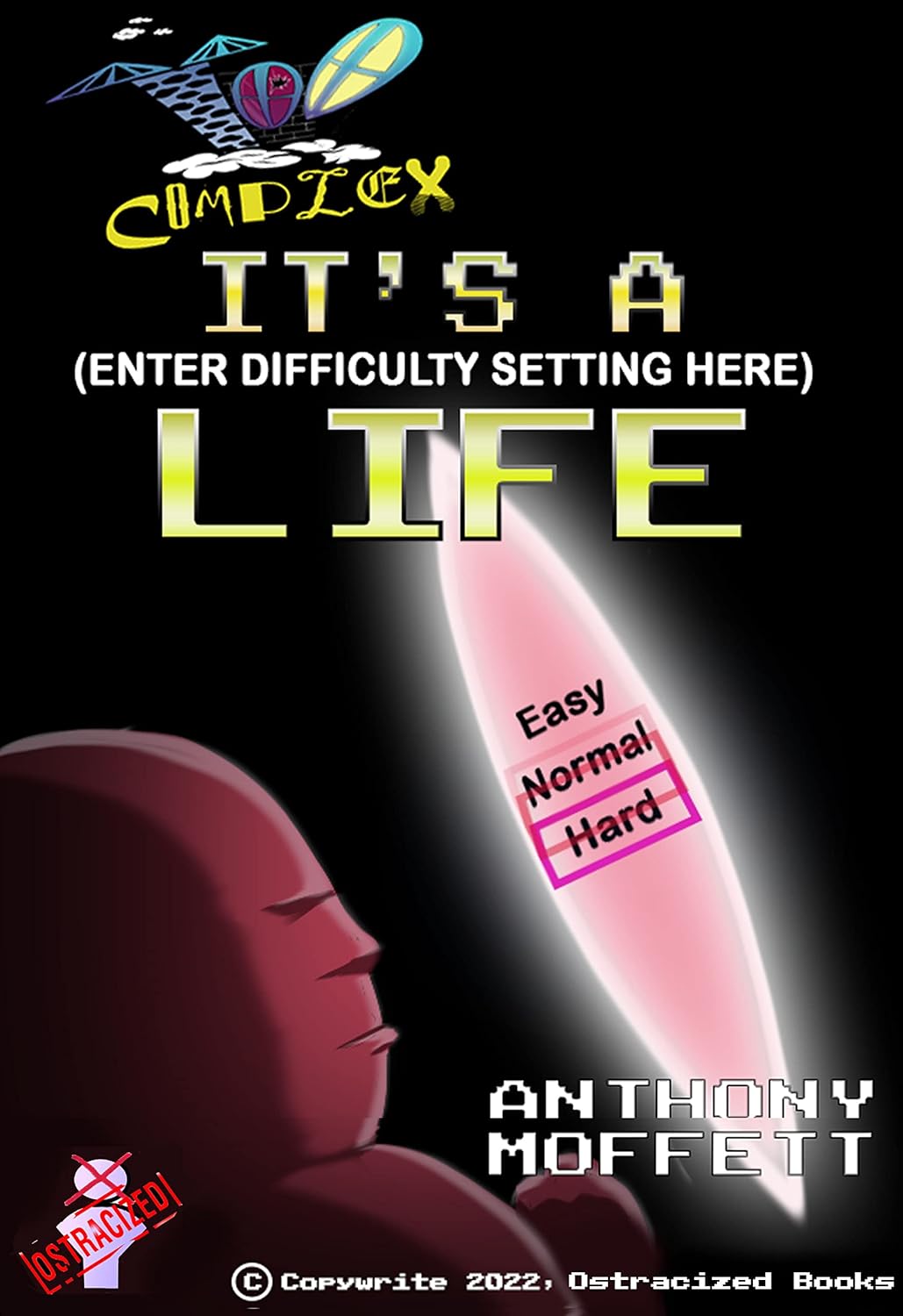
Cody Redbond lives to game. Addiction defines him. His fixation centers on Fantasy Estate, an online battle royale that consumes his days and erases everything else. Hours disappear. Priorities collapse. The game becomes his only reality, while the world beyond his screen loses all appeal. Employment slips away. Social skills erode. Eventually, eviction follows. Even then, Cody refuses to move on. He is too deeply embedded in the digital realm to disengage on his own.
Enter leasing agent Mavirna Holmes and property manager Corey Dwellen. Their task is simple in theory and nightmarish in practice: reach Cody and reclaim the apartment. Doing so requires navigating a living space that has deteriorated into absolute chaos, a physical manifestation of Cody’s inward retreat.
Too Complex: It’s a (Enter Difficulty Setting Here) Life, by Anthony Moffett, is a compact and sharply comic work that blends prose with illustrations. It occupies a space somewhere between novella and graphic novel, using visuals to punctuate its humor and heighten its absurdity.
At its core, the book is an absurdist adventure tailored to video game enthusiasts, but its reach extends further. It functions as a satire of modern adulthood, skewering burnout, disconnection, and the quiet despair that drives escapism. As Cody’s story unfolds, sympathy becomes inevitable. He has not merely abandoned reality; he has replaced it with something brighter, louder, and more responsive. Ironically, the so-called real world offers little incentive to return. It appears dull, unforgiving, and deeply uninspiring by comparison.
This contrast captures the enduring appeal of video games. They promise immersion without consequence, excitement without monotony. When everyday life feels hollow or exhausting, fantasy becomes irresistible. Mavirna and Corey, the unfortunate duo assigned to retrieve Cody, find themselves on a quest of their own, one that mirrors the very games Cody adores. The ultimate irony lies in the aftermath of his obsession. The artificial world he clung to has reshaped reality itself, transforming his apartment into a grotesque, pest-ridden dungeon.
The result is a book that is unabashedly fun. It is silly, unhinged, and gleefully excessive. Beneath the humor, however, lies a pointed warning. Too Complex entertains first, but it also lingers, offering a sharp and thoughtful reflection on escapism, avoidance, and the cost of choosing fantasy over life. I highly recommend this humorous and highly relatable tale to gamers and non-gamers alike.
Pages: 73 | ASIN : B0BR4J3L9Y

The Arts Council

When I finished The Arts Council, a satirical novel by Dolly Gray Landon, I felt like I’d been dropped into a carnival mirror version of the arts world. The book follows Honorée Oinkbladder, a gifted young artist raised inside a family business that quietly manufactures the physical tokens of achievement for institutions everywhere. Through her eyes, we watch a small city’s arts ecosystem twist itself into a tangle of ego, corruption, favoritism, and theatrical self-importance. Her tense rivalry with Modesty Greedance unfolds against a backdrop of inflated awards, misused donor funds, and a once-noble arts council that has drifted far from its original ideals. The result is a story that sits squarely in the literary satire genre, though it often reads like a character-driven dramedy with teeth.
The writing is lush, verbose in a way that feels deliberate, like Landon wants the excess itself to be part of the joke. There are long, winding sentences loaded with wordplay and invented terms, and then sudden needle pricks of clarity. It’s funny, but also strange, because the humor is threaded through moments that cut close to the bone: the way Honorée hides her beauty so she won’t attract the wrong kind of attention, or the way Modesty relies on spectacle instead of craft because spectacle is what the system rewards. The satire bites hardest when the book peels back the arts council’s history, revealing how a once-merit-driven institution slowly rotted after a leadership collapse. The contrast between past ideals and current dysfunction is one of the book’s most memorable tensions.
What I liked most was how much the novel asks us to think about value. Who gets to decide what counts as art. Who benefits from the illusion of fairness. Who learns to play the game and who refuses. Even the absurd elements feel purposeful: Honorée’s family literally manufactures the symbols that feed inflated egos, yet they see through them more clearly than anyone else. That irony gives the book a reflective core I didn’t expect. The novel also manages to be playful without losing its edge. It mocks the arts world, yes, but it also mourns what the arts can become when honesty gives way to self-interest. I found myself chuckling at one page and nodding in recognition on the next.
The Arts Council is a bold, brainy satire with a lot on its mind. I’d recommend it to readers who enjoy literary fiction that doesn’t mind being a little unruly, especially anyone curious about the messy intersection of art, ego, and institutions. If you like stories that mix humor with critique and aren’t afraid of dense, stylized prose, this one will keep you thinking. For readers who enjoy sharp, offbeat takes on creative culture, it’s a fascinating ride.
Pages: 558 | ASIN : B0G2TFBLHZ
Open the Mind of Some Poor “Nitwit”

Revolutionary Women A Little Left of Center, weaves together your personal history with your artistic, and ideological journey, starting with your early life in Toronto to your awakening as a gay artist and the experiences that shaped your identity and worldview. Why was this an important book for you to write?
“The book, Revolutionary Women, a Little Left of Center, is meant to be a work of revolution and revolt. Rejecting stale outdated notions and inspire people to think and see things differently.”
“The old dysfunctional thinking wasn’t working and needed to be laid bare. I wanted to create humorous imagery for all people, who were craving “phycological relief” and “counter-balance,” to the endless outpouring of “agony” and “hate” from the “extreme right.” I wanted to lift up the “left” and show it too, was an important human ingredient.”
“Women, more often than not, embody the left; more subtle in tone, soft, gentle, caring, uncanny intuition, creative and intelligent. These are the same characteristics shared by artists, musicians, gay people and any intelligent free-thinking person. What’s needed is real acceptance by society at large of people who are different. The standing order from idiotic religious & xenophobic ideologies is…. “You’re different and our leaders are telling us who to hate & to join-in their agenda of taking power by suppression and annihilation of others.”
“Let’s look at it from a gay women’s point of view and learn to lean a little to the “left.”
Your book expertly blends memoir with satire, offering readers a dash of humor alongside serious topics that impact modern day women. What is one thing that you hope readers take away from your story?
“What’s happening in the United States right now, sickens and horrifies me. It is my heart felt wish to connect and ease the hearts that ache for the planet and all its living creatures.”
“The “Left” is often attacked, and certainly regarded as less important than the ideas associated with extreme masculine notions of the “Right.” The extreme right rigid binary people are stuck in their own conflict of what is right and what is wrong. Unfortunately, they’ve been misinformed.”
“So, let’s laugh in the face of the ridiculous societal norms. Lay bare the faulty logic in religious beliefs and open the mind of some poor “nitwit” saturated in bigotry and speak out for those who cannot!”
What part of the book did you have the most fun illustrating? Was there one particularly hard section?
“I had the most fun actually drawing all the illustrations. The first four illustrations really set the tone. Firstly, imagine a fantasy of women cleaning up a war scene in WOMEN DO ETHNIC CLEANSING. Or next, envision a 3,000-year-old scene, at the ancient monument STONEHENGE, where women are included in the construction and joke about a huge fear known to all mankind.”
“Thirdly, a reenactment of the famous first moon landing, with women astronauts in MOONWALK. And fourthly, I introduce the character of Mother Nature in the illustration called GOD AND MOTHER NATURE DO THE REVIEW.”
“I suppose THE PHOBE FAMILY was a particularly hard section to finish, as it took me 10 years to resolve the problem presented in THE PHOBE FAMILY and answer it in WHY MAKE IT LEGAL? In the “Phobe Family,” I wanted to hi-light the fear, isolation & denial families go through, when it turns out they have a Gay child. It’s funny but hints of dark undercurrents.”
What is the next book that you are working on, and when can your fans expect it to be out?
Work in progress.
Step into a world where sharp wit meets unapologetic truth. A collection of full color illustrations/cartoons delivers a fierce and funny feminist punch, from the absurdity of gender roles to the hypocrisy of historical myths. With a clever commentary of edgy humor, and a wink into gay culture. These pages don’t just make you laugh; they make you think. Whether poking holes in patriarchy, challenging religious relics or spotlighting modern day madness, these cartoons are radical in the best way. Some are satirical, some are heart felt and sincere. All of them are drawn with a love for justice a questioning spirit and a mischievous pen. Perfect for anyone who’s ever rolled their eyes at the status quo or laughed in its face..
Laura M. Duthie was born in Toronto. Attended the Ontario College of Art from 1976 to 1980. Studied Fine Art. Worked in Real Estate Graphics, Woodworking and Carpentry. Also worked in property management and Security. Recently retired to become a full-time artist.
About the Author:Laura M. Duthie was born in Toronto and studied Fine Art at the Ontario College of Art (1976–1980). Her diverse background spans real estate graphics, woodworking, carpentry, security, and property management. Now retired, she has returned to her true passion as a full-time artist—using her art to speak truth with humor and heart.
Revolutionary Women a Little Left of Center
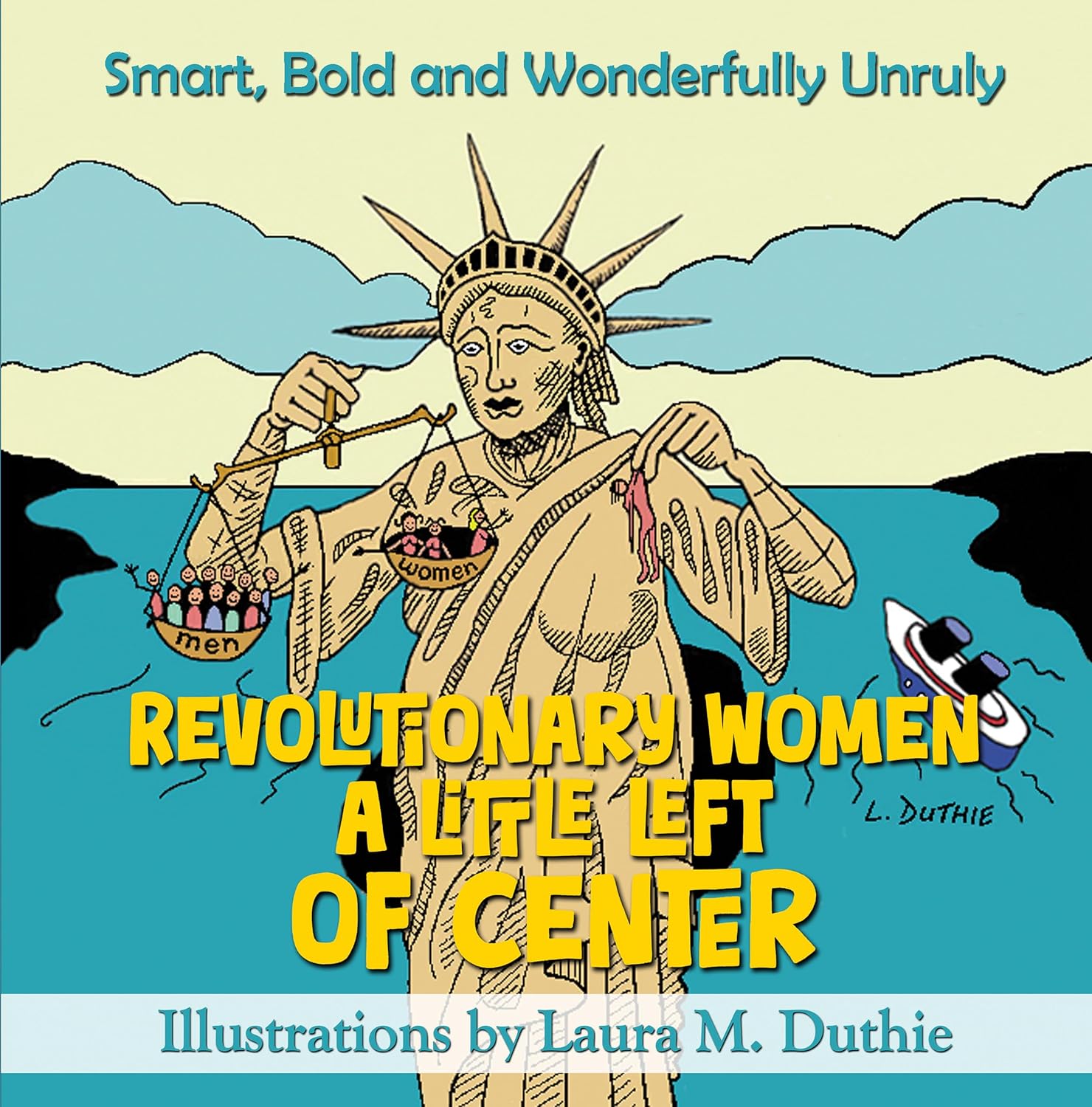
Laura M. Duthie’s Revolutionary Women: A Little Left of Center is part memoir, part feminist manifesto, and part visual commentary. The book weaves together Duthie’s personal history with her artistic and ideological journey. From her early life in Toronto to her awakening as a gay artist, Duthie recounts experiences that shaped her identity and worldview. Alongside her autobiographical reflections, she presents a series of feminist cartoons and essays that tackle themes like religion, patriarchy, sexuality, and society’s deeply ingrained biases. The work feels like both a confession and a call to action, a deeply personal yet universal exploration of what it means to claim one’s voice in a world that often silences women.
Reading this book felt like sitting down with someone who’s lived through several lifetimes of rebellion. Duthie’s tone is sharp and funny and sometimes achingly vulnerable. She doesn’t sugarcoat the pain of growing up under misogyny or the confusion of coming into her sexuality in an unwelcoming world. What struck me most was how her humor doesn’t dull her anger, it sharpens it.
The cartoon’s artwork is executed in a clear, traditional comic-strip style defined by bold outlines and a flat, simple color palette. This accessible visual style serves its purpose effectively, ensuring that the viewer’s attention is drawn immediately to the characters’ actions and the text in the speech bubbles. My favorite was the “Moon Walk.” The cartoon provides a sharp, satirical commentary on contemporary social polarization. It cleverly transports a modern “culture war” debate to a history-making moment, the first landing on another world, signified by the “APHRODITE I” lander. The humor stems from the juxtaposition of this grand achievement with petty ideological infighting.
There’s also something raw in how she talks about art and identity. When Duthie describes art school and the chaos of creative discovery, it’s electric. She paints the world of artists, the lost, the brilliant, the broken, with an honesty that’s both funny and sad. I felt her frustration with the hypocrisy of society, and I admired her courage to turn that frustration into something that challenges and provokes. Some parts run on, sure, but that’s part of the charm. It feels real. It feels like someone thinking out loud, refusing to polish herself for anyone’s comfort. Her take on Freud made me laugh. It’s the kind of commentary you wish you’d said yourself but never found the guts to.
This book left me thinking about what it really means to be revolutionary. Not in the sense of shouting the loudest, but in daring to be honest. Revolutionary Women is alive and full of heart and bite. I’d recommend it to anyone who loves art that has something to say, especially women and gay readers who’ve had to fight for their place in the world.
Pages: 67 | ASIN : B0FFZT3611


