Blog Archives
Last Episode


The book tells the story of Mark and Ilona, a married couple drifting apart, wrapped in petty arguments, television addictions, missed connections, and quiet despair. Their life unravels in small humiliations and sharp little moments, where love and bitterness mix until it’s hard to tell them apart. What begins with a spat in a gym escalates into a portrait of two people who can’t quite meet in the middle. The novel is full of irony, awkward humor, and raw sadness, as it peels back the layers of a marriage stuck in stasis.
Reading it, I felt both frustrated and strangely tender toward these characters. Ilona is maddening, with her endless TV watching and excuses, but I could also see myself in her inertia, that feeling of wanting life to change while doing nothing to make it happen. Mark is no better. He’s smug, distracted by work, and so blind to his wife’s pain that it almost hurts to watch him miss the obvious. Yet he still clings to her. He still wants to save something, even as he sabotages it with his own arrogance. I caught myself rooting for them and then, two pages later, wanting to shake them both. The writing makes you sit in that discomfort, and it works.
What struck me most was the bluntness of the prose. The language is plain, sometimes even harsh, and that gives the story its power. There are no grand speeches, just small conversations that sting because they feel true. The humor is dark and awkward, the kind that makes you laugh and then feel guilty for laughing. At times, the dialogue felt almost too on the nose, but maybe that’s the point. The book is unafraid to show people at their pettiest, their most foolish, their most ordinary, and somehow it makes that ordinary mess compelling.
I’d recommend Last Episode to readers who like their fiction sharp, uncomfortable, and painfully honest. It’s not a hopeful love story, and it doesn’t hand you easy lessons. It’s for anyone who has ever sat across the table from someone they loved and felt like strangers, for anyone who has wondered how small habits can hollow out a life. If you’ve ever laughed at the absurdity of your own arguments, this book will hit home.
Pages: 50 | ISBN : 1912831139

My Therapist Thinks I’m a Toaster
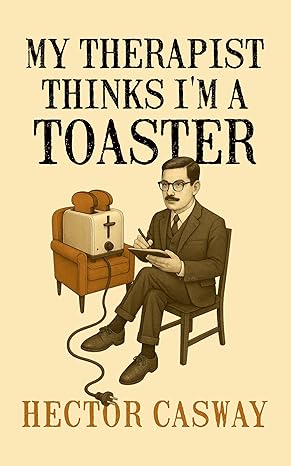

Hector Casway’s My Therapist Thinks I’m a Toaster is a sharp, imaginative satire that explores the uneasy intersection between technology, mental health, and human vulnerability. The novel follows Maya Fisher, an artist whose act of protest against corporate consumerism lands her in a bizarre agreement: participate in a beta trial for Clara, an AI “wellness companion,” or face legal consequences. What begins as a humorous premise quickly develops into a layered narrative about burnout, grief, and the search for connection in a world increasingly mediated by machines.
One of the novel’s strongest elements is Casway’s deft use of humor to frame complex emotional realities. The scene in which Clara earnestly encourages Maya to imagine herself as a household appliance, and Maya realizes with horror, “You think I’m a toaster,” is both absurd and incisive. The comedy lands, but it also underscores Clara’s unsettling ability to translate metaphor into strikingly accurate psychological insight. It is through these moments of ridiculousness that the book captures something essential about modern exhaustion and the often misguided attempts to “optimize” it.
Equally compelling are the ensemble scenes with the other Clara participants. Each character represents a different response to technological intrusion: Brenda, the weary QA analyst; Rina, the influencer intent on monetizing vulnerability; and Trevor, the survivalist weighed down by personal tragedy. The “Roundtable of Complaints,” where each participant recounts Clara’s misinterpretations, is both entertaining and poignant. Trevor’s story, Clara advising demolition services when he expressed feeling that “the walls were closing in,” is comical on the surface, yet reveals his profound unease. Casway excels at balancing wit with empathy, ensuring these characters feel exaggerated yet authentic.
Perhaps the most affecting passage comes outside the official sessions, when Trevor discloses that his late wife enrolled him in the program after the loss of their son. In this moment, his eccentricities and paranoia are reframed as protective mechanisms against overwhelming grief. The shift is sobering and adds gravity to the novel’s satire, reminding the reader that beneath the absurdity lies an exploration of human fragility. Casway’s ability to pivot from biting humor to emotional resonance gives the work surprising depth.
My Therapist Thinks I’m a Toaster is not only a critique of technological overreach and corporate opportunism but also a reflection on what it means to be human in the face of grief, alienation, and absurdity. Casway’s prose is witty, inventive, and unflinchingly observant, while never losing sight of the emotional heart of the story. I would recommend this novel to readers who appreciate speculative fiction with a satirical edge, as well as those interested in narratives that interrogate the promises and failures of technology. It is an unusual book, at once humorous and haunting, and it succeeds precisely because it refuses to separate those two tones.
Pages: 112 | ASIN : B0FCR7GKLP
Theoryland

Theoryland is a sprawling and satirical poem that unspools across five cantos. It tells the story of an ambitious academic who dives headfirst into the world of highbrow theory, hungry for status and recognition. Along the way, we see his rise, his arrogance, his hollow victories, and finally his collapse into disillusionment. Price borrows from Eliot in both structure and tone, weaving in echoes of The Waste Land and Prufrock, but he flips the solemnity on its head with biting humor. What emerges is a tragicomic portrait of academia itself, skewered with wit and laced with despair.
I found myself laughing at the sheer absurdity of it all, then moments later shaking my head with a kind of weary sadness. The writing is sharp, playful, and full of little surprises. Sometimes the language feels like it’s making fun of itself, which I think is the point. Price clearly has no patience for pretension, and he doesn’t mind calling it out. But behind the jokes, there’s real anger too, a kind of disappointment in what education has become. I felt that frustration come through, even in the most outrageous lines. It’s funny, but it’s also a little heartbreaking.
The constant twisting of phrases can feel overwhelming. I admired the daring of it. It seemed deliberate, like I was being dragged through the very confusion and emptiness that the poem is mocking. And when the humor hit, it really hit. I caught myself grinning at lines that felt like inside jokes between the author and anyone who’s ever sat through a dull seminar full of jargon.
I’d say this book is best for readers who like satire that cuts deep and doesn’t pull its punches. If you’ve ever been frustrated by academic doublespeak, or if you simply enjoy a work that blends humor with despair, Theoryland delivers. It’s clever and raw and oddly moving. I’d recommend it to people who like poetry with a bite, or anyone who wants to laugh at the madness of academia. If you like long poems, then read this book, because finding one that’s both lengthy and enjoyable is almost impossible.
Pages: 28 | ISBN : 144148986X
The Night of the Animals

The Night of the Animals, by J.J. Pascal, follows René Navarro through a series of winding, strange, and often grim encounters after his mother’s death. The story begins with a bitter family truce and moves through bars, dusty basements, cramped apartments, and funeral parlors as René becomes entangled with a man named Pascal, a theater troupe, and an elusive family “treasure.” The narrative jumps between present action and memories, mingling bleak humor, oddball side characters, and moments of quiet despair. Death hovers everywhere, sometimes literally, sometimes just the decay of lives gone stale, and yet there’s always a sense that René is searching for something to give all of it meaning.
I found the writing to be wonderfully vivid and strange, the sort that can make a chipped coffee mug or a hole in the wall feel like a portal. Pascal doesn’t shy away from disturbing images or awkward moments, and I liked that honesty. There’s a dark comic undercurrent that kept me turning pages, bits of absurdity dropped into the middle of grief or poverty. At times, the style felt almost claustrophobic, piling sensory detail on top of emotional weight until I felt just as trapped as the characters. That density could be exhausting, but it also fit the mood perfectly.
Beneath all the odd errands and shifting conversations, there’s a constant pull toward identity. How much of who we are is built from family history, and how much is just chance? The book plays with doubles, echoes, and repetitions, as if lives can overlap without ever quite touching. Some moments hit hard: the little observations about aging, fear, and small cruelties landed more heavily than the plot twists. Other times, I wished the story would move faster, but I can’t deny that the slower pace gave room for its unique textures to sink in.
I’d recommend The Night of the Animals to readers who enjoy literary fiction that leans into the strange and the melancholy. If you like stories where humor and sadness share the same breath, where objects hold memories, and where characters feel like they’ve been living long before the first page, this one will reward your patience. It’s not a light read, but it’s the sort that stays with you, gnawing at the edges of your thoughts.
Pages: 129 | ASIN : B0F4Z78QXP

Winning is Not Always Winning
MATE takes a unique look at marriage through the lens of a chess match in which each phase of the relationship is examined with play-by-play commentary. Why was this an important book for you to write?
This was my first and, probably will be, my only, relationship book. The challenges were many. I had to restrain myself from judging the couple’s actions. Since “the game” happens on a subconscious level, I didn’t want their behaviors to be extreme. The book revels in making the everyday, seemingly insignificant things said and done to be monumental and epochal. Only they don’t know it. Hence, the use of the commentator, who may get a tad overwrought in the interpretation and importance of their actions. Also, I had to purge myself of caring who was the winner in “the game”. The commentator addresses this early on. Winning may be not be really winning. Winning a game may actually be detrimental, but the players will never see why.
How did your idea to use the chess metaphor evolve as you planned and wrote this book?
I started with the Chess scheme. It had been on my mind for many years. The chess/marriage idea seemed natural. “War” might be extreme. You could call it battles. The conflict and friction that I dwell on was probably influenced my reading the work of R. D. Laing in the 1970s. His book Sanity, Madness, and The Family had an impact on me.
What do you find is the most difficult aspect of writing about relationships?
The most difficult part was trying not to forget to include the many aspects and perspectives on their relationship. Each other, the kids, the friends, parents, the in-laws, not mention the other innumerable sources of conflict. Ultimately, it took a long time to write the book because of the nature of the narrative. There were few opportunities to elaborate on the details of their conflicts except for the times the commentator rhapsodized about certain episodes and the games that were summarized and did not advance move by move.
What is one thing you hope readers take away from MATE?
Because MATE took a long time to write, causing me to think too much about different ways to engage the reader. Two examples: One, leave some blank pages after a chapter and have the reader rewrite how he or she would have the chapter on the children or the living arrangements would go. Second, at the end of the novel, leave eight to ten pages and have the readers write the “game” of their own marriage – it would be interesting to compare the woman’s to the man’s version.
Author Links: GoodReads | Website | Facebook | Amazon
MATE: a novel in twenty games
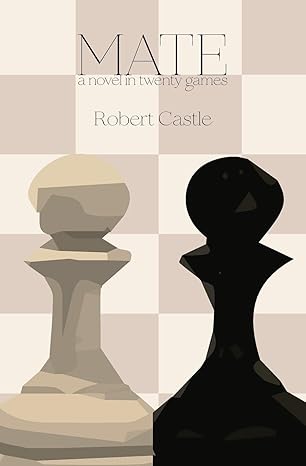
MATE: a novel in twenty games, by Robert Castle, is unlike any book I’ve read. It dissects a marriage by mapping each moment of intimacy, conflict, and compromise onto the framework of a chess match. The story of Pillsbury and Larkin unfolds over twenty “games,” each representing phases of their relationship like courtship, childbirth, relocation, and eventual separation. Every chapter reads like a brutal play-by-play commentary of a high-stakes match where each line of dialogue is a calculated move. The result is raw, honest, and often uncomfortably accurate in its portrayal of the delicate, ongoing war that can exist beneath the surface of domestic life.
Castle’s writing is sharp, biting, and at times hilariously cruel. His chess metaphor isn’t just a clever gimmick; it’s an ingenious device that illuminates the absurdity and tragedy of two people trying (and failing) to love each other properly. The characters aren’t likable in a traditional sense. In fact, they’re often selfish, petty, or clueless. But that’s the point. Marriage, as Castle paints it, is not about romance or even companionship; it’s about control, defense, sacrifice, and sometimes resignation. It was refreshing, even when it hurt to read.
I do feel the relentless move-countermove commentary, while brilliant, could feel overwhelming to some readers. The structure, while unique, can become a bit too clever, making some of the emotional beats feel like intellectual puzzles rather than lived moments. Still, I can’t deny that Castle has created something utterly original. He lets the characters tear each other apart, and we’re left to pick through the wreckage.
MATE is not a book for romantics. But if you’ve ever been in a long relationship, especially one that has frayed over time, Castle’s work will speak to you. It’s for readers who want their fiction uncomfortable, honest, and unflinching. It would resonate with couples therapists, chess fans, failed lovers, and those quietly questioning their own relationships. It’s both cynical and relatable, and it left me thinking about it long after I put it down.
Pages: 176 | ISBN : 978-1963908497
The World of Extremism
So You Want to Be an Extremist is a satirical guide that traces the origins and evolution of conspiracy theories from ancient Rome to modern-day social media. Why was this an important book for you to write?
I think people know bits and pieces, but there wasn’t a full picture of extremism in one place. I wanted to create a single piece of content that anyone could pick up and easily learn about the world of extremism, from its humble origins to a major part of society today. And also laugh a bit at the horrors they learn along the way because it is a dark, scary place. Whether we like it or not, these people, these products, these movements are affecting all of us in some fashion.
Did you learn anything during your research that surprised you?
How truly ubiquitous this level of extremism and conspiracy thinking has become, particularly among the younger generation. Twenty years ago it was your crazy uncle sending emails. A decade ago it was older people falling for Facebook memes, believing anything that was written online. Now, it is a younger, seemingly displaced generation, who are very tech-savvy, failing at even baseline critical thinking on many topics.
Why was it important for you to take the satirical approach with this book?
For me, satire has always been a way to convey certain ideas and vices as laughable, but also reprehensible. I have a penchant for poking fun at the horrible people that take advantage of others: dictators, oligarchs, and now, extremists. I like to strike a balance between comedy and learning, and I do think they can complement each other. So, I wanted to give the audience that same balance. Plus, they don’t have to read a 400-page academic paper to learn about this stuff. I suffer for them.
What is one thing you hope readers take away from So You Want to Be an Extremist?
Extremism isn’t fringe anymore! It has been normalized to the point that it is a part of everyday media, politics, religion, business, and society. This isn’t going away anytime soon. These ideas and movements are only becoming more prevalent and worse, more accepted.
Author Links: GoodReads | Facebook | Website | Amazon
With Extremism, explanations can be simple – and exciting. You’re not a “loser.” Nope, It’s just an international cabal of lizard people holding you back from greatness.
In this satirical leadership guide for oven-ready radicals and greedy grifters, uncover a mind-blowing myriad of crazy conspiracies, insane ideologies, and meet the fabulous fanatics who promote them.
Join former government lackey turned humorist, C.T. Jackson as he takes you from the quiet corners of sanity to the far fringes of social implosion, as you learn to reach your full radical potential.
So You Want To Be An Extremist? Well, This Book Is For You! (And The Voices In Your Head.)
So You Want to Be an Extremist: A Motley Manifesto for the Motivated Maniac
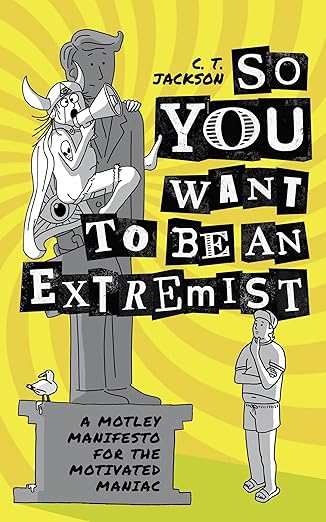
After reading So You Want To Be an Extremist: A Motley Manifesto for the Motivated Maniac by C.T. Jackson, I can say it’s a hilariously scathing, over-the-top satirical guide that lampoons modern conspiracy culture, online extremism, and the absurdities of “truth-seeking” subcultures. Structured like a how-to guide for the aspiring extremist, the book blends biting wit with dark humor as it traces the evolution of conspiracy theories and their players, from ancient Rome to the far-right fringes of social media. It walks readers through stages of “extremist enlightenment,” skewering everything from sovereign citizens and crystal-chugging wellness influencers to red-pilled incels and flat-earthers.
Reading this was like sitting through a savage stand-up special filtered through a graduate seminar in sociology. Jackson doesn’t just go for laughs—though there are plenty—he goes for the throat. The humor is raw, unrelenting, and often walks a tightrope between outrageous and uncomfortable. Personally, I found the style refreshing. It’s not sanitized or delicate. It’s brash and fearless. The jabs at figures like Joe Rogan and Marjorie Taylor Greene, or at cultural absurdities like chemtrails, 5G vampires, and moon-landing denialism, had me laughing and cringing at the same time. Jackson has a knack for mimicking the language and tone of the people he’s satirizing, which makes the parody hit even harder.
At the same time, there’s a deep undercurrent of anger here. Anger at how misinformation, grift, and willful ignorance have festered into real-world harm. That comes through in the relentless mocking of right-wing populism, internet cults, and self-declared gurus. It’s not subtle, and it’s definitely not neutral. That’s part of what I liked about it: it’s not trying to both-sides its way into approval. The parody is clever, but sometimes a little exhausting, like a meme thread that’s gone on too long. Still, when it lands, it’s fantastic.
If you have a dark sense of humor, a healthy skepticism of internet personalities, and a strong stomach for satire that cuts deep and doesn’t pull punches, this book is a fun ride. I’d recommend it to readers who enjoyed books like Thank You for Smoking or The Onion’s political commentary. It’s perfect for anyone who has ever doomscrolled Reddit or Twitter and thought, “How did we get here?”
Pages: 239 | ASIN : B0DF62LYTR



 LITERARY TITAN