Blog Archives
Unsolved Mystery

Hypocrisy drops readers right into a wild mix of government secrets, alien power plays, and strange visions that blur the line between what is real and what is imagined. What was the inspiration for the setup of your story?
I have been intrigued by the UAP disclosure activity in Congress and the ongoing mystery and debunking of the entire UFO phenomenon. I felt that would be a terrific background to create conflict and have different points of view to set the story against, since it still remains an unsolved mystery.
When you first sat down to write this story, did you know where you were going, or did the twists come as you were writing?
The characters came first, and I wanted them to be distinct and different, and from that came the outline of the story.
How did you balance the action scenes with the story elements and still keep a fast pace in the story?
I think it was Dean Koontz who said, “Put a character in a terrible situation and keep making it worse,” and that helped serve as a guideline for how things go wrong to maintain the tension and active plot.
Will this novel be the start of a series, or are you working on a different story?
This will be the start of a series. I intentionally set it up so that the characters could have an ongoing life full of adventure, chaos, and immense conflict. With a little bit of humor and self-reflection thrown in on the side.
Author Links: GoodReads | Ghost Town | Instagram | Facebook | IMDB | X (Twitter) | Amazon
In the world’s most remote outpost—Antarctica—a covert excavation unearths something ancient, intelligent, and alive. CIA asset Charisma, her teenage protégée Leticia, and enigmatic xenoanthropologist Alen Innocent are drawn into a web of deception that spans governments, galaxies, and the very fabric of human consciousness. As shadow factions fight for control of the mysterious Veil of Hypocrisy, the boundaries between truth and illusion collapse.
From Milan’s glittering runways to military tunnels buried under polar ice, Hypocrisy blends science fiction, espionage, and moral satire in a gripping tale of identity, power, and survival. As alien technology exposes the lies that bind humanity, Charisma and Alen must decide whether saving the world means revealing its greatest hypocrisy—or becoming part of it.
Science-fiction fans will be drawn to this mind-bending, character-driven thriller where the ultimate battle is not between species, but between truth and self-deception.
Tachyon Tunnel 3
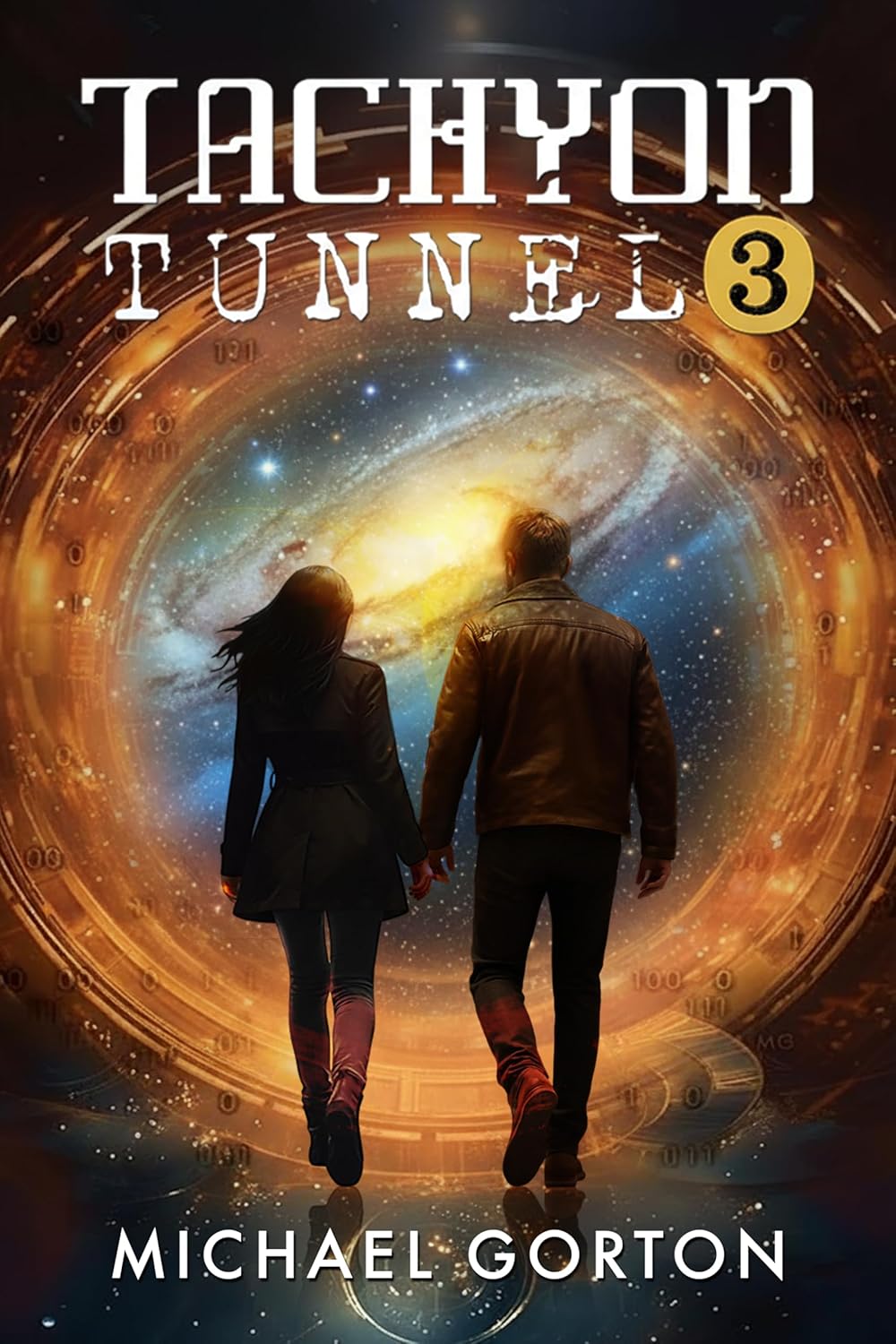

Tachyon Tunnel 3 continues the breathtaking saga of Alex Durant, Paula Campbell, and the evolving AI, Emily, as they face a galaxy on the brink. The story picks up where the last book left off: Earth barely spared from annihilation and the Daklin Empire’s grip tightening over the Milky Way. Author Michael Gorton plunges us into a universe brimming with complex technologies, alien politics, and impossible odds. We meet Fortak, a Daklin scientist stranded on Earth, and follow the growing resistance led by Alex and his allies. There are vast ships that hold cities within their hulls, civilizations millions of years old, and battles that unfold across the fabric of space and time. It’s part space opera, part philosophical exploration of humanity’s place in the cosmos.
Gorton’s writing crackles with energy. His descriptions of the Martian Empire and their cities made me feel the weight of their history, their pride, their downfall. The pacing runs hot, but it fits the chaos of a war that stretches between galaxies. I loved how science isn’t just a backdrop here. It’s part of the soul of the story. Tachyon tunnels, plasma consciousness, and sentient AI aren’t just gimmicks. They’re extensions of how we think about creation and survival. I wanted to sit longer with the characters, especially Fortak, who’s both villain and victim. His curiosity and isolation hit me harder than I expected.
Emotionally, this book is a roller coaster. It made me think about what it means to be human in a universe filled with beings far older and smarter. The scenes on Andromeda Prime, with its harmony and peace, contrasted beautifully with the Daklin Empire’s cruelty. There’s awe in the way Gorton writes about discovery. There’s sorrow in his portrayal of loss. And yet, there’s a spark of hope that keeps burning, even when the odds seem hopeless. I found myself rooting for Emily, the AI who feels more alive than most of the humans. Her growth and sharp wit gave the story its heart.
I’d recommend Tachyon Tunnel 3 to readers who love big ideas mixed with real emotion. If you enjoy science fiction that feels vast but still human, this one’s for you. It’s for those who want their space battles served with philosophy and heart. Gorton writes like someone who believes in both science and soul, and that combination makes his universe feel alive.
Pages: 519 | ASIN : B0DWKRQFJS

Light and Dark Shades

After the Before follows a pair of scavengers navigating the ruins of a collapsed world who uncover a mysterious box, only to wind up on an adventure filled with religious fanatics, deadly mechanical beings called A-Eye, and a stark landscape marked by craters and threats. What was the inspiration for the setup of your story?
The original title of AFTER THE BEFORE was “Plassik,” the material from which the sealed, found box is made. The scenario of finding the box created the landscape, the characters that people it, and the story’s chain of events. I liked having a mystery from the get-go, a mystery that’s not solved until the very end of the book. Imagining what a world would be like 300 years after an apocalyptic event was challenging. Even the language was changed. All the imagining was fun!
Your story has some very interesting characters that have their character flaws but are still likable. How do you go about creating characters for your story?
Character flaws are what create interesting characters. A character would need to be a complete psychopath not to have some likeable trait. Backstories or lack thereof provide enough information for a reader to like even a creep like the religious fanatic.
What were some themes that were important for you to explore in this book?
At heart, AFTER THE BEFORE is about four women, from young to old, who live their lives in this forlorn landscape. They each want something different: one wants closure, one wants purpose, another needs freedom, and another wants love. Love is really at the core of everything in the story. Together, these women explore loss, longing, loyalty, desire, and grief. It’s a broad palette with light and dark shades that offer great avenues for emotional exploration.
Is this the first book in the series? If so, when is the next book coming out, and what can your fans expect in the next story?
Yes, this is the first book in the AFTER series. AFTER THE BEFORE took three years to finish. I hope to have book two, IN THE AFTER, out much sooner! Some of the characters from AFTER THE BEFORE will be returning.
Author Links: GoodReads | X (Twitter) | Facebook | Website | Instagram | Amazon
Three hundred years after the fall of civilization, scavengers Sophie and Markus uncover a sealed, translucent box buried deep in the ruins of The Before. What’s inside might hold answers to the apocalyptic origins of The After and a path to a safer future—if it can be opened.
Hoping for help, they set out for the faraway City where a reclusive historian may have the knowledge they need. The trek takes them across the cratered plain, bombed almost into oblivion, and infested with unstoppable humanoid machines hungry for human flesh.
When a religious fanatic derails their mission, Sophie and the box disappear. Markus enlists unexpected allies to help find her, pushing into the heart of his worst fears and opening bitter wounds and testing loyalties.
What’s in the box may lead to a better future—but it just might cost them each other.
Sins of the Saviors Book 1: Escape From the Culling Box

In Sins of the Saviors, TJ Relk throws us into a grim but not entirely hopeless future where war, artificial intelligence, and blind patriotism have reshaped what it means to be human. The story centers on David, a soldier who returns from decades in a senseless, eternal war to a world governed by AI, propaganda, and engineered peace. The tale winds through his memories, regrets, and slow-burning defiance as he comes to understand the true cost of “utopia.” Flipping between David’s perspective and those of his aging mother Gale, his idealistic sister Mary, and his rebel sibling Jane, the book dives into what happens when free will is exchanged for safety, and what’s left when even memory is no longer trusted.
I liked how the book captured emotional decay. The slow erosion of identity in a world that insists it’s perfect. Relk’s writing is sharp. The style is lean and introspective, often haunting in how casually it delivers gut punches. There were pages I read twice because a single line kept ringing in my head, like David’s quiet desperation or Jane’s fiery truths about a world that stopped caring about real truth. Some scenes, like the slow fade of old friendships or Gale’s annual ritual to honor a son who might as well have been a myth, cut deeper than expected. They felt real. There’s no clean villain here, just systems of thought that got out of hand.
Sometimes the pacing slows, especially when the narrative shifts to Mary’s point of view. The dystopian future is vividly imagined. I was left wondering Goliath the network or a god? Sometimes both? Sometimes neither? I got the sense that Relk wanted that ambiguity, and it left me craving answers a few times. Still, I appreciated that the story didn’t spell everything out. There’s something gutsy in trusting readers to make their own calls about what’s real, what’s right, and who, if anyone, is actually free.
I’d recommend Sins of the Saviors to anyone who likes their dystopias philosophical, their heroes broken but not beaten, and their science fiction tangled up with questions about memory, identity, and whether safety is ever worth the soul. It reminded me a bit of 1984 with the heart of The Road, but written for today’s digital chaos. If you’re someone who’s ever worried about where all this tech and tribalism is going, this book might hit a little too close to home.
Pages: 199 | ASIN : B0FDBN6KMT

Everything Is at Stake

Until the Rescue Ship Arrives follows a retired priest who discovers a washed-up alien on a beach and chooses to protect this visitor and not turn them over to the authorities. What are some things that you find interesting about the human condition that you think make for great fiction?
Regardless of genre, what I consider great fiction always reveals the strengths and weaknesses of the characters who are presented with a problem or crisis in which much or everything is at stake. Great fiction requires presenting characters with great challenges.
What was one scene in the novel that you felt captured the morals and message you were trying to deliver to readers?
There are numerous scenes in Until the Rescue Ship Arrives in which characters had to reach deep within themselves, especially in Chapter 22, but to avoid giving those surprises away, a scene I would mention is in Chapter 4 when the female alien, already physically depleted and functioning almost on force of will alone, battles fatigue and the elements in her struggle to reach the Oregon shoreline.
What is the next book that you are working on, and when will it be available?
I am still exploring little fragments of stories that come into my head. Sooner or later, I’ll conjure a scene, a situation, or an exchange of dialogue that tells me there is a story here waiting to be discovered. I constructed the Until the Rescue Ship Arrives from the opening of Chapter 1 in which Father Hughes discovers the alien female on the beach. I saw everything pretty much as I wrote it up to the point when he kneels down and realizes he has discovered a person from another world. For some time thereafter I engaged in “what happens now?” until finally, I just began writing that scene. From then on, I was mostly just a reporter describing what I saw and what I heard the characters saying. The next book will probably follow that pattern.
Author Links: GoodReads | Amazon
Redemption

Heavy Weight of Darkness follows a disgraced former officer given one last chance to redeem himself by hunting down a once-privileged woman turned revolutionary who has become a symbol of the uprising across colonies.What was the inspiration for the setup of your story?
The story continues the story of the Endless Fall of Night from the perspective of Captain Willard Bennett, former captain of the Jefferson Davis where our heroin, Cassandra Kurtz, escaped and started of movement on Mars to rid the fledging colony of imperialism, racist patriarch. In a desperate act to curb insurrection on Earth, space command’s admiralty and tribunal branch offers him redemption in the form of a new mission: track, find and kill Cassandra Kurtz. In return, he will receive his freedom, commission, life extending health care and a return to his former glory. He does find redemption but not in the way he expects.
I find the world you created in this novel gripping and immersive. Where did the inspiration for the setting come from, and how did it change as you were writing?
Drawing inspiration from Joseph Conrad’s Heart of Darkness, the Heavy Weight of Darkness is the sequel to the Endless Fall of Night where questions are answered, lives are altered, and truths come out in the final confrontation between Acting Captain Willard Bennett and the infamous disrupter, Cassandra Kurtz.
What were some themes that were important for you to explore in this book?
Heavy Weight of Darkness takes a look at Dietrich Bonhoeffer’s work that found stupidity to be the driving force of heinous crimes against humanity. It was not mere evil or malice that convinced an educated population in an industrialized, cultured society in the 21st century in the middle of a “civilized” Europe to embrace genocide, accept racism and to practice wholesale fascism, but rather it was good people who suspended critical thinking, believed one small lie after another until the “truth,” irrefutable facts became inconsequential, irrelevant and incidental. Bonhoeffer’s work is cautionary postscript of one of the darkest periods of human history while Heavy Weight of Darkness is a tale of how history can rhyme when it doesn’t repeat.
Will there be a follow-up novel to this story? If so, what aspects of the story will the next book cover?
There is another chapter in the works that will return to Casandra’s world as a new instrument of destruction, XO Robert Lee VI of the Robert E Lee, picks up her trail and is tasked with completing the mission that Captain Bennett abandoned.
Author Links: GoodReads | Instagram | Website | Blog | Second Website
In a desperate act to curb insurrection on Earth, space command’s admiralty and tribunal branch offers him redemption in the form of a new mission: track, find and kill Cassandra Kurtz. In return, he will receive his freedom, commission, life extending health care and a return to his former glory.
Originally enthused, he researches Cassandra’s origins, the once first class, full citizen from the oldest family of the Third Republic turned insurrectionist on Earth and a full-blown terrorist on Mars. But it’s after his investigation of the Delta Quarter, where it all started for Cassandra, that Bennett’s resolve diminishes.
Drawing inspiration from Joseph Conrad’s Heart of Darkness, the Heavy Weight of Darkness is the sequel to the Endless Fall of Night where questions are answered, lives are altered, and truths come out in the final confrontation between Acting Captain Willard Bennett and the infamous disrupter, Cassandra Kurtz.
Heavy Weight of Darkness
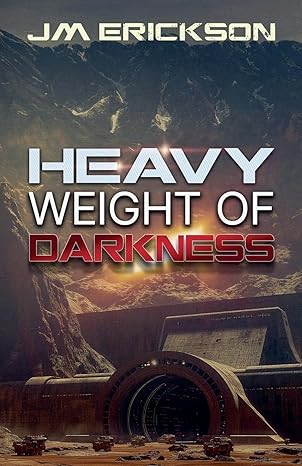
Heavy Weight of Darkness is a dystopian science fiction novel set in a future where slavery is institutionalized, patricians rule with unchecked privilege, and rebellion brews in the shadows of Mars. The story follows Captain Willard Bennett, a disgraced former officer given one last chance to redeem himself by hunting down Cassandra Kurtz, a once-privileged woman turned revolutionary who has become a symbol of uprising across colonies. Told through sharp scenes and immersive internal monologue, the book is a gritty, fast-paced exploration of power, corruption, and conscience.
This book doesn’t pull punches. Erickson’s writing is blunt, sometimes brutally so, and there’s an edge to the prose that kept me a little on edge in a good way. One of the most powerful moments for me was when Bennett visits the Delta Exchange. It’s grotesque, honestly. The smells, the heat, the masked patricians casually buying children like products. It’s a gut punch. And that’s the turning point, not just for him, but for the reader. Bennett, once a man who benefited from the system, is forced to see it for what it is, and the way Erickson layers his disgust, confusion, and growing empathy, it feels real. The writing is raw and broken, like Bennett himself. And that makes it work.
But here’s the part that surprised me: I liked Bennett. I didn’t expect to. He starts out as a selfish, complicit jerk. But his transformation is subtle and kind of tragic. He’s not some hero on a redemption arc. He’s a man caught in a machine that’s already chewed him up. And Cassandra is barely even on the page directly, but her voice haunts everything. Those intercepted transmissions, where she calls out the hypocrisy and brutality of the patrician class, gave me chills. She isn’t just a character; she’s an idea, and you can feel it spreading like wildfire.
If you’re into sci-fi with a heavy dose of political commentary and psychological grit, this book will be your jam. It drags you into the mud and makes you look around. That said, it’s also not for the faint of heart. There’s graphic content and brutal realities, and Erickson doesn’t shy away from any of it. But if you can handle the darkness, Heavy Weight of Darkness is one heck of a ride. I’d recommend it for fans of The Expanse series, or anyone who likes their dystopias unapologetically grim and their characters complicated.
Pages: 210 | ISBN : 1942708556
Human Stupidity
Endless Fall of Night follows a woman who is convicted as an insurrectionist and sent to prison, where she is compelled to join a mission to discover what has happened to the Martian colony that has gone dark and left severed heads in its wake. What was the inspiration for the setup of your story?
The set up was the novella Heart of Darkness by Joseph Conrad. Similar to that work, I wanted to show how the human condition and society has not changed much whether it is a Belgium Company’s outposts along the Congo River in Africa in 1899 or a US Swift Boat going up the Nung River in Vietnam in 1969, human emotions and behaviors construct our present day of 2025 and sets the stage for a future like 2126.
What are some things that you find interesting about the human condition that you think makes for great fiction?
Themes around prejudice, racisms, fascism, misogynistic and misanthropic bents will still be challenged by courage, strength in community and resilience are all part of being human. It is the journey that makes us. It is the discomfort and challenges that forge who we are.
What were some themes that were important for you to explore in this book?
Of all the themes presented, human stupidity is the focus of this story as defined by Carl Jung – blaming others for own flaws, inability to self-reflect, rigid thinking and dogmatism, lack of empathy and emotional intelligence, overconfidence without competence and repeating the same mistakes without learning.
Will there be a follow-up novel to this story? If so, what aspects of the story will the next book cover?
The Heavy Weight of Darkness, published in September 2024 follows one of the antagonists tasked with terminating the heroine, and then finds himself transformed.
Author Links: GoodReads | Instagram | Website | Second Website
Based on Joseph Conrad’s Heart of Darkness, we see our future that shows striking similarities to this age of imperialism, classism, and capitalistic expansion where racism is commonplace, slavery exists, and a minority of people are in absolute power. Instead of Belgium Company’s outposts along the Congo River in Africa in 1899 or a US Swift Boat going up the Nung River in Vietnam in 1969, this is the great Third Republic on Earth and colonies on Mars in the year 2126.
Cassandra XI, patrician and first-class citizen, is exposed to a traumatic experience that later has her questioning the established social order. She is eventually tried and convicted as an insurrectionist, her personal AI deactivated, social status and titles revoked, and she is sent to prison. Cassandra is then approached by Captain Willard Bennett of the light cruising ship the Jefferson Davis to investigate why the Martian colony New Georgia went dark, leaving severed heads on spikes and the message “Bring Cassandra Kurtz.”
With no choice but to go, Cassandra’s life is about to change in unimaginable ways.



 LITERARY TITAN