Blog Archives
Tech Confidential: The Insider’s Playbook for Daring Entrepreneurs
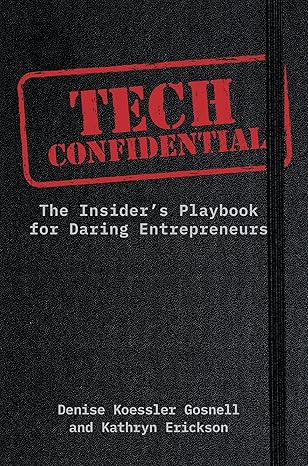

Tech Confidential by Denise Koessler Gosnell and Kathryn Erickson is part memoir, part survival guide, and part no-nonsense startup playbook. Structured in four “levels,” it blends personal war stories from Silicon Valley with lessons on leadership, resilience, and strategy. The authors pull back the curtain on the tech industry’s chaos, highlighting ego traps, toxic culture, funding realities, and the gritty human side of innovation. It’s blunt, funny, and practical, written to prepare readers for the messy reality of building a career and company in tech without losing their health or their soul.
The writing has a raw and punchy style that keeps you hooked, moving from hard-earned truths to ridiculous anecdotes without losing momentum. I loved that they owned their mistakes as openly as they exposed bad actors. It made the lessons feel earned rather than preached. Some of the analogies are wild, dumpster phoenix and gladiator arena, and yet they stick with you because they capture the absurdity of working in high-stakes tech. It’s not polished in the corporate sense, and that’s exactly why it works.
I enjoyed the balance between cynicism and hope. The authors don’t whitewash the burnout, politics, and plain bad behavior that plague the industry, but they never let it slip into pure bitterness. There’s a steady thread of belief in people’s ability to change, to lead better, and to protect their own boundaries. At times, the bluntness hits hard, and at others it feels like a pep talk you didn’t know you needed. I also appreciated how they mixed in concrete, tactical advice, like how to spot ego traps, how to build real teams, and how to survive acquisitions, without burying you in jargon or theory. It’s written for people, not for résumés.
I’d recommend Tech Confidential to anyone considering a leap into the startup world, to mid-career tech leaders wondering if the next rung up the ladder is worth it, and to anyone who’s ever felt like an outsider in the industry. It’s a book for people who can laugh at the chaos while still wanting to make something meaningful out of it. If you’re looking for a glossy playbook with neat frameworks, this isn’t it. But if you want the messy, funny, and often sobering truth, and a reminder that you’re not alone in the madness, you’ll get a lot out of this.
Pages: 203 | ASIN : B0FM4DZHCR

Preserving Internet History and Culture

Framed is part confessional, part manifesto, and part digital history lesson, giving readers an unflinching look at the dark underbelly of social media from the eyes of someone who didn’t just observe the chaos but actively fueled it. Why was this an important book for you to write?
I was annoyed by how shallow social media punditry had become. As a prolific reader, I enjoyed most of the “Big Tech” books but was surprised to find that none of them had been written from the engineer’s perspective. Further, there was indication that some of them had been “dumbed down.”
In playing the software engineer and “bad guy,” I wasn’t looking for penance. Rather, I was interested in preserving internet history and culture. Writing this book came at a massive opportunity cost that I could never possibly recoup in book sales. My hope is that this book can entertain readers, drive policy discussions, and perhaps be one day seen as an important reference work.
I appreciated the candid nature with which you told your story. What was the hardest thing for you to write about?
In terms of writer’s block or “getting it right,” the Myspace chapter was the hardest. In 2022, it was nothing more than an add-on and I was trying to secure interviews and source material from people I attended middle school with. By late 2023, I was restructuring the book around Myspace being the genesis. I’ve cut thousands of words and several notable tangents from that chapter, and I could spend another two years trying to perfect it.
In terms of emotional difficulty, it was hard to reconcile that my ventures, though “successful,” paled in comparison to other operators which earned millions of dollars more than my team did.
It was also tough to face the reality that, after years of effort, I produced this cool book, but how many other “cool books” haven’t been started because we’re so distracted by cell phones? “Screengrabbing,” originally, would have been almost one hundred pages in print. It was really hard to find the right way to address this problem.
What were some ideas that were important for you to share in this book?
- The evolution of “Myspace whoring” to digital marketing automation
- Big Tech’s reversal of course on “open” APIs
- The wide spectrum of “black hat” and “white hat” in user behavior and business decisions
- Instagram growth’s reliable ~10% rate of reciprocity, established by research and aligned with my experience
- An updated take on the dead internet theory
What is one thing that you hope readers take away from Framed?
The Internet Age has brought immense opportunity but also has ushered in social and ethical decay.
Author Links: Goodreads | Website | Newsletter | Amazon
A rogue software engineer built bots that ran rampant across social media, helping clients gain millions of followers. His reputation as a rule-breaker landed him at a startup where he designed the controversial systems—news feeds and push notifications—that keep users addicted.
Framed pushes opinions on influencers, algorithms, filter bubbles, botnets, screen addiction, spam, shadowbans, black hat marketing, deplatforming, the “dead internet” theory, and why people are still buying fake followers.
And–getting banned. Read Framed while you still can.
Framed: A Villain’s Perspective on Social Media
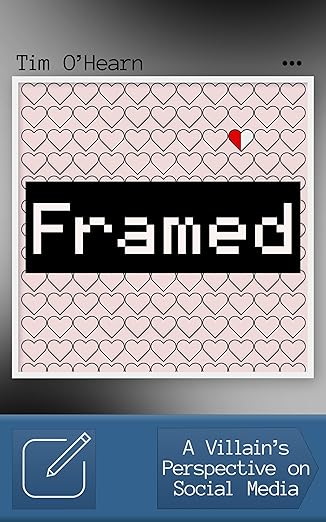
Tim O’Hearn’s Framed is part confessional, part manifesto, and part digital history lesson. It’s an unflinching look at the dark underbelly of social media from the eyes of someone who didn’t just observe the chaos but actively fueled it. The book is split into two distinct thematic halves: one that offers a raw and tragicomic commentary on the evolution of online platforms and another that lifts the curtain on the black-market mechanics behind Instagram growth services. It reads like a fever dream stitched together by code, ambition, nostalgia, and regret.
The writing is sharp, sarcastic, often hilarious, and, at times, deeply unsettling. O’Hearn opens with a blunt confession—he bought fake followers in 2012, then built systems responsible for hundreds of millions of Instagram engagements. There’s something haunting about watching a man justify digital manipulation as retribution for “all the hours stolen” by addictive apps. His tone wavers between playful arrogance and reflective melancholy, especially when he recalls declined payments from users who emptied their bank accounts chasing online validation.
Where the book really shined for me was in its documentation of the “Instagram Underworld.” I had no idea how deep the rabbit hole went. Chapters like “Instagress Alternative Alternatives” and “The Puppeteer Part II” read like noir thrillers. O’Hearn walks us through SMM panels, botnet mechanics, and the endless game of cat-and-mouse with Instagram’s legal team. He doesn’t just tell you what happened—he shows you the gritty details, the hustle, the absurdity. I was shocked by how openly he talks about skirting terms of service, about creating entire ecosystems to sell illusions. Yet somehow, you’re compelled to keep reading. It’s like watching someone build a house out of matchsticks—fascinating and inevitably destructive.
Still, what moved me most wasn’t the technical stuff—it was the nostalgia. In the section on Myspace, O’Hearn lets his guard down. He describes being a “computer nerd” who found solace in HTML, emo bands, and chaotic whore trains. That chapter, “A Place for Friends, Pimps, and Whores,” might be one of the best tributes to early internet culture I’ve read. He captures the weird, wonderful mess of Web 2.0 with affection and insight, highlighting how Myspace wasn’t just a platform—it was a playground, an identity factory, a war zone of teenage hormones and CSS. I couldn’t help but smile through those pages.
Framed isn’t trying to solve social media’s problems—it’s just telling you what’s been swept under the rug. O’Hearn doesn’t ask for redemption, and he doesn’t offer any, either. His honesty is disarming, his sarcasm sharp, and his storytelling addictive. If you’re a digital marketer, a tech skeptic, or just someone who’s spent way too much time scrolling through curated lives, this book is for you. It’s a ride through the seedy backstage of social media—and once you’ve seen it, you’ll never look at your feed the same way again.
Pages: 436 | ASIN : B0DW2X8YSK
Singularity of Hope: Humanity’s Role in an AI-Dominated Future
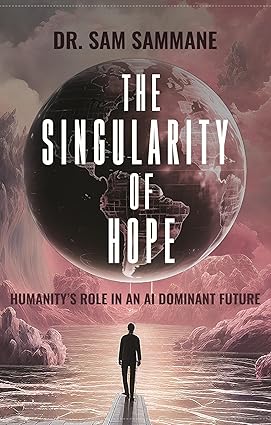
Singularity of Hope: Humanity’s Role in an AI Dominant Future, by Dr. Sam Sammane, offers a thoughtful and well-balanced exploration of artificial intelligence and its potential impact on humanity. AI sparks a wide range of emotions—some view it with fear, others with boundless optimism. In truth, our reaction should probably fall somewhere in between. This book seeks to put AI into its proper perspective, examining its current state, forecasting where it’s heading, and imagining what its future role in human life could be. AI is undeniably here to stay, and works like this are invaluable for helping us understand and engage with it responsibly.
Dr. Sammane provides a rational, clear-headed analysis of AI’s place in today’s world and what it may become. At a time when many people either want to flee from this rapidly evolving technology or embrace it wholeheartedly, Sammane’s measured approach is a refreshing middle ground. He draws on his extensive expertise in the field, sharing complex concepts in an accessible, straightforward way that demystifies AI for readers who may not be familiar with its intricacies. His steady and knowledgeable tone reassures those who might fear that AI is on the verge of taking over every aspect of our lives. Rather than painting a dystopian future where machines dominate humanity, Sammane presents a more optimistic vision. His outlook is far from the bleak scenarios portrayed in science fiction or Hollywood films like The Terminator. Instead, he predicts a future where AI and humans coexist in a symbiotic relationship, one that could lead to a more harmonious and efficient world. While there are certainly challenges and unknowns, Sammane’s perspective is hopeful, envisioning AI as a tool for progress rather than a force for destruction. The book does not shy away from the fact that AI is still in its early stages and will only continue to evolve at an accelerating pace. Sammane acknowledges the uncertainties that lie ahead, but his calm, reasoned approach helps to quell fears. His analysis suggests that the key to navigating this future is not fear but careful thought and preparation. He presents AI not as a threat but as an opportunity for humanity to grow and improve.
In Singularity of Hope, Sammane perfectly balances caution and optimism. He explores AI’s potential with a sense of wonder while emphasizing the importance of ethical considerations and thoughtful integration. This book is an essential guide for anyone looking to understand AI’s role in shaping our future—whether they approach it with excitement or trepidation. It leaves readers informed and hopeful, providing a clear path toward a future where AI enhances, rather than diminishes, the human experience.
Pages: 236 | ASIN : B0CVNLBGSG



 LITERARY TITAN