Blog Archives
Do Your Thing: Lessons from Banking’s Biggest Digital Transformation


Do Your Thing: Lessons from Banking’s Biggest Digital Transformation, by Ralph Hamers, is a book on business leadership, digital transformation, and banking management built around the reinvention of ING after the global financial crisis. Hamers takes readers from the bank’s years of government support, forced restructuring, layoffs, and battered employee confidence into the much more ambitious project of turning ING into a digital-first, customer-centered organization. What gives the story its energy is the scale of the undertaking as Hamers aspired to get tens of thousands of people across multiple countries to agree on what ING existed to do, how it would compete, how its leaders should behave, and what customers should actually experience.
The book’s central argument is that transformation comes from connecting all of those pieces and then staying remarkably consistent about them. That makes the ING story useful well beyond banking. Anyone interested in organizational change, business strategy, corporate culture, or transformation leadership will recognize the problem Hamers keeps returning to: having a vision is much easier than getting an enormous organization to live it every day.
The strongest parts of the book are where that big idea gets concrete. Hamers walks through the creation of the Think Forward strategy, ING’s purpose of “empowering people to stay a step ahead in life and in business,” the Orange Code that defined expected behaviors, and the shift from a product-centered bank to a customer-centered one. He is adept at showing how seemingly separate choices reinforced each other. Customer centricity led to simpler products and better digital experiences. The “Do Your Thing” brand gives an outward expression to ideas the organization had already spent years putting into practice. The progression Hamers presents makes this digital banking transformation story unusually satisfying because readers can watch strategy travel all the way from a CEO’s thinking to technology, organizational structure, office design, employee behavior, and finally the public-facing brand.
Hamers also makes the book feel personal enough to keep the management material from turning into a stack of frameworks. His recurring emphasis on consistency is persuasive because the later chapters show what consistency looks like when the decisions become harder. The discussion of sustainability and ING’s Terra Approach, for example, extends the book’s purpose-driven leadership argument into lending decisions, climate commitments, stakeholder expectations, and the messy reality of societal change. Hamers is willing to discuss adjustments, resistance, imperfect execution, and the tension between empowerment and control, which gives the change management and executive leadership lessons some welcome texture. His voice is confident and occasionally repetitive, especially when returning to purpose, customers, and consistency, but that repetition also mirrors his leadership philosophy: if an idea matters enough to organize a company around, people are going to need to hear it more than once.
The final section brings the ING experience into the age of artificial intelligence, and that turns out to be a natural destination for the book rather than an add-on. Hamers’ most useful contribution is the idea that leaders don’t need perfect foresight so much as a clear direction and an organization capable of moving, learning, and adjusting without losing its purpose. By the end, ING’s transformation feels less like a banking case study than a working example of how strategy becomes real through thousands of linked choices. For executives, transformation leaders, and readers interested in digital strategy, customer experience, agile organizations, corporate purpose, and the future of leadership, there’s a lot here worth carrying into the next big change.
Pages: 318 | ISBN : 978-1544552033

Singularity of Hope: Humanity’s Role in an AI-Dominated Future
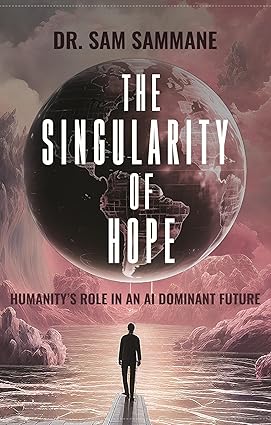
Singularity of Hope: Humanity’s Role in an AI Dominant Future, by Dr. Sam Sammane, offers a thoughtful and well-balanced exploration of artificial intelligence and its potential impact on humanity. AI sparks a wide range of emotions—some view it with fear, others with boundless optimism. In truth, our reaction should probably fall somewhere in between. This book seeks to put AI into its proper perspective, examining its current state, forecasting where it’s heading, and imagining what its future role in human life could be. AI is undeniably here to stay, and works like this are invaluable for helping us understand and engage with it responsibly.
Dr. Sammane provides a rational, clear-headed analysis of AI’s place in today’s world and what it may become. At a time when many people either want to flee from this rapidly evolving technology or embrace it wholeheartedly, Sammane’s measured approach is a refreshing middle ground. He draws on his extensive expertise in the field, sharing complex concepts in an accessible, straightforward way that demystifies AI for readers who may not be familiar with its intricacies. His steady and knowledgeable tone reassures those who might fear that AI is on the verge of taking over every aspect of our lives. Rather than painting a dystopian future where machines dominate humanity, Sammane presents a more optimistic vision. His outlook is far from the bleak scenarios portrayed in science fiction or Hollywood films like The Terminator. Instead, he predicts a future where AI and humans coexist in a symbiotic relationship, one that could lead to a more harmonious and efficient world. While there are certainly challenges and unknowns, Sammane’s perspective is hopeful, envisioning AI as a tool for progress rather than a force for destruction. The book does not shy away from the fact that AI is still in its early stages and will only continue to evolve at an accelerating pace. Sammane acknowledges the uncertainties that lie ahead, but his calm, reasoned approach helps to quell fears. His analysis suggests that the key to navigating this future is not fear but careful thought and preparation. He presents AI not as a threat but as an opportunity for humanity to grow and improve.
In Singularity of Hope, Sammane perfectly balances caution and optimism. He explores AI’s potential with a sense of wonder while emphasizing the importance of ethical considerations and thoughtful integration. This book is an essential guide for anyone looking to understand AI’s role in shaping our future—whether they approach it with excitement or trepidation. It leaves readers informed and hopeful, providing a clear path toward a future where AI enhances, rather than diminishes, the human experience.
Pages: 236 | ASIN : B0CVNLBGSG
Keap Cookbook: Over 75 effective recipes for CRM optimization, marketing automation, and workflow mastery

Michelle Bell walks readers through complex topics with step-by-step instructions, making Keap Cookbook easy to digest. Her use of detailed screenshots and precise language makes even technical tasks like setting up CRM automations or integrating third-party tools feel manageable, even for those new to the process. Well-structured and practical, Keap Cookbook excels at breaking down complicated CRM and marketing automation concepts into simple, actionable steps. Bell’s approach is like a recipe book; each chapter offers a new “dish” complete with ingredients (requirements) and instructions. This methodical structure allows readers to progress smoothly from system setup to advanced automation without feeling overwhelmed.
One of the most impressive aspects of this book is its comprehensive nature. Bell doesn’t just focus on CRM optimization; she covers broader business processes like sales pipelines, email marketing, and customer engagement, making the book an all-encompassing guide. The chapters flow logically, ensuring that readers build their knowledge in a structured manner. By starting with foundational tasks and moving to more advanced automation, Bell ensures readers can follow along without being overloaded with information upfront. The book’s standout feature is its immediate usability. You can implement Bell’s steps in real time, applying the “recipes” directly to your business. The inclusion of modern, relevant tools such as Google Business, Zapier, and payment processors adds practical value, offering streamlined solutions for businesses. Bell even provides real-world examples—like managing contacts and setting up marketing forms—to ground the lessons in everyday business scenarios. Ideal for a wide range of readers, Keap Cookbook serves small business owners, marketing professionals, and CRM administrators alike. Whether you’re a newcomer to Keap or looking to expand your expertise, this book is tailored to meet you where you are. Bell offers quick, actionable insights without bogging readers down with unnecessary theory.
User-friendly and straightforward, Keap Cookbook is precisely what it promises to be. Its well-organized content, clear writing, and practical approach make it a must-read for anyone looking to optimize their CRM and marketing processes.
Pages: 497 | ASIN : B0CW1KST24


