Blog Archives
Pallomand


J. W. Murray’s Pallomand, the second book in The Winter’s Twins Series, is a sprawling epic fantasy novel built around prophecy, fractured kingdoms, ancient crimes, cloudships, dragons, and a war that keeps widening in scope. Murray opens with the fall of the Winter Kingdom and the murder of King Karradine Tieton, then carries that history forward into several interconnected storylines whose characters are living with the consequences centuries later. The central prophecy gives the novel its gravitational pull: the Pallomand, or Traveler, is destined to unite the Raven clans, while the Arcusian is tied to the destruction of the ruling Triumvirate. That setup makes Pallomand feel like high fantasy in the fullest sense, with old bloodlines, competing religions, magical artifacts, hidden civilizations, and political powers all converging on the same approaching crisis.
The worldbuilding is probably the book’s most immediately distinctive feature. Murray has created a fantasy world where air currents function like highways, rocky aerracks float in the atmosphere, Raven navigators sail cloudships, the Haik fly on their own wings, and time itself can be manipulated through objects and places such as the Oculan and Nol-Tajerus. The Moonstones can harness tremendous elemental power, while the book’s other supernatural systems involve telepathy, weather control, temporal travel, animal communication, prophetic visions, and the disturbing ability to steal memories through a victim’s eyes. The extensive glossary shows just how deliberately all of these cultures, technologies, titles, creatures, and magical concepts fit together. As epic fantasy worldbuilding, it has a lived-in quality. Terms such as Ko’journ, Saken, Marschirne, Strix, Navarasche, and har’korda gradually become parts of a coherent history.
What keeps all that lore grounded is the book’s attention to family, belonging, and identity. Marek’s story carries much of the emotional weight as he learns the truth about his Nordac ancestry, struggles with his failures as a father, and reaches a breaking point with both Elenya and the Triumvirate. L’dai’s arc has a different kind of force. After losing her wings, she has to rebuild her sense of self among the Snow Walkers, a people carrying their own inherited shame. Cassille develops from a stubborn child into someone frighteningly powerful, while Caleg wrestles with the legacy of Tadral the Traitor and the possibility that his people might finally redeem themselves. Even secondary threads, such as Alexi’s determination to protect his son and Harnen’s attempt to save Serrat through preparation, reinforce the same concern: what do people owe their families, their communities, and the generations that come after them? That gives this fantasy adventure a strong human center even when armies, dragons, and prophecies are moving across the page.
Murray also gives Pallomand a darker current that suits readers looking for dark fantasy alongside traditional high fantasy. The Korgon’s power comes as much from understanding desire and weakness as from military strength, which makes him a more interesting presence than a distant monster at the head of an army. His dominions embody different forms of corruption and control, from the Strix and Sedurai to the memory-stealing Navarasche. The Legion’s use of bonded soldiers and creatures gives the recurring image of chains real thematic importance. At the same time, the book knows how to stage large fantasy set pieces. The hunt for the Moonstones beneath the ice, L’dai’s encounters with the Strix, the dragon assault on Serrat, and the fall of Caladrin all have their own visual character. The attack on Caladrin in particular combines dragons, flying warriors, cloudships, collapsing towers, and an evacuation into a sequence that feels enormous while still making room for individual acts of courage.
By the final chapters, Pallomand begins pulling its many threads into a clearer pattern, and some of the book’s earlier mysteries take on entirely different meanings. Marek’s encounter on the Southern Ocean gives the prophecy a deeply personal dimension, while Tylene’s return as the Winter Queen reshapes Elenya’s understanding of her visions and of the Korgon’s long manipulation. Elenya learns that her supposed gift of prophecy is actually something else, and that another presence has been fighting to reach her through those visions. The ending provides revelation, which fits a continuing epic fantasy series whose central conflict is now expanding into something much larger than the original search for the Moonstones. Pallomand is ultimately a lore-rich, character-driven high fantasy adventure about people discovering that the histories they inherited are incomplete, the roles assigned to them can change, and the approaching war will demand that scattered families, clans, and kingdoms decide what they’re willing to become together.
Pages: 350 | ASIN : B0H2BY12HS

What If You Could Start Over?

One Chance follows a middle-aged man haunted by the consequences of his own choices who is offered an unexpected way out through a doorway leading him into a world of giants, witches, and enchanted objects. Where did the idea for this novel come from?
I think it started with the idea that if I could live my life over again, would I do anything differently? I think most people have that thought from time to time, and the main character exemplifies an extreme of that. It’s not just that he would change one thing or another, but that he would change the person he was. From there, the book explores ideas around why people make the decisions they make and ultimately become who they are as people. Finally, can we change and start over, or are we trapped by our place and circumstances? The challenges and obstacles he faces in the story, although pure fantasy, in many ways can be related to the challenges we face in everyday life.
Why did you choose a middle-aged protagonist instead of the younger heroes often found in portal fantasy?
One of the main issues for the character was a life filled with regrets. He had regrets about decisions he had made, possible life paths that he had not taken, and even regrets around the very person he had become. Those character issues fit much better with an older character with a lifetime of mistakes rather than someone younger. As he goes through the portal, he becomes young again, a change that is far better appreciated for an older character. I think the theme of starting over and becoming someone new wouldn’t have made as much sense with a young protagonist.
How long did it take to build the world of Wisteria before you began drafting the novel?
I actually started by developing the characters in the story and an overall theme. After that, I developed the general storyline and the first couple of chapters. The bulk of the world-building happened as I was writing the story. I wrote the storyline I had outlined and essentially built the world around it as I wrote. So I really didn’t start building the world until after I began drafting the novel.
What do you hope readers discover about themselves while following Chance’s journey?
In the story, Chance faces a lot of obstacles to becoming the person he wanted to be. Of course, the outward things included traps, monsters, and villains threatening him, but the greater obstacles came from within himself. He faced selfish temptations, old habits, personal vanity, and good old-fashioned fear. I hope readers would recognize that those same challenges exist in our own world, in different forms, but the greater barriers to growth and success are the ones we create ourselves. He’s only truly able to acknowledge those personal challenges and move forward when he fully lays down his own desires in order to become the person his friends needed him to be.
Author Links: GoodReads | Facebook
What he finds there is a world in crisis, with danger around every corner. He meets two friends who each have a unique power, and together they’re given a quest to save everyone from impending destruction. They will have to overcome monsters and villains as they are pursued by a legendary bounty hunter. Can Charlie and his friends overcome dragons, giants, and magic spells to save mankind? Can he overcome old habits and become the person that he’s always aspired to be?
One Chance

James Chamberlain’s One Chance is a portal fantasy about Charlie Baker, a middle-aged man whose life has become a stack of bad choices, unpaid debts, and missed opportunities. When a strange doorway gives him a way out, Charlie steps into Wisteria, a world of giants, witches, enchanted objects, bounty hunters, dragons, and old grudges. The setup is simple and effective: “He was always in trouble.” From there, the book turns that trouble into a second life, one where Charlie becomes Chance Arizona and has to decide, again and again, what kind of person he’s going to be.
What makes the story easy to settle into is its mix of adventure and playful humor. Chance is rarely the most capable person in the room, and the book gets a lot of mileage out of watching him survive through nerve, luck, and the occasional ridiculous idea. Periwinkle, Indigo, Marigold, the Crimson Blade, and the larger cast give the quest a lively, storybook feel, while Wisteria itself feels built for motion. There’s always another strange path, dangerous creature, magical rule, or hidden history waiting around the corner.
The heart of the book is Chance’s slow movement from self-preservation toward loyalty. Early on, he imagines becoming someone people would admire, someone who doesn’t abandon his friends, and the story keeps testing that wish in practical ways. The line “You only get one chance” becomes more than a portal rule. It’s the moral engine of the book. Chance’s growth works because it doesn’t make him suddenly noble or polished. He’s still funny, impulsive, vain, and scared, but he starts choosing people over escape.
The novel also has a warm sense of compassion for its side characters and even some of its antagonists. Gamboge’s arc, in particular, gives the giant conflict more emotional weight than a simple men-versus-monsters battle. The book is interested in grief, bitterness, courage, and forgiveness, but it handles those themes through action and character rather than slowing down for speeches. Marigold’s sharp wit and fierce independence bring a lot of spark to the story, and her relationship with Chance gives the later chapters a sweet, earned emotional payoff.
One Chance is a fast-moving, funny, and heartfelt fantasy adventure about getting the chance to become better and actually taking it. It has the feel of a classic quest with a modern comic voice, and its best moments come when danger, absurdity, and sincerity all land on the same page. Readers who enjoy portal fantasies with unlikely heroes, magical oddballs, and a strong friendship-driven core will find plenty to enjoy here.
Pages: 304 | ASIN : B0GRKGQZ4J
Crown Prince: Book One of New Blood

Crown Prince: Book One of New Blood is an epic fantasy that opens with a siege, a royal birth, and a man burdened by prophecy. From the first chapter, author W.D. Kilpack III makes it clear that this book is built around Natharr, the Guardian of Maarihk, whose gift of Sight lets him glimpse danger before it arrives but never frees him from pain. One of the book’s best ideas is captured in Natharr’s own words: “Most often, I See paths, not destinations.” That line gets at the whole shape of the novel. This is a story about duty under pressure, about carrying knowledge you can’t fully use, and about trying to protect a future that keeps slipping out of your hands.
What makes the book work for me is that it doesn’t stay a distant throne room fantasy for long. After the violent collapse of the old order, it turns into something more intimate: a survival story, a guardianship story, and eventually a makeshift family story. Natharr, Darshelle, and the infant Vikari spend so much time together that the book earns its emotional weight scene by scene. There’s tenderness in the roughness, too. Natharr can be curt, stubborn, and unintentionally funny, which keeps him from feeling like a stock heroic figure. Darshelle gives the book warmth and friction at the same time, and their dynamic keeps the story human even when the setting gets mythic.
The worldbuilding is a big part of the appeal, but it’s not just there for decoration. Kilpack builds Maarihk with old gods, bloodlines, political memory, and a living sense of history, then pushes the story into the primal forest where the tone shifts into something stranger and more enchanted. The woodfolk, the Atomie Ulla, the ancient symbols, and the odd beauty of daily life in hiding all give the novel a distinct texture. I especially liked that the fantasy elements feel tied to culture and belief. Even when Natharr is doing something as absurdly practical as putting a baby in a saddlebag pouch, the book still feels rooted in its own world.
By the later chapters, the novel widens again and becomes a story about what happens to a kingdom when its moral center is gone. Natharr’s return to the outside world has real force because the book has already spent so much time showing what he was trying to preserve. The ruined villages, the fear hanging over ordinary people, and his growing realization that Maarihk has been reshaped in his absence give the second half a haunted feeling. Then the final stretch adds an intriguing layer of mystery through the Elder and that pocket of warped time and space, which gives the ending a genuine sense of expansion instead of just stopping at a convenient cliffhanger.
Crown Prince is a serious, character-driven fantasy novel that cares as much about protection, loyalty, and inheritance as it does about battles and magic. It’s at its best when it lets emotional commitment and political danger press against each other, and Natharr carries that beautifully from start to finish. This first installment feels substantial on its own, but it also clearly knows it’s opening a larger saga, and it leaves behind the kind of momentum that makes continuing the series feel less like homework and more like the natural next step.
Pages: 351 | ISBN : 978-1074784522
Spiritual Framework

Battle Beyond the Veil follows a museum curator who discovers she can see a hidden war between angels and demons, only to realize she is the key to stopping it. What was the inspiration for the setup of your story?
I’ve always been fascinated by the idea of an unseen war between light and darkness. In today’s romantasy landscape, demons are often portrayed as seductive or sympathetic, and I wanted to explore the opposite — a world where angels and demons are ancient, powerful, and terrifyingly real. That contrast sparked the entire setup: a woman who doesn’t believe in any of it suddenly discovering she’s at the center of a millennia‑old conflict.
Zahra is tied to prophecy, but she resists being defined by it. How did you navigate that tension?
I love stories where destiny and free will collide. Zahra is bound to a prophecy, but she’s also a woman who refuses to be told who she is. Writing her meant letting both truths exist at once — the weight of fate and the fire of her own will. The tension between those forces is what ultimately shapes her arc.
The book draws from Christian frameworks but prioritizes story over doctrine. How did you strike that balance? I had to keep reminding myself that no one likes to be preached to when reading fiction.
I had to keep reminding myself that readers don’t pick up a fantasy novel to be preached at. My goal was to let the story lead while still honoring the spiritual framework that inspires me. I wanted to invite readers to consider the possibility of a spiritual realm — not by telling them what to believe, but by letting them experience it through the characters, the stakes, and the world. Story always came first, and the themes naturally wove themselves in.
What other layers of the angel/demon hierarchy are you excited to explore?
Kyden’s world is governed by rules, ranks, and ancient tensions that the reader barely glimpses in book one. I’m excited to explore higher angelic orders, the Fallen who operate in the shadows, and the factions within both sides that don’t always agree. Those layers will reveal just how complicated this war really is.
Author Links: GoodReads | Facebook | Website | Amazon
On the most important day of Zahra’s career at the Gallery of Time Museum, everything unravels. A mysterious package arrives from her estranged father, and the Atar’zul, a relic that could secure her promotion goes missing. While betrayal festers within the museum, a long lost love returns, throwing Zahra’s world into chaos.
Kyden, a warrior angel and demon slayer, has guarded the spiritual realm for centuries. When a famous archaeologist and forbidden artifact vanish, Kyden is forced to protect a human, a job he vowed long ago to never do again.
Together, Zahra and Kyden must face rising demon threats and the cursed magic of the Atar’zul. As darkness closes in, they join forces to defend both realms and find that ending the battle beans trusting each other. Sacrifices must be made—the cost of which might be their very souls.
Welcome to the battle for humanity’s future—a story of loyalty, temptation, and the fragile line between light and shadow.
Battle Beyond the Veil

Battle Beyond the Veil is an urban fantasy romance that follows Kyden, a battle-weary angel who hunts demons, and Zahra, a museum curator in Boston whose life is built around ancient artifacts, a sick mother, and a pile of color-coded to-do lists. When Zahra’s famous archaeologist father disappears during a dig in Iraq, and a legendary halo called the Atar’zul goes missing, their worlds collide. The missing relic draws demons, angels, and humans into the same storm, and Zahra learns she is Vaelatori, one of the rare humans who can see beyond the veil and is tied to a prophecy about the halo. The book moves between dusty ruins in Babylon, the polished glass cases of a museum, and the unseen spiritual war that rages around them.
What pulled me in first was Zahra herself. She is capable and driven, but she is also tired, snappy in all the right ways, and constantly chewing on Dum-Dums to keep from slipping back into cigarettes. Her stress about the gala, her rage when a coworker quietly takes credit for her work, and the raw ache around her mom’s dementia feel very human. At the same time, you have Kyden on the other side, an immortal who kills demons for a living and drinks way too much coffee, rolling his eyes at humans while still crossing continents to protect them. I liked how the author lets their paths intersect in messy, awkward ways. Zahra literally slams into him at the museum, spills champagne down his front, and then later has to deal with the fact that the hot donor is actually her angelic bodyguard. The romantic beats are there, but the story does not rush into some instant, swoony bond. Instead, it leans into trust, annoyance, and slow respect, which works well for this genre.
On the worldbuilding side, the book feels like a blend of action fantasy and spiritual warfare, with some clear Christian influence but more focus on story than sermon. Angels and demons are not vague forces; they have ranks, rules, and politics. Apollyon leads seven princes of hell tied to the classic deadly sins, each with their own territories. We see grunts whispering in human ears at traffic jams and fancy galas, shifting moods and nudging bad choices rather than throwing fireballs. That small detail, the quiet influence, made the unseen war feel more grounded. I also appreciated the author’s choice to complicate the love angle. The obvious route in an urban fantasy romance would be “girl falls in love with broody angel.” Here, Zahra has a very real, painful history with her ex Jake, and her arc is less about “picking the hottest supernatural guy” and more about figuring out what kind of love and life she actually wants while carrying grief, betrayal, and responsibility. By the end, her connection to Kyden looks more like a sacred partnership born out of the prophecy and shared battles, while her romantic future with Jake feels surprisingly gentle and earned.
By the time I reached the last pages, I felt like the book had threaded its main promise: big supernatural stakes wrapped around a very personal story. The halo is found and fought over, secrets about Zahra’s father and mother click into place, and Zahra steps fully into her role as Vaelatori without losing sight of her normal life as a curator who still has to show up for work. Battle Beyond the Veil will land best with readers who enjoy urban fantasy romance that mixes angels, demons, and prophecies with real-world problems like caregiving, career pressure, and complicated family ties. If you like a story where the spiritual and the everyday sit at the same table, where the action has heart, and the romance is threaded with responsibility and faith, this one is worth picking up.
Pages: 411 | ASIN : B0G67HC9BC

Thaddeus and the Daemon
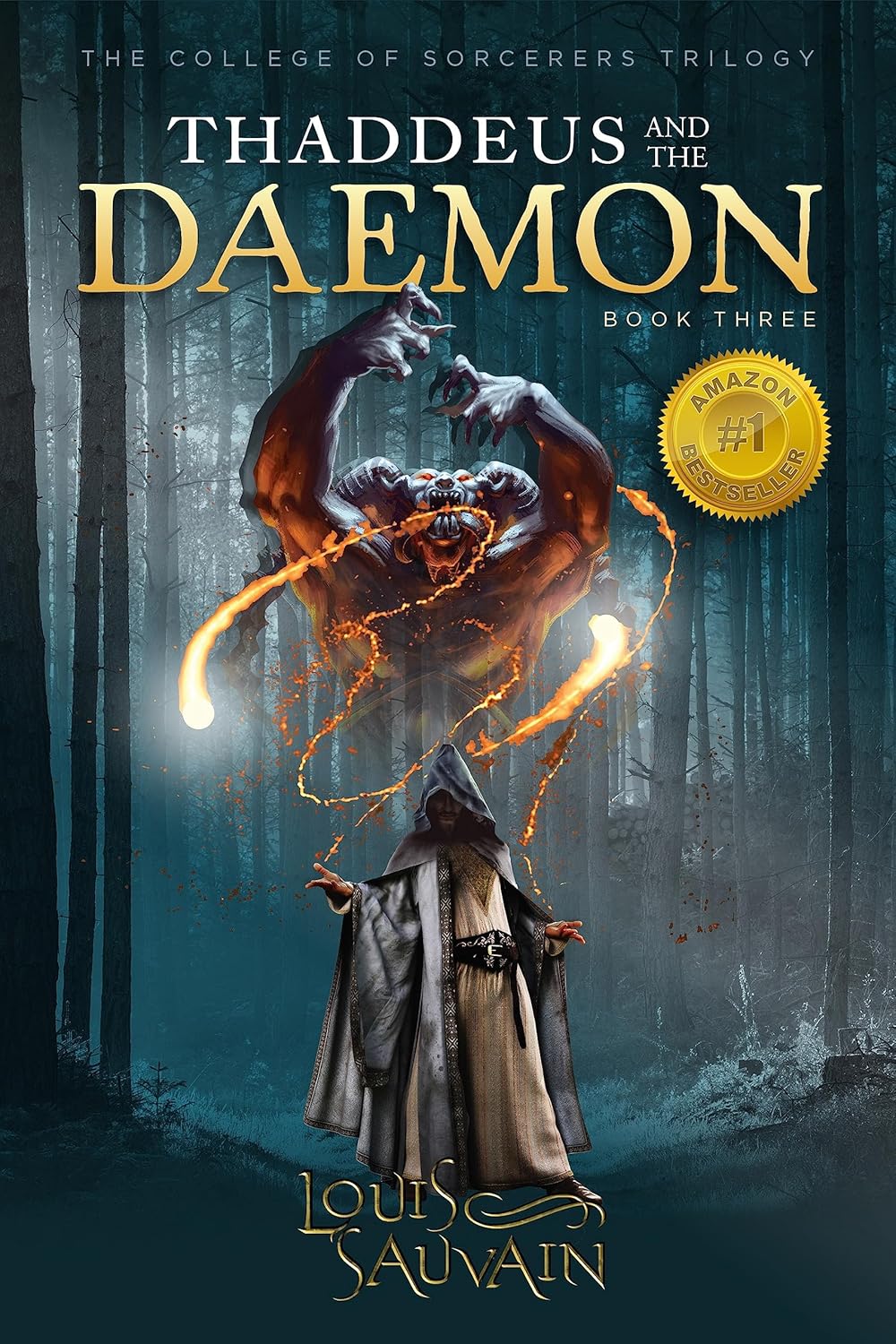
Thaddeus and the Daemon drops readers back into the Collegium Sorcerorum with Thaddeus and his tight little crew, right when everything starts to wobble. A love letter hits like a gut punch, complete with prophecy, a secret child, and a farewell that sends Thaddeus sprinting into danger on pure emotion. The story then widens fast. There’s a creeping plot tied to Master Perditus and a Daemon named Morag, a hunt for a guilty middleman, and a slow reveal that someone inside the school is playing for the other team. It all barrels toward curses, portals, and a showdown where belief itself becomes a weapon and a weakness, and the Daemon’s plans start falling apart in a very strange, very satisfying way.
I liked the writing most when it lets feelings lead. Thaddeus breaking down after the letter felt raw and real, no fancy posing, just pain. The voice also has this cozy old-tale vibe. It can be dramatic, then weirdly funny a beat later, like the book knows when to wink. Some scenes run long, though. I caught myself thinking, okay, we get it. Move it along. Still, when it hits, it hits. I felt that tight chest feeling. The kind you get when a character makes a bad choice for a good reason.
The ideas under the adventure worked for me, even when they got big and mystical. The book keeps poking at belief, fate, and how much choice any of these kids really have. There’s prophecy pressure everywhere, and it messes with how they love, how they fight, and how they trust. I’m a sucker for that theme, and this one leans into it hard. Sometimes it feels a little too neat, like the universe is doing tge heavy lifting. Even so, I enjoyed the tug of war between “I choose this” and “this was chosen for me.” And the whole traitor thread added a nice paranoid edge.
This one gave me some strong J.K. Rowling vibes, mostly in the way the school setting turns into a pressure cooker where secrets and loyalty tests keep piling up. Like Harry Potter, it starts with that familiar comfort of lessons and rivalries, then it swings hard into darker stakes and bigger magic. The difference is the tone. Thaddeus and the Daemon feels more intimate and emotionally direct, less puzzle-box, more heart-first, and it leans into destiny and belief in a way Rowling usually keeps in the background.
I walked away feeling wrung out, in a good way, and also kind of hyped to see what comes next. I’d hand this to readers who like earnest fantasy with heart on its sleeve, teen heroes under massive stakes, and magic that runs on faith and feelings more than math. If you want a sweeping, emotional ride with prophecies, creatures, and school politics turning dangerous, then definitely pick this book up.
Pages: 482 | ASIN : B0C958PRC1
Scallywag!


Scallywag! is a swashbuckling historical fantasy adventure written as the “true-life” prison memoir of “Mad” Molly McCormick, who’s awaiting execution in Fort St. Ambrose and passing the days by writing down how she became a pirate. The story starts with her youth in Ireland and her decision to run rather than be married off, then follows her into a life at sea that begins with disguise, turns into capture, and quickly becomes something like chosen family on a pirate ship. From there it escalates into a chain of episodes: cursed islands with warnings scratched into a dead missionary’s journal, ghost towns that reset themselves every night, and a deepening entanglement with the merpeople, including a princess named Itaska who changes what “freedom” even means for Molly.
What I enjoyed most was how committed the book is to the voice. It has that old-fashioned “Reader, let me tell you” energy without feeling like a gimmick. Molly is blunt, funny when she wants to be, and surprisingly tender when she’s caught off guard by kindness. You see it in the way she talks about being locked up near the water, close enough to hear the waves but not touch them. Then, on the other side of the story, you see it in the warmth that creeps in when she describes pirate life as a patchwork family. I also liked author K. L. Mitchell’s choice to treat piracy less like nonstop swagger and more like a messy social system, with rules, bargains, and the constant math of survival. Even the “we’re legitimate” argument lands, because it’s said with a grin and a knife behind the back.
The supernatural pieces are where the book really has fun, and where the historical fantasy genre shows its teeth. The cursed-island section has that dry, salty dread that I like in pirate novels. The ghost-colony idea is clever too, not just spooky for spooky’s sake, but unsettling in a quiet way: the town resets, the food returns, and memory is the only thing that sticks. And when the story goes underwater, it becomes genuinely magical, from shell-grown “buildings” to courtly politics to warfare that involves trained whales and a leviathan-like beast that is basically a living shipwreck waiting to happen. The episodic structure can feel long at times. We’re carried from set piece to set piece. Still, I never felt lost. The emotional through-line, especially around loyalty and longing, keeps pulling you forward.
By the end, the frame story snaps back into focus in a way I found satisfying, with a wink of mystery about what happens to Molly after her memoir is “secured.” I’d recommend Scallywag! most to readers who like pirate yarns, lush sea lore, and historical fantasy that stays playful while still taking characters seriously. If you enjoy a strong narrative voice, found-family crews, eerie islands, and a dash of romance that feels earned rather than pasted on, this one’s for you.


