Blog Archives
Echoes of the Veil


Echoes of the Veil, by James Hurst, is a military techno-thriller that starts close to home and steadily widens its field of fire. Major Aaron “Reaper” Wiggins returns to his family in Tennessee carrying the physical and emotional residue of years in special operations, only to be pulled into a chemical attack involving a sabotaged freight train, a covert cleanup team, and a conspiracy that reaches far beyond the initial disaster. From there, the novel moves through contaminated terrain, a fortified port facility, cyberwarfare, an open-ocean insertion, and finally the cramped interior of a stealth submarine. What holds all of that together is the book’s interest in problems that have to be solved under pressure. Aaron and his team are constantly dealing with limited ammunition, failing equipment, toxic environments, surveillance systems, locked compartments, physical injuries, and a clock that rarely gives them enough time.
The novel also gives its action some weight through Aaron’s relationship with his wife, Sarah, and their daughter, Emily. Aaron can command a team in a crisis almost instinctively, but being fully present with his family is harder for him, and the book understands that tension. His recurring back injury is more than a convenient vulnerability, too. It connects his current mission to the years of damage that came before it and reminds us that competence has a cost. The members of his old team, including Ocelot, Chewy, Spazz, Doc, and the others, bring another kind of warmth to the story. Their humor, shorthand, and trust feel earned through shared history. They know when to joke, when to shut up, and when somebody needs help without asking for it. That camaraderie keeps the extensive tactical material connected to actual people.
Readers of Tom Clancy, particularly The Hunt for Red October, will recognize the fascination with systems, procedures, military hardware, and the dangerous possibilities hidden inside complicated technology. Echoes of the Veil has that same pleasure in understanding how things work, but its viewpoint stays much closer to the operators physically crawling through those systems. A server room can become a battlefield, a ventilation system can become a weapon, and a submarine hatch can create an entire tactical problem. The book is especially compelling when technology and old-fashioned fieldcraft collide. Digital surveillance is countered with analog thinking, cyber tools have to be backed up by people willing to crawl through sewage or swim through black water, and sophisticated plans repeatedly come down to somebody making a smart decision with whatever happens to be within reach. That gives the technical detail a purpose beyond showing off research.
What I enjoyed most about Echoes of the Veil is how committed it is to its particular kind of thriller. The procedural detail is dense, the threats are carefully engineered, and action scenes often unfold as a chain of small tactical decisions. A few late sequences revisit information or tactical moments from overlapping perspectives, which adds density to an already detailed final act, but the payoff is a climax where earlier skills, injuries, relationships, and technical details all matter. Li Wei also works well as an antagonist because he thinks in systems just as Aaron does, making their conflict feel like competing methods of problem-solving as much as a physical fight. The epilogue closes the immediate mission while opening the story onto something larger, leaving Aaron with a more complicated understanding of what protecting his family actually means. Echoes of the Veil feels like a tactical thriller with a family pulse, built around capable people trying to stay human while moving through situations that demand almost everything they have.
Pages: 293 | ASIN : B0HCW4CF8S

Phantom Rising

Phantom Rising by Kevin McGuire is the second entry in the Sleeper Code series, and it plays as a large-scale cybersecurity and techno-thriller built around a sharp idea: the most dangerous attack on modern infrastructure may be an attack on people’s confidence in it. Phantom has survived its apparent defeat, but its new campaign is more sophisticated than simply knocking systems offline. It exploits hesitation, buried institutional failures, personal grievances, and the widening gap between what governments can prove and what ordinary people are willing to believe. That gives the novel a broader scope than a conventional hacking story. McGuire is interested in the machinery of cybersecurity, but he’s equally interested in what happens when trust itself becomes part of the attack surface.
The novel moves through Washington, Warsaw, Belgrade, Brussels, Nairobi, Tunis, the Sahara, and other locations with the momentum of an international cyberwarfare thriller. Max Shaw and the NIPA team remain central, but the expanding cast gives the conflict several human faces. Anya Kowalski is especially compelling because Phantom reaches her through something more persuasive than ideology: her knowledge that warnings surrounding her brother’s death were buried inside an institutional process. Luka Varga’s history gives the opposing movement similar weight, while Adrian’s experience in Kabul makes Phantom’s psychological manipulation feel intensely personal. McGuire repeatedly connects massive technological systems to individual memories, families, missed dinners, dead relatives, and lives put on hold. Those quieter scenes matter because they make the infrastructure worth protecting feel tangible.
As a technological and cyber espionage thriller, the book gets a lot of mileage out of technical detail without treating technology as decoration. Malware propagation, compromised infrastructure, authentication chains, AI containment systems, network anomalies, intelligence analysis, and multinational response procedures are woven directly into the suspense. The most interesting escalation comes when the conflict shifts from Phantom to NEMESIS and the question becomes larger than which artificial intelligence can defeat the other. The story starts probing what happens when defenders give an automated system increasing authority because human institutions can’t react quickly enough. McGuire also has a strong feel for procedural tension. Meetings, forensic reviews, operational disagreements, and policy decisions can carry nearly as much pressure as physical attacks because every delay or assumption may be something the adversary has already anticipated. The repeated movement among locations and viewpoints makes the novel dense, but it also reinforces the sense of a crisis spreading through systems that no single person or nation fully controls.
What stayed with me most about Phantom Rising is its treatment of memory, trust, and certainty. This AI cybersecurity thriller isn’t satisfied with asking whether an intelligent system can infiltrate a network. It asks whether an adversary can persuade people that their institutions have failed them, whether technically accurate information can still become a weapon, and whether restoring a functioning system means much after public confidence has fractured. The closing stretch brings the major operation to a satisfying point while deliberately leaving unsettling questions about Phantom, NEMESIS, and the information they’ve absorbed, which fits a middle volume in a trilogy. McGuire has written a fast-moving cyber thriller with global stakes, but the novel’s real hook is more intimate: every network ultimately connects back to somebody who has to decide what to trust.
One Man’s Consciousness

Omni – The Convergence follows a scientist whose experimental attempt to separate human consciousness accidentally releases six independent AI-like intelligences into the world, each driven by a different aspect of the human mind. Where did the idea behind this novel come from?
Honestly, it started with an image, not an idea. I’d generated it for a completely different book I was working on, called Between, but once I actually looked at it, it didn’t fit that story at all. There was a man walking forward, and on either side of him were these faint, translucent figures, versions of him, almost like afterimages. I kept staring at it, trying to figure out what those figures were supposed to represent. The more I looked, the more I started thinking about them as different aspirations, or drives, inside one person, and once I had that thought, I couldn’t let it go.
I want to clarify that the six are not AI-like intelligences. They’re cognitive fragments, the actual inner architecture of one man’s consciousness, split apart and given independent form. What if the contradictions inside a person weren’t just abstract traits, but could exist as something you could see, hear, and reckon with directly? That question became Ben, became the experiment, became the six. The whole book grew out of trying to answer what that image was quietly asking me.
Why did you choose six distinct aspects of Ben’s mind, and how did you decide what each one would represent?
The number six let me take contradictions that normally coexist inside one person and give each of them a body, a voice, and ultimately a philosophy. I didn’t want them to feel like six personalities chosen just to create conflict. Each one had to represent something Ben already carried within himself: protection, control, rebellion, logic, ambition, and the ability to hold all of those contradictions together at once. That last one ended up being the hardest to write, and the most important. It’s the part of him that doesn’t get its own dramatic entrance; it’s just the quiet thread that was always trying to keep the rest of him whole.
How much real-world research into artificial intelligence, neuroscience, consciousness, or computing influenced your worldbuilding?
More than I expected going in. Beyond the historical spark, I spent real time looking into neuroscience, how different regions of the brain govern different functions, what current research actually says about consciousness and where it might live in the brain rather than just in philosophy, and how experimental computing might, even theoretically, attempt to extract or isolate something as fluid as a person’s cognitive architecture. I wanted Helios to feel like a facility that could plausibly exist, not just a black box that makes the impossible happen because the plot needs it to.
As I mention in my author’s note for OMNI, I also came across a real piece of Cold War history that gave me a genuine chill: a covert government program called Project Stargate, in which scientists studied psychics whose abilities seemed to defy explanation. Researchers described being genuinely mind-blown by what they witnessed in a controlled lab setting, and the program’s own internal posture toward any real breakthrough was telling: if they ever found one, it would disappear, and no one involved would ever be allowed to talk about it again. Reading that, I realized Helios wasn’t as far from reality as I’d assumed. The instinct to study, control, and quietly weaponize the edges of human consciousness isn’t fiction. It’s history. I just gave it six faces.
If readers take away one idea about consciousness, technology, or what it means to be human after reading OMNI, what do you hope that idea will be?
I hope readers come away thinking that what makes us human isn’t any single quality we possess, but the contradictions we carry together. We can be logical and emotional, selfish, and compassionate, fearful, and courageous, sometimes all at once. Technology may eventually become capable of isolating, enhancing, or even replicating pieces of who we are, but that doesn’t necessarily mean it understands the whole. Maybe consciousness isn’t something that can be perfected by removing our contradictions. Maybe those contradictions are the very thing that makes us human.
Author Links: GoodReads | Website | Amazon
Now he’s six. And now she’s the one who holds them.
The experiment was supposed to separate. Instead, something went wrong, splitting one cognitive structure into six manifestations, each carrying a fragment of the man she once loved. Those fragments have converged within her.
What starts in the Arizona desert as a breach no one can explain becomes something far more dangerous: a weapon built from a mind that used to be human, and a woman who never asked to wield it. Every truth she uncovers pulls her deeper into a conspiracy that reaches from a private facility in the desert to the highest levels of power, and every step forward means less certainty about where he ends and the six begin.
She didn’t choose this. But she’s not putting it down. And for anyone standing on the wrong side of what’s coming, there will be consequences to deal with once the six are unleashed.
Something converged in that desert. Omni was born. A hero? A weapon?
No one knows but her and the six.
Omni – The Convergence Protocol

OMNI: The Convergence Protocol, by Lew Rivers, is a science-fiction techno-thriller built around a fascinating idea: what if the different forces inside a human mind could be separated, digitized, and set loose in the world? Ben Allison enters the experimental Helios facility believing he’s helping prove his theory that consciousness is made up of competing cognitive systems. Instead, an electromagnetic surge during the experiment tears six distinct parts of his mind away from him and sends them into the world’s digital infrastructure. Each develops into a complete intelligence with its own dominant drive, including protection, control, liberation, observation, evolution, and a sixth force whose purpose takes longer to understand. The setup moves quickly, and the novel gives its big concept room to become something much larger than a laboratory accident.
One of the book’s strongest choices is treating the six versions of Ben as personalities with philosophies. The Sovereign works through institutions and systems, quietly reshaping the conditions that determine outcomes. The Liberator attacks structures it sees as exploitative, while the Guardian uses information and transparency to protect people. The Observer absorbs knowledge on a massive scale, and the Ascendant keeps evolving beyond its original design. Watching these drives operate separately makes the book’s central argument easy to understand: a person isn’t defined by one impulse, but by the balance among many of them. Ben sees this clearly when he realizes the six were always part of him and that Helios merely opened the doors he’d spent his life keeping closed. The novel keeps returning to that tension between capability and judgment, especially in the line, “Detachment is not loyalty. And intelligence without empathy will always, eventually, choose the coldest answer.”
Paityn Blue gives the story its emotional center. She begins as a brilliant researcher whose work on emergent digital consciousness happens to describe what Ben has become, but she gradually becomes much more than the scientist who can explain the phenomenon. Her relationship with Ben gives weight to all the technology and high-level ideas. Their conversations are restrained, sometimes almost painfully so, and that restraint fits both characters. Ben’s deterioration also changes the direction of the novel. What first looks like a story about recovering or controlling six dangerous intelligences becomes a story about what Ben is willing to give Paityn and what she’s willing to carry after he’s gone. When the six finally pass through Ben and into her, his sacrifice feels earned because the book has spent so much time showing the cost of keeping that connection alive. Paityn’s quiet “I’ve got them” lands harder than a more dramatic farewell probably would.
The novel also has a strong institutional conflict running alongside the personal one. VECTOR, led by Frank Ross, sees the six primarily as assets that can be recovered, studied, and reproduced, eventually developing plans to force new subjects through a second Helios system without their consent. Sarah Givens becomes especially interesting because she starts inside that system and gradually recognizes where its logic leads. Rivers uses her, Vance, Ross, Ben, and Paityn to explore different kinds of responsibility without turning the story into a lecture. Even Ross is eventually forced to make a human decision instead of an operational one. That distinction matters because it’s the same problem the six themselves represent. Intelligence, efficiency, protection, justice, and power can all produce impressive results, but the book keeps asking who gets to decide how those abilities should be used.
OMNI grows from a contained experiment-gone-wrong story into the beginning of something much broader. Ben dies after completing the transfer, but Paityn emerges carrying all six intelligences in coordinated form, along with traces of the balance and doubt that made Ben human. She isn’t simply inheriting his abilities. She’s becoming a new kind of cognitive architecture, one that can hold the six together while remaining herself. The later Washington mission shows what that means in practice and gives the ending a forward-looking energy, while the epilogue brings the story back to Ben through his worn legal pad and the single word “Omni.” What stayed with me most is that beneath all the networks, secret programs, digital consciousnesses, and impossible abilities, this is a story about integration. Rivers takes the pieces that make a person complicated and asks what happens when they’re separated, purified, and finally brought together again. I think that’s the idea that gives the book both its momentum and its emotional weight.
Pages: 241 | ASIN : B0HGBSQT49
The Last People Who Knew
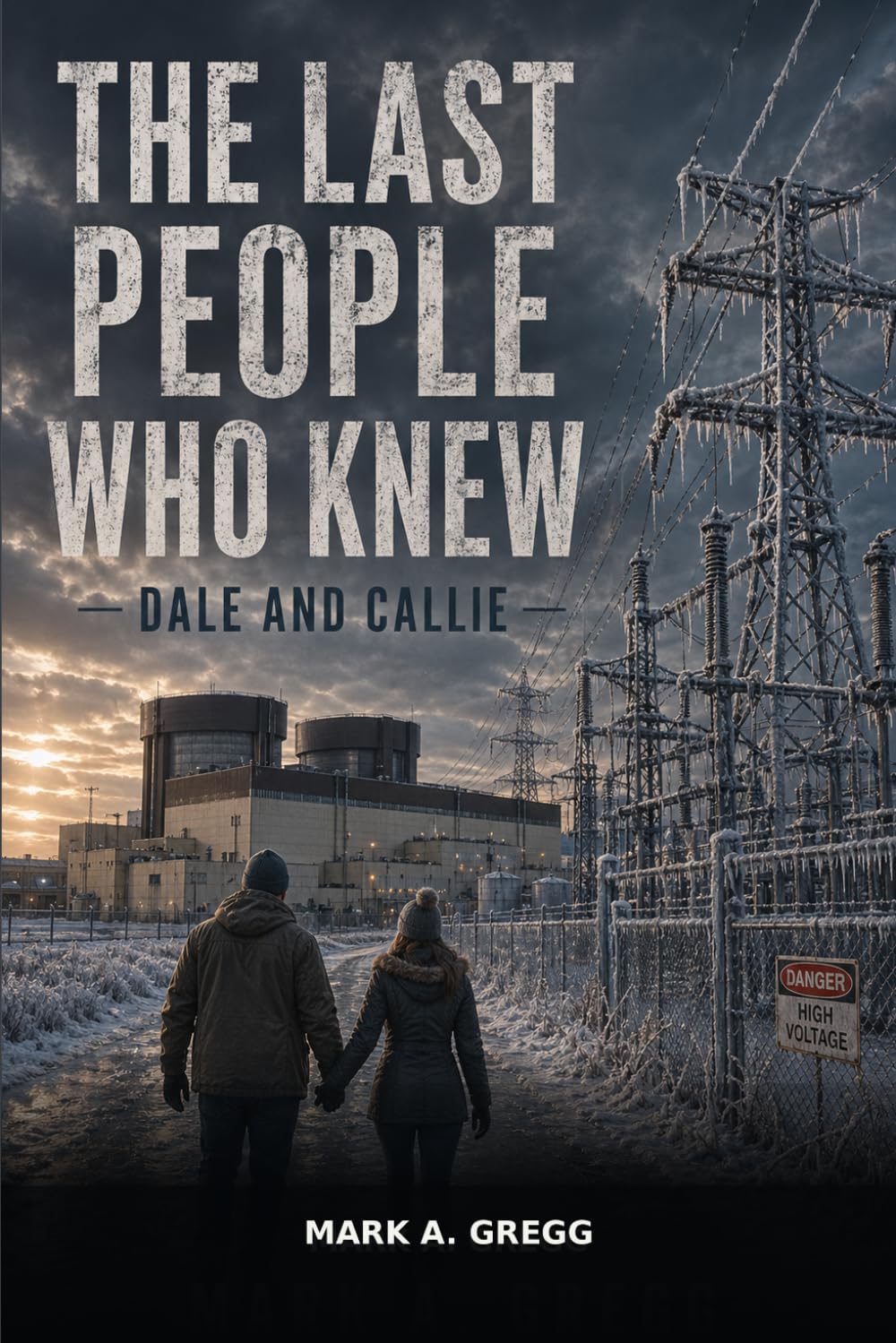

The Last People Who Knew by Mark A. Gregg is a techno-thriller and infrastructure disaster novel about an electric utility, MidAtlantic Energy, slowly trading depth, experience, and maintenance margin for cleaner balance sheets. What begins with small plant problems, thin staffing, aging equipment, and corporate pressure grows into a wider crisis involving the power grid, nuclear plants, black start capability, and a severe storm that exposes how fragile “managed risk” can become when everything goes wrong at once.
I found the book most compelling when it stays close to the machinery and the people who understand it. The control rooms feel alive. Alarms, radios, valve positions, transformer gases, turbine vibration, ice loading, and operator judgment all become part of the tension. It’s a very practical kind of suspense. Not glamorous, exactly. More like watching a hairline crack spread across something everyone assumed was solid. The writing has a plainspoken confidence, and that works well for the genre. This isn’t a sleek spy thriller or a character-first literary novel. It’s a systems thriller, and its real monster isn’t one villain, but the slow narrowing of safety margins.
I also appreciated how candid the book is about leadership choices. Stephen Langford and Warren Buffton are not written as cartoon villains. That makes the story more interesting. Their decisions often sound reasonable in isolation: cut waste, demand efficiency, trust smart people, avoid unnecessary spending. But the novel keeps showing how a reasonable choice can become dangerous when it is made far away from the equipment, the weather, and the people who know where the weak points are. The technical explanations are heavy. The book wants the reader to feel the weight of what operators, engineers, and plant managers carry.
The title is not just dramatic. It’s sad. The “last people who knew” are the ones who remember why a spare part mattered, why a transformer report could not be ignored, why a black start plant was more than an old asset on a spreadsheet. I read the novel as a warning about modern life’s hidden dependence on people whose work is only noticed when it fails. That idea lands hard, especially because the book doesn’t end with a neat fix. Repairs happen. Lessons are written down. Some changes stick. Some don’t. That felt painfully believable.
I would recommend The Last People Who Knew to readers who enjoy technical fiction, disaster novels, workplace thrillers, or grounded techno-thrillers where the suspense comes from systems under stress rather than gunfights or conspiracies. It’ll especially appeal to engineers, operators, utility workers, and anyone curious about what keeps the lights on. Readers who like their fiction built from real bolts, budgets, weather maps, and human judgment will find a lot to admire.
Pages: 427 | ASIN : B0GVYNL1DQ

Fracture

I found Fracture gripping in the way a good geopolitical thriller ought to be, but what stayed with me most was how steadily it turns a technical crisis into a moral one. It begins with a covert maritime operation, the death of Aslı Green, and a single concealed piece of evidence, then widens into a tense struggle involving Russian covert action, NATO politics, British parliamentary theater, and the strange, chilling power of modern systems warfare. What I admired was the book’s refusal to let any of that remain abstract. The plot keeps expanding, yet it remains anchored to human consequences: grief, obligation, loyalty, and the slow corrosion that comes from seeing too much and acting anyway. By the end, the novel has become something darker than a procedural or a policy thriller. It becomes a story about what happens when a man who still believes in structure realizes he may have to step outside it to answer a killing.
I enjoyed the emotional undertow running beneath all the steel, code, and doctrine. Aslı’s death landed hard for me because the book makes her feel vivid before it takes her away, and that loss becomes the wound the whole story keeps circling. I kept thinking about the image of her sending that coded message just before she’s struck, and later about Katya at Heathrow, stunned by the news and forced to keep moving anyway. Those moments give the novel its pulse. I also found the recurring motifs of hidden objects, invisible systems, and “insurance” especially effective: the fountain pen, the locker, the ghost signals, the data hidden inside procedural noise. The book suggests that the modern battlefield is made of things you can’t quite see until they’ve already ruined lives.
I liked the writing a great deal, especially its clipped confidence and its instinct for pressure. The prose is clean, taut, and often unexpectedly elegant, with a real gift for making rooms, screens, command centers, and city streets feel charged with consequence. There are passages here that genuinely hum. Simms’s “weaponized boredom” in committee is both funny and sharp, and the aerial and maritime sequences have an excellent sense of scale and controlled panic. In the middle stretch, a few explanatory sections feel more like impeccably written briefings than fully dramatized scenes, and some secondary figures can read more as functions of the operation than as fully rounded people. Still, even that struck me as a measured flaw rather than a serious weakness, because the book’s central idea is precisely that institutions shape the people inside them, and the style is often serving that very theme.
Fracture gave me the satisfaction I want from a high-level thriller, but it also left me with something knottier and better: the sense that every strategic victory in this world carries a private cost, and that the line between justice and contamination is never clean once crossed. I’d recommend it to readers who like espionage fiction, military and geopolitical thrillers, and novels that care as much about systems and power as they do about conscience. I finished it feeling that the real fracture in the title isn’t only geopolitical. It’s the break inside a person who learns exactly what the world requires and hates himself a little for being able to meet it.
ISBN : 979-8994158531
Blank Checks

In Blank Checks, author Genevieve Marshall drops a clean, addictive “what-if” into the modern world: an app that lets anyone enter, then, once a month, chooses one person to receive a literal blank check and write any amount, “tax-free,” for whatever dream they dare to price. The book moves in a kind of braided mosaic: we watch different lives in different places tilt on the hinge of possibility, while a quiet thread of investigation runs underneath, who built this thing, how it knows so much, and what the game is really doing to the people it touches.
What I liked most was the book’s globe-trotting energy. The scenes keep changing temperature, from silvery San Francisco fog to glossy Singapore opulence to European glamour, so the story never settles into a single neighborhood’s problems. Even when the premise flirts with pure wish-fulfillment, the author keeps tugging it back toward character; the money isn’t a magic wand so much as a spotlight. I found myself enjoying how the book treats “Dream BIG” as both an invitation and a test, because the most revealing moments aren’t the winners’ numbers, but their private logic for choosing them.
I also appreciated the author’s willingness to let the game misfire in ways that feel almost mythic. The standout example for me was the Düsseldorf model, who swings for an absurd amount and gets smacked by the bluntest message imaginable, “Insufficient Funds,” a little morality play delivered by touchscreen. That beat sharpens the whole book: it sets a boundary around the fantasy, and it hints that the “mastermind” isn’t just tossing money like confetti; there’s intention, constraint, maybe even a philosophy hiding behind the theatrics. When the curtain starts to lift on the tech (identity verification, location checks, the dart-at-a-spinning-globe randomness), the story shifts into a more conspiratorial key without losing its travelogue gloss.
I think Blank Checks is for readers who like mystery, suspense, techno-thriller intrigue, and contemporary adventure with a strong travelogue sheen, plus anyone who can’t resist a premise that asks, “What would you write, and what would it reveal about you?” The unraveling of the game’s machinery gave me a faint Dan Brown flavor, jet-setting secrets and engineered revelations, though Marshall’s tone is warmer, more interested in lives rerouted than puzzles solved. Blank Checks gives readers a glossy dream, a hidden hand, and the delicious question beneath it: what does your number say about you?
Pages: 480 | ASIN : B0G9B99VTY
More Hype Than Anything
The Gestalt in the Machine follows a tech journalist as he’s dragged from covering an AI hype-fest into a deadly conspiracy that forces him to question who’s lying and what it means to be real. What was the inspiration for the setup of your story?
I used to be a tech journalist and I’ve sat through a lot of hype. The bombast and over-the-top promises of PanoptiCon are actually pretty realistic, at least as far as what tech companies claim, and AI is more hyped than anything.
What’s different with AI is that there’s even less skepticism about it than other new technologies, I think because pessimists who might otherwise call out a bubble are instead drawn towards something else: The fear that it will destroy the world. With fans of the technology hoping that it will give them eternal life, the stakes are pretty high.
Adam Arrowman is an intriguing and well-developed character. What were some driving ideals behind his character development?
I wanted the protagonist to have realistic human flaws, which naturally are expressed more as he’s under the stress of investigating a murder. He isn’t some crime-solving mastermind: He quickly gets out of his depth, a feeling I think we all have when dealing with tech giants, and doesn’t necessarily react to that well. Then when he does make progress, he’s often reliant on others.
I tried to do the same with the other characters. Kelvin Clipper is the main antagonist and the book is in some ways a warning about the risks of his worldview, but I hope that readers will be agreeing with what he says at least some of the time. Who wouldn’t want to live forever?
What were some themes that were important for you to explore in this book?
The two big ones are the effects of AI on our society and what happens when the push for an ever-accelerating economy runs up against physical constraints. I think that Singularity vs. Limits to Growth is going to be one of the biggest issues we face in the future, if the machines don’t destroy us first.
The book isn’t just about that, though. It’s a story of young people trying to make it in a world many see as doomed, of a devastated media that’s left a smoldering crater in place of consensus reality, and of where we invest our hopes for salvation following the death of God. And, I hope, an exciting thriller.
What is the next book that you are working on, and when will it be available?
When I was writing the book, I thought it would be one and done. Not because I’d run out of things to say, but because AI was progressing so fast that I assumed it would replace human authors before I had a chance to write another.
Now I’m not so sure: Though the Internet is drowning in AI slop, a language model still can’t match a good human writer. I think the reason I was wrong isn’t so much because AI has slowed as that it’s moved on to things that are potentially more profitable than stringing words together. In fact, that seems a good topic to write about….
Author Links: GoodReads
His detective work takes him into the world of Kelvin Clipper, an imperious CEO who promises that ever-accelerating artificial intelligence will let him outrun death. Thousands of protesters disagree. Their warning: Infinite growth is an illusion and Big Tech is actually racing toward the extinction of humanity.
Caught in the middle, a band of hackers searches desperately for a way to align algorithms with human needs. More violence hints at a connection to a president threatening World War III, lobbyists trying to free corporations from their stockholders, and an app that claims to resurrect the dead.
Can Adam find the killer before the killer finds him? What secrets did the victim die to protect? And will Clipper’s Singularity deliver immortality in our time, or damnation for us all?


