Blog Archives
Heightened Stakes

Enemy of the Future follows a high school teen with the ability to time travel who is pulled into a conspiracy involving a deadly virus, and he needs to alter the past before there are global consequences. What was the original inspiration for your story and the Trip Stewart Adventure series?
I’ve always been intrigued by and drawn to stories and movies about time travel. As a result, when I gathered the courage to attempt to write a book, I wanted to involve the concept of time travel but approach it in a different way. I didn’t want it to be focused on the science fiction part because I wanted the lead character to be more of an everyday teenager facing normal school and social problems who stumbles across a global conspiracy.
The conspiracy involving a deadly virus came from my 20-plus years working in the pharmaceutical industry. With my science background, I thought utilizing something I had a lot of experience with was a comfortable way to approach my first book.
Focusing on a passion of mine and using my experience led me to Trip’s first adventure.
Trip begins the story wanting to remain largely unnoticed. What interested you about making a reluctant, socially uncertain teenager the hero of the series, and how did you develop Trip’s personality separately from his unusual abilities?
What drew me to create a character that was reluctant and socially uncertain was watching my daughter, who recently graduated college, grow up and go through the self-doubt and uncertainty of high school (and college). Her journey reminded me of how self-conscious and awkward I was in high school. There is so much pressure on teens in today’s world. Not only do they feel the constant pressure of making decisions that could have major impacts on their futures, but the social part of their lives is also fraught with anxiety, doubt, depression, etc.
I think a lot of Trip’s personality, if I’m totally honest, is derived from my own. I was on the shy side growing up and preferred to remain off the radar as much as possible. I was an “A”-student and a jock, so I struggled to fit into either group, similar to Trip. Like Trip, I struggled to find my place. In addition to drawing from my own personality, I knew his special ability would affect his personality. I didn’t want it to define him, but I also didn’t want to dismiss its impact. What he has experienced and dealt with in his formative years would obviously influence his personality and how he approaches people. Because he is unique, I wanted to bring attention to his feelings of loneliness and his propensity to distance himself from others. While he does isolate himself due to his ability, this is like many teenagers who, even though they interact with their friends and family, often feel alone. I’d like to think that by the end of the book, he starts to realize that having friends you can trust to share the load with is important.
The story balances school, friendships, romance, humor, and potentially world-changing danger. How important was that mixture of ordinary and extraordinary life?
I wanted Trip to be a normal teenager facing normal, everyday problems. Being partnered with his crush, facing off against the school bully, and hanging out with his best friend were ways to keep the story grounded. Even though Trip is uncertain of how he fits in his high school, not to mention the world in general, he’s surrounded by other teenagers who are dealing with similar problems. And despite his desire to seclude and distance himself, he can’t help but get pulled into the relationship drama, the crushes, and the geek-out moments with his best friend. Having that sense of normalcy allows the heightened stakes involving the deadly virus to stand out even more. Intermixing Trip’s everyday school obligations with the conspiracy helps propel the story forward. With the elements of Trip’s normal life being influenced by his extraordinary life, it forces him to make difficult choices and decisions that could have a significant impact on both. In the end, I wanted the reader to feel like the things happening to Trip could be happening to them.
Without giving too much away, what can readers expect as Trip and Jayla’s adventures continue?
In Trip and Jayla’s next adventure, Countdown to Homecoming, the two find themselves trying to figure out who set off an explosion at the Homecoming dance. The story continues to explore Trip and Jayla’s relationship while they navigate the ups and downs of Homecoming week. The book also explores Trip’s struggles to balance his expanding social life and his special ability.
Author Links: GoodReads | Website | Amazon
A jealous boyfriend. A school bully. And a shocking discovery—a conspiracy involving a deadly virus.
Suddenly Trip is the only one standing between a hidden threat and a global catastrophe.
High school was supposed to be hard… just not end‑of‑the‑world hard.
Sanctuary (The Dark Days Series Book 2)


Sanctuary: The Dark Days Series Book Two continues Sonny’s journey after the collapse chronicled in Outbreak, carrying him and his found family toward Fort Gold Rush, a fortified city that seems to offer the protection they have been bleeding toward for so long. But safety is not simple here. Sonny is drawn into a new life of rules, military programs, surrogate family bonds, painful mistaken identity, and fresh violence beyond the walls, making this sequel less a story of escape than a story of uneasy arrival.
I liked how this book changes the pressure without softening the danger. Outbreak was about flight, immediate loss, and the shock of seeing the world die in real time; Sanctuary asks what happens after survivors finally reach a place that claims to be secure. The walls of Fort Gold Rush create a different kind of suspense. Zombies remain a threat, but bureaucracy, grief, loyalty, training, and moral compromise become just as sharp. The sequel understands that a sanctuary can protect the body while still unsettling the soul.
Sonny remains the emotional center, but he feels older here in a way that is both impressive and sad. His relationships with Ashley, Carrie, Will, Kayley, River, Ellen, Clara, Jonathan, Grim, and the others give the book its layered and unique feel, especially when the story explores what family means after biology, geography, and normal life have all been shattered. I was especially drawn to the tension between Sonny’s loyalty to the people who survived with him and the new roles others try to place on him. I had a great time with the battles as well as the quiet recognitions that healing can feel like betrayal, that belonging can be messy, and that a child can become dangerous without becoming cruel.
Sanctuary will appeal to readers drawn to post-apocalyptic survival fiction, zombie horror, young adult dystopian adventure, military science fiction, and found-family drama. While fans of The Walking Dead may come for the undead and the fortified settlements, the book’s emotional compass points closer to the wounded resilience found in The Last of Us. Sanctuary shows that survival is not the same as being saved, and that the hardest walls to rebuild are the ones inside the heart.
Pages: 390 | ASIN : B0G4F9854Y

Aliens as a Metaphor

Little Green Man follows a seventeen-year-old girl living in a small town who, with the help of the new boy at school, tries to find out if there are aliens living in their town. What was the inspiration for the setup of your story?
While I’ve written about aliens before, I wanted to write something that shined a different light on the concept. I incorporated the high school experience to create a young adult book that readers could find both exciting and relatable. I played around a lot with the dynamic of Birdie and Sol early on, as well as the rest of the characters present in the story. Overall, my primary inspiration for writing a book so centered around high school was the fact that, at the time of writing this book, I was about a month from starting high school. While I was sixteen when the novel was published, I was fourteen when I wrote it!
I enjoyed the character of Birdie. Is there anything about Birdie that came from yourself or your life experiences?
Birdie was, in many ways, a manifestation of myself at the time. Although she was several years older than I was at the time of writing this book, there are a lot of things about her that were derived from myself: Her awkwardness when it comes to talking to boys, her tendency to obsess over what fascinates her, and even her love for beautiful views – just to name a few.
What were some themes that were important for you to explore in this book?
It was essential to, inevitably, explore aliens – not only as little green men but also as creatures that may be very similar to humans. I strived to capture experiences that would be relatable to the audience of the book, using the concept of aliens as a metaphor for being left out and excluded from society.
Where does the story go in the next book, and where do you see it going in the future?
A sequel (and perhaps more) is in the works for Little Green Man. While I cannot say much about where the story goes, I explore the alien species that the first book focuses on, as well as the relationship between Earth and this species. Birdie and Sol are also reunited – for better or for worse.
Author Links: GoodReads | X (Twitter) | Website | Amazon
“I’m not going to parties or practicing underage drinking. I’m not sneaking out to see my secret boyfriend. I’m literally searching for aliens.”
Meet seventeen-year-old Birdie Buckley. She’s an alien enthusiast from a small town in Colorado called Mount Pifork, a miserable place where everyone knows everyone, anything that deviates from the norm is looked down upon and, to top it off, there may or may not be aliens lurking. At least, that’s what Birdie thinks.
Ever since she was young, she has been searching for proof that humans are not alone in the universe—and so far, that research has not taken her very far. Until, one night she captures her boldest piece of evidence yet. This sends her on a spiraling journey that opens up a million harrowing questions, because she may not be the only one aware of the anomaly.
Joining forces with Sol, the mysterious new boy at her high school and the one person who shares her interests, Birdie looks deeper into bizarre occurrences, her community’s hidden history, and even a strange observatory on the outskirts of town that she swears was never there before. The more she investigates, the more her findings begin to make sense and the more the truth becomes clear—and that truth may be her dream come true, or her biggest fall from grace.
Perfect for fans of E.T. and the X-Files, Little Green Man takes readers on an eccentric investigation that challenges the definition of alien and explores the overshadowed side of the high school experience.
A Recipe for a Psychedelic Freakout Novel
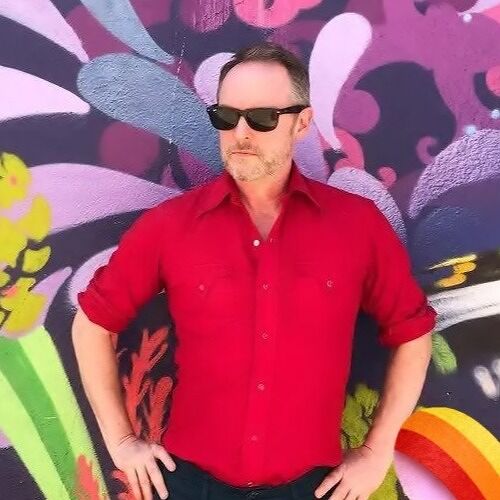
In Many Arms Enfold Us, a young girl, her brother, and her mother move to a remote area of Montana and discover the horrifying truth about what lies beneath the town. What was the idea, or spark, that first set off the need to write this book?
As a teen in Portland, OR, I discovered there was a network of tunnels under our downtown, and that was the case in many cities. I’ve always been intrigued by cephalopods, jellyfish, and bioluminescence, and I spooked myself pretty hard thinking about encountering a floating, oxygen-breathing version in the Ape Cave lava tubes in Washington. Add to that my former religious upbringing, and my wariness of cults and groupthink–this election notwithstanding–and I felt I had the recipe for a real psychedelic freakout novel.
What intrigues you most about the horror genre?
When I was a boy, I saw the short film Amelia starring Karen Black. I had nightmares for a month, and my mom forbade me to watch horror films ever again. My rebellious nature ensured I’d be devoted to scary stories from that moment on. Then I discovered Stephen King and HP Lovecraft, and I was hooked. I steer away from splatter–I think it numbs us to violence. I prefer characters that discover their resilience and bravery through some supernatural trauma.
Is there anything from your own life you put into Kara and her family?
I was raised on a religious commune in the old growth redwoods of Humboldt, CA. My experience was fairly tame, but we were definitely a cult. We believed in demonic possession, and I saw my share of drifters hitchhiking through our camp, having drug-related episodes that we were convinced was the Devil. I spent hours peering into the forest with only a kerosene lantern, listening to the scuttle of unknown creatures, creating horrors for myself. In regards to cults—I think many people with only a faith-based education will have a difficult time criticizing their leaders and practicing independent thought, because obedience, fear, and arrogance are cooked into their unassailable belief. My church was dismayed when we moved to Portland and I attended public school, and for good reason. Evidence, scrutiny, scientific method, citations, and a curious mind are all enemies of religion. Worshipping imaginary friends is unwise–imposing them on others is abuse.
What is the next book you are working on, and when will it be available?
I recently finished an autofiction called The Devil Wand. The first half mirrors my upbringing, but the second half is fiction. The protagonist discovers from watching the opening scene in Kubrick’s The Shining that a VW bug driving through beautiful scenery can be made terrifying by adding scary music. He later becomes a preeminent avant-garde composer for horror film soundtracks, much like Joseph Bishara and Mark Korven. The novel will be published next year. Meanwhile, the book I’m currently writing is tentatively called Silverlake Demon. It’s about a young man living in LA who winds up homeless, and discovers a wealthy alchemist is using an experimental serum to eradicate the indigent population, mutating them and making them commit suicide.
Author Links: GoodReads | X | Website | Instagram | TikTok | Book Review
A terrifying novel that explores feminism and consent, religious fervor, and the dark history of American asylums—filled with kaleidoscopic wonder and cosmic terror.
Many Arms Enfold Us

Many Arms Enfold Us, by Diavolo Ray, offers a gripping horror novel tailored for young adult and teen readers, but it’s unsettling enough to leave anyone with a lingering chill. The story follows Kara, a young girl who moves with her brother and mother to the remote woodlands of Montana, where her mother plans to establish a local internet hub. But from the moment they arrive, it’s clear that something is horribly wrong beneath the town’s surface… literally. Hidden underground, parasitic creatures thrive, feeding on unsuspecting humans. Even more disturbing, the town’s residents seem eerily indifferent to the lurking danger.
From the very first page, Diavolo Ray masterfully keeps readers guessing. The suspense is palpable, with each twist and turn as unpredictable for the reader as it is for Kara herself. Her fear, disgust, and determination radiate through the narrative, creating a tense atmosphere that gradually builds to a state of dread. Rather than relying on traditional monsters or grotesque violence, the antagonists in this novel are far more sinister. They subtly manipulate, coaxing their victims into willing submission. The result is a science-fiction-horror hybrid that feels fresh and deeply unsettling.
Ray’s descriptive prowess immerses readers fully in Kara’s experience. Every scene is vivid and haunting, making you feel as though you are right there, fighting to escape the town’s suffocating grip. And then there’s the ending, which is far from offering a neat resolution. It leaves you with the unsettling realization that the danger is far from over. I won’t give the ending away, but it leaves the reader with the chilling implication that all of humanity might be at risk.
Many Arms Enfold Us brings a refreshing twist to the horror genre, combining sci-fi elements with a creeping psychological tension that leaves an impact. By the time you close the book, you might find yourself pondering just how real the threat of mind control could be.
Pages: 325 | ASIN : B0D42N6LSD


