Blog Archives
An Unexpected Act of Kindness

TOUCH: The Tumbles and Turns of Time Manipulation follows a radiologist whose migraines lead him to an experimental treatment that inadvertently unlocks an ability to manipulate time by sending memories back to his younger self. What was the inspiration for the setup of your story?
The author’s first historic moment for a timeless crystal memory occurred when he was seven. He couldn’t get his kite to fly in the local park. An older kid came to help from across the street but broke the kite. The tall thirteen-year-old immediately replaced it with a new, better kite from his house. Later, the author was a receiver for him in touch football.
Close to the onset of the writing, one of the author’s sisters died of lung cancer because of her teenage smoking start.
A professional football player the author knew died early with severe memory loss.
Were you able to achieve everything you wanted with the characters in the novel?
Yes, the author accomplished what he desired with the characters. He left room for follow-up writing with some of the characters, particularly the female quarterback, Evelynn Dovell, who recognized Cillian.
What were some themes that were important for you to explore in this book?
With regard to time, the author explored the contrast between events that seem inevitable and others that have a rare randomness.
The impact of an unexpected act of kindness can be forever.
What is the next book that you are working on, and when will it be available?
The author’s next book, planned for release in 2025, is a follow-up to Clean Slate (where a woman used a drug to selectively erase her boyfriend’s memories of prior girlfriends.)
Meet Cillian, a physician whose seemingly ordinary life takes an extraordinary turn after a fateful accident during a groundbreaking medical procedure. Suddenly endowed with the ability to send messages to his younger self, Cillian embarks on a quest to rewrite his friend’s medical history.
But as Cillian delves deeper into the complexities of time travel, he discovers that changing the past comes with unforeseen consequences. From opportunities and missed opportunities with his true love, Mary, to heartbreaking revelations about his friend Shawn’s illnesses, Cillian grapples with the weight of his choices as he navigates a maze of alternate timelines.
With each twist and turn, “Touch” immerses readers in a riveting tale of love, sacrifice, and the timeless struggle between fate and free will. Will Cillian mend his fabric of time and secure a future with Mary, or will his attempts to rewrite history only lead to further heartache?
TOUCH: The Tumbles and Turns of Time Manipulation
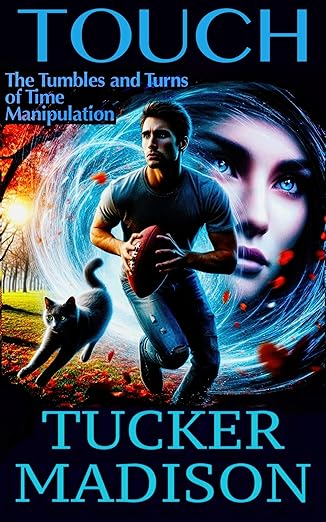

Tucker Madison’s TOUCH: The Tumbles and Turns of Time Manipulation is a mind-bending, emotional journey that plays with the idea of time in a way that is both deeply personal and scientifically intriguing. The novel follows Cillian Cole, a radiologist whose migraines lead him to an experimental treatment that inadvertently unlocks an ability to manipulate time though not in the traditional sci-fi sense of building a machine. Instead, Cillian experiences a series of déjà vu-like flashes that allow him to send memories back to his younger self. This revelation sets off a cascade of existential questions and moral dilemmas as he tries to use this power to prevent tragedy, particularly for his childhood hero and friend, Shawn. As Cillian navigates shifting realities, the novel asks whether changing the past is truly possible or if fate has a way of course-correcting.
One of the most compelling aspects of the book is its treatment of time not as a rigid sequence but as something malleable through memory and consciousness. Madison crafts some truly arresting moments, like when Cillian suddenly has two versions of the past in his mind: one where his medical school canoe trip photos were ruined, and another where they survived because he subconsciously knew to bring a dry bag. That small ripple effect makes the whole concept feel eerily plausible. The writing during these moments is hypnotic, capturing the surreal quality of memory itself. The novel doesn’t bombard the reader with heavy scientific jargon, but rather plays with the idea in a way that feels instinctive like something we’ve all felt in those weird, uncanny moments of déjà vu.
Where the novel really shines is in its emotional depth. Cillian’s relationships particularly with Shawn and later with Mary ground the sci-fi elements in something deeply human. The football scenes between Young Cillian and Shawn are electric, especially the moment of his first big catch, where time slows to an almost supernatural degree. That moment becomes a portal of sorts, something that Cillian later revisits as he tries to change Shawn’s fate. The novel is laced with nostalgia, regret, and a longing for second chances, making it feel less like a traditional time-travel story and more like a meditation on memory and loss. The relationship between Cillian and Mary, which develops through an altered timeline, is equally compelling, giving the novel a love story that feels both earned and deeply romantic.
As Cillian grapples with the implications of his power, there’s an underlying question of how far he should go. The scene where he visits an older, memory-damaged Shawn is heartbreaking, especially when Shawn fails to recognize his own wife, Peggy. It forces Cillian and the reader to ask whether altering the past is always the right thing to do or if the consequences are too unpredictable. The book is at its best when it wrestles with these questions, making the reader feel the weight of Cillian’s choices. The ethical dilemmas feel real because they’re rooted in personal stakes rather than grand, world-saving missions.
TOUCH is an engrossing, thought-provoking read that blends science fiction with deep emotional resonance. Madison crafts a story that is as much about the physics of time as it is about the fragility of human connection. This book is perfect for anyone who loves time manipulation with a strong emotional core. It makes you wonder: if you could whisper advice to your younger self, would you? And even more importantly, should you?
Pages: 160 | ASIN : B0CX96ZTQQ

The Morally Grey Character

The Dark Without follows a young woman living in a world where the Earth is dying, who is abducted by aliens and becomes a powerful mystical leader charged with bringing Earth back from the brink of death. What was the inspiration for the setup of your story?
When I first started, I had no idea where it was heading, but I knew it had to be along the lines of a total power failure and the ensuing outcome of what that brings. But by the third chapter, things started to veer sideways and new ideas hit me all at once. Having aliens in the mix wasn’t in the plans at first. But if I’d kept to the original, it would’ve been pretty drab and predictable, with the backdrop of an Earth falling dreadfully into a dystopian apocalypse with no hope of ever coming out of it. I did toy around with having the aliens as the good guys, but that would’ve been boring, and again, predictable. So I made the protagonist, Esme, the morally grey character – one who the reader would hopefully root for, yet be unsettled with her choices.
The inspiration for the “original” story came about several years ago during a power cut. I sat there feeling absolutely stranded and at a loss of what to do next. No power meant no WiFi, television, or even the air conditioner. What a cushy, entitled life we live in now, right? And from there, a thought bubble formed and a story – what if the power never came back on, what would happen? What would people do? And that ended up the base of the story.
I find the world you created in this novel brimming with possibilities. Where did the inspiration for the setting come from, and how did it change as you were writing?
The setting just sort of manifested organically. I keep a list of names for future characters in future books (which author doesn’t, right?), and I grabbed “Esme” because it sounded right for the story. A simple, classic name, and a little unusual from the norm. From there, I went with it, and decided she didn’t have to be the typical “English-speaking” protagonist, and why not have things happen in Spain, rather than the usual places…and from there, it spiralled onto a wider platform.
What were some themes that were important for you to explore in this book?
Not anything in particular, but by the time I was a quarter way into the first draft, I knew this was going to be a dark story. A vengeful story. One that would reflect humans at their core, as in what and how we would react in extreme situations and conditions. Just seeing what’s happening around the world is enough to understand what we can and will do, especially to another human being. That was the motivator for Esme’s character. A normal, young girl who is thrown into an impossible, horrific reality. What would she do, and how would she do it? And to what extremes would she go to, to get it done?
Will there be a follow-up novel to this story? If so, what aspects of the story will the next book cover?
Tempting, but no. While the end of the story left things ambiguous, the story is done. I enjoyed writing it.
Author Links: GoodReads | X (Twitter) | Threads | Instagram | Facebook | Website | Amazon
“Humankind is always doomed to fail. It has fallen many times before, and many times we have intervened to ensure it stays on the correct course. Earth is salvageable, but if you had continued along the path you were on, it would not have been. You have billions of years more to exist before your planet’s final destruction. We are only making certain it survives that long, and ensuring your survival until the ultimate end. At times you progress too fast, but such is humankind’s way. So we had to accelerate this current failure sooner in order to restart. As we have done before, a guide with a better objective and understanding of how to protect your world, will be inserted…”
But why did they care what humans did with their lives? They were aliens—beings from another dimension! Earth wasn’t their home.
Esme Serrano’s predestined encounter with the trans-dimensional anthropomorphic Aakehollats sends her on a multi-pathed journey spanning ten thousand years. A journey riddled with lies, manipulations and untold layers of deception. She guides Earth as the Sibyl, a powerful and mystical leader, and brings the dying world back from the brink of death. She helps the Aakehollats, and ensures that Earth survives until its ultimate destruction in the cosmos.
But her one true goal is, and always will be, to kill the Aakehollats.
Love and Forgiveness

Lightning in the Collied Night follows a group of scientists who embark on a bold mission to harness the power of a newly discovered wormhole in a desperate bid to secure the survival of the human race. What was the inspiration for the setup of your story?
The original story idea came to me several years ago. Back then, it was a simple story about a young physicist who overcomes personal and external challenges to travel to the future through a wormhole and discovers… well, I can’t get into that as it’s the crux of the story! I can say that there were multiple inspirations for the story, from literary and sci-fi sources; those are brought out in the novel. Over time, I added twists, layers, and characters to my story until I thought it might be suitable for a novel. When I retired in 2023 and had time to learn how to write fiction, I decided to share my story.
A lot of time was spent crafting the character traits in this novel. What was the most important factor for you to get right in your characters?
Probably the most important factor was that I wanted the characters to be relatable to readers. The story is set (mostly) about 30 years from now. I wanted readers to be able to understand and feel what these characters were going through as they overcame many challenges, both from within themselves and the outside world. One of the ways I did that was to try to make the dialogue seem “natural,” like people actually talk, and liberally use interior monologue to let readers get “into the heads” of the main characters.
What were some themes that were important for you to explore in this book?
Probably the most important theme was the power of love and forgiveness to transform a person… or perhaps a world. Another theme is that AI can be an extremely powerful and useful tool when used appropriately, but it’s not the best solution for every problem. There’s a difference I think between what AI could do for humankind, and what we should allow it to do. Finally, I wanted my novel to reflect our wonderfully diverse world, and thus I strove to have the characters be representative of that diversity.
Will there be a follow-up novel to this story? If so, what aspects of the story will the next book cover?
I hadn’t planned on a sequel. But I’ve fallen in love with the characters (most of them, anyway!) and believe there’s much more of their story to tell. Thus I’ve started outlining a sequel, with a planned release of Summer 2025. I don’t want to give any spoilers, but I will share that the draft tagline is, “How far would you go for love?” The sequel will be more of a traditional sci-fi story than Lightning, but still approachable by people who aren’t quantum physicists. Like Lightning, it will be focused on the characters, their relationships, and their struggles. I think it will be entirely based on Earth of the future–no trips to wormholes, this time. And, like Lightning, the title will be from Shakespeare. 😉
Author Links: GoodReads | Amazon
In the mid-21st century, a brilliant American physicist joins a secret mission to travel through the galaxy’s lone stable wormhole. When a series of challenges threaten the project, she must find another way to accomplish its objective: save the human race. With help from an unexpected ally, the young scientist races to harness the universe’s mightiest force and preserve humanity’s future.
Western Lights

Western Lights, by C.P. Schaefer, is a thrilling journey through a near-future world grappling with sudden and violent environmental upheavals. The story kicks off with Ethan Sites, a young NOAA scientist, witnessing bizarre and deadly changes in the Northern Lights. These disturbances set off a chain reaction of events, including strange magnetic anomalies and catastrophic flash fires in Alaska. As Ethan and his team scramble to understand the phenomena, their efforts intersect with various global forces, from government agencies to local Alaskans, all trying to survive and decode the terrifying environmental shifts.
Schaefer’s writing is vivid and fast-paced, pulling you into the chaotic world he envisions with little room to catch your breath. I found his descriptions of the Alaskan tundra particularly immersive. The author’s impressive skill in blending technical details with a compelling narrative makes complex scientific concepts accessible without slowing down the action.
The core idea of a shifting magnetic pole causing such dramatic effects is intriguing and terrifying. Schaefer successfully taps into current concerns about climate change and amplifies them into a plausible and gripping disaster scenario. I appreciated how the novel doesn’t just focus on the spectacle of the environmental catastrophe but also delves into the human responses to it. Characters like Ethan, struggling to make sense of the science, and Sara, a whale rescuer who’s thrown into the chaos, add depth and a personal touch to the narrative. One of my favorite parts is when Ethan and Sara debate the causes and implications of the phenomena while trying to save stranded whales. This scene exemplifies how Schaefer weaves scientific discourse into the plot naturally.
Western Lights is a must-read for fans of eco-thrillers and science fiction. Schaefer combines scientific intrigue with heart-pounding action, making it an engaging and thought-provoking read. The book’s exploration of humanity’s fragility in the face of nature’s unpredictability will resonate with anyone interested in climate change or disaster stories. While I feel the breakneck pace might overwhelm some, it’s perfect for readers who enjoy being thrown into the deep end from page one.
Pages: 434 | ASIN : B0CW18MGZK
Stories With Respect and Admiration

Saint Augustine Sisterhood follows a time traveler on a dual mission to preserve the spirit of St. Augustine as she continues the search for her husband whom she lost two centuries ago at Stonehenge. What was the inspiration for the setup of your story?
After being introduced to the Pirate and Gypsy community in Saint Augustine I started following their activities. These are groups of people that enjoy the historical and artistic social events that they are members of. They are not the traditional gypsies that often connote negative images. I wanted to tell their stories with respect and admiration for the love and happiness that they generate. It took me nearly two years to achieve my goals.
Did you plan the tone and direction of the novel before writing, or did it come out organically as you were writing?
Whenever I start writing a new novel I always begin with a title, a cover, and a conclusion. In this case, the tone was set by the Gypsy Dancers that I followed allowing me to also add the idea of time travelers which is a perfect fit in the ancient city of Saint Augustine with all of its ghost stories and mysterious tales.
Are there any emotions or memories from your own life that you put into your characters’ lives?
In all seven novels that I have written, there is always a personal connection to people I have known, places that I visit, and experiences that I have had. In Sisterhood there are also layers of fantasy, historical fiction, and spirituality. I also paid tribute to my beloved fifteen-year-old Weimaraner, Enya, who unfortunately passed away during the writing of this novel. Lancelot, who was also another Weimaraner that I owned, was my way of honoring Enya’s lifetime of friendship.
What is the next book you are working on, and when will it be available?
Currently, I am working on a stage play that is adapting Sisterhood into a musical interpretation, including the traveling Gypsies who find themselves in the St. Augustine Enchanted Grove. Also, I am writing a sequel to Sisterhood titled Saint Augustine Sisterhood in the Garden of Good and Evil. This will take the time-traveling gypsies to New Orleans, and Savannah where they will be confronted by a group of evil counterparts. I am hoping to have that novel released early next year.
Author Links: GoodReads | Website | Amazon
When Mandana arrives to settle the estate of her estranged Aunt Caroline, she has no intention in remaining in Florida. That is until the Sisterhood of Gypsy dancers captivates her imagination, an Irish artist enchants her with his mysterious charm, and a Weimaraner named Lancelot becomes her knight in shining armor.
Mandana soon discovers that this ancient city known for harboring ghostly spirits is also a haven for time travelers that seek refuge at the Extended Life Institute. What she doesn’t understand is her role in this mysterious story that is layered with supernatural intrigue.
Saint Augustine Sisterhood

Saint Augustine Sisterhood, written by Eleanor Tremayne, is a masterful blend of history, fiction, and the supernatural. The novel follows Emerald, a time traveler who becomes separated from her husband Liam at Stonehenge during their trip to America’s oldest city, Saint Augustine. As Emerald searches for Liam, she also seeks out five strong-willed women destined to preserve the spirit of Saint Augustine’s gypsy sisterhood.
The story takes an intriguing turn with the introduction of Mandana Morrison, an unexpected character who complicates the narrative. Despite her initial plans to leave the city, Mandana finds herself drawn to the idea of the sisterhood and captivated by the charm of an Irish artist. Her curiosity leads her to uncover the secrets of the time travelers, though she remains unaware of her own crucial role in this supernatural saga.
Tremayne’s Saint Augustine Sisterhood is a paragon of the supernatural genre. She deftly intertwines historical and fictional elements, crafting a captivating tale that highlights the significance of gypsy and pirate groups while delving into their historical roots. Her descriptive prose draws readers into a vividly imagined world, showcasing her exceptional storytelling skills. The novel features a dynamic and engaging cast of characters, with both Emerald and Mandana playing pivotal roles. Their character development is particularly noteworthy, adding depth and dimension to the narrative. The plot is rich with unexpected twists and turns, maintaining suspense and keeping readers hooked from beginning to end. The infusion of supernatural elements and subtle humor further enhances the novel’s appeal.
Saint Augustine Sisterhood is a perfect blend of suspense, fiction, and history. With its rich characters and enthralling storyline, this epic read is sure to astonish and inspire readers. Tremayne has crafted a compelling narrative that is both entertaining and thought-provoking, making this book a must-read for fans of the genre.
Pages: 312 | ASIN : B0CW1N27PQ
Unintended Consequences

GENEFIRE follows a PhD student studying the DNA of a young girl who discovers a warning from the future about Earth’s destruction. What was the inspiration for the setup of your story?
Having been through a PhD myself, I know how hard it can be. It really can feel like the world will end if you don’t finish your PhD. As an academic over the last 15 years, I have also supervised many successful PhD students, and have also seen the whole range of experiences. Many of my former students were the inspiration for Milton, trying to capture that PhD experience in fiction. The journey that Milton goes through is a bit of a metaphor for that experience when you feel like nothing is going right in your PhD, then suddenly you find something amazing, but then your supervisor pours cold water on the idea. You try like crazy to replicate the results (“it’s not a real result unless you validate it”) and end up heading to your PhD viva filled with imposter syndrome and feeling as though you’re on trial.
The other inspiration for this story is the idea of writing in DNA. I have always been fascinated by the idea that we could write messages in DNA, and I wondered how far could we take it?
The science inserted in the fiction was well-balanced. How did you manage to keep it grounded while still providing the fantastic edge science fiction stories usually provide?
As a scientist, it was important to me that the science presented in GENEFIRE was either possible with today’s technology, or easily plausible and likely to come true. Genetic engineering in humans is on the cusp at the moment. Only a few days ago, there was an announcement of regulatory approval in the UK for curing sickle cell disease and beta-thalassemia with CRISPR gene editing technologies. It starts with noble disease-curing goals, but where does it end? That is what this novel sets out to explore. We are already far behind the technology in our understanding of the ethics and potential consequences of editing genes. The main theme of the novel is the idea of unintended consequences and the ethics of tinkering with the human genome. There are some harder sci-fi elements but balanced out with fast-paced action and suspense as the characters make their choices and follow their destinies. I hope that most readers will be willing to come along for the ride.
What was one scene in the novel that you felt captured the morals and message you were trying to deliver to readers?
There is a scene on the international space station where all hell breaks loose. The dangerous chemical that Gessica discovered has arrived with the refugees from Earth and has contaminated the ISS. Everyone is in danger, except Tammy, who is immune to the danger due to his genetic makeup. He has to watch all of his friends die a horrible death. That is the culmination of everything going wrong from one terrible mistake.
“Sweet mercy! What a mistake.” – Gessica Kelly.
Will this novel be the start of a series, or are you working on a different story?
Yes, I am hoping this is part one of a trilogy. Being the serious “planner” that I am, I have the next two books plotted out (no spoilers), ready to be written, if only I could find… Now where did I put that time? I can’t seem to find it anywhere.
Author Links: GoodReads | Twitter | Facebook | Website | Amazon
Sometimes it feels as though the world will end if you don’t finish your PhD. For Larry Milton, it’s true.
Larry has discovered a dire warning from the future about Earth’s destruction — written in the DNA of a young girl.
With the destruction of the planet at stake, and no one believing him, he goes to extraordinary lengths to help the messenger from the future save the world… and try to finish his PhD at the same time.



 LITERARY TITAN