Blog Archives
A Rich Inner Life

Somewhere Else follows a history professor who experiences the past through artifacts, becoming addicted to these encounters while awakening a sinister force. Where did the idea behind this novel come from?
Honestly, it came out of my own classroom. I’ve spent years teaching history, and the thing I always try to get students to do is feel their way into a moment, not just memorize dates. There’s actually a term for that: temporal empathy. One day I found myself thinking, what if that wasn’t just a mental exercise? What if the right object, in the right hands, could actually pull someone back into the moment it came from? I was also chewing on Einstein’s block universe theory, the idea that the past isn’t really gone; it’s still out there, somewhere else. Put those two things together, and you get Joe: a man whose gift for empathizing with history becomes a door he can’t stop walking through. And once you have a door like that, it’s not much of a stretch to wonder what dark forces might be waiting on the other side.
Why was it important that Joe knowingly makes choices that hurt the people closest to him?
Because I didn’t want to let him off the hook, and I didn’t want readers to either. Joe isn’t sleepwalking into this. He knows what it’s costing him with Margaret and with his own life, and he does it anyway. That’s what addiction actually looks like most of the time; it’s not blindness, it’s a kind of willful looking away. There’s also an irony I kept coming back to while writing: Joe has this huge well of empathy for people who have been dead for centuries, soldiers at Valley Forge, an artist in his final days, and almost none left over for the people sitting across the table from him. That gap felt like the real heart of the book.
How did you decide where historical fact should end, and imagination should begin?
I tried to be upfront about that instead of blurring it, which is part of why I wrote an Author’s Note that gets into it directly. The physics is real; the block universe theory is a genuine, debated idea in modern physics, not something I made up to make the plot work. Temporal empathy as a term is real too; it’s how historians talk about teaching people to feel the past rather than just study it. What I invented is the jump from those two real ideas to a person physically stepping into history. I also use a metaphor, a hallway of doors, when I explain the concept in interviews or marketing copy. That’s purely explanatory; it doesn’t literally appear anywhere in the book. My rule was simple: ground the premise in something true enough that readers trust it, then take the one leap the science itself will not take.
What do you hope readers take away from Joe and Margaret’s very different relationships with time?
Joe treats time like something to enter and collect, one door after another. Margaret is a visual artist, and she’s rooted in the present in a way Joe has completely lost; she’s making things with her hands while he’s disappearing into the past. I wanted that contrast to sit with readers a little uncomfortably. Is a rich inner life spent somewhere else worth more than actually being present in the life you already have? I purposely don’t answer that cleanly, and the ending won’t let you off easy either. But if someone closes the book thinking harder about where their own attention lives, that’s really all I was hoping for.
Author Links: GoodReads | Amazon
At sixty-six, history professor Joe Patterson discovers he can touch an artifact and step inside the moment it came from: Valley Forge, the fevered hours in Van Gogh’s room at Arles, the cramped cabin of Apollo 11 as it broke from Earth’s orbit. It feels like a miracle. It’s a trap.
The visions escalate, and the hunger for them becomes its own kind of addiction, one that costs Joe his marriage, his son’s trust, and, piece by piece, his grip on which century he’s actually standing in. Something on the other side of history has been feeding on minds like his for a very long time; it isn’t finished with Joe yet.
Somewhere Else is a literary novel with a horror pulse: a story about obsession, erasure, and the price of touching the past.
Somewhere Else


Alan McKee’s Somewhere Else is a literary speculative novel with the steady pull of psychological horror. Joe Patterson, a sixty-six-year-old history professor, discovers that touching certain artifacts lets him enter the experiences attached to them. He witnesses Jefferson and Franklin shaping the Declaration of Independence, Neil Armstrong stepping onto the moon, Van Gogh painting The Starry Night, and the Wright brothers taking flight. These encounters feel intensely physical, complete with smells, emotions, and borrowed memories. They also awaken a dark figure that seems to feed on moments of human transcendence. What begins as a historian’s dream soon develops the rhythm of an addiction, with every extraordinary encounter making Joe’s present life seem a little dimmer.
The historical sequences are the book’s showpieces, and McKee writes them with warmth and sensory detail. His version of Van Gogh experiences color as sound and feeling, while Edison’s successful light bulb matters because it will allow an imagined child to finish reading after dark. These scenes reveal the novel’s generous view of achievement: history is made by vulnerable people who don’t yet know how their work will endure. McKee occasionally repeats phrases about consciousness, infinity, and transcendence more often than their meaning requires, but the recurring language also reflects Joe’s narrowing mind. His intellectual curiosity gradually hardens into a private creed, one that can justify each new deception and disappearance.
The novel becomes especially affecting when it returns to Margaret, Joe’s wife of forty-five years. Her chapters give ordinary life its own weight through coffee, paintings, family dinners, missed calls, and the familiar sounds of another person moving through the house. She understands Joe’s behavior as a wife watching a husband become less honest, less reachable, and less interested in the life they built. That perspective keeps the supernatural plot emotionally credible. Joe’s transformation isn’t treated as a simple fall from grace. He recognizes the value of Margaret, their son, and their granddaughter, then knowingly chooses something else. The ending lands because it preserves that uncomfortable truth, while the epilogue follows Margaret toward a hard-earned freedom from carrying his choice forever.
Readers of Stephen King’s 11/22/63 will recognize the fascination with entering history and the conflict between a monumental mission and an intimate human life. Both books treat the past as a seductive place that can rearrange a person’s loyalties, though McKee approaches that idea through concentrated visions. His strongest contribution is the question beneath Joe’s obsession: if transcendence asks us to surrender the relationships that make us human, what exactly have we transcended? Somewhere Else answers through Margaret’s paintings and memories, finding vast meaning inside finite moments. It’s a haunting first novel about history, compulsion, and the danger of valuing cosmic significance more than the person sitting beside you at breakfast.
Pages: 177 | ASIN : B0HCDR75Q2

Gelding Rock


K. E. Thompson’s Gelding Rock, the second novel in the Stewart’s Camp series, is an ambitious work of historical and contemporary fiction built around buried crimes, damaged people, and the uneasy relationship between guilt and redemption. The novel moves primarily between 1997 and 2010, with earlier episodes reaching back into the history of Stewart’s Camp and the nearly abandoned community of Gelding Rock. At its center is the improbable relationship between Adelyn O’Malley, an elderly woman who has lived alone for years, and Hartford Daniels, a predatory and deeply troubled man who arrives at her home after becoming stranded during a storm. Thirteen years later, young friends Jacob Moses and Ruthie begin uncovering the physical remains and secrets left by an earlier mudslide, while retired detective Harold Capps revives his interest in Hartford’s long-unsolved disappearance. These strands gradually converge into a story in which the excavation of old objects becomes inseparable from the excavation of memory.
The novel’s greatest strength is its treatment of character, particularly Adelyn and Hartford. Thompson gives neither of them a simple moral identity. Adelyn is vulnerable, funny, traumatized, lonely, nurturing, and capable of alarming decisions. Hartford enters the novel with a clear awareness of his own cruelty, yet years of isolation, physical suffering, work, and companionship alter the way he understands himself and other people. His development is deliberately uncomfortable because the book never requires the reader to erase what he has done in order to recognize what he later becomes. Adelyn’s history provides a parallel examination of how violence can remain active in a person decades after the event itself. Near the end, the narrator observes of her past, “It wasn’t so easy to escape one’s self.” That sentence captures much of the novel’s psychological argument: time can change a life profoundly, but it doesn’t automatically dissolve memory, responsibility, or injury.
Thompson balances this darker material with an unusually broad ensemble and a distinctive vein of humor. Jacob Moses and Ruthie give the 2010 sections curiosity and momentum as their amateur investigation moves from artifacts in the mud to family history, hidden documents, and finally Gelding Rock itself. Their friendship also provides an emotional counterweight to the adult characters, whose relationships have often been shaped by secrecy, regret, and avoidance. The book’s shifts in viewpoint allow the same events to acquire different meanings depending on who is watching, and its references to Crime and Punishment reinforce its interest in confession, punishment, conscience, and the burden of concealed wrongdoing. The historical material involving Harriet Stewart deepens that inquiry further. Her attempt to protect the young Adelyn becomes another morally complicated act whose consequences reach across generations, connecting the novel’s mystery structure to its larger questions about whether violence can ever be cleanly divided into victims, perpetrators, protectors, and bystanders.
What makes Gelding Rock especially affecting for me is that its mysteries serve a story about human connection. The resolution of Hartford’s disappearance matters, as do the buried histories of Stewart’s Camp, but the book’s emotional culmination belongs to Adelyn, Ruthie, and Hartford as the past and present finally occupy the same room. Ruthie’s willingness to become, for a dying woman, the long-lost Harriet she needs is one of the novel’s most moving developments. In Adelyn’s final consciousness comes the simple realization, “And if she was loved, everything was alright.” The novel earns that sentiment by placing it beside decades of fear, shame, violence, loneliness, and compromised choices. Gelding Rock is therefore both a mystery and a character-driven meditation on conscience, trauma, forgiveness, and the forms of grace people sometimes extend to one another. Thompson’s combination of dark subject matter, eccentric humor, historical layering, and compassionate characterization gives the novel a strong identity and an ending that brings its many timelines together with considerable emotional force.
Pages: 298 | ASIN : B0GLKBSHYM
Patriots in Shadows: Inspired by a real event, a historical political thriller set in British India during World War II

Krishna Kumar’s Patriots in Shadows is a historical political thriller set in British India during World War II. Inspired by real events, the novel reimagines the catastrophic 1944 explosion at Bombay’s Victoria Docks as the culmination of a coordinated campaign of sabotage. Its story moves among Calcutta, Allahabad, Bombay, New Delhi, and Simla, connecting warehouse fires, disrupted communications, altered currency shipments, destroyed military equipment, and a vast police investigation. This geographical scope gives the book the character of a wartime dossier while steadily revealing the network operating beneath the colonial administration’s notice.
The novel’s central achievement is its portrayal of resistance as disciplined, collaborative work. Rohini, Penelope, Shreya, Rashmi, Sonali, Lieutenant Colonel Biswas, and their associates rely on compartmentalized information, professional access, coded messages, and carefully constructed identities. Their operations are juxtaposed with investigations led by capable officers such as Partho Chatterjee, Manoj Pande, and Harrison, which prevents the authorities from becoming simple caricatures. The epigraph’s quotation, “He who saves his country violates no law,” captures the moral conviction driving the conspirators, even as their methods force the reader to confront the human consequences of political violence.
Kumar writes with a historian’s interest in institutions and logistics. The novel explains rail networks, shipping procedures, police hierarchies, military supply chains, wartime censorship, and the administrative structure of the British Raj in considerable detail. These passages give the acts of sabotage practical credibility and place them within the pressures of the Bengal famine, the Indian National Army’s campaign, and the broader war in Asia. The amount of contextual explanation slows the immediate action, but it also establishes how an empire functioned and how determined individuals could exploit its routines, divisions, and dependence on Indian personnel.
Patriots in Shadows offers an expansive account of covert resistance shaped by patriotism, grief, intelligence, and patience. Its ensemble structure asks the reader to follow numerous characters and investigations, yet the separate threads converge effectively in the destruction of military trains and the Bombay harbor operation. The closing gathering in Simla provides a restrained sense of triumph while preserving uncertainty about several participants, fitting the novel’s final observation that “Some details are better left unexplained…” The result is an ambitious thriller that combines historical reconstruction with a sustained examination of the people who chose to challenge colonial rule from within its shadows.
Pages: 308 | ASIN : B0GQV1YTNT
Psychological Growth

Church Shoes centers around a teenager from her mother’s mysterious disappearance after a Sunday church service to her adult career as a lawyer and her ongoing determination to uncover the truth. Where did the idea behind this novel come from?
I was born in 1944. My dad was in the Army Air Force overseas in the South Pacific.
My initial impressions of life were from my mom and maternal grandparents, who were Czech immigrants. WWII was the major social, cultural, social, and economic influence in people’s lives. I learned of my grandparents’ lives and my mom’s and dad’s and family relatives’ lives from the 1920s, 30s, and 40s and have always had an interest in those historical periods, as well as my decades during the 50s to the current time.
Many of my novels are inspired by American and European history. The Discontent of Mary Wenger and Paper Dolls are historically related to Church Shoes and draw on people, locations, and events from the 30s, 40s, and 50s.
Teens becoming adults living during those periods are an integral foundation for those novels.
Alice Quint conveys the complex emotional caring, psychological growth, and physical and mental fortitude portrayed by all my female protagonists. Each of their stories is a unique personal journey.
I enjoy writing women’s fiction. Women are incredibly amazing people.
They have had an influence on my life since I was born to this day.
My wife and I have been married for 60 years. We are 82 years old and are sorry, but grateful, that we and others have A Limited Time Only, the title of my 27th novel.
The idea behind Church Shoes comes from those influences and my own experiences growing up in the 40s and 50s in the rural and urban Middle West.
The prevalence of the Nazi German American Bund during the 30s and 40s created the dramatic conflicts Alice and her family encountered and the ironic lifelong friendship she developed with a Mafioso’s daughter, a girl and her family I once met when I was 13 years old.
Where did the inspiration for Alice’s traits and dialogue come from?
Alice is a character who is very much alive in my head. Her physical appearance, habits, manners, and manner of speaking, and sardonic sense of humor at extreme human behavior are tools of her personality to confront and deal with what she considers stupidity, discrimination, and injustices.
The church shoes become more than just evidence—they represent memory, loss, and the search for answers. How did you develop that symbol throughout the story?
Alice identifies, realizes, and comments on her mother’s church shoes as symbols of her mother’s human values, which are treasured by Alice and conveyed in her many character encounters and interactions throughout the novel.
What do you hope readers take away from Alice’s journey about persistence, justice, and the importance of confronting the past?
Alice’s journey of persistence in pursuit of justice against political corruption provides readers with a strong feminine hero to admire and to be inspired.
Confronting the past, the phrase that “history repeats itself” is more evident now than ever with the attempted destruction and demise of American Democracy by Donald Trump’s authoritarian dictatorship, his corrupt administration, and his racist ICE brownshirts terrorizing, intimidating, and imprisoning innocent citizens, including children, as a revisitation of Hitler’s SS, the basis for the Nazi German American Bund in Church Shoes.
Author Links: GoodReads | X (Twitter) | Facebook | Website | Amazon
Church Shoes

Robert Tucker’s Church Shoes is a historical mystery and coming-of-age novel centered on Alice Quint, a sharp, stubborn teenager whose mother disappears after a Sunday church service. The only immediate clue is a pair of church shoes found along a country road. Set against the Great Depression and the rise of the German American Bund, the story follows Alice from her family’s uneasy relocation to rural Illinois through her adult career as a lawyer. What begins as a missing-person mystery gradually widens into a story about family secrets, political extremism, institutional cruelty, and a daughter’s refusal to stop asking questions.
Alice is the book’s strongest feature. She’s intelligent, combative, funny, insecure, and sometimes exhausting, which makes her feel like a person rather than a polished heroine. Her narration has an appealing bluntness, especially when she comments on social expectations for girls and women. The novel also gives plenty of space to family life, friendships, school, romance, and professional ambition. These everyday experiences matter because they show how Alice’s search for her mother shapes nearly every stage of her development. The church shoes become a moving symbol of decency, memory, and the trail Alice follows toward the truth.
The book is ambitious in scope, moving through several decades and bringing together organized crime, Depression-era hardship, fascist movements, abusive institutions, wartime change, and women’s growing participation in law and public life. Its most powerful scenes involve Alice uncovering what happened to her mother and confronting the human consequences of secrecy and unchecked authority. The pacing is leisurely, with long conversations and detailed side episodes, but those passages create a broad picture of Alice’s world and the people who influence her. The historical material is woven directly into her personal journey, so political events feel connected to the dangers facing her family.
Church Shoes will appeal most to readers who enjoy character-driven historical fiction with a strong mystery at its center. It’s especially well suited to readers interested in determined female protagonists, complicated family histories, Depression-era America, early women lawyers, and stories about ordinary people caught in larger political forces. Book clubs may also find plenty to discuss, from the meaning of the shoes to Alice’s moral choices and the lasting effects of trauma. Readers who like a novel that follows a character across many years, while steadily uncovering a buried family truth, should find this an absorbing and thoughtful read.
Pages: 289 | ASIN : B0H1ZTM4TS
Nero’s Nile
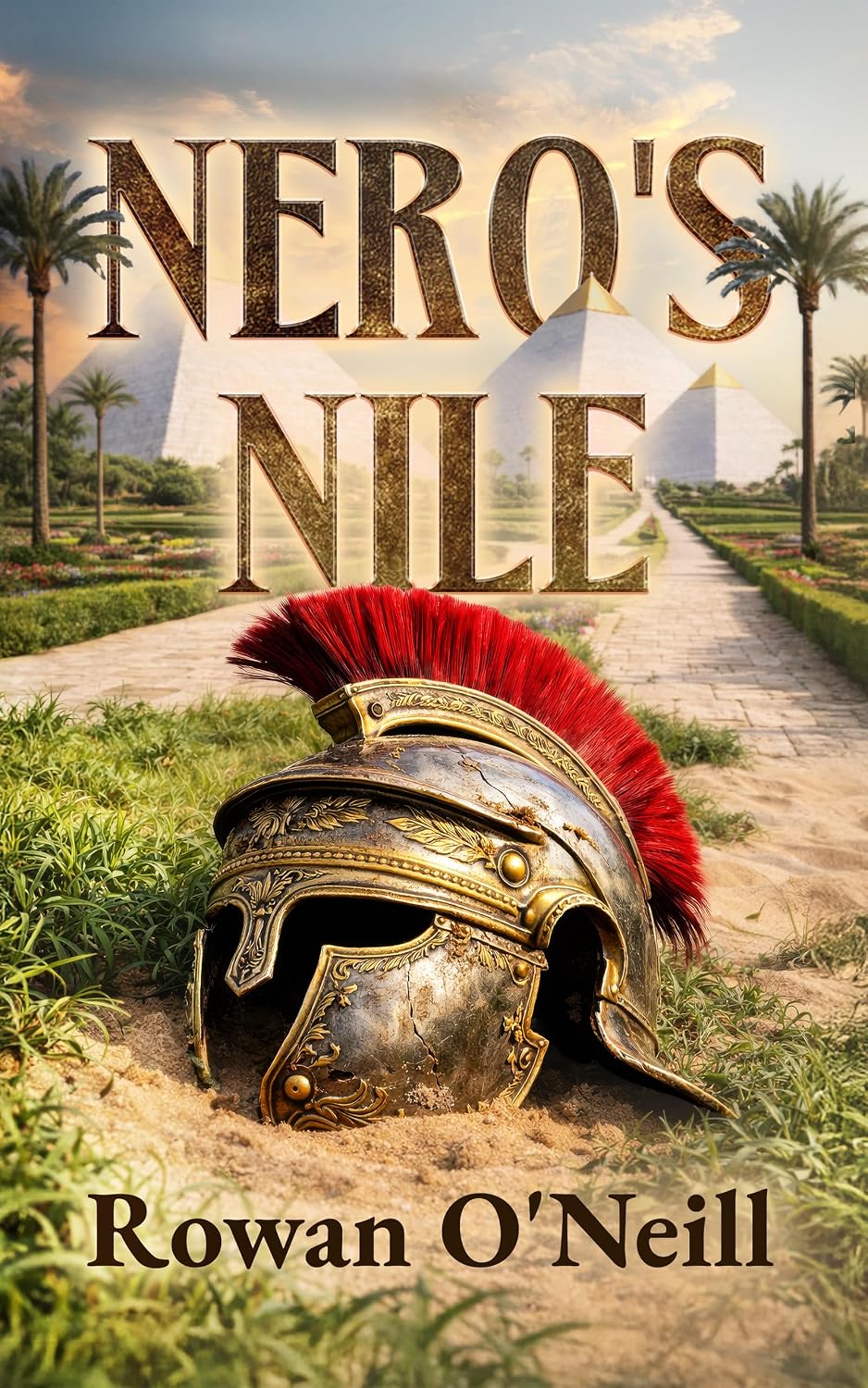
Nero’s Nile, by Rowan O’Neill, is a historical fiction adventure that follows Emperor Nero’s obsession with discovering the source of the Nile. To carry out that ambition, he draws Titus Statilius Taurus back from the quiet life he has earned and sends him into Egypt and beyond, while Rome itself rots under ambition, violence, grief, and spectacle. The novel moves between imperial politics and expeditionary danger, mixing Roman history, Egyptian myth, and supernatural menace into a fast, dramatic story about power and the price of being useful to people who see the world as something to own.
What stood out to me first was the pace. This book doesn’t linger at the doorway. It kicks it open. O’Neill writes in bold strokes, and the result is a novel that often feels closer to a sword-and-sandals epic than a restrained historical drama. Battles, assassinations, betrayals, crocodile attacks, ancient temples, and political murders arrive with steady force. I liked that confidence. The writing sometimes favors impact over subtlety, especially in the dialogue, where characters often say exactly what they mean and say it loudly. That can make some scenes feel theatrical rather than natural. But honestly, that theatrical quality also fits Nero. His world is all performance, blood, gold, and applause, so the heightened style makes a strange kind of sense.
I was most interested in the author’s choice to make the Nile expedition more than a geographic mystery. The book treats the river almost like a living border between history and myth. Titus becomes the steadier center of the novel, a soldier who wants peace but keeps getting pulled toward other men’s dreams of glory. Nero, meanwhile, is written as both ridiculous and dangerous, which can, at times, be a hard balance to hold. He is vain, childish, cruel, and sometimes oddly sad. I found that mix compelling, even when the character work leans broad. The historical fiction genre gives the novel its bones, but the adventure and supernatural elements give it its pulse. By the time the darker mythic material moves closer to the surface, the book has shifted from Roman intrigue into something stranger and more feverish.
I would recommend Nero’s Nile to readers who enjoy historical fiction that is energetic, dramatic, and unafraid to bend history for the sake of the story. If you like ancient Rome, dangerous quests, myth-soaked adventure, and a plot that keeps throwing new hazards into the river, they will probably have a good time with it. I did. The book is a torchlit march into empire, obsession, and chaos, and it knows exactly the kind of spectacle it wants to be.
Pages: 269 | ASIN : B0GY27MQ2B
Aletheia Vol. II The Binds Of Fate

Aletheia Vol. II: The Binds of Fate, by Luigi A. Kohli, continues the ambitious historical vision established in Aletheia Vol. I: In the Shadows, carrying its story of secrecy, vengeance, faith, and political danger into an even broader ancient world. Where the first volume moved through the fraught transition from Tiberius to Caligula and centered on the dangerous inheritance binding Cassius and Justus, this second volume widens the frame across Rome, Parthia, Judea, and the early Christian movement. It remains a work of historical fiction, biblical-era drama, and political intrigue, but its sense of consequence feels larger now, as private grief and buried truth begin to press more forcefully against empire.
Kohli’s strength is still his seriousness of atmosphere. He writes as though the texture of the ancient world matters, from Roman law and imperial maneuvering to Parthian custom, military culture, spiritual unrest, and the fragile lives of those caught between power and belief. Justus’s concern with justice, Saif’s search for purpose, Cassius’s corrosive hunger for vengeance, and Michtam’s movement through the shadows all give the novel a steady moral tension. Compared with the first volume, The Binds of Fate feels less like the uncovering of a dangerous secret and more like the spreading of its consequences. The pace still allows room for reflection, but the story has a stronger sense of outward motion, especially as its characters move through unfamiliar lands, shifting alliances, and widening historical stakes.
The novel’s relationship to Lew Wallace’s Ben-Hur is especially important, and it’s more than a shared setting or a coincidental similarity of themes. Kohli is making a deliberate nod to Wallace’s classic, while writing in his own modern historical style. Judah Ben-Hur is not merely a distant influence on the book; his presence and dreams become part of the story’s unfolding design. Like Wallace, Kohli is interested in how individual lives cross the path of early Christianity, but the pattern has changed. This time, the focus is not on Judah’s encounter with Jesus, but on the sons of Pilate crossing paths with Jesus’ disciples. That shift gives the novel a compelling sense of literary continuation while allowing it to stand as its own interpretation of faith, fate, and the hidden costs of empire.
One of the most intriguing aspects of The Binds of Fate is the way it asks readers to think about the border between legend and history. The closing “Legend or History” section makes clear that Kohli isn’t simply using the past as decoration; he’s asking whether a story like this could be plausible within the gaps left by the historical record. The novel’s use of real events, real figures, disputed identities, and imagined connections gives the book an intellectual charge. Its suggestion of hidden Essene writings, tucked away in the hills with other documents of importance, quietly evokes the kind of revelations associated with ancient scroll discoveries. That idea fits the title’s concern with truth: history may not be fixed only by what has already been found, but also by what remains buried, waiting to complicate what we think we know.
Aletheia Vol. II: The Binds of Fate is a rich and serious continuation of Kohli’s ancient-world saga. It deepens the moral unease of In the Shadows while expanding the story into a more sweeping meditation on justice, vengeance, faith, and historical memory. Readers drawn to Ben-Hur, Roman historical fiction, biblical fiction, and political conspiracy will find a novel that respects its inspirations without being confined by them. The ending offers enough resolution to satisfy the movement of this volume, but its epilogue also leaves the strong impression that Kohli’s larger design may not yet be finished.
Pages: 478 | ASIN : B0FGJWQQW8


