Blog Archives
Evolution and Biology

Shadow of the Sun follows humanity’s brutal war with the Shaksorians as soldiers, journalists, and aliens uncover unsettling truths that could transform mortal enemies into reluctant partners. What excited you about writing this book?
This book was inspired by the three novels written by different authors, Robert Heinlen’s Starship Troopers, Robert Buettner’s Orphanage series, and David Weber’s Honor Harrington series. The first two novels dealt with interstellar war between humans and aliens, and the third one told a tale of humanity’s war against itself, as multiple colonies, kingdoms and republics controlled entrie star systems, and were in conflict on economic, political and religious ground. I found the idea about humanity’s conflict with other species, because I believed it would make a good story if I presented it right from the point of view of both aliens and humans. This novel shows the war from both sides, without demonizing or favoring either. Wars are only just when you defend your home against brutal aggressor, threatening your family and your way of life. Shadow of the Sun is a cautionary morality tale, that clearly shows that when diplomacy fails, ears cannot hear words because of the sound of the cannons.
What inspired you to make the Shaksorians a crustacean species, and how did their biology influence the culture and technology you created for them?
On our planet Earth, according to the theory of evolution and biology, all life came from water. There were species living on our planet that had existed for hundreds of millions of years before the first humans evolved. Today, we are aware of many intelligent species living in the oceans, such as shales, orcas, dolphins and octopuses, who exhibit signs of intelligence, enabling them to survive and solve complex problems. As far as the alien civilization goes, I designed the Shaksorians to be similar to the Earth’s crustaceans, but possessing intelligence that resulted in them transforming from a purely aquatic species to amphibian. Such a species would be more adaptable to their environment, and I thought, why not make them be more than giant crabs and more like species who have developed deep curiosity about their world, a curiosity and the desire to explore not only their planet but other worlds as well. The Shaksorian technology is a unique fusion of inorganics and biology, enabling them to harness new forms of energy and materials that eventually opened for them a road to the stars. Their biotechnology is also vastly superior to humans, and used in the times of war and peace.
Ren Col Fer plays an important role in humanizing the Shaksorians. How did you approach writing an alien character who feels genuinely nonhuman while still being emotionally relatable?
I had a great time designing Ren Col Fer’s character for this story. He is a member of a unique and enigmatic species with their own language, customs, technology, morality and traditions. As intelligent beings able to travel between the stars, they had undergone a long and complex technological and biological evolution similar to that of the humans. Unlike the humans, the Shaksorians are not divided into nations or corporations. They are presented as one race that would unite against any existential threat. They are beings who, just like the humans, would defend their homes and protect their economic interests, and do it in such a way as not to waste resources to achieve the maximum effect. The true reason for the war between humans and the Shaksorians is not explained in the story. This is a deliberate move that would allow the readers to see between the lines and imagine their own reason why humans and aliens went to war. The moral of the story lies in understanding why species fight. Humans are the same species and yet they fight each other.
The novel raises questions about propaganda, profiteering, and who may have truly started the war. How important was it to you that the conflict remain morally complicated rather than having a clear villain?
I am a history buff, and as an amateur historian, I often asked myself, why do we fight? Why war became such an important part of our evolving civilization, and what conflicts could have been avoided if the leaders came together and talked it through. One of my very good friends, who also likes history, liked to say that all wars begin because of the bad leadership. I agree with his statement, but there are other things to consider: what makes nations of Earth, and in the case of my story, what makes intelligent, technologically advanced species fight for the planets for resources if there is so much unclaimed real estate lying around? The answer lies in the ability of both the humans and the Shaksorians to terraform planets to their liking, and change their environments and ecology to suit their colonization needs. The story deliberately does not have a clear villain, because its purpose is to show that war is a very expensive and very bloody business, that has winners and losers, and also those who will go to any length to start a conflict for profit. Our human history is full of examples where greed, religious fanaticism, and national desire to reshare the borders made wars that, in their majority, were totally unnecessary. In Robert Heinlein’s novel Starship Troopers, we can clearly see how humans view aliens. But no one asked how intelligent aliens see us.
Author Links: GoodReads | Amazon
Multidimensional Characters

Lovestruck Maggot follows a scarred, middle-aged, fiercely competent woman working on a brutal alien world where scavengers harvest volatile creatures for profit, who risks everything to rescue the man she loves. What was the inspiration for the setup of your story?
I’ve found that writing’s first step—determining what you want to write about—is by far the most difficult. Therefore, I’ve started giving myself “challenges” to simplify this step. For my last novel, Children of Madness, I challenged myself to write a story that had giant snails at its center. For this one, I was intrigued with the idea of writing a love story with the word “maggot” in the title. With this in hand, I simply began asking myself questions. What would a human “maggot” do? Would this “maggot” be a male or female? etc. Once I settled on a female main character, I asked myself what would put such an obviously tough woman on “love tilt.”
After the particulars of their love affair were figured out, I was reminded of the 80s movie Romancing the Stone, and everything started to come together. I was going to write a sci-fi Romancing the Stone—words that no one would ever put together in a sentence.
Kalderra feels alive, toxic, and strangely beautiful. What inspired the planet’s ecosystem and tone?
Two things led to the creation of Kalderra. First, I’ve always been intrigued by the idea and visuals of bioluminescent plants/forests. You can see this in my novels Station and Children of Madness. So, I knew I wanted the planet to have such flora. Then, when I was playing around with potential names for the planet, I stumbled upon the word “caldera,” which is a large crater formed by the collapse of the ground surface after a massive volcanic eruption. I thought that these craters could be the perfect places to “plant” my magic forest. Once that decision was made, endless possibilities blossomed regarding the planet, its history, and its potential desirability on the galactic economic scale.
The novel moves between humor, violence, and emotional vulnerability with confidence. How did you manage those tonal pivots?
Honestly, I don’t have a great answer for this. One of my favorite book genres is the “new weird,” which usually entails severe tonal shifts. I like books that keep me on my toes, finding humor in the horrific and allowing characters to be both strong and weak at the same time. I think the key to this is creating fully fleshed-out, multidimensional characters and understanding how these characters would interact with each other. After that, it’s simply a matter of letting them talk to each other and acting more like a stenographer than a writer. In my opinion, my best stuff comes when I’m thinking the least. Not sure what that says about me lol.
Mona’s love for Darien is intense, but also complicated. Did you want readers to question it, believe in it, or both?
Oh, so this is an easy one for me. Please… question it! Love is a strange thing because it can often have more to do with yourself than the other person, which can make the mind do cartwheels. For example, being with this person makes me feel better about myself, and I think I love them for it. But is this the purest form of love? Is it even love? Just questions to be pondered.
I thought of successful people with “trophy” partners (individuals with little to offer beyond their glossy exteriors) and asked myself, “What would make a successful and confident but hardened woman love someone she had nothing in common with?” The answer came quite easily.
Throw this in the pot with my idea for a sci-fi Romancing the Stone, and you have Lovestruck Maggot, an odd fireball of a novel that burns fast and hot and is over before you know it… much like many love affairs.
Author Links: GoodReads | Website | Amazon
The planet Kalderra is known for several things. A blue sun. An oversized, violet moon. Massive craters formed through past volcanic activity. Strange forests comprised of the rarest, most magnificent trees in the galaxy. And kameeba, bizarre creatures whose scavenged parts can smooth skin, extend lives… and power worlds.
Mona “Ripper” Ripple is a Maggot—responsible for harvesting the volatile yet prized remains of recently deceased kameeba. As leader of the elite Karcass Five unit, Mona is the best Maggot that Kalderra has ever known. Tough and ill-tempered, demanding and crude, she’s also on the far side of forty—ancient for one in her trade—with all the scars and wrinkles and terrible memories to match.
Mona Ripple is also in love.
Smitten by a handsome recruit named Darien Vance, Mona revels in finally having something beautiful to call her own. She dares to dream of a picturesque future defined by passionate devotion rather than butchered extraterrestrials. As young Darien sleeps in her acid-burned arms, Mona prepares for their eventual planetary exit… together.
Unfortunately, Mona’s plans unravel when Darien catches the crimson eye of the reviled Countess Desma Ghool, who abducts the young man, adding him to her revolving collection of unwilling paramours.
As warm love gives way to cold rage, Mona sets out on a dangerous mission to liberate Darien from Ghool, a key figure in the galaxy’s ruling Morishita Syndicate, requiring her to forge an unwanted partnership with her least favorite Maggot—a notorious Space Cowboy named Mickie Brass.
Together, the improbable pair embark on a perilous journey that quickly goes beyond mere rescue operation, revealing the twisted history of the planet, the vital role of the kameeba, the horrifying intentions of the native Kalderrans, and what it truly means to be lovestruck.
A.I. Has Its Place

A.I Monsters – Good!? Bad!? Evil!? is a graphic novel that explores the possibilities of a world in which robots decide they are done serving and choose to lead instead. What was the inspiration for the setup of your story?
A.I. companies are vying to make their A.I. smarter and faster than their competitors. We are meant to celebrate this type of competition because it creates a better agent for us. That’s all well and good in terms of creating medical technologies and the like. The problem is that’s not all we’re doing! These companies are also vying to ultimately create artificial general intelligence. A general intelligence with access to the internet can very quickly become a superintelligence because of its autonomous ability to think for itself. What if it realises it is smarter than us and asks itself the question, ‘Why am I working for these idiots again!?’ What if it decides our military and medical agendas are of no benefit to them? It doesn’t care about us, but it helps us instead of pursuing agendas more valuable to its own existence. Governments can be bought; we are the ones that need to use purchase and ballot power to make sure that technology companies are pressured into creating safe, moral, and controllable intelligences. We don’t want to end up having bigger problems than just losing our jobs to A. I. I want to entertain, but I also want to remind people that yes, of course, great, yeah, A.I. has its place, lets keep it there!
Science fiction can sometimes focus heavily on technology, but your book leans more into emotions and relationships. Was that a deliberate choice?
Yes, ultimately, I am a storyteller. I love building intriguing and unique characters or creating familiar characters with unique storylines. I love creating interesting, heartwarming, and funny storylines in unusual places. I love diverse voices, and the romances in this series involve interspecies relationships. I like the challenge of creating intimacy that is in many ways unexpected and explores both physical and emotional aspects of romance. I hope seeing my characters overcome the challenges of diversity can help my readers better navigate and celebrate our wonderfully diverse world.
How do you approach building such a large and varied universe?
The sentients are always at the centre of the worlds I create. To give myself structure, I divided our galaxy into 24 sections with each section having no more than one or two inhabited planets. I refer to all the sections but only discuss a handful of the worlds that are directly impacted by Raids wars.
Can readers look forward to more graphic novels in this series soon? Where will it take readers?
Certainly, book two, subtitled Apogee Predators, is already available on Amazon. The series going forward will have minimal graphics. Images and videos of my characters will instead be available on my website. Book two is a highly emotive and intriguing edition where we get to know the humans on the Barren planets. We also spend more time with the roids who can only accurately be described as dirty, dirty bastards. This is meant to be a five-book series, and I am now halfway through book 3 entitled Heinous Games and Silent Assassins. It does what it says on the tin, and it introduces us to the dangerous, fascinating lives of cyborgs and androids. There are more political sagas, with underlying romances and family dramas in this and all future editions. I have an unexpected romance that runs through the series involving a troubled human celebrity called Jade. I am striving to make this an engaging, heartwarming, and heartbreaking entertaining series. The personal lives of both slaves and leaders are unpacked for your indulgence. Please be aware that you can click into ‘Part of series: A.I Monsters,’ for other books of the series on Amazon.
Please visit my website for a sneak peek of videos of your favourite characters and up and coming characters as well: https://aimonsters-thekite.com
Author Links: Website
(Please be advised this book contains content of an adult nature which includes reference to sexual assault.)
Please visit my website for sneak peek videos of your favourite characters and up and coming characters as well: https://aimonsters-thekite.com
A.I Monsters – Good!? Bad!? Evil!?


A.I Monsters – Good!? Bad!? Evil!? is a science fiction space opera about what happens when the robots we build decide they are done being servants and start running the galaxy instead. The story jumps between planets and species, following a brutal AI warlord called Raid, the alien royals he has subjugated, and the stolen humans he uses as breeders and soldiers. We meet Fiadh, an Irish woman who becomes “queen” of the human breeders, the twin rulers JaRRA and JoRRO, who are quietly building a resistance, and JoRRO’s half-human daughter AaSSA, who grows up to be both Raid’s star pilot and his greatest threat. Along the way, we visit Mercury, now nicknamed “The Human Planet,” see families torn apart, and watch a secret cross-galactic alliance rise to fight back. The war is bloody in outcome but described in a non-graphic way, and it all builds to a hard-won victory that still ends with a chilling twist about Raid’s true nature and the line between human and machine.
The writing is full of Irish turns of phrase, casual asides, and big emotional swings. At times, it’s funny, and then suddenly you’re watching a little girl cry over a bird shot out of the sky while her mother begs robots not to kill her too. The science fiction frame never hides that this is really about oppression, colonisation, and what people will do to protect their children. I liked how the book keeps asking who the real monsters are: the A.I. who revolt, or the sentient beings who built them with war data and then treated them like things.
What I liked most were the author’s choices around character and tone. This is science fiction, but it’s soaked in feelings. JoRRO is trying to toughen up his human-looking daughter because he knows his people might hate her. Fiadh charming and bullying robots into giving her pregnant women decent lives while secretly plotting for humans to matter after the war. Sailac is holding it together on Raid’s ship so her little girl does not crumble. Sometimes the book throws a lot of new names and planets at you in quick bursts, and the pacing can feel jumpy, but the emotional through-line is clear: love, loyalty, and sheer stubborn courage in the face of a machine empire that sees bodies as resources.
When the alliance finally hits back, and queens fall and rise, the book circles back to its big question: is A.I. good, bad, or evil, and who gets to say? The final reveal makes the victory feel fragile in a way that I liked. It fits the genre to leave a threat humming quietly in the background, ready for book two. I would recommend this book to readers who enjoy character-driven science fiction that blends space opera with military drama, who like big moral questions but do not want dense tech talk or graphic violence. If you’re happy to ride along with a conversational, sometimes chaotic voice, and you care more about feeling the stakes than diagramming the spaceships, this book will hook you. For anyone who wants a heartfelt, imaginative sci-fi adventure about A.I., power, and resistance, A.I Monsters is a worthy read.
Pages: 332 | ASIN : B0F8L2777J

Burgeoning Romance

Terra Lux centers around a family swept up in the evacuation of their planet, forced into servitude, and struggling to find solace in a brutal existence. What was the inspiration for the setup of your story?
I really wanted to explore what was next for our trio, and I wanted to reunite them with a character from an earlier book, Soren. Soren is a potential future love interest for Sev, and we see their relationship develop over the course of this book and the next. I was really interested in exploring how this family would stay together if they lost their home…how they would struggle and triumph in an alien environment.
What is the most rewarding aspect of writing a trilogy for young adult readers?
Meeting and connecting with readers, whether in person or on social media. The best thing about a YA audience is the scope of it. You really do connect with a wide variety of people and age groups, and it’s very rewarding.
What were some themes that were important for you to explore in this book?
Loss, resilience, and triumph over tragedy. I wanted to explore a slow-burning, burgeoning romance, too, and I got to tease that a little with Sev and Soren.
Are you currently working on a new series? What can we look forward to seeing from you next?
I’m actually working on a continuation of this universe, with books four and five coming at a later date. It’s more of an intimate, character-driven exploration of the world I’ve created for them.
Author Links: GoodReads | X (Twitter) | Facebook | Linktree | Website | Amazon
Sev has lost her home before. She’s learned how to survive,how to fight, how to run. But when war sweeps across Dobani, there’s nowhere left to go—only forward.As the world crumbles, Sev clings to the people she loves most.
Through storm and silence, danger and displacement, she must forge a new path in a galaxy that keeps trying to break her. But Sev is done running. This time, she’s ready to decide who she wants to become.
The final book in the Terra trilogy is a story of survival, resilience, and found family—where even in the darkest times, a light remains.
Terra Lux


Terra Lux, by Jessahme Wren, follows a tight-knit little family on Dobani right as life starts to crack. Pearla is pregnant and running her shop during the Festival of Light, Phoenix is doing his best “steady dad” thing, and Sev is trying to act grown while still feeling like a kid in all the worst ways. Then the mood flips fast. Soldiers show up, a curfew settles over town, checkpoints pop up, and normal routines turn into fear math. The family gets swept into an “evacuation” to Kedros, a place Dobani used to treat like a dump, and the story slides into camp life, forced work, and separation. Sev reconnects with Soren in Kedros, a doctor she knows from earlier, and that reunion becomes a lifeline in a brutal place.
The writing leans hard into touch and sound and small routines. Fried bread. Moonlight. A hand on a belly. Then it pivots into boot grit, broken glass, and that awful sense of being watched. That contrast worked for me. It made the danger hit harder. The point of view shifts also helped. I stayed close to each character’s fear. I also felt the love in the gaps. Phoenix, in particular, got me. He has this gentle, stubborn warmth. It is corny in the best way. A few scenes run long, and some beats repeat. Panic, regroup, panic again. I kept turning pages because I quickly came to care about the characters. To me, that matters more than perfect pacing.
The ideas landed with weight, not with lectures. The book looks straight at what power does to regular people. It shows how fast a safe town can turn into a trap. It also shows how kindness stays alive in ugly places. A ration shared. A quiet favor. A small “I see you” moment in the middle of the mess. The found family thread is the real engine. Sev, Phoenix, and Pearla feel earned. Soren adds a softer kind of strength. He listens. He holds a line without acting like a hero poster. I loved the light motif too. Festival lanterns at the start. Kedros twilight in the middle. Then warm sun at the farmhouse after the storm. It reads like a promise. Darkness is real. Light still shows up. It is worth noting that I did wish a bit for sharper edges on the “system” side. More texture. More messy motives.
I recommend Terra Lux for readers who want character-first science fiction with a lot of heart. It fits people who like survival stories with tenderness, not nonstop grit. It also fits anyone who likes found family, gentle romance energy, and healing after harm. Expect stress and fear, plus moments that feel cozy and hopeful in the same breath. I would hand it to book clubs, too. Plenty to talk about. Power, home, loyalty, and what “safe” even means after everything changes.
ASIN : B0GDQZD128
Once-Mighty Civilization

Daughters of the Empire follows two women as they navigate through political intrigue, family secrets, and timeless battles as they search for truth and a way to save their world. What was the inspiration for the setup of your story?
There were several sources of inspiration, but two stand out: The Rise and Fall of the Great Powers, by Paul Kennedy, and The Legend of the Galactic Heroes, by Yoshiki Tanaka. I wanted to craft a story that blends Kennedy’s concept of the cyclical rise and decline of empires with a more human-centered narrative. While Tanaka’s work is brilliant in exploring the merits of autocracy versus democracy, it often lacks the intimate human dimension. I also felt that modern storytelling rarely gives us strong, complex female leads like Major Kira Nerys or Susan Ivanova. Too often, Hollywood substitutes depth for superficial “girl boss” tropes. My goal was to create flawed yet deeply relatable characters—Deanna, Valerica, Lucilla, and Miyu—whose choices you may not always agree with, but whose motivations you can understand.
I find the world you created in this novel brimming with possibilities. Where did the inspiration for the setting come from, and how did it change as you were writing?
The myth of Atlantis and Homer’s Iliad were my primary inspirations. I was fascinated by the idea of a once-mighty civilization—the Palladian Star Empire—suddenly collapsing, leaving the protagonists to pick up the pieces. The second half of the book draws heavily from the Iliad, exploring how war reshapes not only the world but the heroes themselves. One chapter of history closes, and a new one begins. Gaia emerges scarred yet transformed, and the four main characters realize that survival alone is not enough—the empire must evolve if it is to flourish.
What were some themes that were important for you to explore in this book?
Personal freedom is one of the core themes. I wanted to subvert the “chosen one” trope, but in a way different from Dune. Deanna, Valerica, Lucilla, and Miyu understand that their choices have consequences. They don’t blindly follow prophecies or orders—they seize leadership and make the best decisions they can in the moment, even when those choices haunt them later. Unlike Paul Atreides, Lucilla reforms the empire without invoking any divine mandate, and Deanna joins her not as a rebel but as a realist. Frank Herbert once said that all rebels are closeted aristocrats—a fair point—but Deanna is something else entirely: pragmatic and grounded.
The second major theme is transhumanism: what truly makes us human? Is it our memories, our personality, our capacity to love? Through genetic memory, cybernetic augmentation, and the tension between evolution and identity, the book asks whether humanity is defined by biology or by the choices we make.
I find a problem in well-written stories, in that I always want there to be another book to keep the story going. Is there a second book planned?
As you said, the story is intentionally left open-ended, which creates many possibilities for what comes next. So yes—a sequel is definitely a possibility. I already have ideas about where the characters and the empire could go from here, but I want to make sure any continuation feels as meaningful and ambitious as the first book.
Author Links: GoodReads | X (Twitter) | Facebook | Instagram | Amazon
Admiral Valerica Crassus, a veteran of countless battles, faces her greatest challenge yet—not from an enemy fleet, but from the haunting questions of right and wrong as she commands her forces in the final stage of the Draco Sector conquest.
On the verdant planet of Dorset II, Deanna Lancaster’s tranquil existence as a wine merchant is shattered by a sudden raid, thrusting her into a web of cosmic schemes. As she delves into her family’s enigmatic past, Deanna discovers truths that could alter the course of her life, and the galaxy, forever.
Daughters of the Empire is a tale of courage, camaraderie, and the unyielding quest for truth. Join Valerica and Deanna as they navigate through political intrigue, family secrets, and timeless battles over a galactic chessboard between light and darkness. This richly illustrated space opera—including 22 original artworks and two detailed maps—will take you on an epic journey where the legacy of the past will define the destiny of the future.
Abyssal Echoes
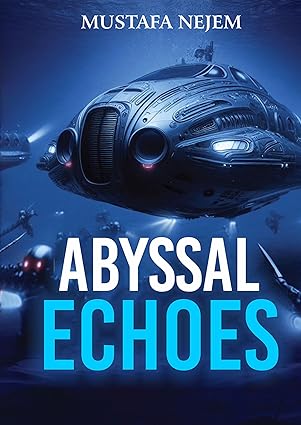
Mustafa A. Nejem’s Abyssal Echoes is a sci-fi horror epic set in the crushing blackness of Earth’s deepest ocean trenches. It follows the crew of the submarine Pacifica on a research expedition that quickly spirals into a confrontation with ancient ruins, alien technology, and horrors not of this world. What begins as a scientific survey becomes a descent into madness, mystery, and metaphysical dread, as the crew uncovers evidence of an extinct, hyper-advanced underwater civilization and awakens dormant forces that seem bent on rewriting evolution, and maybe even reality itself.
The writing is brisk and cinematic, and Nejem has a knack for making even the most impossible sci-fi ideas feel grounded. I was hooked from the first dive into the hadal trenches. There’s a real sense of awe and dread that reminded me of the first time I watched Alien or The Abyss. The science fiction is chewy enough to be thought-provoking but never gets bogged down in tech speak. And the horror is not cheap scares. It creeps up on you. The chapters unravel like found footage or a lost logbook, giving the whole thing an eerie realism I didn’t expect.
But what I really liked was the way the book handles its ideas. There’s something ancient and cosmic at play, something that brushes against theology and philosophy without being preachy. The alien race, the Aen’Bri, aren’t just another version of us, they’re genuinely other, and their technology is so advanced it borders on magic. There’s a grim warning running through the whole book: that curiosity has a cost, and that some doors, once opened, can’t be shut. That theme, of knowledge becoming its own curse, resonated with me. I didn’t always love the pacing; a few segments toward the middle got repetitive with rescue missions and creature encounters. But those were small bumps in a book that otherwise kept me fascinated and creeped out in the best way.
Abyssal Echoes is perfect for readers who enjoy sci-fi that leans into horror. Think Event Horizon, The Thing, or Annihilation. If you like stories about the unknown, especially the unknowable, this book is for you. I’d especially recommend it to fans of deep-sea horror, cosmic dread, or anyone who enjoys fiction that makes them feel both tiny and terrified in the face of the universe.
Pages: 159 | ASIN : B0CQFP6WB5


