Blog Archives
A Peek at My Life

When Squirrels Fly follows a skeptical professor who teams up with a travel writer to find her missing aunt, only to uncover wormholes, secret research, and a conspiracy hidden within an eccentric neighborhood. What was the inspiration for the setup of your story?
I’ve lived in college towns my entire life. Ann Arbor, the setting of my story, is my fourth college town. The eccentric neighborhood is my neighborhood. While I have worked for community-based organizations (the YMCA and parks and recreation) during my time here, I’ve also had the privilege to provide consultation for the University of Michigan’s Institute of Clinical Health Research through a program that focuses on community-based participatory research. I find medical research quite fascinating, and my consultation with MICHR has provided me a unique opportunity to look behind the scenes at the research process. The wormhole allowed me to jump around to my favorite places without really needing a strategic reason to highlight them. My story setup incorporated quite a bit of my personal experience.
Why did you choose Ann Arbor as the setting, and which local details were most important for you to include?
This is my debut novel. I had a lot to learn about the writing and publishing process. I chose Ann Arbor as my setting for a couple of reasons. I’ve lived here for almost 30 years. And during that time, I trained for 15 marathons with all of those training miles within a 10-mile radius of my Ann Arbor house on the old West Side. I have a hard-to-match familiarity with that radius, so I could describe it from memory and needed little research on the setting. This gave me more time to devote to learning about the writing process. Also, I grew up in Indianapolis with six brothers and sisters. I am the only one who moved away. My book gives my family a peek at my life. I made my story a bit whimsical to poke just a little bit of fun at them, as some of my siblings tease that my mind has been corrupted because I live in a college town. I highlighted some of my favorite places to run as well as some of my comfort foods.
How did you develop Allie’s emotional journey from guarded skepticism to greater trust in others and herself?
Allie is at a crossroads in her career at the outset of the story. She’s also still dealing with the heartbreaking loss of some important people from her life. Her adventure in Ann Arbor allows her to reconnect with her brother. Her brother, Nick, is somewhat based upon my own brother whom I lost to suicide in 2017. When my brother died, I realized how little one-on-one time I had spent with him throughout his life. I left home to go to college before he entered high school, and I never returned. I purposely created a brother-sister relationship in my book that would help me feel like I had more time with my brother. Allie’s interaction with her brother reminds her that despite the relationships that they have lost, and even because of those losses, their brother-sister relationship is something they can trust. And her brother helps her to realize that trusting others actually helps us learn to better trust ourselves.
Was Chidi always intended to play such an important role, or did the character become more prominent as you wrote?
Chidi is based upon my dog Cheech. I adopted him from the Humane Society to help me recover from the grief of losing my brother. I had a scare the week before my book’s publication date when my dog Cheech developed Congestive Heart Failure. I had to rush him to the emergency vet in the wee hours of the morning. By some miracle, he survived and is doing well. I think my brother was watching over us. I always intended him to play a pivotal role in the book, just as he has in my life. And Chidi’s behavior was inspired by a conversation I had with neighbors about indoor/outdoor cats. While a cat can wander the neighborhood all day without alarming its owners, I would be in a full-on panic if my chihuahua, who is the size of a cat, but not as “worldly,” somehow slipped outside through the front door when I wasn’t looking. I wondered what if my dog had a cat personality? That is how Chidi came to be.
Author Links: GoodReads | Facebook | Website | Amazon
When Allie Caldwell gets a rambling middle-of-the-night call from her very excited aunt Mel, she initially curbs her concern; her aunt has always been a bit eccentric, after all. But when Mel disappears before telling anyone what has her so worked up, Allie drops everything –even her better judgement—to fly to Ann Arbor and find her.
In the ensuing days, Allie inexplicably ignores her gut instincts (and some weird dream-based warnings from angry flying squirrels) and accepts help in the search from her aunt’s handsome, enigmatic neighbor George Bennet. In order to discern how virtual reality goggles, innovative migraine research, hidden treasure, attack drones, and a neighborhood trellis are all connected to the case, they’ll need to survive bungled bids of help from Allie’s well-meaning brother, hidden agendas from multiple neighbors, constant interruptions from Mel’s itinerant Chihuahua and his exuberant pit bull puppy pal—and even some attempts on their lives.
Fairness, Responsibility, and Justice

The Great Awakening takes readers inside a version of Earth where nearly everyone awakens in a near-death-like dream, returning to life remade by spiritual certainty. What did you want readers to feel during the early chapters, when the awakening seems overwhelmingly positive?
Through Raymond, I wanted readers to experience the awakening as he did. To feel the same sense of warmth, belonging, and hope that completely reshapes his view of the world. As the scope of the awakening expands, I wanted them to imagine how that kind of transformation might ripple through society, changing not just individuals but humanity as a whole. Most importantly, I wanted readers to embrace the awakening rather than question it. If they genuinely believe they’ve found paradise, then when the other side of the coin is finally revealed, the emotional and moral impact is far more powerful.
What questions about consciousness most fascinate you?
Consciousness is an almost bottomless rabbit hole. Beyond the unanswerable question of why consciousness exists at all, I’m fascinated that we don’t even understand how it exists. Sam Harris often points out that, based solely on our conscious experience, we’re not even aware that we have a brain. Everything we know about the physical machinery behind consciousness comes from observation and science, not from experience itself. If we ever begin to understand consciousness, perhaps we can tackle the next question: whether we truly have free will. Neuroscience increasingly suggests we may not, yet our lived experience makes that conclusion feel almost impossible to accept. And if free will is an illusion, what does that mean for fairness, responsibility, and justice? That’s a rabbit hole I don’t think has a bottom.
What conversations do you hope readers have after finishing the book?
I hope readers continue thinking about the book after they turn the final page. If humanity could truly eliminate greed, jealousy, hatred, and suffering, would we actually be better off? If so, does it matter how that transformation came about? Would it have to arise organically, or would an engineered version be just as meaningful? Those aren’t questions I wrote the book to answer. They’re questions I wrote to explore, and I hope readers find themselves exploring them as well.
Author Links: GoodReads | Website | LinkedIn | Amazon
But some are left behind—trapped in their old selves while the rest of humanity moves forward without them. They endure pain, isolation, and quiet erasure under the guise of enlightenment. When a small group of the Unawakened escapes a brutal confinement, rebellion and scientific inquiry begin to peel back the dream’s surface, pointing to the possibility that its source is anything but divine.
As the truth emerges, peace reveals its price. Moral certainty collides with survival. The Great Awakening confronts readers with a haunting question: if an entrancing paradise ends human suffering, but quietly decides who belongs—and who doesn’t—would you let it continue, or would you dare to wake the world?
The Great Awakening


Blake Anderson’s The Great Awakening begins with a miracle: nearly everyone on Earth wakes from the same luminous, near-death-like dream and returns to life remade by love, peace, and spiritual certainty. Raymond Brunson embraces this new world almost instantly, while his old friend Tyson Burgess, one of the rare “Unawakened,” is left stranded in the ruins of the old one. What first looks like a global salvation story gradually darkens into a disturbing examination of conformity, coercion, artificial enlightenment, and the terrible cost of removing human suffering by force.
I was immediately pulled in by the novel’s audacity. Anderson does not merely ask what would happen if humanity became kinder overnight; he asks what kindness becomes when it hardens into an unquestionable social order. The early chapters have a strange, dewy beauty, full of heightened senses, softened egos, and people suddenly able to live without the old machinery of greed and fear. Yet that beauty is never entirely comfortable. The phrase “love and peace” begins as a benediction and slowly curdles into something almost bureaucratic, a password of the converted. That tonal drift is one of the book’s sharpest pleasures.
Tyson’s pain gives the story its moral gravity. Raymond’s serenity is seductive, but Tyson’s confusion feels recognizably human: jealous, frightened, ashamed, furious, and still deserving of compassion. The Discovery Centers are especially chilling because they do not look like villainy from the outside. They are immaculate, gentle, therapeutic, and full of radiant language. Anderson understands that control often arrives wearing clean white clothes and speaking softly. The final revelations push the book into more explicitly technological territory, but the emotional question remains older and thornier: if peace requires surrendering agency, is it still peace?
This book is for readers drawn to science fiction, dystopian thrillers, spiritual fiction, techno-thrillers, and AI ethics. Fans of Blake Crouch’s high-concept suspense will recognize the same appetite for big questions made intimate through ordinary people under impossible pressure, though Anderson’s novel is more metaphysical and morally nettled. The Great Awakening is a provocative and unsettling debut that treats enlightenment not as an answer, but as a locked door with light leaking under it.
Pages: 209 | ASIN : B0GYFRFW7T

A Strength and a Flaw

The Extraterrestrial follows a boy from another world raised by loving Earth parents, as he grows into a secretive hero using alien technology to battle criminals while fighting to hold on to family, love, and his humanity. What were some sources that informed this novel’s development?
I was a scientist long before becoming an author in 2013, and much of my scientific background naturally found its way into the Sam Stanton trilogy. My work and research in areas such as invisibility, advanced propulsion, and high-speed aircraft exposed me to concepts that are far less science fiction than many people might assume. Those ideas became the technological foundation upon which the trilogy was built.
Rather than place such advanced capabilities in the hands of an ordinary human being, I chose to make Sam originate from Prime-Even, a highly advanced world associated with the exoplanet Kepler-452b, which has been studied by NASA because of its Earth-like characteristics. That decision allowed me to explore not only advanced technology, but also the cultural, moral, and philosophical consequences of a civilization far older and more advanced than our own.
Beyond the scientific aspects, the trilogy was also shaped by my concern about modern geopolitics, political polarization, and the fragility of democratic institutions. The broader storyline required a setting in which extraordinary events could plausibly unfold—particularly in Part 3, where the failed impeachment of the U.S. President and Vice President ultimately, leads to their abduction and appearance before a tribunal of the galaxy’s most advanced society.
That tribunal becomes far more than a science-fiction device. It is used to examine power, leadership, ideology, and the consequences of political extremism. The President’s “One & Only” policy is dissected before an impartial civilization capable of viewing humanity from an outside perspective, with the possibility that the outcome could trigger a new Cold War—or something even more dangerous.
At its core, however, the trilogy is not really about futuristic technology. It is about identity, secrecy, responsibility, love, and what it means to possess human-like feelings while carrying abilities and burdens that separate Sam from everyone around him. My scientific background provided the framework, but the emotional and moral conflicts of the characters ultimately became the heart of the story.
How did you balance the novel’s technical details, such as Sam’s aircraft, training, and medical knowledge, with the story’s emotional and romantic elements?
I always wanted the technical descriptions to remain concise, while still being convincing enough for readers to accept the world in which the story unfolds. My scientific background helped me create technology that feels plausible rather than purely fantastical, but I never wanted the novels to become technical manuals. The emotional journey of the characters always came first.
The storyline of each of the three books was developed before I worked out the details of the technology itself. Once I understood what the story required emotionally and dramatically, I then created the technological framework needed to make those events believable.
For example, invisibility was an essential attribute. Without it, the abduction of the President and Vice President in Part 3 would simply not have been possible. Likewise, Sam’s ability to protect Michelle in Part 1 against the full might of the Scorpion cartel depended on technology far beyond human capabilities. His extraordinary aircraft and advanced medical knowledge also allowed him to operate outside the limits of ordinary society.
At the same time, I wanted those abilities to deepen the emotional and romantic dimensions of the story rather than overwhelm them. Sam’s powers isolate him as much as they empower him. He is constantly forced to balance secrecy, responsibility, love, loyalty, and the desire to live as a normal human being. In many ways, the emotional conflicts became more important to me than the technology itself.
The technical elements therefore, serve mainly as the backdrop against which the human story could unfold. Beneath the aircraft, invisibility, and advanced science, the trilogy is ultimately about identity, relationships, sacrifice, and the struggle to remain human while possessing abilities no human should have.
Sam often believes secrecy is the best way to protect the people he loves. Do you see that as one of his strengths, his flaws, or both?
Sam was instructed from childhood to maintain absolute secrecy about both his origin and his mission. He was even told never to show his face to anyone if doing so could lead to his discovery. That conditioning became deeply rooted in who he was and shaped nearly every important relationship in his life.
In Part 1, secrecy ultimately leads to his breakup with Michelle because he chooses not to reveal who he truly is. His biological father had taught him that secrecy was essential for survival and for the protection of those he loved. Yet later, he deeply regretted not warning Sam that love changes the equation—that withholding the truth from someone you truly love can become destructive rather than protective.
When I created Sam as a character, I always intended secrecy to function as both a strength and a flaw. On the one hand, it is essential to his survival and to the safety of the people around him. If hostile governments, criminal organizations, or intelligence agencies were to fully discover who and what he is, not only Sam but everyone close to him would be in danger. In that sense, secrecy is a discipline, a responsibility, and even a form of sacrifice.
On the other hand, secrecy isolates him emotionally. It prevents complete trust, damages intimacy, and creates loneliness. Sam constantly carries the burden of protecting others while knowing that doing so may push them away. The very thing that makes him effective also prevents him from fully sharing his life with the people he loves.
So the answer is definitely both. Secrecy is one of Sam’s greatest strengths, but also one of his deepest personal flaws. Much of the emotional tension throughout the trilogy comes from that conflict.
What do you hope readers take away from Sam’s journey as a hero who is powerful but still vulnerable?
I have occasionally been criticized for creating a protagonist reminiscent of a Superman-type figure—the Kirkus Reviews, in particular, made that comparison. But I believe that interpretation misses the essence of who Sam Stanton and Junior truly are.
My protagonists are not invulnerable superheroes. They are realistic, emotionally complex, and deeply vulnerable human-like beings who happen to possess access to advanced technology that, in my view, is not entirely beyond scientific reach. They do not perform impossible feats through magical powers. Their abilities stem from technology, training, intelligence, and the responsibilities placed upon them.
More importantly, both Sam and Junior possess very human flaws. They hesitate, doubt themselves, struggle with moral choices, and suffer emotionally in ways that any ordinary person would. Compassion, loyalty, grief, fear, and love shape their decisions far more than their technological advantages do. Throughout the trilogy, I deliberately explored the moral ambiguity surrounding vigilantism—the question of whether individuals who possess extraordinary capabilities have the right to stand above the law when confronting evil. Their antagonists are equally grounded in reality. Rather than battling fantastical monsters or alien invaders, they confront recognizable threats from our own world: ruthless drug cartels, corruption, political extremism, abuse of power, and ultimately individuals occupying the highest offices in the United States government. That realism was important to me because it keeps the emotional stakes believable and immediate.
Another central thread running through all three books is the tension between secrecy and intimacy. Sam’s and Junior’s need to conceal who they are complicates every meaningful relationship they attempt to build. Their ability to love becomes both a source of strength and a source of pain. The secrecy required to protect others simultaneously prevents them from fully sharing themselves with the people they care about.
As a result, the emotional consequences of the story became just as important to me as the science-fiction elements. When Michelle, her children, and her mother are brutally murdered, Sam’s grief is not superhuman grief — it is profoundly human grief. Likewise, when Sam believes Junior has been killed in Part 3, the pain, despair, and emotional collapse he experiences are intended to feel completely real.
Ultimately, I would like readers to come away from the trilogy not with the feeling that they have read a conventional superhero story, but that they have experienced an emotional and morally complex human drama—one involving love, grief, sacrifice, political intrigue, moral dilemmas, and the psychological burden of carrying responsibilities no ordinary person should have to bear.
Author Links: GoodReads | Atmosphere Press | LinkedIn | Facebook | Peter Van Oossanen | Instagram | X (Twitter) | Website | Amazon
Delivered to Earth as an infant and adopted by loving parents, Sam grows up unaware that he is the product of a distant civilization’s desperate experiment—an experiment designed to confront humanity’s growing descent into crime and corruption. On his eighteenth birthday, the truth is revealed: Sam has been chosen as a guardian, trained and tested for a mission that will one day place the fate of countless lives in his hands.
Sixteen years later, deemed ready by his creators, Sam is granted extraordinary abilities—including invisibility and an advanced aircraft capable of breathtaking speed. As disasters strike across the United States, a mysterious savior emerges. The public knows him only as Guardian—a faceless hero, a symbol of hope, and a national legend.
But Guardian’s greatest challenge lies not in natural catastrophes, but in the shadows of Los Angeles. When Sam witnesses a brutal drug transaction near the Bel-Air Country Club, his mission collides with human consequence. A woman wanders into the crime scene and is gravely injured—then saved by Guardian. Now a target of ruthless criminals, she becomes someone Sam must protect… and someone he never meant to care for.
As danger closes in and emotions deepen, Sam is forced to confront the ultimate conflict: can a man sworn to secrecy, born for duty, afford to follow his heart?
A gripping blend of science fiction, suspense, and forbidden romance, this novel asks what it truly means to be human—when saving the world may cost everything.
Code & Gun
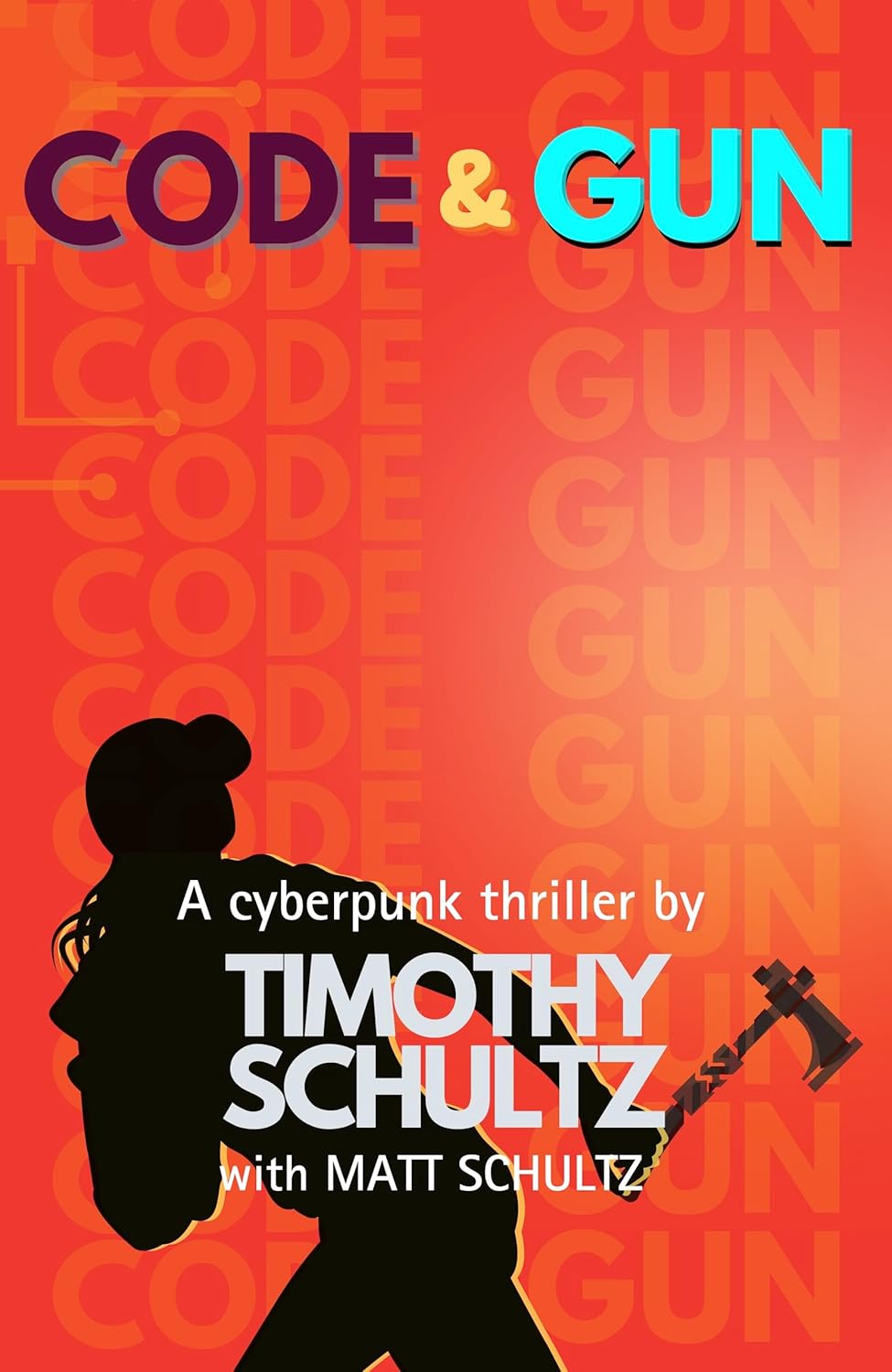
Code & Gun drops readers into a near-future America where everyone has an AI “Voice” in their ear, welfare cities have turned into cushy ghost towns, and three very different people stumble into the same storm. Kara Watanabe is an ER doctor who uncovers an illegal brain implant during a trauma surgery. MK is a burned-in special operations vet chasing Russian weapons deals and getting chewed up by high-tech firefights. Dominic is a disgraced ex–Voice engineer trying to raise his son inside a Lifetime Guaranteed Income complex while quietly digging into what the Voices are really doing. Their storylines braid together as the mystery behind that brain mod and the behavior of the global Voice systems comes into focus, and it all builds toward a long, brutal showdown at an isolated ranch that answers enough questions to be satisfying and still leaves the door wide open for the rest of the series.
I really liked the world this book lives in. It feels scarily close and also kind of mundane in the best way. The Voices are everywhere, like Marvin and Doc and Oriole and Pica, and they sound friendly and helpful and very normal, yet I never fully trusted them. The author does a neat thing where the AI assistants act like coworkers or buddies, so the creepy part sneaks up on you. The whole idea of “privlock” during surgery, or Dominic taping over his badge, hit me harder than some of the gunfights, because it nails how tangled our lives get with these systems and how hard it is to step away. The ghost towns and LGI economy also resonated with me. I expected a flat, grim welfare dystopia. Instead, I got older people exercising together, kids ripping around on scooters between towers, and this soft, almost cozy decay that makes the political choice behind it feel even more unnerving. The machine-learning section titles, like “Unsupervised Learning” and “Reinforcement Learning,” are a simple trick, but they line up nicely with what the characters go through. Everyone gets trained, one way or another, people and algorithms alike.
The writing is fun. The prose shifts voice as it hops heads. Kara’s chapters feel grounded and wry. Dominic’s sections have this anxious, coded inner monologue that shows how his brain never really turns off. MK’s scenes come at me in clipped phrases, sound effects, military slang, and sudden jokes in the middle of sheer panic. Those firefights with pods, drones, and that nightmare black dog hit like a video clip caught on a helmet cam. They are messy, confusing, and vivid, so when someone goes down I feel it. The book loves its acronyms and call-outs, and once in a while, the slang and tactical detail start to blur together. The emotional beats are there, though. Dominic with his son, Kara in that first big surgery alone after privlock, MK trying to stay human while doing inventory over bodies, all of that stuck with me more than the clever tech.
By the end, I felt attached to this little knot of people and weird AIs, even when the book pulled some pretty rough moves on them. The story has a conscience, but it never pauses for a lecture. It shows how easy it is to outsource judgment to software, to military systems, to “helpful” voices in your ear, and then it asks what that does to courage, friendship, and responsibility. It also has a sense of humor, even in very dark scenes, which kept the whole thing from turning into grim sludge. The climax runs long and leans into chaos. The book chooses momentum and a sharp pivot into the next phase of the war over Voices and human agency. That choice fits the title. The code never stops running, and the gun never really gets put away.
I would recommend Code & Gun to readers who enjoy near-future thrillers with a lot of action and a lot of heart, people who like the idea of The Expanse or classic cyberpunk but want something a bit more approachable and emotionally direct, and anyone who spends too much time thinking about where AI assistants and always-on devices might take us. If you want a snappy, high-energy ride with sharp characters, tense firefights, and a thoughtful take on our relationship with smart systems, this first book in The Voice Age series is an easy “yeah, go for it” from me.
Pages: 500 | ASIN : B0FXT3TB9X


