Category Archives: Five Stars
Peaches and Jake Celebrate Christmas
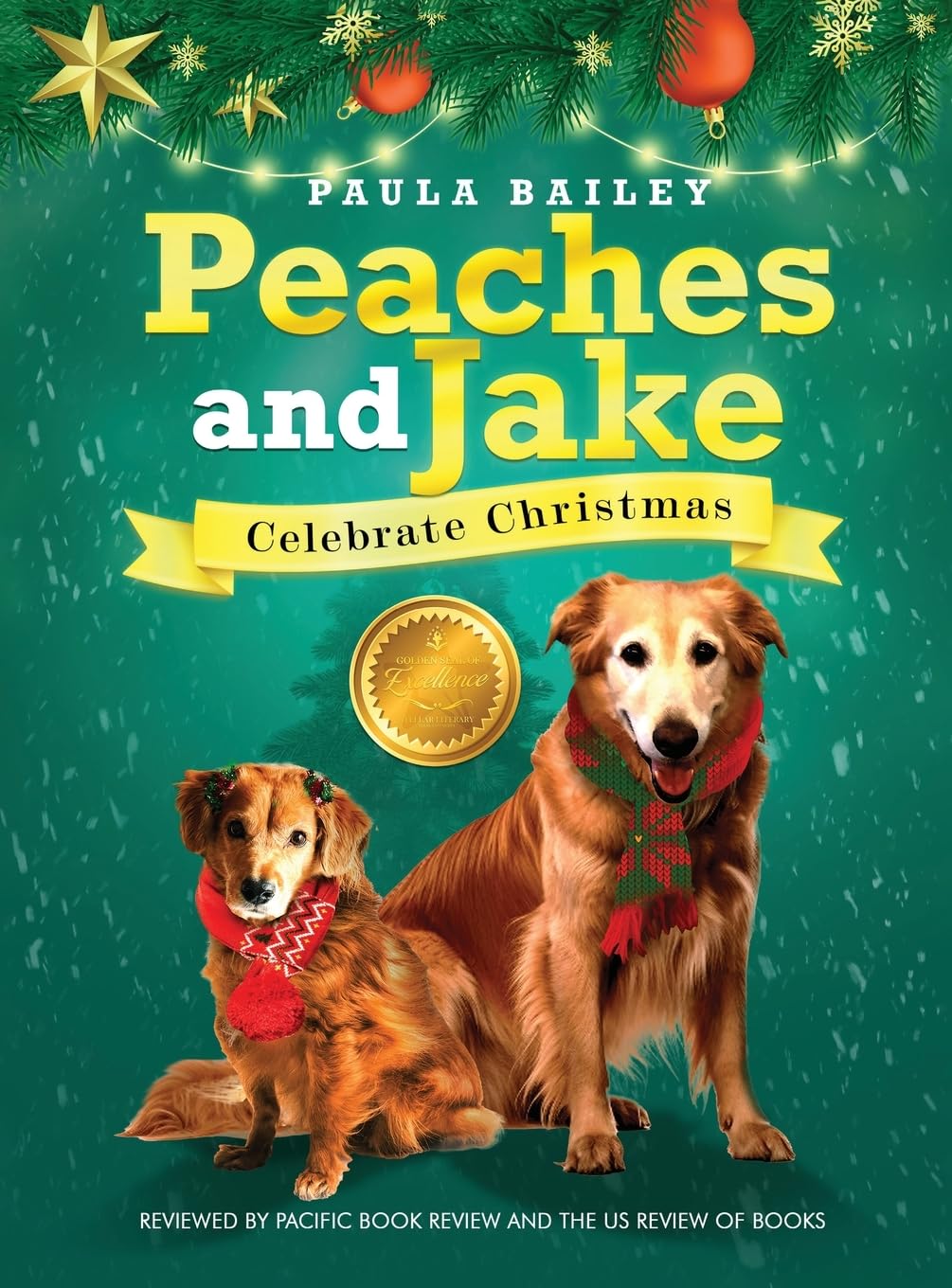

Peaches and Jake Celebrate Christmas is a sweet little story about two rescue pups waking up on Christmas morning to discover the surprises Santa left them under the tree. They each get giant bones and then two toys, a moose for Jake and a fox for Peaches, and the rest of the day unfolds with the dogs learning what to do with their gifts. Jake destroys his moose with pure joy, Peaches figures out that Foxie makes a perfect nap buddy, and their mom watches over the whole thing with so much love. It feels like flipping through a family photo album where every picture tells its own tiny story.
There is a softness to the writing that feels like someone talking to me from their couch with their dogs at their feet. The real photos of Peaches and Jake add charm because they are so expressive. I kept giggling at Peaches trying to figure out Foxie. And the whole saga of Moosie slowly losing limbs and stuffing had me cracking up. There is something sweet about how Jake loves that toy even when it becomes a little fabric scrap. It says a lot about how dogs attach meaning to things and how we do the same sometimes without even realizing it.
I also liked how the book shows the two dogs having such different personalities. Jake barrels into Christmas like it is the best day of the year. Peaches moves carefully and watches everyone else first. It reminded me of how different pets can be, even when they grow up in the same home. The photos on almost every page make it easy to stay engaged. Honestly, it felt a little like being invited into the author’s living room to watch a memory replay itself.
I think this picture book is perfect for young kids who like animals and for grown-ups who just want something soft and happy to read. It is especially lovely for dog lovers or anyone who enjoys holiday stories that feel real and cozy. If you want a children’s book that brings a smile without trying too hard, this one is a great choice. It is playful, sweet, and full of genuine affection, and that makes it a wonderful holiday read for families.
Pages: 48 | ASIN : B0DFDWN1SN

Chasing Permanence: How Businesses on Our High Streets Can Adapt and Thrive
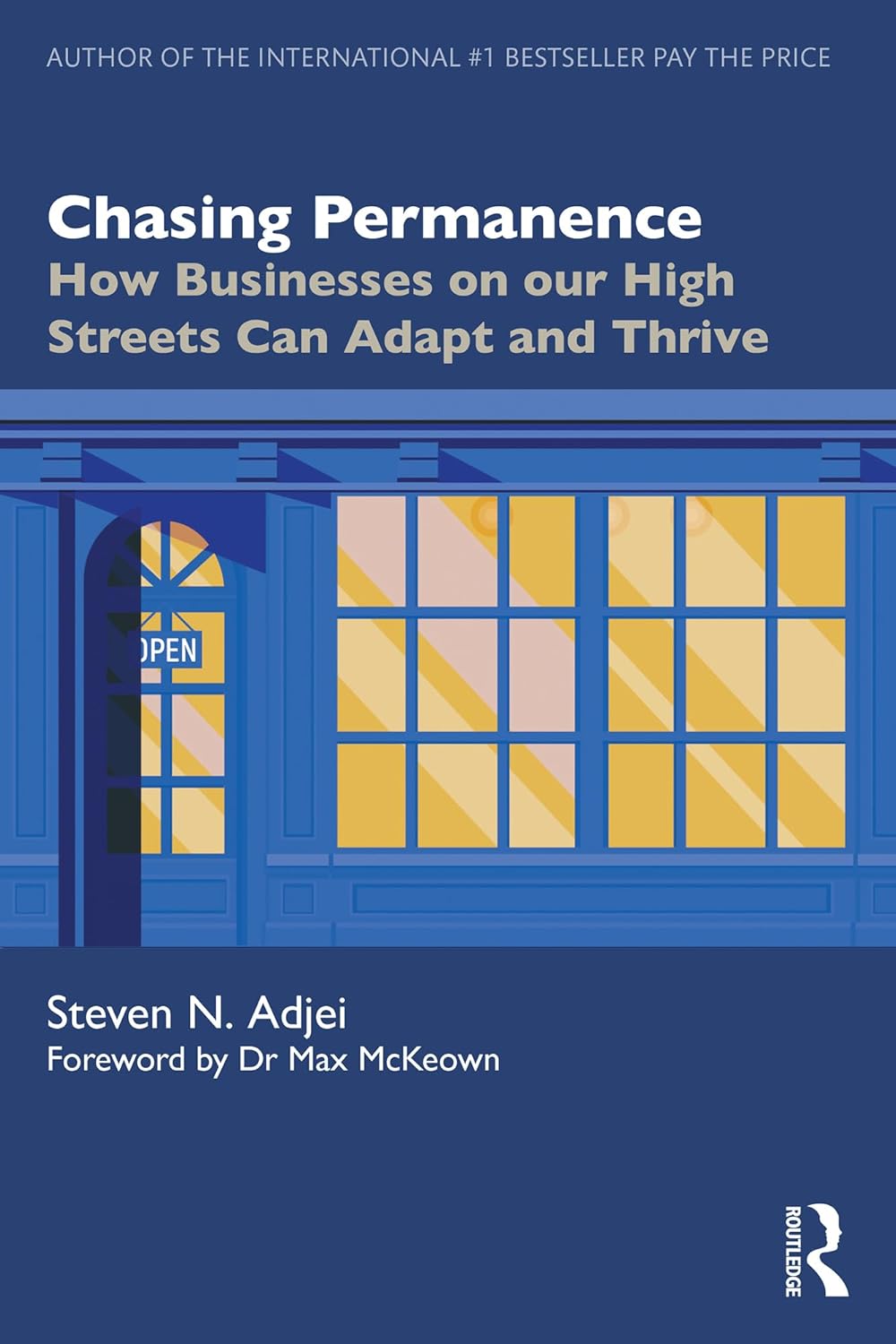
Chasing Permanence explores why some High Street businesses fade while others seem to hold on with surprising strength. Author Steven N. Adjei blends research, interviews, personal history, and real-world case studies to show how companies can adapt and thrive even as the world around them shifts. He lays out seven mindsets, five determinants, and a set of strategies that give owners and leaders a clearer way to build resilience and community in a time when storefronts close by the thousands. The book reads like a roadmap for anyone who wants to understand not just how businesses survive, but how they can shape their own future even when conditions look bleak.
Adjei writes with a kind of grounded warmth that makes the research feel personal. His stories about his mother working at Selfridges and his own early days on the High Street pulled me in right away. Those scenes made the later arguments hit harder, because they show the emotional cost behind the statistics. At times, the writing surprised me with its honesty. I found myself nodding along when he talked about the hollow excuses we make about market forces and how easy it is to blame the world instead of looking at what a business can actually change. I liked that he didn’t shy away from calling out lazy thinking. It made the whole message feel more alive and a bit braver.
I also found myself wrestling with some of the ideas. Adjei argues that businesses need to embrace collaboration, community, and what he calls Permanence, but he never paints it as a simple formula. The mix of mindset, strategy, and realism made me stop more than once and think about how often we expect business success to come from some magic trick. There were moments when I wished he had expanded on certain examples, especially when he talked about towns that felt like ghosts. Still, the rhythm of the book kept pulling me forward. His insistence that companies can shape their own destiny felt hopeful without drifting into fantasy.
The book made me look at High Streets with fresh eyes. It reminded me just how much these places mean to people and how much potential sits in the hands of owners, staff, and communities who care enough to adapt. I would recommend Chasing Permanence to entrepreneurs, local leaders, and anyone who wants to understand why some businesses hold their ground while others disappear. It’s practical, heartfelt, and surprisingly moving. And it’s a great fit for readers who want guidance, but also want a story that speaks to real human experience as much as business theory.
Pages: 391 | ASIN : B0F4R8G9BC
The Coming Disruption: How AI First Will Force Organizations to Change Everything or Face Destruction

The Coming Disruption is a blunt, high-energy warning shot aimed at anyone working inside an organization that hopes to survive the AI era. Author Fred Voccola lays out a simple message. AI is not a future trend. AI is a meteor already hitting the atmosphere, and every business, institution, and worker must adapt fast or get wiped out. He explains how AI multiplies productivity at a pace that makes earlier revolutions look sleepy, and he pushes the idea that becoming “AI First” means rebuilding the entire structure of an organization from top to bottom. The book blends history, economic analysis, and practical guidance, and it uses a vivid, almost urgent storytelling style to keep you moving through concepts that could reshape every part of modern work.
Voccola writes with a mix of confidence and impatience. Sometimes I nodded because the urgency made sense. Other times, I felt a little overwhelmed because the pace is relentless. Still, his arguments are sound. The idea that AI requires zero infrastructure change right now, and that the only barrier is leadership willingness, really resonated with me. I liked how he compared past transformations to the present because it made the speed of what’s coming feel real. I occasionally wished he explored a few examples more deeply.
What I liked most was his emphasis on internal AI. Not the headline-grabbing model wars. Not AGI speculation. The boring stuff inside every company that nobody glamorizes. I appreciated that focus. It made the book feel grounded. I kept thinking about how many organizations cling to outdated structures because they’re afraid to rip up the old playbook. His frustration with bureaucracy is loud and clear, and I found myself agreeing more often than not. His call to eliminate the “organizational deep state” is sharp, but it definitely made me think about how much waste we accept as normal. The book made me look at leadership, communication, and speed through a different lens.
I’d recommend The Coming Disruption to executives, founders, managers, and anyone who feels responsible for guiding others through change. It’s also a useful read for students and curious workers who want to understand the forces reshaping their careers. If you want a wake-up call that pushes you to think bigger, move faster, and challenge the comfort of slow adaptation, this book delivers.
Pages: 295 | ASIN : B0G2CNYPN6
Think Like an Herbalist

Think Like an Herbalist is part handbook, part pep talk, and part field guide to a more grounded way of living. The author walks through the basics of bodily systems, gut health, diet choices, vitamins, lifestyle, foraging, herbal remedies, and mindset. She mixes practical steps with personal stories and folds them into a larger message about taking responsibility for your health. The book is split into prevention and remedies, and she uses the house metaphor again and again. Build the foundation first. Add the herbal siding later. It all feels direct, simple, and very relatable.
As I read, I found myself pulled in by her voice. It’s blunt. It’s funny. It’s very real. She shifts from nutrition advice to honest stories about HPV scares, gut issues, farm work, and motherhood, and she does it without softening anything. That raw tone hit me. When she talks about people wanting an herb to fix a deep problem, I caught myself nodding hard. I have been that person. I liked how she refused the easy path. Her focus on mindset surprised me most of all. She treats it like the missing puzzle piece, and I felt that in my chest while reading.
I also loved the practical sections. The lists of wild plants made me want to walk outside and start spotting things in the grass. The food explanations are plain and simple. No fancy science words. Just straight talk about fiber and color and what actually helps a body feel alive. She writes with strong opinions about diet, wheat, dairy, and medical culture, and sometimes I wanted more nuance. Still, her confidence brings a spark to the pages. The passion behind her advice is obvious. She really cares about people learning how to help themselves, and that energy carries the book.
I walked away feeling hopeful. I would recommend this book to people who want to take their health into their own hands and don’t mind a straight-shooting guide who tells stories along with solutions. It’s great for beginners, for curious foragers, for folks tired of feeling stuck, and for anyone who wants a warm shove toward better habits. It’s not a medical text. It’s a conversation, and a pretty lively one at that.
Pages: 302 | ASIN : B0FMYXKRSN
A Bold Bargain

A Bold Bargain follows Jack Blaine, an eighteen-year-old conservation agent in 1950s Missouri who keeps stumbling into danger, mystery, and unexpected connections. The story moves between tense encounters with poachers, the quiet bond between a boy and a half-wolf pup, and Jack’s growing involvement with vulnerable people near the Sac River. The book blends rugged outdoor life with soft moments of compassion, and it ties everything together with a thread of personal history that Jack can’t quite outrun.
Jack’s mix of grit and gentleness lands with a real thump in the chest, and the writing makes his inner world feel close enough to touch. The scenes along the river pulled me in fast. The pacing shifts from calm to sharp in a blink, and that rhythm kept me turning pages even when I told myself I should stop. The dialogue feels natural, plain spoken, and warm. I liked how it brought out the heart of the community around him. No big speeches. Just people trying to make sense of life as it comes.
I also felt a tug of emotion watching how Jack steps into other people’s pain without hesitation. His encounters with Mrs. Fletcher and the French family hit me harder than I expected. The writing paints poverty, loneliness, and aging with a simple brush, and it still lands heavy. Nothing feels overplayed. I appreciated how the book lets kindness show up quietly, almost shyly. At the same time, I wanted just a touch more complexity in a few side characters. Still, the sincerity in the storytelling made me forgive that pretty quickly. I could tell the author cares deeply about these people and this place, and that care shines through.
A Bold Bargain is a book for readers who enjoy heartfelt stories set against open sky and rough country roads. If you like character-driven tales with danger, tenderness, and a little old-fashioned grit, this one will be perfect for you. In many ways, A Bold Bargain reminded me of Where the Crawdads Sing, because both stories mix raw nature, quiet resilience, and the fierce pull of human connection into something that stays with you.
Pages: 346 | ASIN : B0FD7VSY68
Peaches and the 19 Cobras

Peaches and the 19 Cobras tells the story of Peaches and Jake, two sweet rescue dogs who misunderstand COVID-19 as “19 cobras” and spend the pandemic doing everything they can to protect their mom. The book moves through their daily adventures from quarantine in Florida to summers in Maine. There are masks and costumes, funny misunderstandings, shiny Christmas trees, and a whole lot of love. The dogs tell the story in their own voices, so the whole thing feels warm and comforting.
As I read it, I kept catching myself smiling. The writing feels like someone chatting with me in their kitchen. It’s simple in a good way and full of genuine emotion. The idea of hearing the pandemic through the ears of two confused and devoted dogs was surprisingly emotional. It reminded me of how strange that time was and how pets kind of carried so many of us through it. Some moments even made my eyes sting a little because the mix of humor and fear from that year still sits in my chest. Seeing the dogs try to make sense of everything made the whole memory softer for me.
I also loved how the book leans into joy. There are photos everywhere, and they’re adorable. The stories jump from masks that never stay on to gigantic Christmas trees to lobster dinners in Maine. It felt chaotic in a charming way. Like watching someone you love tell a story while getting distracted every few sentences. I honestly laughed out loud when the dogs kept ditching their masks or when Peaches tried to look fierce with her tiny warrior stance. The whole thing just felt honest. Not polished in a stiff way. More like real life with all the messiness and sweetness mixed together.
Peaches and the 19 Cobras is great for kids who want a gentle way to understand a heavy moment in history and for adults who want a soft, funny reminder of how we made it through. Anyone who loves animals or who leaned on a pet during the pandemic will feel this one. It’s light and goofy and unexpectedly touching. I’d happily pass it along to families, teachers, grandparents, and anyone who just needs a picture book that feels kind.
Pages: 88 | ASIN : B0DDW3GM88
Fungus Theory of Conscious Growth

Fungus Theory of Conscious-Growth is a speculative science and philosophy-of-consciousness nonfiction book that argues all life on Earth is really one vast, ancient fungus that exists to grow consciousness to its maximum potential, with humans as the spore that eventually carries that consciousness off the planet and into space. The author starts with cosmology, describing a universe that hides our true origin, limits our lifespans, and ties us to fragile biospheres, then walks through biology, evolution, technology, and psychology to claim that everything from slime mold to smartphones is part of one continuous fungal system pushing us toward “maximum conscious growth” and eventual evacuation of Earth.
Mark L. Christensen mixes straightforward explanation with capitalized concepts and acronyms. Underneath the terminology, though, the core ideas are simple: the universe is built so we can never fully know where we came from, we all die, and we are stuck on a planet that will eventually cook us, and those three constraints are what force intelligence and technology to grow. I appreciated how the chapters loop back to the same framing, so you never forget what the author is trying to prove. The long passages on cosmic expansion, black holes, and the difficulty of tracing any “true origin” were a bit dense, yet they set a clear mood of mystery and frustration that fits the book’s central question.
Where the book got most interesting for me was in the biology, technology, and psychology sections, where the fungus metaphor gets fleshed out. The idea that all plants and animals are variations of the same original fungus, and that this fungus has slowly prepared the planet for a bipedal creature with a big, hungry brain, is truly compelling. I liked the image of early fungi and plants essentially “setting the table” with rich fruits and vegetables, so a future human brain could have the calories it needs.
The technology chapter frames every tool, from early adaptations to modern spaceflight, as a kind of informational mycelium spreading through minds, with certain thinkers as “spikes” in the network that accelerate the whole system. The psychology chapter leans into this even more, describing a “void of psychosis” that opens when humans become aware that they cannot know their true origin, and arguing that our drive for identity, conflict, communication, and eventually space travel all come from trying to fill that void. I did find myself thinking about how much of my own motivation comes from not knowing, and from not wanting life to feel pointless.
I see Fungus Theory of Conscious Growth less as a strict scientific thesis and more as a big thought experiment in speculative science. It asks you to imagine the entire history of life as one fungal organism trying to launch itself into the dark, and to see humanity as the spore that might carry that effort into the galaxy. If you like big-picture questions, cosmic timelines, and philosophical riffs on evolution and technology, there is a lot here to chew on. I would recommend this book most to readers who are comfortable living with unanswered questions, who like their popular science mixed with metaphysics, and who do not mind a bold, unified theory that sits somewhere between lecture and late-night conversation about why we are here at all.
Pages: 402 | ASIN : B0CVXCNBY7
Indra’s Net: A SEEKER’S Guide to the Human Experience

Indra’s Net, by Indra Rinzler, is a spiritual guide built from seventy-eight themes that weave stories, reflections, and practices into a single tapestry of awakening. The book blends personal experience, Tarot-inspired structure, mythic symbolism, and grounded spiritual lessons. It invites readers to look inward, release old patterns, and explore consciousness with curiosity. The author draws from decades of study, travel, meditation, and teaching to create a kind of living manual that meets readers wherever they are. The effect is a blend of memoir, parable, and spiritual toolkit.
Reading the book, I kept feeling a mix of surprise and comfort. The writing carries a warm, almost conversational honesty that makes even the heavier ideas feel approachable. I liked how the author refuses to separate the mystical from ordinary life. A simple bowl of oatmeal becomes a miracle. A long walk in Thailand becomes a spiritual dilemma. A beggar’s smile becomes a master class in grace. The stories feel loose and unforced. I found myself nodding along, then stopping, then looking up from the page because something landed in my chest. The rhythm moves from personal anecdote to broad spiritual teaching so quickly that it left me slightly off balance in a good way. It reminded me that understanding rarely arrives in a straight line. It sneaks up on you.
At the same time, the ideas stirred up a strange mix of awe and restlessness. The author talks a lot about surrender, intuition, and letting life unfold. Some moments felt so gentle that I relaxed into them. Other moments poked at me. The theme of impermanence, for example, made me strangely uneasy. I felt myself push back, even as I knew the point was to soften. That emotional tug made the book stick with me. I appreciated how the stories never try to be perfect teaching moments. They wander and land where they land. The book feels authentic, and that gave it a texture that pulled me deeper.
By the last pages, I felt a quiet gratitude for the way the Rinzler uses imagery and structure. The Tarot framework, the themes, and the practices are presented at the end of each chapter. It all creates a rhythm that feels like a long walk with someone who has been on the road a while and wants you to see the scenery with fresh eyes. I would recommend Indra’s Net to readers who enjoy reflective, spiritually curious writing and who like books that offer small, steady insights rather than big proclamations. It is especially good for people who want a companion on their inward journey. Someone who wants to feel less alone and more connected to something larger and kinder than their own thoughts.
Pages: 286 | ASIN : B0FX65LB69



 LITERARY TITAN