Blog Archives
The Power and Pitfalls of Social Media

Living at the Edge of the World – Spring follows 12-year-old twins who uncover an ancient artifact in the peat banks of Papala Island, Shetland leading them on a journey filled with insight about community, courage, and belonging. What was the inspiration for the setup of your story?
This is the second book in my Papala Island series, and the inspiration came from observing how many youngsters today spend much of their time indoors, absorbed by screens—whether on their phones or playing video games. When I was their age, I was outside with my friends, walking dogs, riding bikes, building camps, and hanging upside down from climbing frames.
I wanted to write stories that would spark a sense of adventure in kids, setting them in a relatively safe environment, away from constant WiFi and the influence of social media. The irony? Social media is woven deeply into the story itself! There’s no escaping it, so instead, I’ve embraced it—showing both its power and its pitfalls—while encouraging a balance that serves the greater good.
What were some challenges you felt were important to defining your characters in this story?
One of the biggest challenges was making sure the kids took center stage—driving the action—while keeping the adults in the background without them taking over the story, yet still creating a realistic world!
For the main antagonist, Tabitha, I wanted her to start as a spoiled brat, deeply unhappy about being stuck on a remote island, so far from trendy London. Her character arc in the first book allowed her to grow and adapt to this rugged new life. The challenge in the second book was pushing that growth even further while also bringing her brother, Timothy, more into the spotlight.
Beyond the twins, I have two other key young characters: Fenella, a local girl who provides insight and guidance, and Omar, a refugee who has just arrived on the island and instantly connects with its wildlife. Each of them brings a different perspective, but the central challenge remains—how to empower the kids realistically to have their own adventures without adults overshadowing the story.
What were some themes that were important for you to explore in this book?
One of the key themes in this book is the sense of belonging. With three of the main characters coming from vastly different backgrounds—London and Syria—there are inevitable cultural differences, and exploring how they navigate them fascinates me. Living at the Edge of the World – Spring delves into what it means to find a home in an unfamiliar place and how connections with people, nature, and history shape our sense of identity.
Shetland itself plays a huge role in this theme. It’s a place of contrasts—stunning yet rugged, remote yet welcoming, with a strong community spirit. To bring authenticity to my stories, I weave in as much real-life detail as possible, drawing from both research and my ongoing penpal relationship with a Shetland ranger. Learning about daily life in a tiny community of just 30 people has given me invaluable insight into the unique rhythms and challenges of island living.
Another key theme is archeology, which naturally ties into Viking history and mythology. The book explores the ethical dilemma of discoveries—where should ancient artefacts belong? Should they stay in the place they were found, or be taken elsewhere for preservation? The kids actively debate this, and their perspectives evolve as they uncover not just deeper insight into historical artefacts, but also have to actively defend their discovery.
Where does the next book in the series take the characters?
The next book in the series, Living at the Edge of the World – Summer, follows the twins as they return to Papala Island for their summer holidays—this time by choice. They’ve grown deeply connected to their friends, the wildlife, and the island’s way of life, eager to continue their journey.
In this adventure, I’ll be exploring ocean pollution—not just as an environmental issue, but as a personal challenge that affects each character differently.
Author Links: GoodReads | Facebook | Website
Living at the Edge of the World – Spring is a vivid tale of adventure, tradition, and belonging set on a remote Shetland island.
Twelve-year-old twins, Tabitha and Timothy, are nearing the end of their three-month stay in Papala before returning to London. Determined to make the most of their time, they throw themselves into island life—peat cutting, sheep shearing, and exploring the rugged landscape. But when they uncover Viking artefacts buried in the peat bog, their discovery stirs excitement and draws the attention of treasure hunters….
Borealis
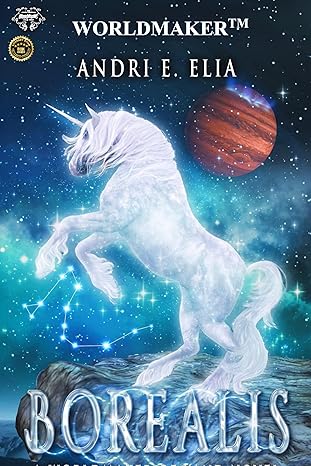

Borealis, by Andri E. Elia, is an engaging tale of Queen Asimia and her family’s quest for a new home amidst the devastation of war. Set in the kingdom of Yandar, the novel deftly intertwines themes of war, romance, and hope as the royal family faces defeat at the hands of the K’tuls. Key characters include Willie, Princess Hyrsa, and a young orphan named Sunny, who manage to escape the conflict. Sunny, adopted by the royal family, soon reveals extraordinary abilities that hint at a royal lineage and his potential to save the kingdom.
The novel stands out for its detailed and thorough narrative. The character development is particularly noteworthy, as each individual’s past and struggles are meticulously unveiled, allowing readers to witness their growth and transformation.
The world-building is exceptional, with vivid descriptions of planets, animals, and characters that create an immersive and fully realized universe. Elia’s attention to detail and thoughtful construction of this world is impressive. The story is enriched by various smaller narratives and side plots that seamlessly weave into the main storyline, making for a cohesive and entertaining read. The inclusion of time travel and space exploration adds layers of complexity, masterfully handled by the author. While the story may initially seem complex, especially given its place within a larger book series, it quickly becomes more engaging as the chapters progress. The narrative clarifies, and the plot’s intricacies unfold smoothly, making it easier to grasp and enjoy. The appendix at the end of the book serves as a helpful resource for understanding the broader context and specific details.
While the book contains mature themes that may not be suitable for younger readers, it offers a compelling read for young adults and beyond. The mature themes are handled with sensitivity and add depth to the narrative, making it resonate with many readers.
Borealis is a must-read for fans of science fiction and adventure stories. Its rich world-building, intricate plot and well-developed characters make it a standout in its genre. Andri E. Elia has crafted a novel that is both thought-provoking and entertaining, appealing to a broad audience of readers.
Pages: 310 | ASIN : B0CWDGMBS4

Everything a Civilization Needs

Magic Compendium: Tales of Illuminaria is an intriguing fantasy work that introduces readers to the system of magic that your series is based on. What was the inspiration for this world and its magic?
I’ve always wanted to write a story set in a world where the magic system can be explained scientifically. This won’t become clear until book three, but it’s a foundational principle of the story.
The nine schools are designed to encompass everything a civilization needs to thrive.
Can you share a bit about your writing process? What was the methodology like to create and write your world and the magic system used in Illuminaria?
I start with the illustrations. Once the story’s outline becomes clear through the paintings, I begin the writing process. I’m not a big fan of long, boring descriptions, so the images take care of that. From there, I let the story flow naturally.
What scene in the book did you have the most fun writing or illustrating?
Probably the flight of the Telekinator-1. I’m a huge fan of steampunk, and that painting was the perfect excuse to sneak a bit of it in.
Can you tell us a little about the story’s progression in book three and when the novel will be available?
The third book will completely flip the table. It is actually a sci-fi story that will explain the zodiac legion and the magic of Illuminaria. Already available: https://www.amazon.com/gp/product/B0DX38CGNZ
Author Links: GoodReads | X (Twitter) | Website | Amazon
Filled with stunning illustrations, this book invites you to step into the magical world of Illuminaria and join the Zodiac Legion. Your training begins now!
The gods have chosen only the most promising individuals to master the power of magic, and the guardians of Illuminaria have deemed you worthy to stand among them.
Like every great mage before you, your journey begins as a novice. To prepare you, the Zodiac Legion has built nine schools to hone your skills and awaken your arcane potential. Within this index of ancient knowledge, you’ll uncover Illuminaria’s timeline, the nine arcane disciplines, and the secrets buried by the gods.
Dive into mysteries such as:Telekinesis—command objects with the sheer force of your will.
Nature—control the essence of life that sustains Illuminaria’s balance.
Death—peer beyond the veil separating the living from the dead.
But magic has not always existed. Long ago, in a time before magic, the Precursors—a forgotten civilization—constructed awe-inspiring cities and artifacts. Through ingenuity and discovery, they unlocked the first magic, turning frailty into unimaginable power. Then, they vanished, leaving behind only their secrets.
Now, it’s your turn to unearth those secrets, master your craft, and claim your power bracelet—the ultimate symbol of your mastery.
Your magical education begins here. Are you ready to answer the call?
Genesis of the Story
Last follows a boy raised in a world where humans are no longer the dominant lifeform and the struggle for survival is harsh, who refuses to give up on hope and chooses to go on a perilous quest to the city of robots for answers. What was the inspiration for the setup of your story?
The very first version of this story that I ever thought of was probably close to eight years ago, and was about a lone, conscious robot in a world of people. That idea was perhaps a bit too similar to the film A.I., a sort of Pinnochio adventure. But then I went through some very rough personal experiences as I was working on some other projects, and realized the story I really wanted to tell was about a flesh and blood boy who was living alone in a world full of metallic ones, which ultimately became LAST.
In many contemporary coming-of-age fiction novels, authors often add their own life experiences to the story. Are there any bits of you in this story?
I lost my father when I was very young. That experience, growing up for a time without a father, then having a stepfather, and then, eventually, becoming a father myself has been an element that has informed all of my books, from the Jim Morgan series to Last. But at the time I was writing LAST, I had also just gone through a turbulent time in my adult life, grappling with overwhelming feelings of loneliness and failure. I felt like an exposed nerve in a metallic world, and that was really the genesis of the story.
What were some themes that were important for you to explore in this book?
If I were to pick one, it would simply be “we need each other.” Even though some of them are antagonists in the novel, robots, and technology aren’t Win’s real enemies. His greatest adversaries are loneliness and despair, and of course the realities of the world he lives in, where people and communities grew apart and then began to fade away. Technology can be a wall between people, but it can also be a bridge. We just have to remember that to really live as humans, that requires having humans in your life, even if they aren’t perfect and sometimes hurt us. The richest memories and moments in my life are almost entirely moments that were shared with others.
Is this the first book in the series? If so, when is the next book coming out, and what can your fans expect in the next story?
It’s possible. I’ve thought a lot about where Win goes after the end of this story. Who does he find and what obstacles will still lie between him and his ultimate destination and goal? I have another idea for a stand-alone novel that I may tackle first, but if there was a big enough audience demanding more of Win’s journey, there’s certainly more to be told. For now, if readers are hungry for more of my writing, they might try Lord of the Wolves next, as I think it’s the closest in theme to Last, though it features no humans at all, only animals.
Author Links: GoodReads | Facebook | Website | Amazon
When tragedy strikes the farm, Win is at last left completely alone. Forced to leave the safety of home, he sets out toward the distant robot city on a quest to find the legendary AIs, picking up a pair of companions along the way: an orphaned wild dog and an irrepressibly optimistic robotic signpost. But when the three of them become prisoners in the robot city, Win will not only seek to escape, but also to find the answer to the world’s final question: are there any humans like him left, or is he truly the Last?
Filled with hardship and hope, darkness and light, despair and victory, LAST is the story of a boy learning what it means to live as flesh and blood in a world of steel and circuits, to break through barriers built around us and those we build for ourselves, to know the frailty and wonder it is to be human.
Dancing Valley


Karen Black opens the door to a spellbinding realm in her sequel, Dancing Valley. This fantasy novel brims with magical creatures of all kinds—fae, pixies, goblins, and even a dogman. For readers craving a story steeped in enchantment, this book delivers in spades. At its heart, the narrative centers on two remarkable women whose lives intertwine in the midst of extraordinary events. The first protagonist, Carolyn, serves as the guardian of the fae, devoting her centuries-long life to protecting the magical inhabitants of Dancing Valley. Her counterpart, Anita, has a far different path. Orphaned at birth and later losing her adoptive parents, Anita seeks solace in nature. During a fateful hiking trip, she loses her way and stumbles into the mystical Dancing Valley. There, she meets Carolyn and discovers that the magical beings she once thought imaginary are not only real but deeply connected to her. A biologist with a passion for cultivating rare plants, Anita becomes a target of Bagrim, a malevolent goblin intent on exploiting her skills. Together, Carolyn and Anita must rally their magical allies and newfound friends to defend their home. But will their combined efforts be enough to thwart evil?
One of the novel’s strengths lies in its rich cast of characters. From the many mystical beings to the two leads, each one is carefully crafted with a distinct personality. Despite the abundance of characters, Karen Black manages to give them depth, making them easy to remember and relate to. The background provided for each adds dimension, creating an immersive world full of life and variety. The book’s short chapters contribute to its readability. The pacing keeps the story engaging, pulling readers into a steady rhythm. It’s one of those books where you find yourself saying, “Just one more chapter,” until suddenly, it’s finished.
I feel the writing style may divide readers. Magical chants are frequent in the narrative, and while they attempt to rhyme and evoke a sense of wonder, they often come across as ordinary monologues. This detracted somewhat from the immersive quality of the magic. The story delves into every character’s thoughts, giving insight into their motivations but sometimes at the expense of pacing. While this approach makes the plot easy to follow, it can feel dense, with details that are easy to forget or skim over due to the volume.
Dancing Valley is a vibrant and imaginative fantasy tale. Its compelling world-building and memorable characters make it a must-read for fans of magical adventures. Though the writing style may appeal to a specific group of readers, the story’s charm and creativity shine through, making it a worthy addition to any fantasy lover’s collection.
Pages: 239 | ASIN : B0DPLKBN9S
Always Asking Questions

Rebels and Saints follows a ragtag group of rebels fighting against the oppressive rule of a corporate regime that controls food, water, and livelihoods in a post-collapse America. What was the inspiration for the setup of your story?
America has been riding high in many ways since WW2. The US ended up being the most powerful nation in the modern world. And yet… How then can there be no universal health care? So many gun deaths? Teachers paid a pittance? So much poverty in a country with so much? Such a division between the haves and have-nots, as well as polarized politics?
Maybe it’s my Canadian showing (and we’re no 51st state), but I fear a collapse could happen. I doubt it will be like my books, but there are too many problems for things not to come to a head. It’s easy to imagine corporate overlords running the government when so much is about the bottom line and making money.
The GreenCorps towns were modeled on coal mining towns of the past and the monopoly of the company stores, as was District 12 and the Seam from The Hunger Games. Some of my inspiration came from reading The Glass Castle by Jeannette Walls and watching the movie October Sky, about Homer Hickum and the Rocket Boys. Escaping that kind of life of drudgery was so difficult.
Another inspiration was for the entire series. The train hoppers were modeled on my grandfather, his brother, and a friend who hopped trains from Utah to California and back several times during the Great Depression.
The landfill scavengers of SoCal were inspired by Ada’s Violin: The Story of the Recycled Orchestra of Paraguay by Susan Hood.
I also wanted to set some of my story in Utah because I was born in Ogden. My family moved to Canada when I was two, but we visited every year through my childhood, and we went on several road trips using Ogden as a starting point. I’ve hiked in the canyons, swam in the Reservoir, and visited dozens of towns and cities in the west. I also forced my husband to detour to Craters of the Moon on our Volcanoes Roadtrip in 2010, so I loved that I could picture the landscape and setting of the story.
Your characters are wonderfully emotive and relatable. Were you able to use anything from your own life to inform their character development?
I always borrow bits of myself and people I know when writing. I hope I can get inside my characters and make them feel real. Clark, for example, doesn’t connect well with others and always feels alone. I’ve felt that way often, and like Clark, I went through a short phase when I couldn’t speak around others. Elsa is tough and doesn’t give in to peer pressure and constantly strives to do better, which I can also relate to. Plus, she’s much happier and more secure with Walker. I can relate to having a partner who makes me feel safe and accepted as myself.
I find that, while writing, you sometimes ask questions and have the characters answer them. Do you find that to be true? What questions did you ask yourself while writing this story?
My editor has pointed out that I ask a lot of questions, and I’m working on reducing the number. That said, I have constant questions and things I’m wondering-my head is a very busy place. I used to think everyone was that way, but it seems I might have been mistaken. I think it might be more common with a neurodivergent brain.
When I was writing, I asked myself what would make the story satisfying? What would happiness look like to the different characters? What would they need to show their hope, their belief in a better life? I thought about what would make a rebellion successful. I didn’t want huge battles and a huge war, but I asked myself how else an uprising could work. My answer was that everyone scared to take part needed to choose a side and be brave in their own way.
I hope the series continues in other books. If so, where will the story take readers?
I have two ideas…so far.
1. Wade got away. I think Tatsuda, Ginger, and Wade might meet again in a few years.
2. I have a story on the shelf, one written in 2020, that I plan to revise. It’s set in 2192 across the continent in Salem, Massachusetts. It could be the opening of another series that might connect to the Train Hoppers, showing what’s happening in other places throughout North America post-collapse.
Author Links : GoodReads | Facebook | Instagram | Website
With renewed hope, they return to join the rebels. Some sneak into SoCol to free Elsa’s family, others lead teams to collect seeds from the bunkers, and others bring hope to the populace and free the downtrodden.
Like Elsa, Janna grew up in SoCal, but instead of escaping, her brother sold her as a prostitute. Liberated by the rebels, she plans to fight alongside them.
Clark grew up in rebel Utah and, one by one, has lost his family to GreenCorps. Broken, he hides among the neutral Saints, taking refuge and avoiding his problems—until he meets Janna.
Though cracks have appeared in the Greencorps stranglehold, it will take everyone working together to break them apart. Without them, the rebel cause will fail and the corporatocracy will once more prevail.
Grab your copy of Rebels and Saints: Catching Freedom, the action-packed conclusion to the Train Hoppers series.
Remembering Demons

J. Cornelius’ Remembering Demons is the kind of dark fantasy that pulls you in with its eerie atmosphere and relentless sense of mystery. The book follows Daryl, a man trapped in an asylum with no memory of his past, haunted by visions and surrounded by physicists who may or may not be just as lost as he is. From the first pages, the story weaves elements of psychological horror with cosmic dread, hinting at something ancient and terrifying lurking just beneath the surface of reality. The deeper Daryl digs into his past, the more the lines blur between madness and something far worse.
Cornelius has this way of making even simple conversations feel heavy and loaded with secrets waiting to spill out. The dialogue between Daryl and his therapist, Susan, for example, starts off clinical but gradually shifts into something much more personal and unnerving. There’s an unsettling moment early on where Daryl’s perception of reality starts slipping—he sees hands materializing in the mirror, hears whispers in the dark—and Cornelius doesn’t hold back on the creeping horror of it all. It’s subtle but chilling, and it keeps you on edge, wondering if Daryl is insane or if he’s actually seeing something beyond human comprehension.
Then there’s the world-building, or rather, the way the book bends the world we think we know. Remembering Demons plays with quantum physics and supernatural horror like they belong together, and Cornelius makes it work. The discussions between the asylum’s physicists about gravity, dimensions, and black holes don’t just feel like exposition, they add to the sense of unease. They talk about theories that seem far-fetched, but within the context of the story, they feel disturbingly plausible. When one of them disappears after an incident in the basement, it’s not just a scare, it’s a warning that the rules of reality might not apply here.
The book also does something I love in dark fantasy: it doesn’t spoon-feed answers. The character of Hubble, an imaginary (or maybe not) gnome, is a great example of this. He’s comic relief at times, but he also drops cryptic warnings that make you question what’s actually real. And then there’s Ginny, the little girl Daryl dreams of, draws obsessively, and mourns without knowing why. Every time she appears, the emotions hit hard. It’s not just grief, it’s something deeper, something wrong. When the book finally peels back the layers of what happened to her, it’s both heartbreaking and terrifying.
If you love dark fantasy that makes you question reality, this one’s for you. It’s a slow burn, but the payoffs are worth it. Fans of The Silent Patient with a Lovecraftian twist, or House of Leaves but with more tangible horror, will eat this up.
Pages: 282 | ASIN : B0D2XQQ73J
Labyrinth of Shadows: The Witch’s Rebirth

The Witch’s Rebirth by Michaela Riley is a gripping historical fantasy novel that weaves magic, destiny, and resistance into a dark and immersive tale. Set against the backdrop of 5th-century Gaul and later 16th-century Denmark, the novel follows Anna, a midwife accused of witchcraft and a lineage steeped in mystical power. The novel explores the rise and fall of rulers, ancient prophecies, and the enduring struggle between fate and free will. Through detailed storytelling, Riley transports readers into a world where history and myth blur, crafting an evocative journey of transformation and resilience.
From the very first pages, I was captivated by Riley’s ability to create atmosphere. The opening scene in which Anna is dragged through the streets of Copenhagen is harrowing and filled with raw fear and injustice. The sensory details—the cutting cobblestones, the jeering crowd, the smoke curling from the waiting pyre—make it impossible not to feel Anna’s dread. The historical weight of these events is palpable, and Anna’s silent suffering, followed by an unexpected, supernatural twist, sets the stage for an unforgettable transformation.
Beyond the immediate horror, what struck me most was how the novel balances its historical roots with elements of myth and magic. The story of the Merovingians, rumored to have fey blood and arcane abilities, adds a fascinating layer. The way Riley intertwines their supernatural legacy with real historical upheaval gives the book a sense of depth and authenticity. The legend of the Deep Ones, the whispers of ancient powers, and the role of the gods create an eerie and mystical undertone that lingers throughout the story. Clovis, the young Merovingian prince, emerges as a compelling counterpart to Anna’s journey, bound by destiny yet desperate to carve his own path. His curiosity about his origins mirrors Anna’s struggle against the fate others have forced upon her, making both storylines equally engrossing.
The writing itself is fluid and evocative and, at times, leans heavily into dramatic descriptions. The book thrives in its character-driven moments. One of my favorite aspects was Mairead, the priestess who guides the people of Gaul through prophecy and fear. Her presence grounds the novel, providing both wisdom and a sense of inevitability to the story. The villagers’ uncertainty and the looming dread of the supernatural made her chapters some of the strongest. Meanwhile, the antagonist, Armaeus, a daemon with his own dark ambitions, adds a layer of thrilling menace that keeps the stakes high.
Labyrinth of Shadows: The Witch’s Rebirth is a layered tale that will appeal to fans of historical fiction, dark fantasy, and stories of witches reclaiming their power. If you love novels like The Historian by Elizabeth Kostova or The Once and Future Witches by Alix E. Harrow, this book is worth diving into. Riley delivers an intricate and haunting tale filled with mystery, magic, and the resilience of those history sought to erase.
Pages: 532 | ASIN : B0DTBLDNCX



 LITERARY TITAN