Blog Archives
Confusion to Confidence

AI for Beginners Demystified turns artificial intelligence from a confusing buzzword into a practical tool, guiding everyday readers through how AI works, where it shows up in daily life, and how to use it with confidence. Who did you imagine as the ideal reader when you started writing?
When I started writing AI for Beginners Demystified, I had a very clear reader in mind: the curious person who keeps hearing about artificial intelligence but feels slightly overwhelmed by it. It might be a business owner, a professional trying to stay relevant in a rapidly changing workplace, or simply someone who sees AI mentioned in the news every day and wonders, “What exactly is this, and should I be paying attention?”
I’ve met many people like this through my work in digital marketing. When my company began implementing AI tools, I noticed that many business owners were hesitant to adopt them. They weren’t uninterested. They were intimidated. The technology sounded complicated, and they worried they might not understand it. That reaction became one of the motivations for writing the book.
The ideal reader I imagined was someone intelligent and curious, but not technical. They don’t want a textbook filled with jargon. Instead, they want clear explanations, relatable examples, and maybe even a little humor along the way — like sitting down with a knowledgeable friend who explains it in plain English.
Ultimately, I wrote the book for people who want to move from confusion to confidence. Once readers start exploring AI tools, they often discover something surprising: AI isn’t just about technology. It’s about creativity, productivity, and finding smarter ways to solve everyday problems. My reviews strongly indicate I’ve reached that audience.
Why do you think so many people feel intimidated by artificial intelligence?
First, AI as we know it is still in its infancy. Before 2022, AI was powerful but mostly invisible to everyday people — living inside search engines, industry, and back-end software. That changed in November 2022 when OpenAI released ChatGPT. As of this writing, it’s not even four years old. It’s barely old enough to tie its own shoes! (Its exact birthdate is November 22, 2022 — feel free to add that to your trivia book.)
Beyond novelty, many people feel intimidated because AI is often presented as something extremely technical and mysterious. When people hear terms like machine learning, neural networks, or generative AI, it can sound like a foreign language. There’s also fear of the unknown: AI is advancing rapidly, and headlines tend to amplify that by focusing on dramatic possibilities rather than practical realities.
Then there’s Hollywood. For decades, AI has been portrayed as a world-conquering machine. Those stories are entertaining, but they shape how people think about AI in real life — which is far more practical: voice assistants, recommendation systems, tools that help us work more efficiently.
The intimidation usually fades once people simply start using AI. That realization was a big reason I wrote the book: to remove the technical barriers so readers can shift from feeling intimidated to becoming genuinely curious about how AI can improve their lives.
What do you think people misunderstand most about AI and jobs?
The biggest misunderstanding is that AI will simply replace people across the board. History tells a different story. When computers entered the workplace, similar fears arose — and what happened was that computers automated certain tasks while creating entirely new industries and career paths. The internet followed the same pattern. AI is likely to do the same. Rather than replacing humans, it will enhance human abilities — handling repetitive tasks, analyzing large datasets, and automating routine work so people can focus on creativity, strategy, and relationship building. The key advantage will go to those who learn to work with AI rather than fearing it. I believe the future of work will be defined less by humans versus machines and more by humans who understand AI working alongside those who don’t. That’s the central message of the book: AI isn’t something that replaces you — it’s a tool that can make you more capable and competitive.
Which AI applications do you think will have the biggest impact on business in the next decade, and how should professionals prepare?
Three areas stand out. First, AI-powered data analysis and predictive analytics. Businesses generate enormous amounts of data, but making sense of it is difficult. AI can identify patterns, spot trends, and help companies make faster, more informed decisions — predicting customer needs, streamlining operations, and sharpening strategic planning.
Second, AI-driven automation. Scheduling, customer service, report generation, and administrative work can increasingly be handled by AI. This frees people to focus on higher-value work like problem-solving and relationship building. Think of it as a digital assistant that handles the grunt work.
Third, Generative AI. Tools that create written content, marketing materials, images, and software code are already transforming industries like marketing, media, and design. A related evolution is Agentic AI — AI that doesn’t just answer questions but gets things done. Ask it to plan a dinner party, and instead of prompting you step by step, it looks up recipes, makes a grocery list, orders the groceries, and sets cooking reminders. You give it a goal; it figures out the rest. That’s the future.
As for preparation: you don’t need to become an AI engineer, but you should understand the basics and develop a mindset of continuous learning. Professionals who stay curious, experiment with tools, and develop AI literacy will be well-positioned for the decade ahead.
Author Links: GoodReads | Facebook | Rick Samara | Website | Amazon
Instead of presenting artificial intelligence as a confusing or intimidating subject, this book makes AI accessible, practical, and relevant to everyday life. From virtual assistants (Siri, Alexa, Copilot, Grok, Perplexity) to smart home devices, photo editing apps, and personalized online shopping, you’ll discover how AI already powers the technology you use every day.
Inside this engaging guide, you’ll learn:
What AI really is and why it’s more of a helpful partner than a threat.
Machine Learning explained through fun, relatable analogies that actually make sense.
Generative AI tools that create text, images, and even music, and how you can use them.
Chatbots and conversational AI like ChatGPT, Gemini, and Copilot, and how they’re shaping communication.
How AI is transforming the job market and why it creates new opportunities instead of just taking jobs.
With witty commentary, personal anecdotes, and straightforward explanations, this book takes the fear out of AI and turns it into something exciting to explore. Whether you’re a student, professional, entrepreneur, or simply curious, you’ll finish this book with a clear understanding of artificial intelligence, machine learning, and generative AI plus the confidence to use these tools in your own life.
If you want to understand AI without the jargon, laugh while learning, and gain practical knowledge of the future of technology, this is the book for you.
AI for Beginners Demystified
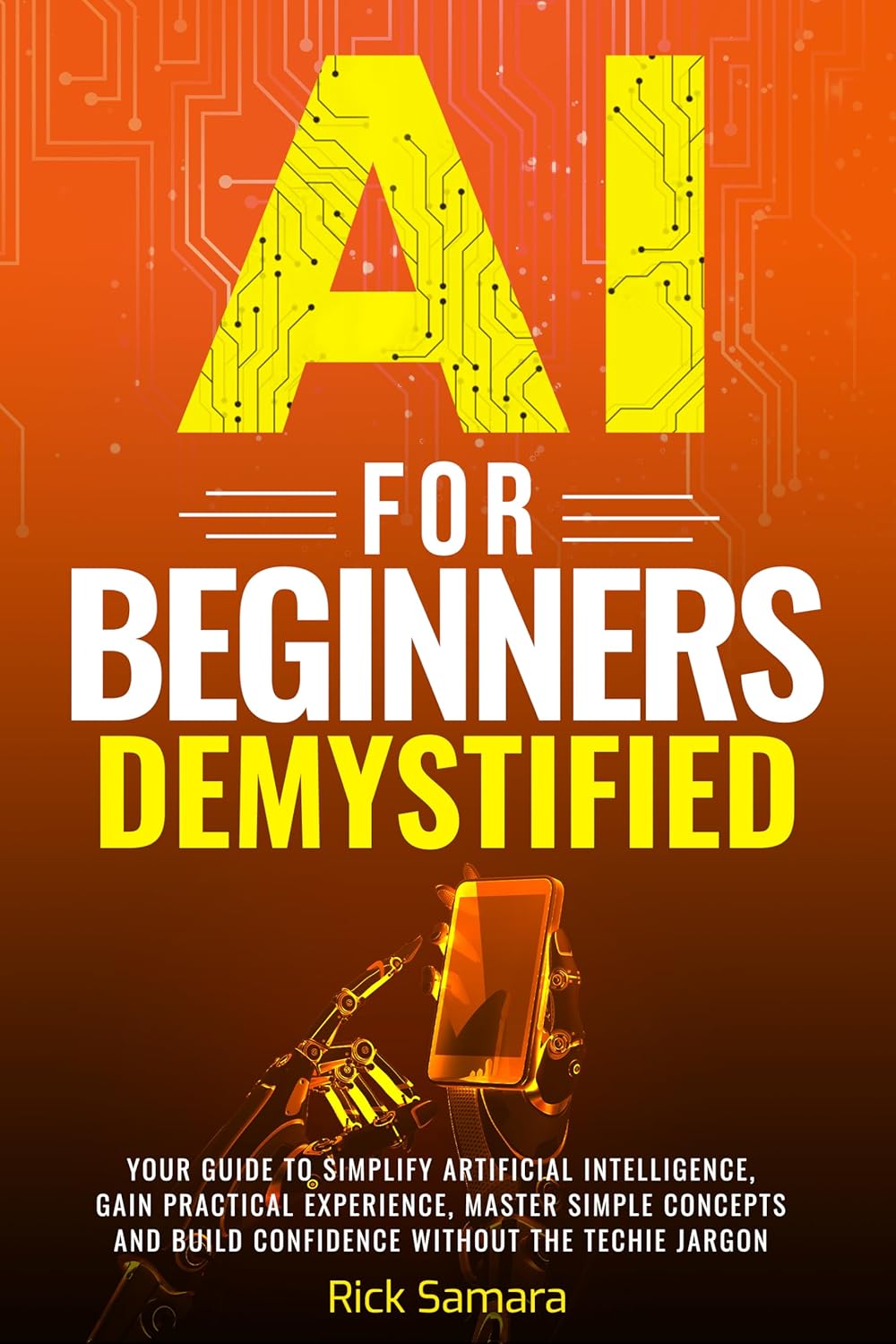

AI for Beginners Demystified by Rick Samara is an introductory guide to artificial intelligence that walks the reader from basic concepts to real-world uses in business and everyday life. It starts with the fear and confusion around AI, then explains core ideas like machine learning, neural networks, deep learning, and generative AI in plain language. From there, it tours familiar spaces such as smartphones, smart homes, social media, transportation, healthcare, finance, and education, then moves into ethics, bias, misinformation, and finally, practical next steps like courses, Facebook groups, and an addendum on using AI in business. The book aims to turn AI from a hazy buzzword into something a non-technical reader can talk about and actually use.
The tone stayed warm, reassuring, and a little chatty, which fit the target audience. He uses a lot of personal stories from the Air Force, from his marketing work, and from family life, and those stories kept me engaged. I liked the way he came back again and again to the idea of making the complex simple and actually stuck to that promise. The explanations of AI versus machine learning versus neural networks versus deep learning felt clear and grounded, and the nesting doll image for those layers worked for me.
I liked how practical the book felt. The sections on everyday AI, like smartphones, smart homes, shopping, and banking, pulled AI out of the clouds and into real life with examples that almost anyone can recognize. The “easy and fun exercise” pieces sprinkled throughout were a nice touch. They nudged me to pause and connect the material to my own habits. The ethics chapter and the parts on surveillance, bias, and job loss anxiety added a needed sense of seriousness. When the author talks about balancing innovation and responsibility, and about collaboration between companies, governments, and the public, the tone stays accessible instead of academic, which I found refreshing.
I actually liked the structure and depth of the book. It feels like a friendly guided tour, inviting me to wander through different ideas. The way the focus moves from one domain to another, then loops back to themes like job security and lifelong learning, gives the book a conversational rhythm. Beginners will benefit from the upbeat tone and clear enthusiasm. The business addendum works well as a starter checklist and offers a broad, accessible foundation that leaves room for readers to seek out their own case studies and frameworks later. Since the goal is to build comfort and confidence rather than teach a technical course, the approach feels right. When I picture someone who feels intimidated by AI opening this book, the welcoming tone and relaxed pacing seem perfectly chosen.
I would recommend this book to readers who feel uneasy or left behind when people talk about AI, especially adults who do not see themselves as “tech people” but still want to understand what is happening and how to keep up. I think it suits small business owners, teachers, parents, and older professionals who need a gentle on-ramp rather than dense theory or code. For someone at the true beginner level who wants a calm voice, real-life examples, and a path to keep learning, this book is a solid and encouraging read.
Pages: 138 | ASIN : B0FLW34RKW



