Blog Archives
So You Want To Be A Coder (Computer Programmer)


So You Want To Be A Coder, by Linda Soules, introduces children to the world of computer programming in a thoughtful and expansive way. The book explains what coders do, where they work, the tools they use, the joys and frustrations of the job, and the qualities that make someone suited to it. Rather than treating coding as a flashy mystery, it presents programming as a patient craft built from problem-solving, curiosity, communication, and a willingness to keep trying when things break.
What I appreciated most was the book’s honesty. As a parent, I’m used to children’s career books that make every job sound shiny and effortless, but this one gives coding texture. It talks about failure without making it feel scary, and it explains that much of programming is reading, testing, fixing, asking better questions, and learning how to sit with not knowing. The writing has a calm confidence to it, and at its best, it makes coding feel less like a secret language for a certain kind of kid and more like a patient conversation between a curious mind and a machine.
The artwork gives the book a warm, almost storybook glow that softens a subject that could have felt dry. I liked the cozy desks, city windows, libraries, bedrooms, and team spaces, because they make the work feel relatable and lived-in. Some pages are more text-heavy than I’d expect for a traditional picture book, so younger children may need an adult beside them to slow the pace and talk things through. But that also gives the book substance. It doesn’t just skim the surface. It respects kids enough to explain real ideas, from debugging and version control to open-source communities and the quiet importance of writing clearly.
I found this to be a sincere, intelligent, and encouraging children’s book that treats children as capable thinkers. It’s a book to read together, especially with a child who likes puzzles, games, building things, or asking how everything works. I’d recommend it to curious elementary and early middle-grade readers, particularly those who might enjoy computers but need a clearer picture of what coding actually feels like.
Pages: 332 | ASIN : B0GX2ZQG3V

Confusion to Confidence

AI for Beginners Demystified turns artificial intelligence from a confusing buzzword into a practical tool, guiding everyday readers through how AI works, where it shows up in daily life, and how to use it with confidence. Who did you imagine as the ideal reader when you started writing?
When I started writing AI for Beginners Demystified, I had a very clear reader in mind: the curious person who keeps hearing about artificial intelligence but feels slightly overwhelmed by it. It might be a business owner, a professional trying to stay relevant in a rapidly changing workplace, or simply someone who sees AI mentioned in the news every day and wonders, “What exactly is this, and should I be paying attention?”
I’ve met many people like this through my work in digital marketing. When my company began implementing AI tools, I noticed that many business owners were hesitant to adopt them. They weren’t uninterested. They were intimidated. The technology sounded complicated, and they worried they might not understand it. That reaction became one of the motivations for writing the book.
The ideal reader I imagined was someone intelligent and curious, but not technical. They don’t want a textbook filled with jargon. Instead, they want clear explanations, relatable examples, and maybe even a little humor along the way — like sitting down with a knowledgeable friend who explains it in plain English.
Ultimately, I wrote the book for people who want to move from confusion to confidence. Once readers start exploring AI tools, they often discover something surprising: AI isn’t just about technology. It’s about creativity, productivity, and finding smarter ways to solve everyday problems. My reviews strongly indicate I’ve reached that audience.
Why do you think so many people feel intimidated by artificial intelligence?
First, AI as we know it is still in its infancy. Before 2022, AI was powerful but mostly invisible to everyday people — living inside search engines, industry, and back-end software. That changed in November 2022 when OpenAI released ChatGPT. As of this writing, it’s not even four years old. It’s barely old enough to tie its own shoes! (Its exact birthdate is November 22, 2022 — feel free to add that to your trivia book.)
Beyond novelty, many people feel intimidated because AI is often presented as something extremely technical and mysterious. When people hear terms like machine learning, neural networks, or generative AI, it can sound like a foreign language. There’s also fear of the unknown: AI is advancing rapidly, and headlines tend to amplify that by focusing on dramatic possibilities rather than practical realities.
Then there’s Hollywood. For decades, AI has been portrayed as a world-conquering machine. Those stories are entertaining, but they shape how people think about AI in real life — which is far more practical: voice assistants, recommendation systems, tools that help us work more efficiently.
The intimidation usually fades once people simply start using AI. That realization was a big reason I wrote the book: to remove the technical barriers so readers can shift from feeling intimidated to becoming genuinely curious about how AI can improve their lives.
What do you think people misunderstand most about AI and jobs?
The biggest misunderstanding is that AI will simply replace people across the board. History tells a different story. When computers entered the workplace, similar fears arose — and what happened was that computers automated certain tasks while creating entirely new industries and career paths. The internet followed the same pattern. AI is likely to do the same. Rather than replacing humans, it will enhance human abilities — handling repetitive tasks, analyzing large datasets, and automating routine work so people can focus on creativity, strategy, and relationship building. The key advantage will go to those who learn to work with AI rather than fearing it. I believe the future of work will be defined less by humans versus machines and more by humans who understand AI working alongside those who don’t. That’s the central message of the book: AI isn’t something that replaces you — it’s a tool that can make you more capable and competitive.
Which AI applications do you think will have the biggest impact on business in the next decade, and how should professionals prepare?
Three areas stand out. First, AI-powered data analysis and predictive analytics. Businesses generate enormous amounts of data, but making sense of it is difficult. AI can identify patterns, spot trends, and help companies make faster, more informed decisions — predicting customer needs, streamlining operations, and sharpening strategic planning.
Second, AI-driven automation. Scheduling, customer service, report generation, and administrative work can increasingly be handled by AI. This frees people to focus on higher-value work like problem-solving and relationship building. Think of it as a digital assistant that handles the grunt work.
Third, Generative AI. Tools that create written content, marketing materials, images, and software code are already transforming industries like marketing, media, and design. A related evolution is Agentic AI — AI that doesn’t just answer questions but gets things done. Ask it to plan a dinner party, and instead of prompting you step by step, it looks up recipes, makes a grocery list, orders the groceries, and sets cooking reminders. You give it a goal; it figures out the rest. That’s the future.
As for preparation: you don’t need to become an AI engineer, but you should understand the basics and develop a mindset of continuous learning. Professionals who stay curious, experiment with tools, and develop AI literacy will be well-positioned for the decade ahead.
Author Links: GoodReads | Facebook | Rick Samara | Website | Amazon
Instead of presenting artificial intelligence as a confusing or intimidating subject, this book makes AI accessible, practical, and relevant to everyday life. From virtual assistants (Siri, Alexa, Copilot, Grok, Perplexity) to smart home devices, photo editing apps, and personalized online shopping, you’ll discover how AI already powers the technology you use every day.
Inside this engaging guide, you’ll learn:
What AI really is and why it’s more of a helpful partner than a threat.
Machine Learning explained through fun, relatable analogies that actually make sense.
Generative AI tools that create text, images, and even music, and how you can use them.
Chatbots and conversational AI like ChatGPT, Gemini, and Copilot, and how they’re shaping communication.
How AI is transforming the job market and why it creates new opportunities instead of just taking jobs.
With witty commentary, personal anecdotes, and straightforward explanations, this book takes the fear out of AI and turns it into something exciting to explore. Whether you’re a student, professional, entrepreneur, or simply curious, you’ll finish this book with a clear understanding of artificial intelligence, machine learning, and generative AI plus the confidence to use these tools in your own life.
If you want to understand AI without the jargon, laugh while learning, and gain practical knowledge of the future of technology, this is the book for you.
Where Did Computers Come From?

Jake and Eli are precocious brothers with a genuine love of learning. Yet one question puzzles them: where do computers come from? When their father encourages them to investigate the garage, they discover Techtor, a sentient technological construct eager to guide them. What follows is a lively journey through time, tracing the origins of the earliest computers.
Along the way, the brothers receive a fast-paced introduction to the history of computing. They meet friendly helpers, including Max the Mainframe. They also encounter punch cards and see how early systems relied on them. By the end of the adventure, Jake and Eli return with a strong foundation of new knowledge and a fresh appreciation for the technology they use every day.
Where Did Computers Come From?: Jake and Eli’s Adventures, Book 1, by Hector Morales, is a short, illustrated children’s book best suited for readers ages four and up. Each page keeps the text minimal. A few words. Bright, colorful pictures. Clear visuals help young readers follow the action without making them feel overwhelmed.
The simplicity is a strength. Two curious kids. A straightforward path to hands-on learning. A friendly guide who makes the unknown feel inviting. The story and artwork echo the spirit of “let’s pretend” play, but the imagination serves a greater purpose here. Jake and Eli get their big question answered, and they do it in a way that feels like exploration rather than instruction.
It’s also an age-appropriate premise. Computers are everywhere in modern life, which makes them easy to take for granted. While this topic may eventually appear in school, this approach makes the subject feel accessible and fun. The backstory keeps the pages moving, the illustrations add energy. The learning lands almost effortlessly.
Techtor and Max the Mainframe arrive without an origin explanation, and that omission works well within the storyline. I appreciated the fact that the fantasy elements do not demand justification. Children will accept them readily and stay focused on the adventure. Meanwhile, the history lesson quietly does its job. It offers an early framework for understanding how computers began and how they continue to grow more capable as time goes on. I highly recommend this book for parents and teachers seeking ways to integrate technology into their reading routines.
Pages: 32 | ASIN : B0FRG8G8ZF
Bots & Brilliance: 101 Things You Should Know About Artificial Intelligence
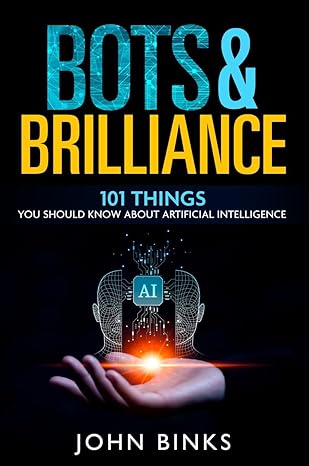
John Binks’ Bots & Brilliance is a crash course in artificial intelligence that reads like a lively conversation rather than a textbook. The book walks readers through 101 essential things to know about AI, from its history and daily applications to its ethical dilemmas and future possibilities. Whether you’re an AI newbie or someone with tech chops, Binks keeps things engaging with humor, real-world examples, and just enough technical depth to make you feel smarter without overwhelming you. It’s part explanation, part think-piece, and an enjoyable ride through the ever-evolving world of AI.
One of the standout features of this book is its knack for making AI accessible. The early chapters, like “AI, A Love Story” and “AI for the Complete Beginner,” strip away the intimidating layers of AI and present it as something we already interact with daily, such as smartphones, streaming services, and even online shopping. Binks compares AI to a “super-smart parrot” that mimics, learns, and sometimes surprises us, a metaphor that sticks. He also dispels common AI myths grounding the discussion in reality without killing the excitement. This approach makes the book perfect for readers who might be curious about AI but don’t want to wade through pages of technical jargon.
The book shines brightest when it explores how AI is already shaping our lives. The chapters “AI in Your Daily Life” and “AI at Work” are packed with examples of how AI is seamlessly integrated into everything from social media feeds to financial markets. Binks’ take on AI-powered streaming recommendations had me chuckling, he describes Spotify’s algorithm as a “magical music cauldron” that somehow knows you better than your best friend. The way he blends humor with insight keeps things engaging, and his examples make you realize just how deeply AI is embedded in everyday experiences.
Binks also doesn’t shy away from the darker side of AI. In The Dark Side of AI, he delves into bias, job displacement, privacy concerns, and the looming question of AI ethics. These are serious issues, but Binks presents them in a way that feels like a necessary reality check rather than fear-mongering. His discussion of AI bias, where AI can inherit and amplify human prejudices was especially eye-opening. He makes a strong case for why ethical oversight is crucial and why we can’t afford to let AI develop unchecked. This section adds depth to the book, making it more than just an AI enthusiast’s handbook, it’s also a call for responsible innovation.
In the end, Bots & Brilliance is a fantastic read for anyone curious about AI, whether you’re a beginner or someone who wants to connect the dots between tech and real life. It’s especially great for professionals trying to grasp AI’s impact on their industries without getting lost in tech-heavy explanations. If you want a book that makes AI feel less like a sci-fi concept and more like an everyday reality, while keeping you entertained, this one’s a solid pick.
Pages: 168 | ASIN : B0CVGP852J
100 Livestreaming & Digital Media Predictions, Volume 4
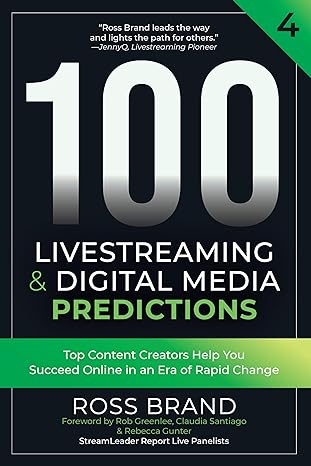

Ross Brand’s 100 Livestreaming & Digital Media Predictions brings together over 100 experts to provide a comprehensive guide for content creators navigating the rapidly evolving digital media landscape. This book is both timely and relevant, serving as a roadmap for the future of live streaming and digital media. It offers a wide range of predictions on emerging technologies, changing consumer behaviors, and innovative content strategies.
One of the book’s standout features is its authoritative stance on the controversial topic of AI. In an era where discussions about AI are highly divisive, the book’s balanced approach addresses both ethical and practical concerns, ensuring readers are well-informed about the benefits and potential pitfalls. This nuanced treatment of AI lends the book a credible and authoritative voice in the ongoing discourse.
The diversity of perspectives included in this book is another significant strength. Ross Brand has curated insights from across the digital media spectrum, from live streaming and podcasting to email marketing and community building. This comprehensive approach provides a well-rounded view of the industry’s collective opinion, enhancing the book’s credibility. The book features a variety of voices, each contributing unique insights. For example, Laura Clapp Davidson and Marisa Cali discuss the potential of micro-content, while Ross Quintana predicts a shift in advertising from traditional channels like TV to platforms like YouTube, alongside discussions on Web3 and VR/AR experiences. Bryan Kramer, on the other hand, highlights the enduring effectiveness of email marketing newsletters, particularly in an era of increasing privacy concerns and restrictive social media algorithms. While the book is rich in predictions, opinions, and discussions, its sheer variety offers a wealth of knowledge. I do feel that bit more thematic organization could enhance readers’ ability to digest the information seamlessly.
Ultimately, this book will open readers’ minds to a world of possibilities and re-energize their creativity. 100 Livestreaming & Digital Media Predictions reads like a captivating fairy tale rooted in reality, blurring the line between the two. It provokes thought and conversation about technology, its implications, and the opportunities the future holds.
Pages: 232 | ASIN : B0CSBCQSZR
Compiled by Ross Brand, an on-air personality and consultant for leading live video brands, this latest volume in our award-winning series (with 25 book awards to its name) is more than just a collection of predictions; it’s a roadmap to mastering the digital realm in 2024 and beyond.
Within these pages, 113 expert contributors, including Emmy winners, renowned YouTube influencers and Hall of Fame podcasters, share their foresight. They delve into how AI is redefining content creation, offering both foundational advice and groundbreaking strategies. From exploring AI’s role in enhancing productivity to addressing fears of losing authenticity, this book tackles the pressing questions every creator and entrepreneur faces:
What are the essential tools to integrate AI into your work?
How can AI be leveraged to maximize efficiency without sacrificing creativity?
What are the pitfalls of AI in digital media, and how can you navigate them?
How can you maintain a genuine connection with your audience in an AI-driven world?
“100 Livestreaming & Digital Media Predictions, Volume 4” isn’t just a window into the future; it’s a treasure trove of insights from industry leaders. You’ll find exclusive predictions that shed light on emerging trends and practical pathways to navigate the complex interplay of AI and human creativity. Whether you’re a seasoned creator or just starting, this book equips you with the knowledge to thrive in the dynamic digital media frontier.
Critics and peers alike praise the “100 Predictions” series for its depth, accuracy and utility. As the fourth installment, this volume continues the tradition of excellence, offering a unique blend of expert opinions and actionable advice.
Embark on a journey through the converging paths of AI and human ingenuity. Let the insights of seasoned experts arm you with the tools to not just anticipate the future but to shape it.
GET IT NOW and be part of the vanguard shaping the digital media landscape in 2024 and beyond.
Reshape the Digital Landscape

Let’s Meet Blockchain educates readers on blockchain technology using terminology and examples that even those without a technological background can understand. What were some ideas that were important for you to share in this book?
My goal was to provide a thorough but fun and uncomplicated explanation of not only what the components of blockchain are and how they work, but also how they are being used around the world today using simple, easy-to-understand language. The book is broken down into four sections: Blockchain, Cryptocurrency, NFTs or non-fungible tokens, and Web3. Each section includes a bit of history for context, pop culture references, and websites where readers can go to get their feet wet.
What is a common misconception you feel people have about internet security?
To a certain degree, people assume technology is infallible.
What do you hope is one thing readers take away from Let’s Meet Blockchain?
I want readers to know that blockchain is a movement designed to protect online privacy and offer data protection, while at the same time reducing transaction costs by removing the middleman. It’s still in its infancy with great potential to reshape the digital landscape, upending the way we do business.
Author Links: GoodReads | X (Twitter) | Facebook | Website | Amazon
It’s called blockchain, and it promises to disrupt the way people interact with one another online, whether it’s messaging, banking, keeping up with medical records, land records, booking a vacation, socializing, or voting. Programs are also being developed to use blockchain to serve as one’s identity “papers.”
Blockchain technology is based on the idea that all online transactions should be between two people without the need for public or private third-party oversight. Blockchain technology developers believe thoughts and ideas should be shared, not quashed. It’s a world where web platforms are governed by their members, not a board of directors; privacy comes first, and one’s personal information is kept private, not for third parties to take and sell as they, please.
Blockchain technology offers everyone opportunities to take part. Anyone can participate in the fast-growing world using non-fungible tokens (NFTs), where works of art, music, literature, and poetry can be tokenized and sold or traded on a blockchain.
These components comprise the next generation of the World Wide Web, which is referred to as Web 3.0. Billions of dollars are being spent to create infrastructure to create a viable framework to mainstream blockchain.
This book offers a peek into this new world with examples of how this technology is being used today as well as the hurdles, including legal challenges, it must overcome to be viable.
So, if you’re ready, let’s meet blockchain.
A Sense Of Limitless Possibility

See Yourself in Cybersecurity teaches middle-grade and high-school children about cybersecurity, explaining the different career paths that go into making the field what it is today. Why was this an important book for you to write?
See Yourself in Cybersecurity holds a special place in my heart because it’s my way of igniting a spark in the younger generation. I wanted to show them that the cybersecurity industry is not only exciting but also a career space where all the diverse characters represented in the book from across the globe do belong in the industry, with countless paths to explore. I also receive inquiries from aspiring professionals almost daily on platforms such as LinkedIn eager to join the field, I aim to convey that cybersecurity is a very broad field with a breadth of opportunities. This book is my tool to inspire and inform, helping the next generation envision a future in this evolving industry.
What is your background and experience in cybersecurity, and how did it help you write this informative book?
I am an immigrant from Ethiopia, mother of four, a career changer from the legal field, a multi-award-winning cybersecurity advocate, TEDx Speaker, LinkedIn Learning instructor, & 3x published award-winning children’s book author.
I am a recent Georgia Tech University graduate with a M.S. degree in cybersecurity. I currently work for a Fortune 500 organization as a Cloud Security Engineer and serve on a non-profit organization board, Black Girls in Cyber as a Community Outreach director.
‘Oh, No … Hacked Again!’ My prior children’s book teaches children about the importance of online safety & sparks interest in young readers to consider cybersecurity as an exciting meaningful career option.
I am the recipient of 2023 Minneapolis/St. Paul Business Journal 40 under 40, the 2023 Ivan Allen Legacy Award from Graduate school, Women Who Code Applaud Her Awards in Security, 2022 SC Media Women in IT Security Cyber Advocate, CyberScoop Most Inspiring Up & Comer, 2021 Team Women’s WaveMakers Award – Unchartered Territory.
I have also recently been featured in the media such as on Good Morning America, 11Alive, BBC, Voice of America, Yahoo News, ABC News, CBS Minnesota – WCCO.
My experience working in the field, being part of the different conversations that happen in the industry coupled with being a mother of 4 children or gamers helped me to write the book. My first TEDx talk just 2 weeks ago at TEDxMinneapolis is also about empowering children on their journey to online safety and cybersecurity.
What is one thing that you hope readers take away from See Yourself in Cybersecurity?
One thing I deeply hope readers take away from See Yourself in Cybersecurity is the profound understanding that the cybersecurity industry is not just for a select few; it’s a space that thrives from diverse perspectives. Through the characters in the book, I want them to see that people from all walks of life belong here. Additionally, I aim to inspire a sense of limitless possibility, encouraging readers to explore the many avenues within this expansive field. Ultimately, I want them to envision a future where they play a vital role in the ever-evolving world of cybersecurity.
What is the next book you are working on, and when will it be available?
So I am working on an anthology book project and am fortunate to collaborate with other talented black women in the cybersecurity and privacy field, sharing our journey and experiences in the industry. Stay tuned it will be released in October 2023!
Author Links: GoodReads | Twitter | Facebook | LinkedIn | Website | Amazon
As a cybersecurity professional, YOU can play the role of a superhero who fights against hackers and cybercriminals to keep information, systems, networks, and applications safe from harm. It’s a fulfilling career that requires you to stay one step ahead of the “bad guys” and help protect the digital world.
See Yourself in Cybersecurity is a fantastic book that takes readers on a journey through the world of cybersecurity. It inspires and encourages children, teens, and young adults to discover the various roles available in the cybersecurity industry. Readers will get a better understanding of what cybersecurity is, the opportunities available, and how they, too, can be a part of this growing industry.
If you are interested in technology, solving puzzles, problem-solving, and helping people, then cybersecurity is the career for you! See Yourself in Cybersecurity gives you an exciting glimpse of what YOU can do. So, put on your superhero cape and get ready to learn how YOU could have a future fighting cybercrime!
The Future of Disruptive Technologies
![The Future of Disruptive Technologies: Impacts on Business, Workforce, and Societies by [Dr. Srikanth Gaddam]](https://m.media-amazon.com/images/I/515wCikEzqL.jpg)
In The Future of Disruptive Technologies Dr. Srikanth Gaddam explores modern day problems, solutions and how technology affects each one of us. The book discusses tThe shapers of technology and how everyone should embrace the positives brought by technology while being cautious of the adverse effects. I enjoyed reading this thought-provoking book because the author used real stories and gave practical examples when explaining his points. Some of my favorite parts of the discussions were where he spoke about movers and shakers in the industry, and how their background did not necessarily shape their future and success.
In one chapter, the author goes into detail on how data privacy and the safety of internet users is paramount. I appreciate the author for giving facts and statistics as he expounded on this topic, as it enables the reader to get a clear picture of how things are in the world. Data and information are widely shared today thanks to swift online platforms. While this may appear as a blessing to many, the safety and privacy of any internet users may not be guaranteed given rogue characters and other malicious internet users online. While reading this chapter, I was made to understand why it is important to have at least the basic knowledge on formation security and how to protect the network that one uses.
A lot of things are made easy in the world thanks to technology. Reading Dr. Srikanth Gaddam illuminating book will open your eyes on big data, artificial intelligence and other things that have changed how the world operates today. I like Dr. Srikanth Gaddam’s writing because he explains every new term to readers who are not familiar with tech terminologies, before proceeding with the discussion. At no point does the user feel out of touch with the author’s text even when Dr. Gaddam uses heavy cyber jargon. The author made the book more interesting by including personal stories and experiences he has been through. I loved this about the author because the reader despite not relating with all, gets the impression that everyone goes through different challenges and learning stages in life.
The Future of Disruptive Technologies is a great read for both tech aficionados and people that are least bothered by digital trends and technology in general. The author gets one thinking about the different types of technology and how societies across the world work. The book is wonderfully written with a friendly tone and using an easily readable format. I recommend this book to all readers that want to learn more about technology, the impact it has in the world and how it affects small communities and individuals on a personal level. The content in the book is evergreen and educative. This book will enable readers to change their perspective on things and help them make better decisions in the respective industries that they work in.
Pages: 173 | ASIN: B08NXWHKF9



